Wednesday, April 18, 2012

Return To Miettes

There was a huge celebration in Montpellier the day I returned, and, much as I might wish it had been for me, it was for the inauguration of not one, but two new tram-lines. I'd joked about this in the past, with the town dug up just about everywhere, but I wasn't expecting this huge work to be finished on time, let alone that there'd be two, instead of one, new line.

But there it was, in the mail that had accumulated in my absence, the new tram map, folded into a credit-card-sized thing you could carry in your pocket. Like many public transport maps, though, it's more schematic than informative. I don't yet see the point of Line 4, which seems to describe a circle, mostly passing through places that already have tram stops. Tram 3, though, has two end-stops. One is Lattes, where the Roman village which helped give birth to Montpellier is, along with its excellent museum, and the other is Pérols, where the tram stops at the Étang d'Or -- the beach, in short. I intend to make this journey soon, before it gets warm enough that everyone will be doing it. The beach here is kind of skanky, but it has the kind of seedy vibe that has its own appeal.

As before, the two trams have been decorated with their own color-schemes. The one for Tram 3 seems to be the Mediterranean and its sea-life.


The motif for Line 4 is, I think, the American Express Gold Card, only with the water tower in the Peyroux Park added to the design.


As you can see, they're polished to a mirror finish, and these were in motion, but I think you can get the idea.

The main result of all of this is that Lines 1 and 2 have been slightly changed, so that both now stop near my place on the Comédie, and the schedule has been screwed up so that at any given time you'll see trams backed up at the main stations like Comédie and Corum. Surprising? Uh, not really.

* * *

Meanwhile, just like you lucky folks back in the States, we're about to have elections. This means, among other things, that posters for all the candidates are posted near where people will wind up voting later this week, and that people have already started voicing their opinions. 


As you can see here, the Socialist candidate, Hollande, is the only non-mutilated poster, and as you can't see, the far-right National Front candidate, Mme. LePen, didn't even bother to put up a poster. Montpellier, and this region generally, is pretty left-wing, and every LePen poster I've seen has been ripped to shreds. At any rate, Sarkozy (who, come to think of it, isn't up here either) will likely have his ass handed to him locally. I, of course, can't vote, but I can urge Americans to visit Vote From Abroad if they're living overseas and want to vote in the U.S. elections in November. 

* * * 


There is suddenly an alarming number of cats in the street here. They started off as spray-paintings, and there are still a bunch of those around


but there are also a bunch made from mirrored glass showing up, too. 


The spray-painted ones work best at night, where they seem to be real cats. I've also seen them in other towns in the area, but here in Montpellier, the guys who work for the city's Enlevement de Tags department can't tell the difference between street art and gang tagging, so it's always good to shoot these when I find them, because they might not be there tomorrow. 

Still, there are street artists who are in and out of the mainstream. This guy, Jonny Style, I've caught at several unauthorized places, and, authorized or not, he's doing glamour paintings on high-end shops around town. The first one I found was erased in 48 hours, but this was still up today. 


This may or may not have something to do with the coming of spring, which is sure taking its time. 

* * * 

Finally, some things I learned on my recent trip to the States. 

1) Young American women are turning into Germans. I was unnerved to hear them talking to each other and, when agreeing, saying "Yah" instead of "Yes" or "Yeah" or something. Young American men are well-advised to monitor this situation. German women are nothing to fool around with, take it from a grizzled veteran. 

2) The word "awesome" has come to mean "nice," "okay," "interesting," instead of "filling me with an almost inexpressable sense of wonder." I assume a new word is in the pipeline to describe actual awesome things like the Grand Canyon. Or maybe it's that flattening of affect thing again. 

3) I will never take a 5-week vacation again unless I'm being paid crazy money to do so. Oh, I said that last time? Maybe I have to keep reminding myself. 

Wednesday, April 11, 2012

U.S. Tour 2012, Part Nine and Last: Coming In Second

From some ways of looking at it, it's the second-largest city in New York State, and yet I'd never really been there. The last booking of my over-long trip needed to be in a place from which I could get to JFK Airport easily, and I just assumed that'd be Manhattan. But...PriceLine wasn't being nice at all. Fortunately, Marie jumped into the fray and found me a place in (gasp) Brooklyn. Really? Brooklyn? Well, it's not like I had a choice.

What I did have was a whole day free to have lunch with a friend in Manhattan, do my last-minute grocery shopping, which probably wouldn't take long, and maybe discover Brooklyn. And then, at last, I'd catch the plane home.

Brooklyn, of course, has caught some flak recently because of its huge hipster population and the inevitable displacement of previous residents to elsewhere, the juggernaut of gentrification rolling on as Manhattan became utterly unaffordable by mere humans. I was curious what it was going to look like up close.

By some miracle, the train pulled into the station ten minutes early, as I've said, and although the trip with two heavy bags on the subway wasn't easy (particularly the last part, hauling them up the narrow stairs of the Union St. subway stop -- riding the New York subway will make you wonder how the elderly and disabled get around in the city) but the hotel receptionist was nice enough, and pointed me to nearby 5th St. as a kind of restaurant row. I wound up at a place that was having a soul food evening, but was too late to get their famous fried chicken and had to settle for what they thought was an oyster po-boy: a bunch of fried oysters in a toasted hamburger bun.

The next day I had a hamburger in a toasted hamburger bun, an almost totally perfect one near the New York Times, where my friend works, at the 5 Napkin Burger on 9th Avenue. It wasn't my last meal in the U.S., but it was, symbolically, a good end to the trip. After that, I went to 10th Avenue and 47th St. to a real live Mexican grocery store -- tiny, with a minuscule taqueria in the back -- and bought some corn tortillas so I could make enchiladas with French cheese. I wandered around some, but eventually I found myself getting on the subway back to Brooklyn, where I took care of some business and then, looking out the window, saw a photograph happening.


Sad to say, by the time I got out to 4th Avenue's median to snap this, the deepest red of the sunset had already faded. I stood there for a minute, looking at this skyscraper, reflecting that I had no idea what it was, or, really, where it was except down the street. The architectural details, including a clock tower which, unusually, actually told the right time, made me think it was a landmark, and later research proved it was the Williamsburgh Savings Bank Tower, which Wikipedia confusingly says is either the second- or third-tallest building in the borough. Eventually, it got dark, and I walked a mile or so into unknown territory to join Marie and some friends at a bar, where I had a light meal -- only appropriate after that hunk of burger at noon.

The next day I was confronted with a problem: I had to check out of my room by noon, yet my plane didn't leave until 7:15. Fortunately, there was a baggage room, but unfortunately I had nothing to do, and no idea where I was. First things first: I hiked a few blocks to find an ATM for some cash, then back down to the corner of 4th and Sackett (I think) to the bagel bakery there. Another of my quests was fulfilled: I'd been frustrated by the bagels I'd gotten at the start of my trip, but here was a place making chewy, flavorful, large bagels -- and inexpensively. Another memory to carry with me until I get back to New York -- which won't be soon, from all indications.

After breakfast, I packed up my stuff and stashed it at the hotel. There was nothing left to do but wander around until 4:30 or so, when the hotel's car service would drive me to the airport. So I wandered. First, I headed towards the Gowanus Canal, which wasn't far from the hotel. I tried to snap some of the industrial artifacts of the past, including this garage, which was across the street from the hotel.

Thanks to Marie for Photoshop!


Still, I love those winged wheels, back from the days when America had a real romance going with the autmobile.

The canal is a sad place. One of the most heavily polluted waterways in North America, it's home to some intrepid urban voyagers who call themselves the Gowanus Canal Dredgers, and run canoe trips on what was once a historic stream. I sat at their boat launch site for a while, looking for signs of any life whatever. Some bubbles appeared from time to time, indicating the possible existence of turtles, but the general neighborhood made me think it was just organic decay, maybe a long-dumped mobster, going on.

I finally got up and started walking again, crossing the canal near the apartments shown here with the weird towers. What on earth are they? Not water-towers, not with those windows. The mysteries of Brooklyn.


A bit further down there was a kind of parking lot which contained this, and was ringed with BEWARE OF THE GNOME signs.


I crossed over the canal again and walked down 4th St. to the Williamsburgh tower, then headed back on 5th St., where I figured I'd find some lunch. Not only did I find some, at a place which curiously specialized in meatballs, but I also found the Old Stone House.

This was just what I was looking for: some local history that would show me something about where I was. And, although it's not much of a museum, I did learn about the Battle of Brooklyn, where Washington got his ass royally kicked, and how it fit into the other various local Revolutionary War battles I'd heard about as a kid, growing up not far from the famous Battle of White Plains. Miraculously, even with a victory like this one in their hands, the British still managed to blow this campaign.

I determined that other sites were too far to walk (plus, I was carrying my computer case: I wasn't going to risk leaving that at the hotel, not with the luck I'd had so far on this trip) and finally, out of options, got back to the hotel an hour early to get the ride to the airport. This was where I really got to see Brooklyn, though: the car driver barely spoke English, and sped through mile after mile of bleak industrial landscape (with living-spaces interspersed, depressing apartment buildings which indicated that Brooklyn sure wasn't 100% gentrified yet), finally arriving at JFK. I was broke, tired, and absolutely ready to get on that plane.

By 2pm the next day, I exhaled in relief: I was back in the Slum, listening to Mme. Merde upstairs screeching at her kids. It sounded great. Well, until the next day, anyway. But now I'm back.

Saturday, April 7, 2012

A Brief Interruption For Spring


First day back from North America, and it's Saturday, so what better thing to do but go off to the market and see what they have. I must say, this is a distinct improvement over potatoes and Swiss chard, which was about all that was there when I left. There's a new crop of spinach, the first strawberries (which were good enough that you could almost watch them vanish into the hands of Easter shoppers), some nice green peas from Mme Choisisez (I must record her sometime; what a voice!) and the star of the show, a bundle of alleged wild asparagus. Not sure what I'm going to do with that, but there's ample proof that the non-wild is coming in big-time.

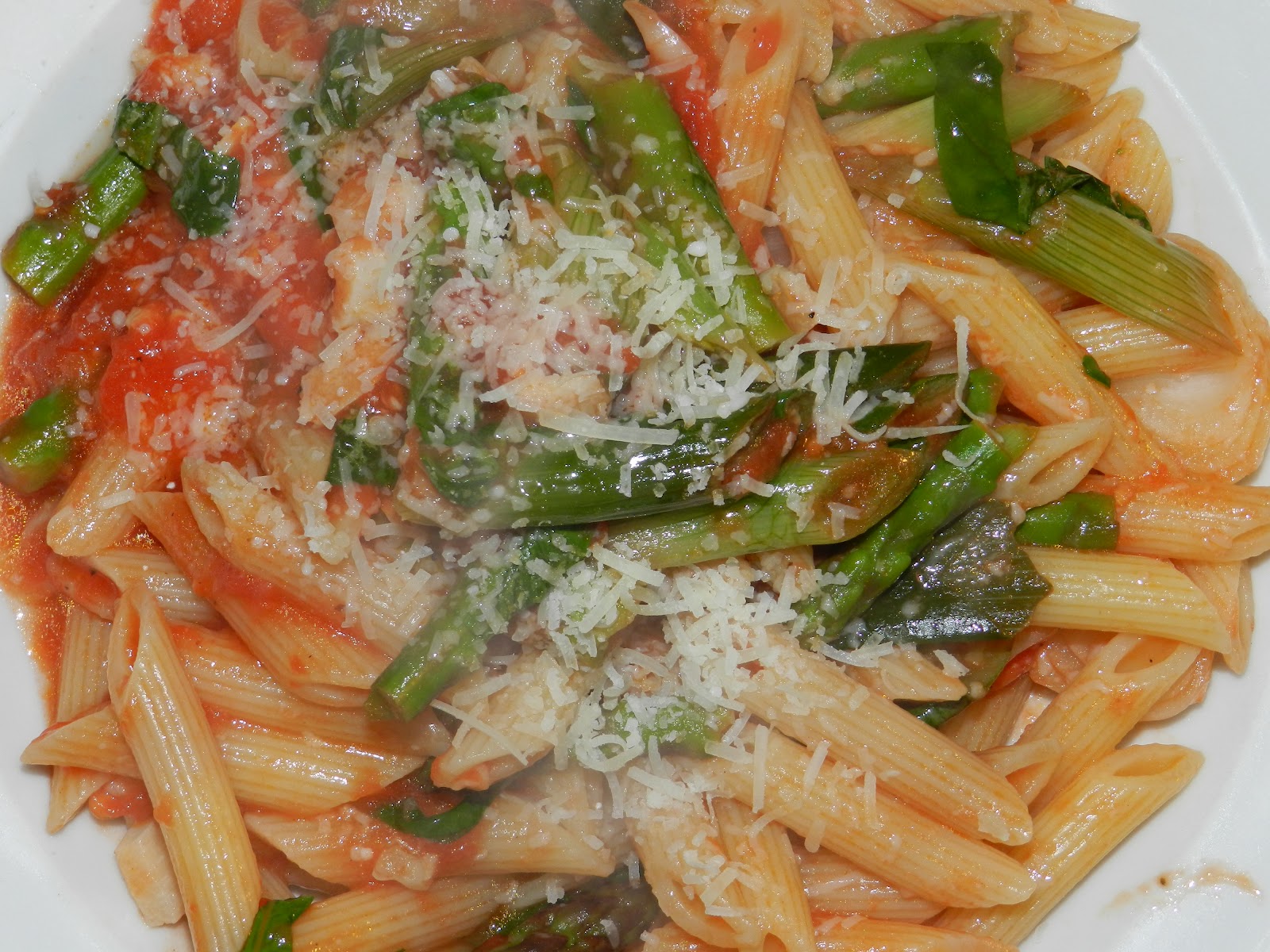
In fact, jet-lagged as I was last night, I still managed to stagger down to the supermarket and grab some (Spanish, not local) asparagus of the domesticated variety. And, since I haven't posted this seasonal recipe yet, I figured I'd let you in on a big favorite around The Slum during the springtime. Given what asparagus goes for (although not the bundle I bought last night) at this time of year, this does qualify as broke-not-poor cuisine. I only got to cook twice on my trip, and this was something I made the night the Vegan Child came home from college. She got to sneer at the cheese we applied at the end, but she ate as much as her mother and I did.

Anyway, first we consider the penne, as it will be the pasta of choice for this. It's a pasta shape with, um, lusty associations, also known as "bridegroom's noodles" and "wedding pasta." I never notice a libidinal boost from the stuff, but who knows. Still, the point of this picture is so you can see the size of one penne noodle.


Kinda hard to see against the wood there, but the point is, that's the size everything you do next should be. So take your asparagus (about half that bundle did for two servings) and snap it into penne-sized pieces, toss them into cold salted water, and heat them just until the water starts to boil. If you're using extra-thick asparagus, you might let them boil for a few seconds full-on, but no more than that.


Drain these, fill up the pot again with water for the pasta, salt that and put it right back on the stove.

As you can see above, straight-ahead green onions are very rare around here, so I have to make do with these "sweet onions" with bulbs on the end. I deal with them by cutting them into approximately penne-sized bits, using the Chinese technique called "horse ear" cutting.


Then I mince up some garlic, heat some olive oil, sautee the garlic until it's fragrant and add the green onions, mixing them around for a minute or two.


Then add a can of crushed tomatoes, hit it with some salt and pepper, mix well, and let it cook down for a while.


Once the pasta water boils, toss your penne into it, and then get a bunch of basil leaves. Lay one on top of the other, making a neat stack, and then, with a very sharp knife, slice them into slivers, a technique known as "julienne." (I added a bit more pepper to the sauce above because I was using the large-leaf basil, not the peppery little-leaved "Provençal" basil, which isn't here yet).


Now throw the asparagus into the sauce to warm it up.


When the pasta's done, drain it (tossing a tablespoon of the water into the sauce) and mix it with the julienned basil and some Parmesan and sit down and enjoy the taste of spring.


* * * 

Yes, there's one more tale from the North American tour, which I'll get to soon, but since I'd noticed that most of the U.S. is awash in lovely green asparagus, I figured I'd document last night's dinner and put it up before the bounty recedes. Any ideas on that wild asparagus are welcome, too. 

Thursday, April 5, 2012

U.S. Tour 2012, Part Eight: In Which We Flee The Country, Return, and Prepare To Flee Again

I hereby heartily resolve that I will never again embark on a five-week trip unless I'm making stupid money by doing so. Instead of spending stupid money. I'm sitting here in a tiny hotel room in Brooklyn burned out as I can be, with the only bright light the fact that I will jump on a plane early tomorrow evening and by 2pm the next day be wondering how I'm going to haul these two suitcases upstairs to my apartment. I'll do it. I've done it before.

I did manage to get out of Times Square, thank heavens, and to Penn Station, where I got on the Adirondack, one of the great train lines of the world even if it is in crappy shape, and head to Montreal. Both the trainride and the stay were designed to be relaxing, and the panoramas which unfold slowly (due to the crawl at which the train travels) are as soothing as they come. If you know where to look, you can see such historic landmarks as the Vanderbilt Mansion in Hyde Park, N.Y., the hull of the U.S.S. Ticonderoga (laid in 1814), and Fort Ticonderoga itself:


This picture was snapped on the way down, though; going up I mostly slept.

I was met by my friends Terry and Patricia, as usual, and as usual, they had some crockery with them. There's no real link there except that there's a very inexpensive and good shop selling dishes in the central train station in Montreal, and neither of them gets there that often, so when I come up, they usually have some shopping to do.

Amtrak was a whopping 90 minutes late (almost early for them, of course), so we got me installed in the Intercontinetnal Hotel, which I'd nabbed in a fire sale discount offer, and which had weird wallpaper alternating (real, I think) birch bark and (definitely fake) fur, as Montrealish a theme as one could wish. Blinded by low blood sugar, we headed into Chinatown a few blocks away and had an absolutely disgusting Chinese meal. (Not, as you will see, because Chinese food in Montreal is all bad, as it is in, say, Montpellier.)

The next day while Patricia worked on her speech therapy classes, Terry and I grabbed a municipal car-share car and drove around doing errands. These included going to the Atwater Market, one of two wonderful market halls maintained by the city, and a collection of some of the finest purveyors of meat and vegetables in existence. Sadly, it was still March, and the real action doesn't start there until the summer comes. We tend to think of Quebec as the Frozen North and, well, it kind of is. But its farmers produce some amazing fruits and vegetables. Of course, one of the things they produce is maple syrup, and Atwater Market is where to get the good stuff cheap. A can sits in my luggage as I type.

Terry had some time before he had to return the car, so we went out to a favorite place, the Lachine Rapids. This is a pretty impressive display of nature in the middle of the St. Lawrence River, and I'm not sure what makes them happen, but I wasn't going to find out today.


It was closed.

Given the strong sunshine and the cold temperatures, the rapids were a reminder of some of the problems the early fur-trappers had bringing their wares to market. You really have to see and hear them in person to get an idea for how vicious they are, but maybe one of these pictures will give you an idea:


Try that in a canoe. In winter.

Although, given what winter feels like up there, this was actually spring. As if we needed a reminder, this guy was hanging out, being admired by bird photographers and generally acting like a star as we headed back to the car.


Yes, folks, sometimes Great Blue Herons really are blue!

That night's dinner was definitely a winner: the Cuisine Szechuan restaurant on Guy, which I wrote about at length last year, just gets better and better. It may be, in fact, one of the best Chinese restaurants in North America. The chef's ability to balance flavors -- including fiery ones -- is unbeatable. It was kind of sad that I ordered one dish -- pork tongue with pickled chiles -- that Terry and Patricia didn't like, because the rest were sublime, and I had to eat all the tongue (there was an identical repeat the next day for lunch: talk about prolonging the pleasure!). The only thing that marred the meal was that the next day I discovered I'd mislaid my sunglasses, and they were never found.

One of the things Terry wanted to do was to show me some of the contemporary art galleries around town, as well as the CCA, the Canadian Centre for Architecture. This last was housed in a remarkable old mansion which had belonged to some Canadian railroad magnate, and we actually did explore a bit of the house itself, which was gorgeous with its carved wood and parquet floor. Unfortunately, the exhibit was ridiculous, incoherent, badly curated, and a waste of time. Called Imperfect Health, it was supposed to deal with the "medicalization of architecture," and dragged in this and that in almost random fashion. Terry and I sat through a bunch of a promotional film for Del Webb's Sun City, made in the late 1950s, to judge from the cars. My parents retired there and then spent over 35 years there, burying one set of friends after another. The visits my sister and I had to make were traumatic: what could be worse than a huge city filled with one-story houses filled with people over 55? It was chilling to watch it presented as a Utopia.

That evening, we visited some friends and watched them cook a paella in their fireplace, something you don't get to do every day, and something they won't be doing every day, what with the weather warming up, even in Montreal. And the next day, we went on a quest for some contemporary art in the former fur business buildings in downtown Montreal. It being Sunday, though, they were all closed, although the eerie hallways were a fascinating space, Frustrated, Terry took me to the McCord Museum of Canadian History up at McGill University, and there were three floors of mostly fine stuff to see. A show of contemporary Inuit art was very well-done, and on the second floor there was a show by some guy whose schtick was taking pictures with a pinhole camera and printing them big (and in negative) which was pretty dull, balanced by a superb small exhibition of the city's history that made up for it. Finally, the small gallery room on the top floor was given over to a great exhbition of photos of empty spaces by the formidable Lynne Cohen, an American who now lives in Montreal. Terry, no mean photographer himself, was gobsmacked.

That evening, there was a special dinner since, as I found out, Terry and Patricia have decided to get married this summer. It was at Pinxto, a Spanish/Basque restaurant that's among the most highly-regarded in Montreal, although it's also affordable. We had their tasting menu, which started with some foie gras (served too cold -- we had to wait a minute for it to warm up so it could be tasted), a shooter of warm cauliflower soup with a bit of crisp-fried Iberian ham sticking out of it (bacon on steroids!), duck tartar, and, on a second serving, a fig stuffed with serrano ham and a hunk of grilled mahon cheese on top of it. All superb. I lucked out with a kind of Spanish interpretation of cassoulet, aswim with tasty hunks of sausage, a big duck confit, and lots of beans. This was all washed down with a Clos Mont Blanc, which, despite its name, is a huge, smoky/woody red with lots of fruit. It was a grand occasion, and I promised Terry I wouldn't perform the ceremony this time, as I had in 1970 for his last disastrous marriage. Note to Pinxto, though: you really should change the silverware between courses -- yes, I know it means more to wash, but it keeps flavors from blurring together -- and you must fire the idiot designer who did your website (loud music!) and business cards (absolutely unreadable even under strong light).

Monday, both of them had to work, learning and teaching, although Terry had time in the morning to hit the fur buildings again, and we found some galleries open. Mostly what we saw wasn't worth discussing, but the SAS Gallery had a neat little show called Possession, about the bourgeois trappings of home, which was run away with by Jannick Deslauriers' iron, typewriter, grand piano, and sewing machine, each rendered in crinoline. It's sure good to see someone who's not carried away with deadly seriousness.

After leaving Terry at his office, I wandered my way back to my hotel. I grabbed my new camera and wandered around, but Montreal pretty much defeats my photographic instincts. One day while wandering, I noticed a place which seemed to indicate that it made its burgers upside-down and with wilted lettuce:


and on the wander back to the hotel, I got this sort of mediocre rendering of the idea that there are various layers of Montreal, with Mount Royal in the background:


and this one of an absolutely bland building by the train station:


I wondered if the Queen was happy about that or not.

In the end, though, I did what I'd come for: see friends, relax, and enjoy a fancy hotel which allowed a wonderful coffee chain, Java-U, to operate on their property for those guests who didn't want to spend $23 minimum on breakfast.

I walked back to the station Tuesday morning and was smart enough to grab a sandwich to eat on the train, Amtrak food being nothing much at its best, and we were ten minutes early getting into New York. I'm writing this in Brooklyn, where I've never really set foot before, but I'll be happily flying back home tomorrow evening. I'll likely have some pictures of Brooklyn to post, but I'm looking forward to being in one place for a long time. This has been too long of a vacation, and I'm going to have to find some work to pay for it -- fast.


Sunday, April 1, 2012

U.S. Tour 2012 Part Seven: In Which We Leave San Francisco, Eat Towel Guard, and Get Robbed

Here's how to get into San Francisco's De Young Museum for free. I woke up on Sunday, packed, and said good-bye to my gracious hostess Lori in Petaluma. Not long thereafter I was catching up with friends over brunch in Marin County. They had to rush off to work afterwards, and suggested I spend the time between the present and the time I had to check into my airport-area hotel (I didn't want to risk driving from Petaluma to the San Francisco airport, filling the car up, turning it in and making a 9:15 flight all during rush hour) driving around the newly-opened Presidio and checking out the De Young, which, they thought, had undergone some interesting changes since I was last there. All very good suggestions for a cold but sunny Sunday afternoon, I thought.

I approached the Presidio in a kind of haphazard fashion. This large former army base had always nestled at the San Francisco end of the Golden Gate Bridge, and had been largely off limits to civilians since around the time of the Civil War. Of course, officers were allowed to have their families with them there, and there's a kind of surreal suburbanity to a lot of the place, with looming pine trees, a lush green humidity coming out of everything, as well as barracks of various kinds, a large hospital, a parade ground, an airfield, and an old cemetery. The whole thing was decommissioned some years back, and turned over, from what I can tell, to both the Parks Service, which is turning the historic buildings into a kind of Museum of the Presidio, and to private interests, who have already turned the officers' quarters into private homes and apartments. A large hotel was about to open up and, down by the waterfront on the Bay, lots of private businesses have opened up, the whole thing being seamlessly joined to the city's Marina district.

I should have taken pictures, because it was very cool, if a bit creepy, and I made a note to spend more time there next time I was in the area to learn more about this part of the city where I lived for 13 years but was never allowed to see. A posting here, or to the officers' yacht club on the other end of the bridge at Horseshoe Bay, must not have been the most hellish thing the Army could do to you during the Vietnam era, something which occurred to me every time I spotted these places while going between my house in Sausalito and San Francisco back then.

Next stop was Golden Gate Park, which I eventually found (I wasn't used to starting from where I exited the Presidio, and had to roam around some before I found a place where I could orient myself), and made my way to Ocean Beach, where I snapped a picture of heavy surf, the Cliff House, and a surfer in Blur-O-Vision and then discovered I could e-mail it instantly to a friend in Texas:


No idea why it didn't turn out better, but trust me, all those elements are in the picture. I could probably plead expressionism, in that it was cold and windy and I can still feel it looking at that shot.

From there, I kind of randomly made my way into the park and eventually the museum complex of the De Young and the Academy of Sciences appeared. One thing my friends had told me was that there was a huge underground parking facility there now, which really helped a lot. What they hadn't told me was that the De Young had gained an odd nine-story tower. But sure enough, there it was. I crossed over the plaza between the two museums, and found an old Chinese guy, grinning like a fool, playing "Jingle Bells" over and over on his accordian. Well, or something approximating it. Just right for late March.

I'd been warned that the main visiting show was Jean-Paul Gaultier, since struggling art museums -- and non-struggling ones, for that matter -- have found out that big fashion shows bring in visitors by the score, and this one seemed to me to be both a no-brainer and something I had no interest whatever in seeing. Still, there was the rest of the museum, and judging from the way others in line were dressed, J-P would be where the crowds were. I walked to the end of the line and suddenly heard my name. Out of nowhere, Andrew and Ani Roth, old friends from Berlin who'd escaped even before I had, appeared, looking happier and healthier than I'd ever seen them. They turned out to be De Young members, scored me a guest ticket, and, chattering away to catch up on old times, we got on the elevator to the panoramic view from the tower.

After returning to ground level, we parted, and I quickly discovered that the De Young hadn't gotten any better in the years since my last visit. They've spun off their top-notch Asian collection to another building downtown, and now the central collection is called The Americans. You start by having to make a choice between going right or left, into the Indian collection or towards the European-American art collection, which is clever, because either choice will foster guilt. Guilt drips all over the captions, with, for example, a painting of Mount Vernon in 1833, the year a bunch of women got together a fund-raising campaign to save it, the first such effort of historical preservation in the young nation. The house is clearly in bad shape, and probably a number of these paintings were made to show potential donors. None of that is in the caption, however. Mount Vernon is described as "the slave plantation" of George Washington, who owned many "enslaved persons." Never mind that the plantation system ran on (legal, regrettably, but legal nonetheless at that moment) slavery. And what's up with "enslaved persons," a locution I also encountered at the Oakland Museum? Doesn't "slaves" sound much worse? And, "slave plantation" owner though he was, Washington was hardly Simon Legree. Nonetheless, his slave-ownership is mentioned in the caption before his Presidency. It's just this relentless righteousness that I found oppressive when I lived in California. Mind you, if you choose the Indians to start, you'll not only get the extermination guilt, but what seems to me to be a false equivalency between the artifacts there and the more self-consciously created art pieces in the other wing. It wasn't like that. These curators should be forced to read 1491. It'll make them spitting mad, but the fact is, these were very different societies than exist in our world today.

Satisfied that the level of the collection was still mediocre (although there's nothing as bad as the Renaissance Madonna and Child that caused a friend of mine straight out of art school to erupt from giggles to outright laughter years ago -- I had to steer her out of the gallery), and just enjoying it for what it was, I passed the rest of the time wandering hither and yon and finally had exhausted the place and myself. I got back into the car and, after some more wandering through the park, exited on 19th Avenue and headed to the airport motel.

Because I'm an idiot, I didn't print out the address, and as a result, the nice gas fill-up I'd made wound up nearly a quarter-tank down by the time I reached the place. (Hint: there are two South Airport Boulevards, one of which is, logically, south of the airport, filled with lovely scenery of the Bay, over which departing flights take off, numerous hotels, and no Travelodge. The Travelodge, it developed after I'd driven for over an hour in and out of SFO, was on South Airport Boulevard north of the airport.) It was also the most tawdry joint I've parked in since the whorehouse in Nîmes (no longer there) or some of the oil-crew motels in southern Louisiana during the '80s oil boom. The freeway was about 200 feet from the room, the clerk didn't know how to make a key ("Oh, yeah, I used the old system."), and about the only nice thing was the huge Samoan wedding which was breaking up just as I arrived. What a sad place to have your wedding banquet.

Fortunately, my favorite Zen nun picked me up in her Prius (first time I'd been in one of those) and drove me to dinner not long afterwards. This was to be at the Little Sichuan Restaurant in San Mateo, where there was supposed to be a large menu of hard-to-find authentic items. And there was: where else on the planet will you have the opportunity to try sautéed towel guard? But there it is, right on the menu! The question, of course, is what is towel guard and is it okay for vegetarians? One of our party, who's been eating at this place since he was a teenager, had deciphered the Chinese, though, and it turned out to be green loofah, which is, after all, a squash that's edible before it develops its skeleton. I wish the menu had said that, because "towel gourd," which is what it probably meant to say, is equally inscrutable.

The menu sure wasn't. Man, extraordinary Szechuan cuisine is to be had here -- and this was the first of three amazing Szechuan meals I was going to have on this trip. (And towel guard, smooth, bland, and juicy, makes a great palate-cleanser after each highly-spiced dish). It was a great way to end my week in California -- good food, good people -- and I pretended the noise of the freeway was really the ocean or something.

* * * 

I'd been curious to fly Virgin America from SFO to JFK, and overall it was a pleasant experience: $169 for the flight, which is certainly budget friendly, and if the "Italian sandwich" I had cost $9, that's reasonable, given that it resembled actual food and tasted like it, too. The only big disappointment was the wi-fi, $14.99 and spotty and slow. My time would have been better spent reading and not trying to respond to a request from a friend for where to stay in Berlin. My answer got eaten by the cybersphere, she panicked and booked a place you couldn't pay me to go into, and I hope she'll be all right. 

Things went a little pear-shaped, to say the least, in New York. Disappointed with my experience at the New Yorker, I'd booked a Times Square-area hotel, the Millennium Broadway, on PriceLine. I was in something of a rush: my pal Dickie Landry was playing at the Guggenheim, a solo show, and he'd originally told me this was on the 27th. It wasn't: it was on the 26th, the day I was flying in. The plane got in at 5:30, and the show was at 8: I had to get into the city, book into the hotel, and get uptown before it started, which didn't leave me a lot of time. In my haste, as we got into Manhattan, I grabbed the wrong bag -- it was also bitterly cold and I wanted to get inside -- and I got to the hotel at about 7:15, only to discover I'd gotten the carryon bag of some guy from Turkey. It was a Ralph Lauren bag, so I knew it wasn't mine. 

I grabbed a taxi uptown, and endured the hate radio coming out of its speakers (what was a black taxi driver doing listening to some hate-spewing moron blathering about what Obamacare would do to "us," and backing it up with phone calls from old ladies who'd lived in the USSR?), and not only got to the museum in time for the show, but with time enough to at least skim the John Chamberlain retrospective there. Chamberlain's the guy who is most famous for working with crushed cars, and although yes, it's something of a gimmick, he was good enough at it to make you forget the origin of the materials and see it as abstract sculpture in which lurk some familiar curves and, of course, strips of chrome. There's a wonderful scary installation of chrome bumpers with black paint called "The Black Armada" here, but that's about as literal as it gets. There are imposing shapes, graceful hunks, wisps that weigh a ton. 

Chamberlain died in December, just missing the opening of this show. In his later years, apparently, he'd taken up the saxophone, and my assumption (without really knowing) is that his friend Dickie Landry may have been the inspiration for that. Dickie is someone I've known for years, a guy who's played with both Otis Redding and the Philip Glass Ensemble, as well as amassing a very impressive body of work -- visual and audible -- on his own. He's currently got a show at Salomon Contemporary in New York, and  while he was up to deal with that, he booked a concert of solo improvisation at the Chamberlain show. 

He started out on the ground floor, playing with elements, teasing them around, drawing, although not too overtly, from his jazz and soul background, creating some building blocks. Then, he walked over to the Guggenheim ramp and started his ascent. 


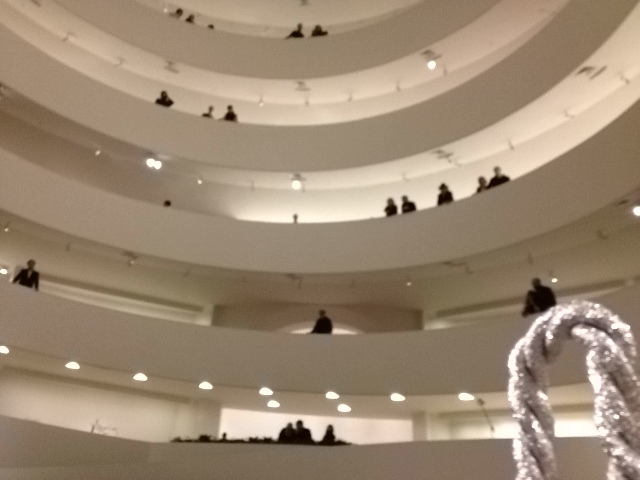
In no time, he was lost from view to those of us on the floor downstairs, but the unique sonic properties of Frank Lloyd Wright's spiral kept us apprised of his progress as he went around and around, becoming elegaic, drenched with soul, as he confronted the works of his late friend. The audience, too, was scattered among the works, and tracked his progress. 


(That's a kind of atypical Chamberlain sculpture from the ground floor in the corner, covered with aluminum foil). 

Finally, he got on the elevator, playing the whole time, and emerged on the ground floor, where he blasted out the last of his tribute. 


It was emotionally draining, uplifting, and absolutely worth rushing across the country to see. Afterward, the audience, a virtual who's who of the '70s and '80s downtown scene, congratulated a sweaty and tired Dickie, and I went back to the hotel talking Hindu theology with an ebullient cab driver who seemed to be the perfect companion after such a show. 

Oh, but there was this bag to deal with. It was still early -- only about 9:30 -- and the concierge at the hotel got me the central number of the Airporter shuttle. I called there and discovered that not only did they have my bag, but they were in touch with the Turkish guy. They had my bag at the bus they have parked by Grand Central, so I walked over there, made the exchange, and walked back to the hotel, happy that it had been that easy. If only it had: when I opened the bag, I discovered that my camera was gone. Now, either it had been liberated by the Airporter folks, or the Turkish guy had grabbed my bag and taken it. I have no way to prove either theory, but it was a most unwelcome discovery. 

The next day, I spent money I really didn't have on a new camera -- a better one, reconditioned, at B&H, the classic Hassid-run camera store. And that night, to test it out, I documented one reason I'm never going to stay in Times Square again. 


The action over to the right there is all of the flashing, incredibly bright lighting that's going 24 hours a day in Times Square, a place oddly devoid of character, chockablock with American tourists of a particularly repellent kind who don't seem to demand anything of the place they are except to be relentlessly entertained on a brainless level. They wander around, taking pictures of the ads and each other, and of themselves talking with actors wearing Smurf or Disney costumes, having brochures for comedy clubs and tours thrust at them, and generally circulating in Brownian motion in a way that makes it impossible to get from A to B. You don't get them in your hotel room, thank heavens, but all that light gets through the curtains. Pretty hellish circumstances, and I was undeniably happy to get to Penn Station (after yet another memorable Szechuan meal with friends) and get on the Adirondack to spend twelve hours in a train going to Montreal. 

That's where I am now, and that's what the next blog post will be about. I have to say, though: I'm more than happy this tour is drawing to a close, and I'm really longing to get back to Montpellier. But there are two more nights in New York to endure. Stay tuned. 

Sunday, March 25, 2012

U.S. Tour 2012, Part Six: Petaluma, Without Pete

She was ahead of me all the way out of San Francisco and onto the Golden Gate Bridge, where I couldn't pass her, a small Ford whose license frame had these words on it: "This rush ride is my blue dream." Halfway across the bridge, I saw a cop handcuffing a perfectly normal-looking young guy as tourists passed them on each side. I was back in California, all right, where weird stuff happens all around you and nobody thinks much about it.

My destination was Petaluma, former egg capitol of the U.S., now a bedroom community for San Francisco, which is a little over an hour's drive away. It's a much more suburban place than when I was last here in the early '70s, chauffeuring my British friend Pete Frame as he interviewed Norman Greenbaum, but traces of the past do still peep out.


It's kind of the gateway to the whole Sonoma/Napa wine country, too, which made this discovery on a streetcorner stand out.


Not a message that gets much traction in a place that's not only one of America's great wine-growing regions, but also one of the centers of its craft beer movement.

It's been about a decade since I was last in California, north or south, and in the interim a number of things I used to enjoy have disappeared. My friend Bob, for instance, a talented chef and polymath who became the art director of the online magazine Salon, died, thereby eliminating a California stop as an imperative during U.S. visits during which I refuelled on his wit and wisdom and that of his wife Lori and teenaged daughter Cady. Another loss was Village Music, the record store in which I learned a huge part of what I know about the history of American popular music. It closed its doors a couple of years back and its one-of-a-kind owner, John Goddard "retired" to selling his stock via mail-order out of his warehouse. A documentary film about the place has been shot, although I'm not in it, except in the credits, where I Kickstartered in a few bucks.

But I was determined to come to California on this journey to the States, and Lori and Cady opened up their home to me ("Petaluma is an hour from anyplace you'd want to be around here," Lori said, and she's right), so I've spent the week based here. It's a good resting place after the hurly-burly of SXSW, and it's full of American stuff to wonder at and explore. (Trader Joe's: what a weird store!) Plus, it's still not built up enough to be unpleasant: the rural and the suburban still seem to have a nice balance, unlike Marin County further south, where the yuppies just rode roughshod over everything.


The farmers are still a real presence, and there are a couple of places where you can buy a bag of dogfood for your dog or a truckload of alfalfa hay for your cattle. One evening, driving to Santa Rosa, we passed a small slaughterhouse, which Lori said had had some Nimby problems with some of the folks recently arrived from the city, but for the moment was still there, providing a local, well-inspected source of meat for those who chose to seek it out: hamburger with a history.

It's a kind of California you don't get to see closer to the bigger cities, where you can see a Mexican seafood joint with crudely painted octopi and fish on its windows and go in and get a real live vuelva a la vida, that old-time Cal-Mex seafood cocktail loaded with bits of octopus, scallops, crab, shrimp and chunks of avocado in a sauce that's got tomato juice, cumin, cilantro, and citrus in it. The one Tony served me at El Playa Azul, his joint downtown, was spectacular:


Maybe that's why I used the pseudonym Petaluma Pete in the 1970s when I first wrote about food for City, a magazine about San Francisco which my friends who worked there and I helped Francis Ford Coppola acquire. Petaluma in those days sort of signified "hick," and might have been my way of taking a stand against what I thought then to be the over-fancification of the local food scene at the hands of Alice Waters and the Chez Panisse brigade. I was wrong about that, but not about the first piece Pete did for City, in which I tried a new product that was being test-marketed in San Francisco and a few other cities in the country and pronounced it a vile brew, an utter failure. I'm not sure what it says about me or the world of food that both Waters and Miller Lite have survived to the present day and I'm willing to admit I was wrong about one of them.

Certainly the Petaluma gastronomic scene has grown with the times; the first meal I had here was in Central Market, an up-to-date joint with locally-sourced food, some of which was cooked in a wood-burning oven burning almond wood, of all things. The second meal was my own pastafazool made with a local Italian sausage, that deceptively-named only-in-America adaptation of southern Italian salsiccie. With that we had a bottle of 2003 Paradigm Cabernet Sauvignon from Oakville that was spectacular, complex, and yet not too subtle, in the grand old California tradition.

Northern California's been sunny and cold (right up to today, when it turned rainy and cold), and one day I met for lunch in San Francisco with my former next-door neighbor, the legendary Susie Friedman, who suggested we go to "new Chinatown" on Clement Street and see what we could scare up for lunch. We wound up in a classic dim sum restaurant with the odd name House of Banquet. (Although the website's English bit refers to "authentic Chinese food," the big sign announcing that they'd been chosen as one of the 100 best Chinese restaurants in America by some organization I've never heard about, called it "Americanized Chinese food," which may be, but certainly not in the chop suey way). The food was served upstairs in a mirrored room with a high ceiling, and we were about the only gwailo there. The ladies came by with carts laden with har gow, siu mai, and all the other greatest hits, we ordered a plate of pea shoots with garlic at our server's insistence, and we caught up. Good food, good company, and at the end of the day Susie snapped a decent picture of me just before I drove away.


Unfortunately, somewhere during that day I caught the cold that was going around the airplane I took from Texas, and so the next day's lunch, in Oakland with Charlie Haas, author of a wonderful novel about a vanished world (magazine publishing) called The Enthusiast, was much enjoyed but untasted. This was a shame, because it was at Nan Yang, whose business card claims they were the Bay Area's original Burmese restaurant, and it included a tea salad, which a half-Burmese friend once told me is called "the salad that promotes conversation." The fish-noodle soup was probably pretty good, too. The salad, though, did its work and after we conversed a lot, we went our separate ways and I spent the rest of the afternoon at art museums.
Charlie recommended the Berkeley Art Museum over the Oakland Museum, so I went there and it was evident that I was fated to go in because there was a parking spot right out front. (Actually, what it really meant was that it's spring break for the Berkeley students). The building is first-rate, raw concrete walls and superb lighting, suitable for a show of Tibetan Buddhist sculptures, approaches to abstract expressionism, or a huge show called State of Mind about conceptual art in California. That last is a good trick: part of the whole conceptual art deal is that it's not museum work, and often exists in the present. However, artists are usually not dumb, and realize that they're not going to get paid unless they document what they're doing, so we get several floors of videos, documents, photos, and other objects relating to the actions, and famous folks like Chris Burden, William Wegman (who was Californian before he was New York) and Ed Ruscha. I was rather surprised to find a section devoted to the Ant Farm, whom I knew when we all lived in Sausalito (they were down on Gate 5), but never considered to be conceptual artists because they actually made things, like their giant inflatables and the world-famous Cadillac Ranch. I still have a bunch of their documentation in my storage area in Texas, and this show is a spur to making me think it should maybe be somewhere where scholars can pore over it and perhaps come to the same conclusion I did all those years ago: these goofballs sure are fun.

The Oakland Museum, on the other hand, suffers from trying to do too much at once, at least the bit I saw. I walked in and there was a ticket desk, but it was closed, which I assumed was because the museum would close in an hour. However, there was a door that led to the floor with the art, so I walked in and spent a pleasant thirty minutes watching the museum juggle educating a pretty unsophisticated assumed audience about art, make statements about California, make statements about identity politics, and try to justify a collection that's even worse than the one I saw at the SFMOMA the last time I was here. I assumed that I was welcome, the two guards roaming around with iPads were very friendly, and it wasn't until one of them directed me to the floor below, where the history collection was, that I came to the ticket booth that was open and I realized I was supposed to have paid ten bucks to get in, as I had at Berkeley. Oops! But I had places to go, so I went and I hope the nice guards don't lose their jobs.

Tomorrow, I leave Petaluma for the South Bay, check in at a Travelodge near the airport, and leave the next morning early. (I didn't want to risk a hair-raising ride from Petaluma to the airport with a rent car to turn in). There'll be a Chinese meal, and then I fly to New York, to catch a rare solo performance by Dickie Landry and...well, I'm not sure what. The trip is half over now, though, and I'm already itching to see spring in Languedoc. But the U.S. Tour 2012 continues!


Saturday, March 17, 2012

U.S. Tour 2012 Part Five: Food, Miettes, a Camel

So you're walking from one place to another at SXSW -- the BMI party to Ray Benson's new bar, to be precise -- and, as often happens, you see a camel:


The camel is in a trailer attached to a truck. It looks unimpressed, something camels are good at.

To be continued.

* * * 

After the gruelling social events, there was, as one would hope, dinner. This time it was at a brand-new Japanese restaurant, Komé, which, fortunately enough, has opened very close to my hotel. I say "fortunately," because although they don't do it in the evening, they have a ramen and udon service at noon, and I've often found myself stumped for a lunch place in this godforsaken corner of Austin, particularly on Tuesdays, when Tâm Deli on far north Lamar, the best Vietnamese lunch joint in town, is closed. 

We ordered omikase style, chef's choice, and I specifically requested gyoza, the pan-fried dumplings, to start, because the ones I'd had in New York were so good. These had equally good filling, but tougher skins. I do wonder how the New York folks do what they do, because theirs were the best I've ever had. But the rest of what we were served -- fatty tuna sashimi, salmon sushi three ways, including a hot one with fat underneath which just dissolved in the mouth, extremely tender beef on a brochette, some beef sashimi in a very tangy garlic sauce reminiscent of some horse sashimi I'd had in Japan ten years ago, and, um, a couple of other things, including a roll made from grilled eel. Those who dared (not I) had a slice of saké cheesecake with preserved ginger for dessert. The whole thing, including alcohol, came to about $50 each before tip, the waitress (Allee, as I remember, although I could be wrong) was extremely knowledgeable, and the whole thing was perfect. They've opened recently, and seem to be doing very well, and I highly recommend them. 

* * *

One thing I've never gotten in anything like a canonical version in Austin is fried chicken, so imagine my delight the next night when I found out that dinner was at Lucy's Fried Chicken. This place has only been open eight weeks, and shows every sign of catching on. There's indoor and outdoor dining, a nice balance between tradition and innovation, and a jukebox with a fine selection of Texas music, new and old. 

I started with the fried deviled eggs, which sound better on paper than they proved in practice: the breading scooted right off of them when they were cut, and you had to cut them because they were way too big to stick in your mouth whole. The deviling part, though, was truly satanic, unlike the polite filling you'd get at a church picnic. Zowee! Highly recommended, structural flaws notwithstanding. Next everyone got fried chicken, duh. To my way of thinking the batter was too darkly fried, and it was also saltier than I'd have liked. Sides included sweet potatoes whipped with "Mexican" Coke (ie, made with cane sugar, not HFCS: I can only get the cane sugar kind in France, but Texans now have to rely on Mexico for the real thing ) and a potato salad with crab boil (a spice mixture) in it. It was fine, and I was pissed when I went outside for two minutes to guide a friend to the table (he had just gotten off a plane and wasn't familiar with South Austin) and returned to find my uneaten chicken and potato salad whisked away. The service was, as they say, attentive and friendly, but maybe a tad too much on the attentive side. Let's hope this institution survives, too. 

*  *  *

The next day, I managed a trifecta, almost a fourfecta, of legendary Texas guitarists. Billy Gibbons, of ZZ Top fame, was rolling out his new line of barbeque sauce at a local restaurant, and I now wish I had stolen a bottle, because I'm not going to be able to get this in France: it was, um, assertive, but in a very good way. I spotted Van Wilks hanging around as we came in, then as we moved upstairs to sample the sauce on some excellent barbequed pork, a trio featuring Jimmy Vaughn began to play. I mingled and hung for a while, but there was stuff to do, so as I left, up the stairs came Billy himself. We hadn't seen each other in decades, and he shook my hand and said "I'll call you in a minute, man." Still haven't heard from him, but I know how long Texas minutes can be. 

That night, eating at the Evangeline Café way south in town, Cajun food, pretty good, but not as good as I make, even in France, it turned out that there was live music after the kitchen closed, and the night's entertainment was Bill Kirchen, whom I first met 42 years ago when he played with the Commander Cody band in California. I had to leave before he started, but we're going to see each other in California next week. 

* * * 

Finally, thanks to Chef George, I can announce that I've found (with his help) easily the best Indian restaurant in Austin. The Maharaja Indian Café isn't going to win any awards for decor or art direction, and you have to order from a counter and then wait for your meal at a funky table, but oh, man, is it ever worth the wait. The folks who run it are from Goa, a former Portugese colony in the south of India, and you just know it's going to be good when you look at the menu and there's a whole entire goat section. Goat four ways! Kozhi Varutha Curry aka Chicken Chettinand, which (I didn't have it) can be skin-peelingly hot and delicious. Goan fish curry! Dosas and uttapams! And cold chaats, incuding Sev Batuta Puri, which are little balls stuffed with potatoes and spices and doused with yogurt and tamarind chutney, and the more sedate (and heavier) Dahi Wada, which are lentil dumplings given the same basic treatment. Boy, if I lived in the neighborhood, the takeout number would be on my speed dial. They've also got a very nice-sounding buffet from 11am-2pm Tues-Fri, and 12-3 on Sat-Sun, with off-menu items (and more of 'em on weekends). 

And if you're in the neighborhood, the same shopping center (8650 Spicewood Springs at 183, by the Big Lots store) has a Chinese noodle joint that's only open for lunch, which I ate at a couple of years ago and almost lost my mind, it was so good. It makes me wonder if the Mexican joint in the strip is also cosmically good. 

Almost makes me wish I was staying another few days...

* * * 

I'm not, though: Monday morning sees me flying to San Francisco for the next chapter of the U.S. Tour, and I bet there'll be more good eats there, along with some nice photos if the weather clears up some. Although rain can be a blessing: Austin's coming off of a two-year drought, and this poor guy didn't get the memo about parking under a tree where grackles roost in Texas: 


If he can see to drive to the carwash, it's going to cost him several trips through. 

* * * 

Oh, and the camel? I dropped off my 1962 Gibson J-50 guitar today, recently restored to a very fine state by master luthier Bill Giebitz, at South Austin Music, where they're holding it for me on consignment ($2800 and worth every penny -- which pennies I'm going to need before this gruelling tour is over), and headed down Lamar towards my next destination. Stopped at the light at Mary waiting to turn left, I saw the camel, happily giving rides in the parking lot across the way. He looked just as unimpressed as he did in the truck. 
 
Site Meter