But I had a shining light to follow: in March, at SXSW, I was asked by a friend from Finland if I'd like to do a keynote at their Musiikki & Media conference in early October. I've never been to Finland, and I was assured that Tampere, the city where the event was was "sort of Finland's Austin" (only, one presumes, without edible Mexican food), and, furthermore, that I could get a round trip from Helsinki to Berlin cheap on Air Berlin, so I could add on a cheap trip to my past to the whole experience. Which is pretty much what happened. So here's the story, with pictures.
* * *
The route the Finns sent me on started with that damn non-stop flight to Heathrow, one of the two non-stops to Europe from here (the other being to Frankfurt). Heathrow is a vision of Hell at any time, not to mention after a 9-hour flight on a plane with rather limited legroom, and of course no matter where you're going, you have to change terminals, so you have to go through security again, where the ill-tempered British security minions yell at you and hurry you along. This time I was so hassled by them that I thought I'd lost my house keys until an accident at my hotel in Tampere revealed that I'd tossed it into my computer bag along with my loose change as someone was yelling HURRY HURRY HURRY at me. Whew.
But first I was headed to Helsinki, where by a fortuitious error I'd booked two days in a hotel to recover before heading to Tampere. Paid for them, too. And I'd accidentally picked a very nice hotel: Radisson Blu Plaza, which is in part the former corporate headquarters of an old company whose product I couldn't quite figure out, but featured stained glass windows and heroic decorations.
 |
| Workers, the lifeblood of any company |
Another error -- not nearly as fortuitous -- was not knowing that Finland is two whole time zones away from Central European Time, which is what I'm used to in Spain or Germany. To say I was particularly gazorbled when I pulled into the hotel at 6pm is no understatement. I also had a problem: I'd no-refund paid for those two days, but the conference wanted me in Tampere the next day. Fortunately, my train wasn't until later, so this gave me time to be a little more liberal with my checkout time -- and meet Pekka Lainen, something of a superstar on Finnish public radio, who'd be interviewing me for the keynote. We hashed over what we'd be talking about over lunch (I passed on the chile con carne tacos and ordered fish -- Arctic char, to be exact) and as he said good-bye, the rain stopped for the first time since I'd arrived and I grabbed my camera and walked to a square Pekka had mentioned over by the University. It's overlooked by a huge white church, which, since the sun was out, gleamed beautifully.

This is Constitution Square, and since I had a train to catch, I didn't explore much, but I did notice across the street the oldest building in Helsinki.

As you may be able to see if you click the picture, it dates from 1785. That's right: the entire nation of Finland is celebrating its 100th birthday this year. It used to be Russia. And thereby hangs a tale, which we'll get to in a minute.
I got back to the hotel, packed, and caught my train. It takes about 90 minutes to get to Tampere from Helsinki, and it rained intermittently the whole way. Before it got too dark, I looked at the countryside and the occasional town. The architecture is quite different from western Europe, and one feature I thought rather silly: metal ladders on the roofs which led to the ground. It occurred to me that these were fire escapes, and they'd get hot if the house was on fire. Really dumb, until I had a flash: they weren't fire escapes. They were snow escapes. Yes, they get a bit of snow in Finland in the winter, as you may have heard.
The hotel where the conference was held was also the hotel where I was put up, a huge tower, the largest or second-largest structure in Tampere (it was hard to tell; the explanatory text was in Finnish, a language with no cognates in English, but fortunately every public bathroom I used had a little man or woman cutout, because if it had just been the word I'd have been out of luck). Naturally I went the wrong way, and, being still very gazorbled, took a cab when I walked across town to the other hotel the chain maintains in Tampere. There was a mandatory welcome party, I grabbed a meal in the hotel restaurant and eventually crashed.
 |
| Tampere from the 13th Floor (Yes, there were Elevators) |
Jet-lag got me up early, so I checked my mail and Facebook and...uh-oh: Pekka was planning on catching a train in Helsinki at the time our interview was scheduled to start! Fortunately that got straightened out and he arrived on time. It was a great interview, and went way over our time limit. The discussions continued in the hotel restaurant, and by the time it was all over, it was mid-afternoon. This was a good thing: my return to Helsinki wasn't for another day. I had 24 hours to see what was in Tampere. I mentioned this on Facebook, and a Finnish woman I know suggested the Lenin Museum. The Lenin Museum?
But there it was on the map, so off I went. A relic of the Russians was nearby.

But there it was on the map, so off I went. A relic of the Russians was nearby.

Now, if I remembered the map right...
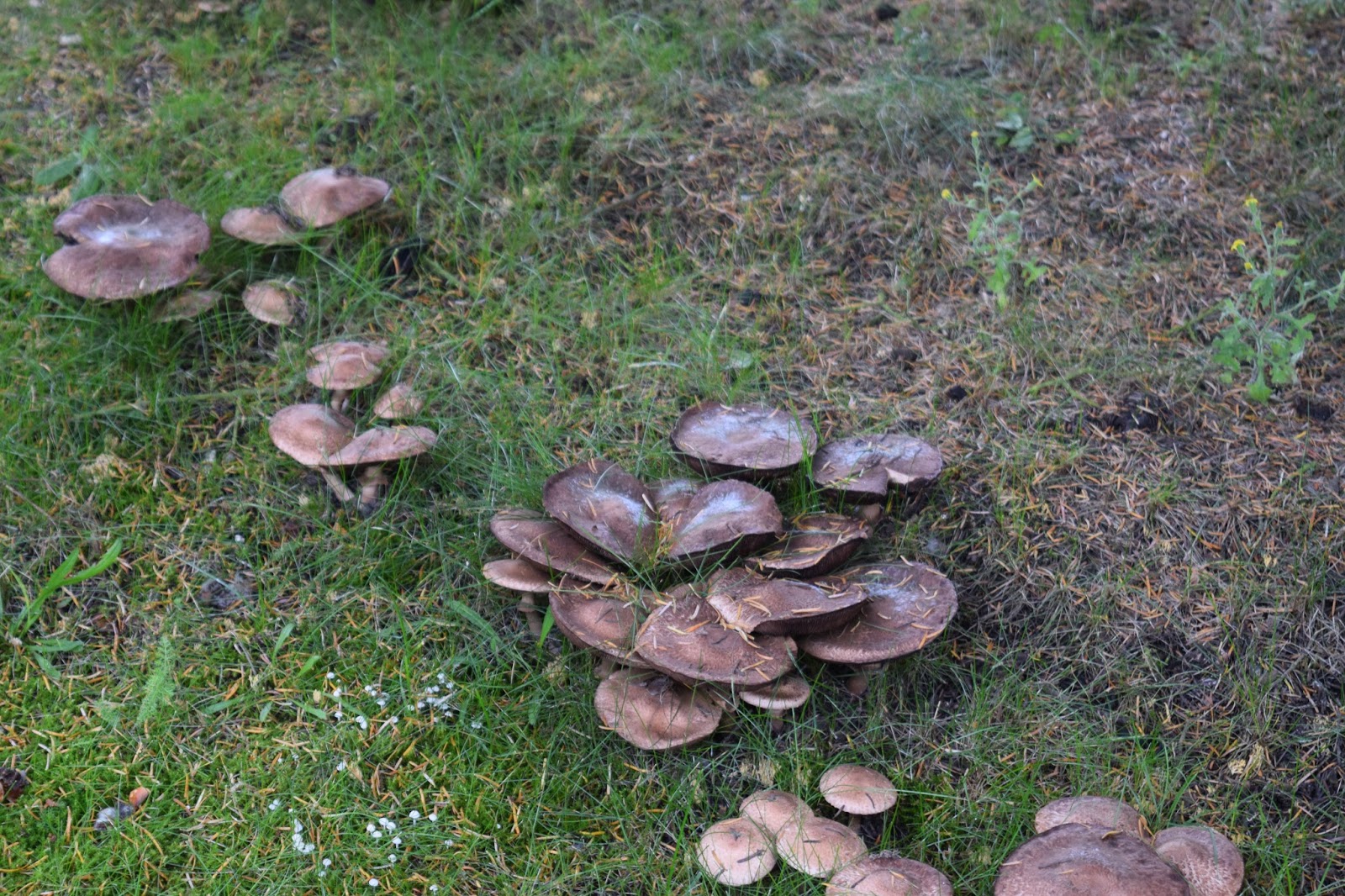
I didn't. I took a wrong turn and kept walking. There was a park. I remembered a park from the map, so I kept walking. There were mushrooms. Big mushrooms.
I didn't. I took a wrong turn and kept walking. There was a park. I remembered a park from the map, so I kept walking. There were mushrooms. Big mushrooms.
 |
| You can't tell from the photo, but this guy was close to two feet tall. |
 |
| Each lobe was the size of my hand. |
 |
| And these were like mini-pizzas |
Eventually, I came upon a sewage treatment plant, which was way wrong. Had a nice view, though.

But none of this was supposed to be there. I turned around, and for the first time I remembered that my phone was in my pocket, so I dialled up Google Maps. I had a 37-minute walk ahead of me. The day was overcast, wet from the previous day's rains. I was still jet-lagged. I walked and walked and after about 20 minutes of slogging through industrial wasteland and alongside a freeway, I arrived just down the hill from the Russian church at a place where I should have turned right instead of left. The phone said I still had 18 minutes to go. I don't know if it was a combination of jet-lag and diabetes or what, but I was exhausted and starving. I lurched onto a traffic island and felt myself losing my balance as oncoming traffic sped inches away from me. I threw out an arm and embraced a traffic sign. When the light changed, I trudged in the right direction and sure enough: there was a park. I had to sit down, but soon enough felt good enough to soldier on. An arm of the park I'd sat in divided a street on the right, and I walked where the phone told me to. And there was the Lenin Museum, confusingly enough in the administrative building of the state theater. And, a quick look at the map told me, the market hall was just a few minutes away, so, knowing that I needed to eat, I headed in that direction, and found it. Right inside there was a lunch counter, and the woman behind it spoke simple English. I ordered what she said was chicken in a cheese sauce with mashed potatoes. It wasn't like any chicken in cheese sauce I'd imagined, but it was very good, and not just because I was hungry. The rest of the food hall, I discovered, was mostly lunch counters, but then, I doubt there were many crops in early October.
Okay, time for Lenin. The building was fairly opulent, and I eventually learned that it had been the union hall for all the industrial unions in Tampere, where Finland's heavy industries created factory equipment and locomotives. I'd even passed an ancient locomotive in the industrial section I'd wandered through. In the early 20th century, Tampere's workers were unionized and were very interested in the communism/socialism brewing elsewhere in Russia, so when a couple of Bolshevik thugs knocked over a bank in Estonia (another Russian province), they realized they were too hot for Petersburg, where most of the rest of the Bolsheviks were and fled to the small provincial city of Tampere, where the union guy welcomed them at the opulent union hall, all polished wood and marble. One of the thugs was a Georgian named Josep Dzhugashvili, who seemed hot to get the revolution going, so the Finns sent word to Germany, where Lenin was hanging out, and he got on the famous sealed train to Tampere. The unionists introduced him to the bank robbers and he soon decided it was time to go back to Petersburg and get this Party started. When he arrived, he was greeted in an office at the union hall, which is now the Lenin Museum. There's actually not much in it, the major artifact being Lenin's cane (although it's not even his cane, but an exact replica traded to Tampere's mayor, who brought the original to Moscow on a friendship tour some years ago), and there's this corny bit:
I'm pretty sure you can't read what's on the red spot on the floor, but it says that this is the exact spot where Lenin and Stalin first met. The corny bit of Lenin in the sidecar ("Have your picture taken on the motorcycle!") and the life-size Stalin figure (my friend JJ Gordon, during his acting career, performed a one-man play called I Am Joseph Stalin, about one of the doubles Stalin used, and I have to say that I never met Stalin -- thank heavens -- but this thing's the spitting image of JJ) give you something of the flavor of the place. Cool gift-shop, though, if you don't have enough Commie crap.
The reason this is Finland's 100th birthday is because once the Bolsheviks took over the Russian government, they thanked Finland by giving it its independence. Of course, they also changed their mind, which resulted in yet another 1917 revolution, and that's given as the reason Finnish, inscrutable as it is, is the national language. (Actually, Swedish is the second official language, which means German-speakers can sort of make out some signs).
The next day, I returned to Helsinki, and spent the night, flying off to Berlin for a short visit, my first to the place I'd lived for 15 years for eight years. I understood it had changed. Uh, yeah.


But none of this was supposed to be there. I turned around, and for the first time I remembered that my phone was in my pocket, so I dialled up Google Maps. I had a 37-minute walk ahead of me. The day was overcast, wet from the previous day's rains. I was still jet-lagged. I walked and walked and after about 20 minutes of slogging through industrial wasteland and alongside a freeway, I arrived just down the hill from the Russian church at a place where I should have turned right instead of left. The phone said I still had 18 minutes to go. I don't know if it was a combination of jet-lag and diabetes or what, but I was exhausted and starving. I lurched onto a traffic island and felt myself losing my balance as oncoming traffic sped inches away from me. I threw out an arm and embraced a traffic sign. When the light changed, I trudged in the right direction and sure enough: there was a park. I had to sit down, but soon enough felt good enough to soldier on. An arm of the park I'd sat in divided a street on the right, and I walked where the phone told me to. And there was the Lenin Museum, confusingly enough in the administrative building of the state theater. And, a quick look at the map told me, the market hall was just a few minutes away, so, knowing that I needed to eat, I headed in that direction, and found it. Right inside there was a lunch counter, and the woman behind it spoke simple English. I ordered what she said was chicken in a cheese sauce with mashed potatoes. It wasn't like any chicken in cheese sauce I'd imagined, but it was very good, and not just because I was hungry. The rest of the food hall, I discovered, was mostly lunch counters, but then, I doubt there were many crops in early October.
Okay, time for Lenin. The building was fairly opulent, and I eventually learned that it had been the union hall for all the industrial unions in Tampere, where Finland's heavy industries created factory equipment and locomotives. I'd even passed an ancient locomotive in the industrial section I'd wandered through. In the early 20th century, Tampere's workers were unionized and were very interested in the communism/socialism brewing elsewhere in Russia, so when a couple of Bolshevik thugs knocked over a bank in Estonia (another Russian province), they realized they were too hot for Petersburg, where most of the rest of the Bolsheviks were and fled to the small provincial city of Tampere, where the union guy welcomed them at the opulent union hall, all polished wood and marble. One of the thugs was a Georgian named Josep Dzhugashvili, who seemed hot to get the revolution going, so the Finns sent word to Germany, where Lenin was hanging out, and he got on the famous sealed train to Tampere. The unionists introduced him to the bank robbers and he soon decided it was time to go back to Petersburg and get this Party started. When he arrived, he was greeted in an office at the union hall, which is now the Lenin Museum. There's actually not much in it, the major artifact being Lenin's cane (although it's not even his cane, but an exact replica traded to Tampere's mayor, who brought the original to Moscow on a friendship tour some years ago), and there's this corny bit:
 |
| Red marks the spot! |
The reason this is Finland's 100th birthday is because once the Bolsheviks took over the Russian government, they thanked Finland by giving it its independence. Of course, they also changed their mind, which resulted in yet another 1917 revolution, and that's given as the reason Finnish, inscrutable as it is, is the national language. (Actually, Swedish is the second official language, which means German-speakers can sort of make out some signs).
The next day, I returned to Helsinki, and spent the night, flying off to Berlin for a short visit, my first to the place I'd lived for 15 years for eight years. I understood it had changed. Uh, yeah.
* * *
 |
| Dude, where's my apartment? |
It's really hard to take a picture of what's not there, but since Berlin has always been a city of vanished places, I got kind of good at it there. This one takes some explanation, though, because it's not a very good picture of something that's not there. Okay, my old apartment was impossible to find unless you knew the secret. The yellowish building in the center of the picture was Borsigstr. 2. Next door on the right was 1, and next door on the left was 4. I was in 3, which, for reasons known only to the city of Berlin, referred to the building behind 2. Somehow, my landlord sold off the driveway you'd walk down to get to it, the tiny vacant lot on the side of the driveway, and part of the parking lot behind the building to developers, who put up the grey building, which is now allegedly a four-star hotel. I need not remind anyone who visited me at this place that my apartment was barely even a one-star one. The note on the grey door, which was never open during the 11 years I lived here, says that access to 3 was through the hotel garage.
That was only the first shock. Although I could probably have found cheaper and better accommodation, for nostalgia's sake I chose the hotel on the corner (to the left and all the way up the block), Honigmond. Honigmond started as a bar during Communist days, the Borsigeck. It was the favored watering hole for the students at the theological seminary in the church two doors up from my place, and back then, the church and divinity students were secret centers of dissidence, as was the theater. Borsigeck was also a favorite of another bunch of malcontents, actors. The code word for meetings was "playing chess at Borsigeck." After the regime change, a bunch of Borsigeck folks bought the bar and renovated it in turn-of-the-century elegance, and made the kitchen into one that produced excellent German food, with a weekly menu that also had Italian touches. I first ate there with my editor at the English-language magazine whose offices were not too far away, Checkpoint. It had just reopened, and we thought that, as far off the track as it was, it was doomed. Hardly. It was a neighborhood joint, our secret. Once they acquired the whole building and turned it into a hotel, I wondered what the breakfast was like, but I never found out. Eventually, they bought two more buildings to add to the hotel. It made me happy; I ate and drank there a lot, and when I started my communication company, Berlin Information Group, we'd commandeer the back room on Tuesday nights, which were very slow, and have our meetings there until someone talked a developer into giving us free office space a couple of blocks away. So you see why I picked the hotel.
But Honigmond the restaurant died earlier this year. The space has far fewer tables, and it is now Neumond. And on Neumond's dinner menu, amidst all the gussied up dishes, is that signifier of Euro-hipsterdom gone bad: a fancy cheeseburger. I had breakfast there my first day (very generic) and went elsewhere from then on. (Yes, I'll get to food in a minute here).
But beyond all this there was an onslaught of change to absorb. My friend Nikki picked me up at the airport and after I checked in, we went for a walk just to check it out. Torstr., on whose corner I almost lived (it's a major street, so it was good to have a couple of buildings muffling the noise), had been a collection of this and that, a couple of bakeries, kebab stands, a television repair place...that sort of miscellanea. There were a couple of restaurants, especially late in the game, with an excellent if terminally trendy Chinese place, the super-snotty Bandol (I was denied entrance once because I was wearing jeans, which was so out of place in that neighborhood that I just laughed at them), and an excellent Italian place. Now, it's wall-to-wall restaurants, of which the only one I recognized was Bandol. Some of them, I was told, were quite good. Many appeared to be hipster-yupster in appeal: a great number of people with money from elsewhere in Germany have arrived, and it's unlikely I could even manage to aford an apartment on a side-street. By the time we made the grand circle, I was dizzy. Nikki drove off and I went uptairs to think.
The next day I kept walking, this time below Torstr. in the so-called Scheunenviertel, which had been filled with emigrants between the wars and featured the Neue Synagogue, a prominent Reform congregation that was accidentally bombed by the British in World War II. When I lived there, it was where the edgy galleries were, a couple of odd bars, and our magazine offices, and, later, the studios of JazzRadio, where I did three shows a week for about 8 years. I took a lot of shitty photographs. But not all of them were bad.
 |
| The Empty Apartment |
For some reason, I'd never gotten a good shot of this memorial to the deportation of the neighborhood Jews. Or maybe this is better than the ones I took because the greenery's had eight more years to grow in. I could have framed it better, though.
I think the reason the photos were so bad, though, was because I wasn't looking at what was there, which is, well, kind of important. I was looking at what I remembered, and that made accurate documentation imposible. Okay, and the early-morning light was off; I never got up this early when I lived there. But it's also that there were ghosts. Things I expected to see that weren't there. The hotel was quite close to the apartment of my short-lived ex-girlfriend, Lady Drunkula. She may still be there if she isn't dead, which she might well be; it'd only be a question of whether someone murdered her, she had an accident while drunk, or she drank herself to death. I'd walk past places and memories came back to me despite myself. I found I didn't much enjoy this.
To be honest, though, I returned without much of a plan, many of the people I wanted to see were out of town or busy, and I realized that the next visit would have to be planned a bit differently. And there should be one, but maybe not too soon.
One thing that went off brilliantly was that the same day I went below Torstr. I also went to the Bode Museum to look at their room of Tilman Riemenschneider sculptures. The Nordrhenisch school of wood-carvers appeal to me greatly, and I've seen plenty of their work over the years, but Riemenschneider is a cut above. The Bode doesn't even have a lot of them, I discovered. I'd remembered a lot more when I was rushing through the Bode for the first (and until now only) time I'd gone there, writing it up for one of the many guidebooks I'd worked for, and since everything in Berlin is always under construction, there was a room with at least one of his pieces that was blocked off. But the room that had ones was fascinating. I'm not even a sculpture guy, but these knocked me out.
 |
| Venetian dude |
 |
| Another Venetian dude |
 |
| No idea dude |
And then there was Riemenschneider. The masterpiece was the four Evangelists.
 |
| All together |


And, of course, the band of angels.

Most of the rest of the museum is later stuff that doesn't appeal to me, much of which isn't first-rate (that'd be off by Potsdamer Platz in the Gemäldegalerie), and I went and overdosed myself by buying a ticket good for all the museums so I could see what they'd done to the Neues Museum, which had a hole you could (and some did) drive a truck through due to wartime bombing. It's now been patched up, rebuilt, and houses Greek and Egyptian things, including that bust of Tutankhamen's wife (and sister) Nefertiti. Bet you thought that was in the Metropolitan, eh? In the basement was a nice show about the beginnings of civilization in China and Egypt, their similarities and differences as demonstrated by objects. As is the custom in Germany, though, the museum was grossly overheated, I was getting tired, and so I went back to the hotel after an increasingly more cursory glance at this exhibit.
My proposed last-night mass meetup wound up being Nikki, two of her boys, Uwe, her ex, who is also the father of one of the kids, and my friends John and Aimee, at a bar Uwe was running (and has since left) called Kegelbahn. It was pretty low-key, especially since John and Aimee had to leave early, but at one point we were all at the table nursing our beers and I said "You know, this place has ruined me. I just can't get used to the States." And...well, I can't. It's not just our grotesque, evil President, or the utter alienation of the new, bloated Austin. It's a way of living that overlays the entire country I've seen since I've been back. I just don't like it. If it were mere culture-shock, it would have worn off. And it hasn't. I'm not sure what I'll do, exactly, but I can't budge for another couple of years, while I write this next book and promote it when it comes out. I didn't really have any choice in returning: there were things here I needed to use for the book. But once I don't have that choice...
* * *
A FEW CULINARY NOTES:
Finland is probably not high on your list of countries for destination dining, but should you have to do there, you shouldn't regret it. One thing I noticed immediately was that the bread there is extraordinary. This is because it's mostly rye; wheat doesn't grow too well, so it's not as much used in the national cuisine. At breakfast in the hotel, I got that immediately, including a crispbread covered with seeds that I brought back with me. The cheeses were good, too.
I had dinner at some fine places. My friend Karen in Berlin suggested Seahorse, in Helsinki, whose business card advertises "Finnish food and culture since 1934," which would be better for someone who, unlike me, does not have a deep, visceral distaste for beets, root vegetables being another of the mainstays of local agriculture. I had some herring, some of which had a camphor flavor (not bad, but weird), and then a "Scandinavian hash" of ham and potatoes that wasn't too memorable. Cheap and friendly joint, though. Another place I enjoyed quite a bit was Kuu, which means "month" in Finnish (it's the suffix of the names of all the months, the waitress explained). The salmon cured in aqavit with a crayfish sauce was super, and the reindeer stew (had to have it once!) was very well done, letting the distinctive flavor of the meat play off the berry-studded wine reduction brilliantly. A mixture of locals and Japanese tourists, superb service, highly recommended. My third dinner was at Bryggeri, which, as you can tell from its (Swedish) name is a brewpub, but one with extraordinary food, matched with the in-house beers. I had a bit of a cold so I remember I started with their cheese and charcuterie plate, but my taste buds faded before the main course so I don't remember what I had. And the receipt is in Finnish. Recommended, though. Bryggeri is also near the harbor, which is where you'll find the market hall, which has far more food than restaurants (including a pancake place with the motto, in English, "A pancake a day keeps the sadness away," which tells you everything you need to know about Seasonal Affect Disorder in Finland), where I got a nice snack of a slice of superb smoked salmon which I munched as I walked around.
In Tampere, I ate twice at the hotel restaurant (not particularly recommended, although there was nothing wrong with it) and once at Tiiliholvi, a place which also seems to have a branch in Helsinki. This was very nice, although I was the only person in the place when I went. A soup of root vegetables was a fine Finnish start, and the "duck two ways" turned out to be breast meat and liver, each with its own sauce. They brag that they have the best wine cellar in town, and if the glass of Les Douves Latour Carnet (I was intimidated by the "Latour" part, but it was affordable) was anything to go by, they're right. It was not only a perfect accompaniment, but a profound wine -- and, as I discovered on my return, a $20 bottle if you can find it.
In Berlin, after the Honigmond disappointment, I went down the street to a place that had opened when I was living there. I hadn't liked it, thinking it pretentious but not cooking to meet its pretentions, so I never went back. But this time, it appeared that the spirit of the old Honigmond had just picked up and walked a block. True, Alpenstück has white tablecloths, but the Radeberger beer is just as good, and the bread, well, that's different. The reason is that they've expanded across the street, clearing out a hairdresser and a bar (Smily :-) der Friseur and Cheer's -- a copy-editor's nightmare in 3-D) to put in a bakery-cafe, whose first-rate breads and pastries would have been a real boon to the 'hood back when I was living there.
Quite the adventure, and now I'm back in the USA, where hamburgers (and cheeseburgers) sizzle on an open grill night and day. But I know I'll be back to Berlin. And who knows, maybe Finland.