Showing posts with label Texas. Show all posts

Friday, October 21, 2016

Barcelona, Back To Texas, Viewing The Ruins

The room might not have been great, but Barcelona still was. I only had the afternoon to do all the things I'd planned, if I could beat back the drumbeat of the oncoming chaos I was sure would greet me in Texas. One thing I knew: I'd need some new clothes, because I wouldn't have access to mine for a while. Anyway, all the weight I'd lost in the past year meant all the pants I had that fit me -- two pairs of regular ones and one of Levi 501s -- were in my suitcase. I had the Levis on. They'd need washing soon.

I've always like the clothing I'd seen in the high-end Spanish shops along the Paseig de Gracia and, indeed, on some of the Spanish men walking along the street, so, since it was nearby, I went over to the Corta Inglés, the giant department store one sees all over Spain, to see what it offered. It was much like any other department store except that it had Spanish stuff (and, of course, a giant supermarket in the basement, the only part of the store I'd ever been to). The guy at the Hugo Boss boutique on the men's floor even suggested I look at Spanish brands, which were just what I wanted, as it turned out, and considerably cheaper than what brands I can get in Austin like Ralph Lauren and Boss and so on were offering. Two shirts and a pair of pants later, I had what I needed. I'm not a shopping-as-therapy kind of guy, but it did feel good to know that I wouldn't be naked in Austin.

And yes, I did head to the basement to pick up three cans of olives stuffed with anchovies and a couple of cans of Spanish tuna. I'm not a complete idiot.

And, as is my custom, I had my last dinner in town at the always-wonderful Nou de Granados, one of my favorite restaurants: a nice salad, and oxtails in a wine reduction on a pillow of truffled mashed potatoes, garnished with potato chips. Don't sneer at potato chips in Spain: they're a great example of the virtue of simplicity. I can't eat many because of the diabetes, but when they're perfectly crisp and greaseless but redolent of fine Spanish olive oil -- as these and many I was offered at bars were -- they put Lay's and the like to shame.

The next morning I woke early, had a decent breakfast downstairs in the hotel and grabbed a cab to the airport. Barcelona to Paris Charles de Gaulle (the hellish Terminal 2) to Atlanta to Austin. I was lucky: not only had I bought economy plus fare (recommended for large or tall people and/or people with legs, not to mention those of us who've experienced lower vein thrombosis or a pulmonary embolism as the result of a long flight), but it was a Tuesday, so not that many people were travelling, and I had no seatmate. Air France has a fairly crappy selection of films (unless you've always wanted to see The Angry Birds Movie with Arabic subtitles), so I had lots of time to read and think.

Something that's always annoyed me about the menu at the Nou has been the silly errors in the English translation, in particular "backed" for "baked." If I lived in Barcelona, I'd offer to edit their menu in exchange for a bottle of wine or something. (They've also confused "cherries" with "cherry tomatoes," the former of which one doesn't really hope to see in the Caesar salad -- and doesn't) But something Miguel had said in Madrid clicked in my head. He'd noted that Franco had suppressed the teaching of languages during his reign. I knew he'd suppressed Catalán and Basque and Valencian because he rightly feared that allowing them would lead to nationalism, but apparently all foreign languages were ignored until the university level, when it's arguably harder to learn a new tongue. So unlike Germany or France, elementary school kids didn't start adding languages until after Franco was gone.

Of course, this was just the end-point of the story I'd been living in for the past couple of weeks: in 1492, Spain expelled its mathematicians, physicians, philosophers, navigators, businessmen, bankers and intellectuals -- ie, its Arabs and Jews -- turning the country into a land of peasants under the mighty heel of an autocratic church and its Inquisition and a bloated and not very intelligent class of aristocrats, up to and including the royal family.

King Fernando VII, by Goya (detail). Does this look like a reasonable man? An intelligent one? Right on both counts, and obviously Goya detested him.
By the time Spain revolted and threw out the Inquisition in the early 19th century, it had missed the beginning of the Industrial Revolution, and had to import British and German workers to ramp up their technology. Fortunately, those workers did a great job -- and the Germans taught the Spaniards how to make good beer and sausages. To this day, a Frankfurt is a Spanish joint featuring beer and sausages! But the progress was halted again with the appearance of Fascism in the 20th century: it wasn't until 1974 that the transition to democracy -- and cultural freedom -- began, which is why the vibe of post-Communist Berlin is still noticeable in the air.

Spanish design of the '60s and '70s: a collection of SEAT automobiles in the Valencia train station. 

I think this explains a lot about Spain, and why it appeals to me: the process of discovery of new possibilities is still in the air, the Catalan secession movement may not succeed, but, like the Scottish one, may force some interesting and needed change, and the arts and the young people who make them, are still charging ahead.

* * *

Meanwhile, I was on an Air France flight back to a country where, for the first time in its history, it was being challenged by an overtly Fascist candidate in a Presidential election. And, on a more personal level, I was returning to a house that was unlivable and many possessions that had been destroyed, including materials I'd need for my next book. To soften the blow, I rented two nights in the most reasonable hotel I could find, actually a big B&B in Travis Heights that I found on the Hotel Tonight app. The first night, I just crashed, destroyed by 20 hours of flying and changing planes, including two hellish airports, CDG Terminal 2 and Atlanta, where CNN is blaring at an unreasonable volume out of the sound system. The next day, a friend and I went to see what was left of my house. 

It wasn't pretty, but it wasn't as bad as I feared. 

Looking from the living room into the office: the toilet that exploded was in the bathroom whose entry is seen on the left. 

These giant honking dehumidifying fans were everywhere. The electric bill will be stupendous, but I do believe the damage will be far less because of them.
Not a great picture, but a lot of stuff was saved. 
My landlord was great: he sprung into action and got a company involved that specializes in this kind of rescue. Despite my lack of renters insurance, his insurance covers the packing and storage of the contents of the house until it can be rebuilt. (Presumably they also bring the stuff back, too). The company gave me the weekend to take what I wanted for the period ahead, which, jetlagged and just a bit traumatized, I sort of did. I checked into the Extended Stay America on the corner of W. 6th and Guadelupe for a week, and arranged for a Facebook friend's airbnb to be my home for a month after that. Heaven knows if the renovation will be done by then; the landlord says the construction folks say it'll be ready by Thanksgiving, but he thinks mid-December is more likely. Whatever. All I can do is take it a day at a time, passively waiting for word.

Eventually, there'll be dealing with Austin Water and the electric company. On November 6, I'll be on a panel at the Texas Book Festival with Joe Nick Patoski and David Dunton, my agent, talking about writing about music from two viewpoints: biographical (Joe Nick's specialty) and historical (mine) and how the two approaches do in the marketplace. It's free, and I'll be signing some early copies of both the rock and roll history and the Michael Bloomfield book. If you're in town, drop by. If you can't make it then, there'll be a rock and roll history release party at Book People on the 19th.

* * *

This hotel I'm writing this in is a circle of hell, and I'll be glad to be shut of it in a couple of days (the parent corporation has been pestering me with e-mails for my thoughts, and boy are they going to get them!), but when I moved in, I decided to try an experiment. Downtown Austin, in the 20 years I spent in Europe, changed utterly and completely. It's like aliens dropped an entire new city onto a few square miles, but I decided to try a little experiment while I'm here and spend as much time walking and looking at the new city as I could. There are primitive cooking facilities in the hotel, and there's the Whole Foods corporate mothership within walking distance, again making it my neighborhood supermarket like it was 30 years ago (except in a different location and with about a dozen times the floor-space). Waterloo Records and Book People are also at 6th and Lamar, and there are loads of new high-rises and boutiques and restaurants scattered all through the west downtown and what the property developers call the "warehouse district," which, yes, it used to be. 

There's been much talk during the development of this of a "revitalized downtown" and a "walkable city" and how much revenue the property taxes will bring the city. I had lunch with a lifelong Austinite who used to live downtown yesterday, and his views were very interesting. "When I was down here," which was in the '70s and '80s, "the residential population of downtown was between 1000 and 2000. Now it's more like 20,000," although another friend had noted that many of the new buildings are 30% empty because they're used as second residences or "investments." I mentioned to my friend that as I'd walked the streets -- something not too many other people seemed to be doing -- I'd noticed that not only the people I'd seen, but the whole way the residences were marketed, were young, rich, and white. The boutiques also slanted that way, and certainly the restaurants did. (Many are parts of luxury chains with branches in upscale parts of California, Arizona, and elsewhere in Texas, and there's a Ruth's Chris Steakhouse not far from my hotel). 

"Yeah," he said, "there was a lot of talk about rentals and a certain percentage of affordable housing, but in practice the way that plays out is that the renters of the affordable spaces live there for a while and then get offered enticing buy-outs so the developers can up the prices or condominiumize the place. As for the places that are already condos, they're hit and miss." He pointed out a couple that are pretty full, and indeed there's one particularly hideous one near me that's all lit up at night with just about every unit seeming to be full. Others, though, especially some of the more expensive ones, don't seem to be much occupied at night. Still, they keep building them and advertising luxury. Certainly West 6th, which is the thoroughfare I'm on and which I walk daily, is lined by very upscale bars (and a few corpses of failed ones), in contrast to East 6th, which has been party central for ages, and attracts frat boys and sorority girls to bars where the aim is to get blotto. West 6th isn't much different, but I sense that the bars are more expensive here. Offering valet parking for $6 to $10, which you won't see on the other side of Congress Avenue, they seem tonier, the patrons better-dressed and maybe more seniors and MBA candidates or law-school types than on the other side. It's comforting that UT's jeunesse dorée has its own blotto-toria. 

As for the restaurants, I've found very few I'd want to return to. An exception is Lambert's, which has made a workable gimmick out of very good barbeque served in a fine dining context. But even there, the sheet listing the day's specials included a $27 shot of bourbon. As I remarked to a friend last night, for three times that you could probably buy an entire bottle of it. And Manuel's is doing a good job with upscale Mexican food, which needn't be as expensive as you'd think. The service bordered on servile when I was there, but it's usually a good bet. 

It's a cliché for old Austinites to lament what's passed, but to me, there's change and there's change. I'd be a lot more in favor of the new downtown if it were more racially, economically, and culturally inclusive. It's not. I love the idea of waking up what was a wasteland of auto parts shops, printing supplies, and derelict spaces, but it looks like greed had far more to do with it than I'm comfortable with. Imagine that. 

And yet, and yet... One of my favorite memories of West 6th was the spring day I had lunch at Hut's Hamburgers (still there! -- although now paired with an inedible pizza joint) and was walking back to my car, crossing the small bridge over Shoal Creek, and saw a mother turtle plodding down the creekside, with five or six youngsters following her. The other day, I was walking back from Whole Foods on the other side of the street and saw something by the creek. I stopped and held my breath: a heron, four feet tall, was stalking down the creek. It was a really magnificent bird, and I edged closer to the side of the sidewalk to look at it. A Type 1 jogger, togged out in expensive sportswear with some sort of phone/music player strapped to his bicep, swooshed past, hissing "Thanks" as he went by. I didn't do it for you, man. But I'd do it for a few seconds more with that bird. Anytime. 

Tuesday, July 19, 2016

Critter Report, Summer 2016

Any day that starts with a lizard in my pants is okay with me. This morning, I walked out of the bathroom, put on a t-shirt, reached for my pants, and saw a swift motion out of the corner of my eye. Fortunately, I didn't reach out to smash whatever it was, mostly because I thought it was a roach, and those guys are filled with goo that you have to clean up. Nope, I could see it clearly, looking up at me: a tiny lizard. And I knew just which one it was.

• • •

Don't make it sound too good. Tell 'em we got bugs that'll hurt you bad. Plants that'll poison you. There's rattlesnakes and other critters that don't mean you no good. People should think about that before they decide to move here.

Hondo Crouch, in an interview with me, Luckenbach, Sept. 26, 1976

* * *

I grew up in a lizardless region, the New York suburbs. There were salamanders, and I always liked our vacations in Vermont because there were toads and frogs around the lake the cabin we rented was on, but there were few critters around the place I spent most of my time. 

But, as Hondo Crouch (who died the day after I interviewed him) made clear, that simply isn't the case in Texas. You've got to be careful in Texas. The plants can get you: I've never seen such opulent poison oak as used to thrive in the woods by my old house on West 9 ½ Street. Pecan trees were everywhere, and you could pick up a snack any time from the windfalls. If, that is, you were willing to crack them and then very, very carefully pick out the membrane from the meat. It contains so much tannic acid that your mouth will pucker so badly you'll be hard pressed to get anything in it. And of course, there's cactus, but nothing as lethal as the cholla that's all over the place in Arizona. 

Some of the animal life seems incredibly exotic, too. One morning my dog got very excited, the hair standing up on his back as he ran around on tiptoe, growling. I was still asleep and yeah, I heard something walking outside the window, but it was moving quickly and after a while the dog calmed down. After breakfast, the dog and I went on our customary walk in the woods and found two cops with Stetsons and rifles on horseback, and a very excited little Latina girl, about six. "Did you see the pantera?" she asked. "Yeah," one of the cops said. "We got a report on a panther on the loose around here." It happens, I guess. The lady next door to me complained about armadillos digging up her garden, and I'd see them occasionally when I went to pick up my girlfriend in way-far-north Austin (hardly way-far-north these days, of course) and once, on Thanksgiving, I was invited to dinner out in the country, and took a British friend who was about to return home. "I've really enjoyed my stay here," he said, "but I'm sorry I've never seen an armadillo." As if by magic, two appeared at the side of the road. They were, um, making more armadillos. 

So far, there's been a decided lack of such critters here in suburban far south Austin. There are birds, of course. My office looks out on my back yard and I can hear birds with the windows open, which alerts me to their presence. For a while, I had a woodpecker who pecked a wound in one of the trees he visited daily. The wound bled sap, which was sweet, ants were attracted to it, and the bird would show up to eat them. I'd always assumed there were bugs in the wood that they were after. There's also a cardinal couple, who seem to hunt as a pair. He is the most brilliant red imaginable outside of the tropics, a magnificent bird. She, conforming to the ways of birds, isn't. She's a kind of drab brown with a tiny bit of red on her head. That seems to be how bird love works: "Darling, I've seen some drab females in my life, but you're really drab." "Ooh, listen to mister sweet-talk." 

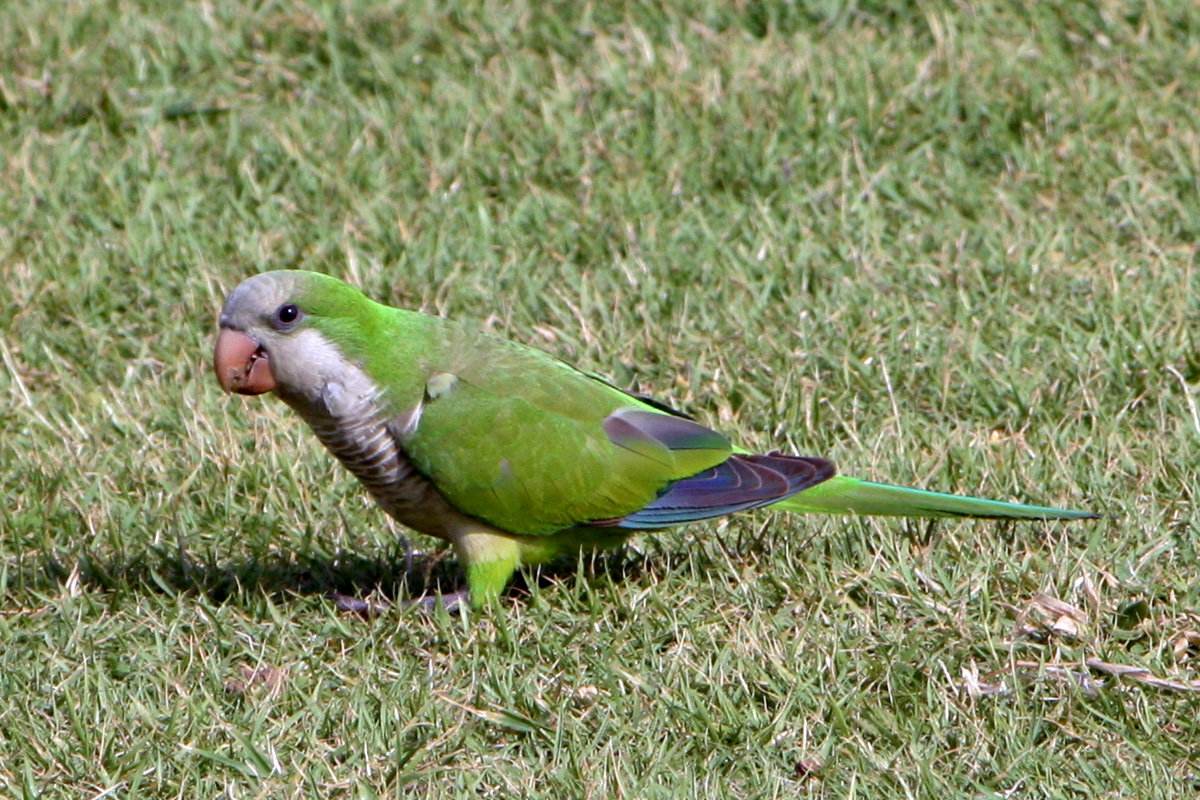
The one bird I've been wanting to see, but hadn't until recently, was the monk parakeet. Friends tell me of them visiting their yard, but they don't come here. Finally, one day when I was walking to the nearby middle school to vote -- it might have been the primary -- I heard a familiar sound, and sure enough two green birds, bickering loudly, swooped over my head and onto a branch. I have no idea why they don't come to this side of South First, but I've never seen one here, although I'm about ⅛ of a mile from that sighting. I also enjoy them in Barcelona, where they seem to outnumber pigeons. 

Bigger than a budgie, and surprisingly omnipresent. Wikipedia photo


But this year I made the decision not to mow the back yard. This was in large part because of the regal toad that used to come every night and sit beneath the light on the back of the house, which also attracted bugs, or, as he thought of them, dinner. I hoped there were more critters out there. Benign ones, of course. And there were: as springtime came on and the rains let up a bit, at sunset giant clouds of lightning bugs would lift off of the plants back there, a luminous flying carpet. That was nice. And I knew I was getting somewhere when I found a small brown Cuban anole hanging out on the deck sunning himself. 

The toad hasn't been back, but the back yard wasn't my only concern. The tree in my front yard was host some days to a magnificent Texas spiny lizard, which I'd never seen before, and whose commanding presence (at about 11") just plain looked good, even though he was expert at dodging the camera. 

Not a great shot, but not mine, either. Wikipedia.
He hasn't been back yet, either, but I gather they have a pretty good range they wander, eating bugs as they go. Welcome back any time, dude. 

And I was aware that there was other critter action in the front, dating from two years ago, when I found a J-shaped toad turd in the driveway, and running up to early May of this year, when I returned from shopping to find a small snake waiting by the front door. I ran inside and grabbed a camera (or maybe it was my phone) and found he'd stuck his head under a pile of leaf litter, so I took a stick and pulled him back to photograph. His head arched up and he took a good snap at the stick, hard enough that I felt it. Then he sat back and let his picture get took:

Healthy snake, wounded stick
A Texas garter snake, a useful website told me. 

I haven't seen him since, but I suspect he showed up because a bit up the hill Google Fiber was putting in cable. This has resulted in a bunch of eco-upheaval, because there's a tiny stream up there, right where they're working, and its critters are abandoning it. The most remarkable one I've seen was hanging out in the parking space in front of my house, fortunately when I was carrying my phone. 

Somewhat traumatized by the speed at which he was moved, a red-eared slider,  who later moved on to another small creek. 
You can tell by the pattern on the shell that he was just hanging out in a diminishing stream when the decision was made for him to move. Nine inches long, and plenty heavy. 

Then there was the night when I went out to light the grill and this guy hitched a ride on my shoe and hopped off when we returned to the house.


Not a great photo, but he was jumping around like crazy, and I wanted him outside where he could do some good: a tiny, tiny toadlet who could have perched on a quarter. Progeny of Back Door Toad? Maybe, maybe. At any rate, a quick ride on a piece of paper, and back to foraging for bugs. 

Because there are bugs. Anybody who lives here knows that. The most common one is the ant, of which Texas seems to have 23,847 kinds. My computer hasn't gotten clogged with Raspberry Crazy Ants, fortunately, but there are small ants who manage to squeeze through the windows, and, recently, great big ants I call Iron Ants because you step on them and they kind of go "ow" and keep on walking. They hold regular love-ins in my shower, where I literally pour cold water on their assembly, and they either go down the drain or retreat behind the shower lining into the wall. Last night, though, I saw something odd that I've never seen before: an Iron Ant walking with another one in its mandibles, a kind of a T walking across the living room floor. I have no idea what that was about. 

And, sadly, there are roaches. Mostly, there are the big ones, the ones you can't step on unless you want to get down on the floor with a paper towel or something to clean up the ooze that results. My research, though, says that these so-called palmetto bugs or waterbugs don't want to be in the house, since it's not their natural habitat. The way I deal with them now is to stun them with a broom and then go all Canadian on their asses and play curling with them, opening the door and launching them outside. Sometimes I say "cheeseburger" to alert the neighbohood reptiles and birds that a sumptuous meal awaits. (Or any Thais who might be around: I found a small Thai grocery here that sells them canned, and in Montpellier there was a Thai restaurant with an insect menu that I never went near). They're not real smart, but they are real fast. And, according to Wikipedia, they're properly called American cockroaches. The ones you don't want because they do want to live in your house (and which you can whack with impunity) are brown, or German cockroaches. I never saw one in my 15 years in Germany, so maybe this is a xenophobic leftover from one of the World Wars, like "liberty cabbage" for sauerkraut or the more recent Freedom Fries. 

Another new visitor this year was one I found irrationally scary. I routinely approach the bathroom by my bedroom with watchful eyes, because there appear to be a couple of entryways from outdoors, and the big roaches get in. Well, the other night there wasn't a roach, but under the sink was a three-inch scorpion, reddish brown. There are over 1000 species of scorpions, none of the ones in Texas are lethal (for that you have to go to the Sonora desert in Arizona), but I, a Scorpio, freaked out, whisked it out with the broom, and stomped the hell out of it. Then I swept it out the door and waited for the adrenaline to subside. 

Right there, on the wall, under the brace, that's where it was. 
But wait, the lizard in your pants, aren't you going to tell us about that? Well, yes, because the above photo is about that, in a way. 

A few weeks back, I was passing in and out, grilling something for dinner, and a two-inch brown Mediterranean gecko (not unlike the Moroccan geckos who occasionally visited in France) ran in. I tried to dissuade him, but no soap: he ran to where I couldn't get him and it was at a crucial part of dinner so I gave up. Anyway, I don't mind a gecko in the house. They have prodigious appetites, and the summer I moved away from Austin to go to Berlin, my house suddenly had two of them in the kitchen. There had been a problem with German roaches, as there usually is in a house with no central air conditioning and open windows and doors. There was, within 24 hours of these two moving in, no longer a problem with German roaches at all. And, with his propinquity to the shower and the ant love-ins, I suspect this one had found a good place to hang and was hanging and dining well. I tried to photograph him, but it was before I'd had my coffee, so it didn't happen: the camera refused to click when I had him in focus and when I returned with the phone (and its clip-on fancy lenses) he'd vanished. But I was curious why the camera wasn't working so I aimed it at the under-sink area, and hence the above photo. 

I'm blessedly without mammals, although a large, fat white cat with black blotches saunters through my yard each day. He is manifestly not welcome: I caught him staring at an area where the toad hung out during the day last year, and wished I had a pan of water to throw at him. Cats are stupid hunters and predators, and with the cardinals and the various reptilia, I just don't want them in the yard. And yes, there are squirrels. I don't pay them much mind, but this spring, there was a very cool sighting. Remember Pizza Rat? He was a thing on the internet a few months ago, a tiny rat straining to take a mammoth slice of pizza down the stairs to the New York subway. Well, one day this spring, I noticed a squirrel behaving oddly, and saw that it had a slice of pizza in its mouth. No camera nearby, no phone, and he was moving quickly: he was, after all, bigger than Pizza Rat, and the slice was smaller. And I kind of felt sorry for him.  Pizza Rat was rewarded by a luscious New York slice. Poor Pizza Squirrel probably had Domino's. But no matter where it was from, it didn't matter: none of us critters in Austin have access to good pizza. 

Tuesday, September 15, 2015

Land Of Disenchantment: A Few Days Off

And so all the factors fell together and on Tuesday, September 8, the Grey Vibe and I left Austin for a few days' adventure in Santa Fe. And boy, did we get it.

Part I: Land of Broken Dreams

It kind of goes without saying that West Texas isn't very interesting, from a landscape point of view, or, really, any other point of view unless you're in the oil bidness. But if you're trying to get to Santa Fe without dawdling, you have to go through it, so sayeth Google Maps. I don't necessarily trust these phone-based guidance systems, as you'll see later, but Google usually does a great job. My own bit of improvement on the system is to write the steps IN BIG LETTERS in a notebook kept next to me in the front seat, so we see:

L 183N/US 84W 30m
L 84W/EARLY BLVD 30m

and so on. It lets me know each intersection (usually) and that intersection is usually there. I did, however, manage to get lost in Early, Texas, not an easy task given its size. The reason, one of the failings of these systems, is that they don't tell you subtleties like that Early Blvd. is, in fact, 84 West. So I drove the wrong direction for about 20 minutes, and, sure after a while that I'd gone the wrong way, turned on the phone to get me to the next route, 153 West, where I would be for the next 71 miles. 

But for some reason, the phone decided I wanted to go back to Austin on 153 West, which I didn't. And I couldn't find a way to change its mind. Furthermore, when I got back to the place I'd made the wrong turn, I saw what I'd done wrong, and that just 30 miles down the road, 153 would appear. But I couldn't turn the goddam phone off. 

I was headed to Clovis, known to me and millions of others as the place Buddy Holly recorded so many of his early records, as did other West Texas stars. So for the remaining 237 miles, my phone was chirping "Make a U turn" or "Take County Road 445" and the like. As I was checking in at the La Quinta, it was still saying "Turn around." 

Clovis, approached as the day was ending, was not impressive. For miles and miles, I'd seen nothing but failures, buildings once housing a bar or a store or a gas station, long shuttered and left to the elements. In West Texas, there were whole downtowns that were like this, some with the concrete buildings falling in on themselves. I wondered who'd been there, tried, and failed, and where they were now. Clovis seemed to have no center that I could see, but lots of dead businesses. I turned the corner up Prince Street, and it was the same, except with a bit of new growth: franchises were taking tentative hold, and, perhaps sensing the halfway-to-elsewhere location of the city, something of a Motel Row was growing. I was glad to see the La Quinta, even if the receptionist didn't seem glad to see anybody, let alone me. 

The next thing was dinner, and helpful friends had found two possibilities on Yelp. I'd seen a couple of Mexican places on the way in, but as is the custom around here, they closed after the lunch hour. There were two, Leal's and Don Mario's, that had dinner. I chose Leal's after being snippily informed that it wasn't pronounced in two syllables (lay-ALLs), but rhymed with "wheels." It turned out to be the most horrible, gringified Mexican place imaginable, although I'll say that their "crispy chile relleno," made crispy by the addition to the batter of the traditional Mexican ingredient panko bread crumbs, is a good idea in theory. Pretty bland otherwise, and I think there was MSG in the salsa.

The bed was welcome after the long drive, seven hours or so, and I awoke the next morning ready to eat breakfast and bomb on to Santa Fe, where I was sure a far better experience awaited. Don Mario's was waiting, and it was yet another gringified joint. I wished I'd noted more carefully the couple of places I'd seen coming in, but I hadn't. Service at this joint was horrific, and the waitress stared uncomprehending when I ordered chile verde with eggs. Apparently it's not pronounced chee-lay vayr-day, but rhymes with silly birdy. I may have seen the reason for the weird service on the way out:

But first, are you expereinenced? Have you ever been expereinenced? Not sure I have...
Nor was that the weirdest sign I saw in Clovis. Prince Street in daylight was more depressing than at night, the worst evidence of that busted dream problem being a very large restaurant about to fall apart. It still had a sign up, Great Wall: American Food and Sushi. Sigh. But I knew that Prince would end at US 84, and that that would be the beginning of my next leg of the trip. Turning right onto it, I saw a Subway, also with a sign board. It read FACE YOUR DARKEST FEARS. 

Okay. Bye, Clovis. Buddy will have to wait for next time. 

Part II: Santa Fe, Sunlight, Seniors, and Slaves

Obligatory New Mexico chile shot


The landscape was changing into outright desert, although at this time of year it starts raining, and, indeed, people in Santa Fe were complaining that I'd have an awful time unless it stopped. The desert, of course, responded as usual, turning green and coming to life. There weren't really dramatic landscape features, but there were mesas and mountains, and Austin doesn't have those yet. And there was life out there: signs to Wastella and Bovina. Of course, I got lost trying to get into town, but it smoothed out well once I followed signs to Historic Downtown. I'd already glimpsed some Historic in Historic Ft. Sumner, which had Billy the Kid memorabilia and his grave, among other things. Why, my route took me directly underneath the Historic Bridge, so labelled, built in 1938 and restored in 1967! The town just sings history: too bad I didn't have time to stop and gawk. 

Santa Fe's Historic Downtown, however, is just a bit older. 1610 is the generally-accepted date. I'd just lucked out yet again on a hotel room, as I had last year in Montreal. TripAdvisor suddenly came up with an unbeatable price at the El Dorado Hotel and Spa, and I grabbed it. I gladly handed the keys to the Gray Vibe over to the valet, stumbled upstairs, and checked in. The room was comfortable, the lowest grade they had (must be nice to have a fireplace room later in the year, though), the lobby had mammoth ceilings, the restaurants seemed reasonably priced, and I was set. The first order of business was to find a place to eat. I was already tired of heavy pseudo-Mexican food, and yet I was confident that I could find better nearby, but I wanted something a bit lighter. The local alternative paper's best-of list had just come out, and a "gastropub" called Fire & Hops seemed not only nearby, but very interesting. And so it proved: the calamari looked a bit overdetermined from the menu description, but wasn't, and the Cubano sandwich was nicely made, if a challenge for my store-bought teeth. And the real discovery was La Cumbre Brewing's Elevation IPA on tap. The mixture of hops they used are so fragrant -- and so complex -- that it's a joy to drink. 

I'd done a quick reconnaissance around the 'hood shortly after getting in, but in the morning I decided to go get breakfast outside the hotel, because of lingering mistrust of hotel restaurants. I stumbled into the first place I found, the Alameda Cafe, where a Salvadoran gentleman named Francisco J. Castillo pours an extraordinary cup of (organic) coffee. His breakast burrito (the signature breakfast dish of New Mexico, apparently) I'm less enthusiastic about, but I suspect that's because I'm not too enthusiastic about breakfast burritos in general. That aside, this is a find. 

My next stop, after a quick check-in at the hotel to grab my camera, was the Railyard District, about which I'd heard so much. The word was that it was the center of a hot art scene, which was what the younger folks in Santa Fe had going, and there were all sorts of cool things down there. I also needed a shirt, because I was having dinner with an old friend that night and the one I'd packed had been poorly chosen: I hadn't seen the stains or the giant hole by one of the buttons, and my friend told me that the REI down there would have something. 

The Railyard district had a very interesting fact embedded in it: although everyone knows the Santa Fe Railroad, it did not, in fact, stop in Santa Fe. Instead, there was a spur from a town further south, Lamy, and today there's one from Albuquerque. There was more to that story, as I'd find out.  Instead, I mooched around a mall set in the former headquarters of a shipping company that made history when it was used to supply the workers at the Manhattan Project in nearby Los Alamos, a place so secret that it was known only as PO Box 1663, Santa Fe, and newly-arrived workers reported to an anonymous building nearby and were driven out to the town. The mall has a nice selection of photos of that period, along with ones of the Railyard in earlier times. 

Down at the end of the Railyard District lay what must have been the reason for the reputation: SITE Santa Fe, a sprawling arts building. They were celebrating their 20th anniversary by inviting some of the artists who'd done projects there before to make new works. 


I thought the protuberances looked a bit dated, but they probably can't be held responsible for something they did two decades ago, and I was pleasantly surprised to discover that as an Old Person, I was allowed half off the ten-dollar admission. Thank heaven. After a quick tour of the place, I had a revelation: academic art is academic art. The only thing that separated this stuff from the similar stuff I'd had to see and sometimes write about in Europe was that it was a bit more naive, a bit less over-thought. But you still have to evaluate it, not by what it is, but by whether it accurately represents the artist's "position" and whether the problem or argument in the artist's statement is well-realized. It was awful. I fled. 

The rest of the afternoon was spent back in the core of the city, walking around aimlessly to figure what was where. Mostly, it was a Shopping Experience, selling the same sort of tack you see in upscale shopping malls, with a local overlay of heavy silver-and-turquoise, cute Indians, roadrunners, Kokopilis (isn't he Arizona?) and the like. Around the central plaza, tents were going up for the annual Fiesta, which, I'd been told, was mostly for the local Hispanic population. I located the state's historical museum, inside the Palace of the Governors, as well as the state art museum and the Georgia O'Keeffe Museum, filing it all away for further exploration. 

I'd been here before, with my family on one of our driving vacations that we started to take when my dad had earned three weeks' vacation and my sister was old enough. We'd pack up in New York and head to wherever we were going, and one time we did the Southwest. I remembered most vividly lunch on a rooftop, in an eccentric (for the times: this was about 40 years ago) restaurant where I had cold raspberry soup. Avant garde! And at the next table, an Anglo couple were chatting with a pigtailed, weathered Indian guy who looked like he'd stepped off of a nickel. It all felt really exotic, an exoticism that vanished when we got to the sidewalk in front of the Palace, which then as now is lined with craftspeople selling, and in some cases, making, beadwork, silver, turquoise, and the like. Today they're still there, but not the sad, resigned Indians I saw as a kid. They're a mixture, and the stuff is overwhelmingly schlock, although the state claims it supervises quality and adherence to tradition on the part of anyone selling there. 

My shirt-shopping had come to naught: both at REI and at one of the few boutiques selling men's clothing, the price of a shirt seemed to be fixed at $138. My dinner host was Baron Wolman, the venerable staff photographer when I was at Rolling Stone, the man who founded Rags, the short-lived counter-culture fashion magazine, and someone I'd reconnected with when he came to Berlin to direct the hanging of a show of his photos at a gallery around the corner from me. I was tired, but had a much better idea of where I was, so I repaired to the hotel. 

D'après Telebob

Baron had selected a new restaurant run by a crew that included a woman he knew, Radish and Rye, not far from the Railyard District. He'd been there a couple of nights previously and couldn't wait to go back. It's only been open a little while, and there are a few problems (including a waiter who said "Fantastic!" to everything), but what's on the table isn't one of them. I had a problem, too: my appetite was off, and my sense of smell was acting up again. Some of this may have been due to the low-carb thing I'm trying to institute, but I think there's more to it, and I hope to see my doctor about this soon. At any rate, my charcuterie plate (served without any sort of bread: major oversight) was one bit of rubber after the next, when I'm positive it was better than that, and only the radicchio salad and the shishito peppers (like padrons, but not as exciting) had any taste. I had to cancel the bowl of corn chowder, which Baron claims is one of their masterpieces, because I just didn't feel like eating (although I'm not sure I'd have been able to handle the big-ass smoked marrow bone floating in it). Dang. Next time. 

The next day I breakfasted at the hotel (a yogurt "parfait" with fruit and granola in it: just what I needed) and set off for some art and culture. First stop was the Palace of the Governors, with the state historical museum behind it. There, I began to get the basics of the story, how Juan de Oñate and his family came north from Mexico and settled on a site where there had been Pueblo villages to establish a regional capital in 1610. This was cool until the Pueblos got fed up and attacked the city in 1680, an event depicted in an oil painting where they're hanging the priests and knocking the cross off of the church. The Pueblos held on to the city for 12 years, making the Palace into a sort of apartment house, and then the Spaniards took it again and held it. The Palace has decent documentation of all of this and the artifacts aren't much to look at, but there is a room with portraits of notable New Mexicans of the 19th century, including Juan Felipe Ortiz, a Catholic priest who'd managed to bring a lot of Indians to the Church by incorporating their rites and ceremonies into a Catholic context, the same way the mass conversions of Europe had happened a millenium before. Of course, when a new Archbishop, Jean-Baptiste Lamy, arrived he was shocked at the goings on -- dancing! -- and excommunicated Oritz. (Nor was this the first time the iron fist of the Church had descended on New Mexico, since the Spanish Inquisition had already grilled a bunch of people who may or may not have been Jews who'd outwardly converted, but maybe not all the way. There's apparently some debate about these conversos, and I saw several books about them but wasn't sure of their veracity, so I didn't buy one). 

One thing the colorful cultures and breathtaking scenery of New Mexico tend to make us forget is that it's reliably the second or third poorest state in the union, along with Mississippi and Maine. And while you don't see it much in Santa Fe, it's sure out there. This is probably why the New Mexico History Museum makes so much of the Fred Harvey Company, started by a British immigrant who rose from dishwasher to owner of a restaurant next to the railroad tracks in Florence, Kansas. He made the connection with the trains, and the unavailability of safe food for travellers, and soon partnered up with the Santa Fe Railroad to operate restaurants along their line. Restaurants need workers, and one of his executives had the brilliant idea of advertising for girls to move to these outposts to staff the restaurants. This led to a spinoff whereby guides -- also women -- would take tourists to local Indian pueblos to buy jewelry, blankets, and pottery, thereby establishing tourism as a business that brought much-needed money to the region, particularly to its poorest inhabitants. He also established a chain of hotels for these tourists, including La Fonda, which is still in operation in Santa Fe. The museum, considering the constraint of having to work around the fact that poverty has been the overriding leitmotif of the state's history, does a real good job. 

It also pays host to travelling exhibits and I caught a good one, dealing with art showing the Virgin Mary in the Hispanic New World. Most of the paintings were from wealthier Spanish colonies like Peru and Mexico, and to tell the truth, I preferred the Palace's display of santos, carved wooden images from the 18th century, which are appealingly primitive, but amidst the opulence (or attempted opulence) of the images on display, this statue really stood out:

Our Lady of a) punk rock; b) PMS; c) Perpetual Sorrow

(My usual Blur-O-Vision approach kind of helps this pic, but compare with this piece of street art):


Friday was for history, what there was of it among the frantic shoppers, who I now realized were trucked into the city in buses and given some time to do the city. A lot of them were senior citizens, some in parlous physical condition, and I began to realize what Santa Fe was, in some respects, reminding me of: Sun City, Arizona, where my parents spent the last 35 years of their lives, outliving three sets of friends, and one of the most horrifying places I've ever spent a lot of time in. There was no age compact in Santa Fe, of course, a minimum age for residence, and the presence of Hispanics and a few African-Americans -- and all those tourists -- definitely brightened things up. I'll never be able to "retire," and in fact have no desire to, since I love my work, but a lot of Americans hit a wall when they're no longer going to their jobs each day, and need to be coaxed out of their former skin to learn how to live differently. There was a touch of this in Santa Fe, which I saw most vividly at the farmers market on Saturday, and of course a lot of these retirees have more money than Sun Citizens, but Baron told me that the median age in town was 45, and that made sense. 

Besides the Palace, there isn't much old building left, but the alleged Oldest House is one of them. Big as it looks from outside, it's tiny inside (although it had another story and maybe a bigger downstairs, if drawings of it are anything to go by). 

Built 1646, a youngster compared to several pueblos, stuff in Puerto Rico, and a slew of buildings in New England, sez Wikipedia
It stands near the Mission of San Miguel, which the sun made impossible to photograph like I wanted to, and which, along with the Palace, was at least begun in 1610. 


This, we learn, was built with the help of Mexican Indians, "servants" of the Spaniards. Apparently it's not kosher to refer to them as "slaves," which, if they fitted the pattern of the Spaniards' use of the local Indians in California and Mexico, is the more apt term. No wonder the Pueblos hanged the priest. 

It's more impressive inside, with a nice altar


and a bell dated 1356, which they'd hauled all the way from Spain. 

Note the milagros hammered into the wood frame
Another place I remembered from my childhood visit was the Loretto Chapel, notable for a wooden spiral staircase whose construction apparently defies physics, created by a guy who wandered out of the desert, built the thing, and vanished. It costs $3 to see, and I passed, because it's likely the only thing to see there and I'd seen it when it must have been free: my parents' hatred for the Catholic Church would have prevented them from spending a dime. 

I lunched at a famous restaurant, Santa Fe Bite, which had been a local institution, Bobcat Bite, until a mess of acrimony shut it down and the owners renamed it and rehoused it as, of all things, a motel coffee shop. I had been told that it had the definitive green chile cheeseburger, and guess what: it did. It was too much for me to finish, and the waitress gave me a tip I'll pass along: they have a 6oz. burger on the menu. Order it with green chile (extra) and cheese (extra) and it'll be a bit cheaper than the burger on the menu -- and you can finish it. You'll want to. 

Then I ran into more history: the opening of the Fiesta, which commemorates the settlement of 1610 and is definitely a celebration of Chicano pride. I was standing at an ATM, waiting to use it, when the gunshots announcing the beginning went off. This was followed by some Indian singing, and that was followed, inexplicably, by bagpipes playing "Amazing Grace." And that was followed by someone singing the most awful song I've heard in a while, which turned out to be Lee Greenwood's "God Bless the USA," containing the lines "At least I live in America/So I know what it's like to be free." Uh, sure. But then I remembered the date, which someone I know refers to as National Pick The Scab Day. A depressing reminder, among the exotica, of where I was. 

This all tired me, and I had to plan my return the next day, so I went back to the hotel, feeling I'd exhausted most of the remaining options. I ate dinner in a place I mention only to warn you off of it: I wanted something light, and they advertised dinner salads, and it was across the street from my hotel, but man, the Hilton, to which it's attached, should do something about El Cañon. The food was awful, but not as bad as the two giddy guys who man the place. They think they're a comedy team. They're not. 

My appetite and digestion were massively screwed up by this point, and that may explain my indifference to the farmers market the next morning, although I'm still kicking myself for it. 
Obligatory cliched photo of chiles

The market is in the Railyard District, and only a short walk from my hotel. I had a problem in that I was going to overnight in Big Spring, Texas, and wouldn't arrive home until Sunday afternoon. I wanted to buy some New Mexico green chiles (far more useful, if less picturesque, than the red) to take home, but I didn't see how it would be possible because I didn't have a cooler, and didn't know where to get one. But these aren't the generic "Hatch" chiles that are now a national phenomenon. These people know their stuff:

Take that, HEB!
Another knowledgeable merchant was the Tomato Lady, American cousin to Eric le Tomatologue in Montpellier, with her list of available varieties: 


There was no way to get these back, cooler or no, and I could only stare.


I waited for that woman to put her hand there so you could see the size of these puppies. 
I should have bought some seeds. There were seeds there. I should have bought a cooler down the road. I should have picked up lunch. But I didn't. Instead I went back to the hotel, checked out, and hit the road. 

Part III: Blowout and the Terror of Critter Alley

There's a lot of nothing between Santa Fe and Big Spring, and Vaughan, NM is smack dab in the middle of it. Good thing, too, because I was low on gas and needed to recycle the morning coffee. Having done so, I got back on  the road. Then there was a funny sound. I looked at my right rear tire, from which it had come, and it didn't look good. I found a turnaround and headed back to Vaughan, but not for long. A worse sound happened, and the tire sounded different -- way different. I got out to see what was what. This is what was what. 


Being the cool character I am, I got out the spare and all the relevant tools and discovered that I couldn't budge any of the nuts, because they'd been installed with a power tool. Back in the car, I dialled 911, which tranferred me to Guadelupe County 911, who gave me a number to call for a wrecker. I called and the guy said he'd be there in an hour. So I sat and waited. There was a stiff breeze, which helped keep things cool, and the amazing landscape to contemplate. 

The immediate neighborhood
It may seem incredible, but 59 minutes after the call, a yellow truck that said TNT TOWING pulled up and a burly young guy emerged and identified himself as Thomas. He had the tiny spare on in no time, and opined that it'd last me about 100 miles, so we motored back into Vaughan, where he checked his stock to see if he had a replacement. He didn't. "So we call the next guy," he said. "We all help each other out around here." And the next guy had what we needed. He also had a slab of limestone into which he'd sand-blasted a bas-relief design and then painted it into a loving portrait of Thomas' big Peterbilt wrecker, which wasn't in evidence at the moment. As Thomas took the dead tire off and put the new one on, another truck showed up and a Hispanic guy got out with a couple of baggies of tomatoes and chiles, just perfect, to give to the guy who'd brought the tire. I guess they do help each other out; it was a nice slice of life in the middle of nowhere. 

$177.91 later, and hearty thanks to Thomas, whom I hope you never have to see, but am happy to have met, I motored on towards Big Spring, still several hours away. Okay, I told myself, the big adventure which had lurked in the back of my mind, sure that it would happen out on the road, had happened, and now it would be a nice dull trip back to Austin. 

If only. 

I got to worrying about whether my Google Map route was right: could US 380 really be this long? Had I missed a turnoff? I stopped for a bathroom break and a Diet Coke to wake me up, and asked the lady in the convenience store if I'd missed Big Spring. No, she said, there was a turnoff just down the road. I was in Post, Texas, and... And she was interrupted by a fat, red-faced farmer in overalls. "If he takes that road there through Gail, he'll get there. Most direct route from here." She agreed he was right. It was also dark by now and my night-vision isn't what it was, so a direct route was very welcome. As the day had dimmed, I'd already had one apparition, a huge, shaggy, dirty white dog walking very slowly across the highway, a giant heart outlined in black among his markings. He made it to the other side, but he was an unsettling sight. At any rate, after confirming that the road just a few feet past the filling station was correct, I got in the car and got on to FM 669. 

The overture: seconds after I'd gotten onto the road, from the side two gigantic wings unfurled, then sank quickly, only for their owner to get unstuck from the dinner he'd been enjoying and rise into the night sky, a huge raptor of some sort that I didn't get to identify because there was also -- is this possible? -- a giant bobcat which cast a disgusted look at me and sauntered into the woods. I pushed on, suddenly aware that my route was teeming with nocturnal life. Among that life, as it turned out soon thereafter, were many, many whitetail deer. Joe Nick Patoski's sage advice came to me: "Deer are never alone. If you see one, be careful because there are more." I never saw more than two at one time, but I was very, very lucky because all of them stood where they were on the side of the road and turned away from my headlights. I was driving with heightened awareness, knowing that at any time a critter could jump into my path and I'd have to react -- fast. There were a couple of huge hairy things that might have been woodchucks, small rodents -- voles? -- dashing across the highway, healthy big jackrabbits and smaller non-jack rabbits. One of these fell victim to my back wheels, but there was no damage to the car. On a bridge, where I stopped being vigilant because there was no land on either side, another huge raptor sat, and took off, annoyed. Toads sat in the road and I passed over them without touching them. And all the while my car was dive-bombed by crickets. 

Some lights appeared in the distance, and suddenly the wildlife stopped, as if a tap had been shut. I realized I hadn't seen any possums, nor had I seen that iconic Texas critter the armadillo. I saw a sign to Big Spring. I exhaled. Finally 669 ended, and I realized I had no idea how to get to my motel. Checking its address, I asked the navigation app to get me to the address on LaMesa Drive. It smartly came up with something, and I noticed that my gas light was on. Okay, let's go. Soon, I was in downtown Big Spring, and then there was a gas station with $1.99 gas. I filled up, then the app directed me. Suddenly, I was in a residential neighborhood, on Mesa Drive, not LaMesa. I got out the phone and corrected the address. It wanted me to go to Midland. It refused to recognize the "la" in the address. I was sitting in a nice neighborhood shouting at my phone, hoping the Big Spring Police had lots of better things to do. Finally, the stupid phone realized what I was doing and got me to where I was going. It was an hour and a half from the end of Critter Alley to the motel, lots longer than it should have been. But then, the route I'd gotten from Google was faulty. I didn't care. I checked in, went to a nearby truckstop, had a sandwich, and went to bed. 

Nothing much happened the next day except I got home. Finally.

Sunday, November 23, 2014

On Returning

I'm usually pretty good about this: marking anniversaries of milestones in my life. August 12: I moved to Germany. Late October: I moved to France. October 23: I moved back to Texas. So why didn't I jump on this first anniversary of that last event to put up a blog post?

Several reasons. Mostly, I've been way too busy to do it. That's the good news. But in small part, because I'm ambivalent about having done it. Let's see if I can explain.

The daily vista
Shortly after I moved into this place, I set up a work area that hasn't changed noticeably since then. I bought and built a desk, which had a defective drawer, so I can't use that helpful aspect of it. And I set it up by a window, which is what I've pretty much always done, everywhere I've lived. The outdoors isn't a distraction so much as it's something to look at while I'm gathering my thoughts. More than once I've been absorbed in writing something, then gotten up to get a drink or just to stretch my legs and suddenly notice that it's rained. Didn't even notice.

But I'm under no illusion about how lucky I am. I arrived in the US minus a credit rating, due to the fact that for twenty years I'd lived in places where that information was between you and your bank (and the police, who have access to most, but not all, of your data), and that's all. "He's a ghost," one prospective landlord told my realtor during my search for a house. "It's like he doesn't exist." By a miracle, a friend of a friend (who was my realtor's husband) with whom I'd almost gone into business (said business proposed by the same realtor's husband) had outgrown his house and was renting it out. He was plenty sceptical, because of the no credit rating, but he took a chance.

Which made me scared. I'd been trying to sell a book that, it seemed to me, was a natural. I was sure my agent could do it, but I was hoping he could do it soon. It was the reason I'd moved back here, or one of them: I wanted access to UT's arts library, which I'd used before. There were other reasons, too. I tried, but couldn't seem to master Catalan, which I needed if I were going to move to Barcelona, which was Plan A. The hard disc was full. Oh, I might have been able to do it if I'd just moved there and taken a class, and I'd seen classes that encompassed both Catalan and Spanish. I might, just might, have been able to do it. I didn't actually know anyone there, but I could probably have made a few friends. And I did like the place. But...with no language, not a good idea.

The days passed, and the book didn't sell. Soon, I was in debt to my landlord. That was not a good thing. I was going to have to live like I could become homeless at any moment, because that's the reality in America, particularly in Texas. I still had no credit rating, and if I lost this place, I would have to live in my car. I wasn't much looking forward to that, and eked out day to day. Fortunately, my "broke, not poor" habits made it possible to feed myself fairly well, but they put a damper on having a social life. But I was living from day to day, and that's not what I'd hoped would happen.

My stuff arrived from France, and I started slapping it onto shelves. Unfortunately, there weren't enough shelves. There still aren't.

90º shot from the previous. More (but not much) in the garage.
It's the same way with the CDs: I desperately need to get them shelved and sorted. So far, though, I haven't gotten the shelves or advertised for help:

And there are many more on the facing wall. 
But, a year after I moved in here (Nov. 8, as it turns out, so this post is actually only a couple of weeks late), I have probably got enough money to make it through the coming year. The feeling of being able to pay my bills, to pay my rent, on time, is entirely new to me. And I like it.

Yes, I sold the book, finally, as I've mentioned here. And now I'm writing it. Another reason not to blog: when I sit down and start working, I eat up all my writing energy, although the results, I have to say, have been pretty nice for a first draft. But that was in August, and the money didn't reach me immediately. When it did, I took off on a vacation, sorely needed: after returning, I couldn't wait to tear into the book.

But really, what that means is that my new life didn't actually start until early October. when I got back from the vacation. Just this week, I replaced the transmission in my car, the last major expense of the change. Now, it's just write and write, picking up some extra money on the side from radio work and teaching the informal class at UT, and hoping nothing else goes wrong.

So now that I've been back a year, how does it feel? People keep asking me that. Well, I'm ambivalent, like I said. Turns out I didn't actually need the UT library -- or not yet, not for a couple of years if everything goes right -- but somehow, my psyche gave a sigh of relief at not being illegal any more. France and Germany (and possibly Spain) are no more eager to have undocumented immigrants than the U.S. is, but it does help to be a middle-aged white guy so the racist immigration authorities don't notice you. But Obama's executive order doesn't affect me personally in the least.

Austin, as anyone will tell you, isn't Austin any more. It's a generic American city made unusual by its weather (we had a very mild summer, for which thanks), its live music scene (to which I am profoundly indifferent), and its youth (I was told that the median age here is 28). It is perhaps a tiny bit more cognizant of the issues facing America, but mostly the people who haven't been squeezed out (and who did the squeezing, along with the real estate developers) are as solipsistic and entitled as they are in other hip capitals. The other night I went out to dinner with friends, one of whom has a leg in some kind of cast and crutches, and while we waited to be seated, two men sprawled across a seat made for four, oblivious of the fact that there was a guy on crutches standing right next to them who could have used the seat. (Later, inside the restaurant, they were at the next table and I overheard enough of their talk to realize that they were in the tech sector: no huge surprise). Although Austin voted pretty liberally in the midterms, it's still in a state with a Neanderthal for governor, another on the way, and represented in Washington largely by the kind of people who make people in other countries fear the United States. And I live in a nation that is preparing to sell off its national parks to extractive industries, further our endless war in the Mideast, make sure children aren't educated or taught critical thinking, and all but ban science. And I can't do anything about that because too many of my fellow citizens are too engaged with entertaining themselves to look up from their devices and see what's happening.

All things considered, I guess I'd rather not be here, "here" being both the U.S. and Austin. But I do have work to do, and this is where I am, doing it. I don't want to move again any time soon, either next door or across a continent, so for today, here I am. As for where I'd rather be, I can't answer that. There are days when I miss France fiercely, even knowing I'm not welcome to live there. There are days (admittedly rare) when I even miss Berlin. I miss being able to get on a train and (if I've planned right) for very little money going to somewhere quite different from where I started. I miss efficient public transportation, something Austin will never have, in part to the Koch Brothers "investing" in defeating proposals to build it. I miss the outdoor market at the Arceaux in Montpellier, and the seasonal changes in the produce -- and the fact that, unlike at Austin's "farmers markets," that produce is priced within reach of the average person. (This summer, tomatoes cost literally twice what they did in France). I miss affordable wine that actually tastes good, and I miss a good variety in things like juice and yogurt at breakfast. I miss being in a place with a deep sense of history.

Is there anything that's gotten better? Yes: besides the physical plant of my house with its gleaming and useful kitchen, which has enabled me to cook better than ever, there's Central Market, the enlightened grocery store where I buy the majority of what I do cook there. I don't have to wonder about meats and vegetables and what would be a good replacement: what you see is what you get, and last night, it being stormy, I cooked up my very first pot roast and it was amazing. I also have access to books in English when I need to buy them, in a browsable bricks-and-mortar bookstore with another browsable books-and-mortar record store right across the street. The Chinese and Vietnamese restaurants aren't "Asia" restaurants, and so I patronize them when I can and recognize what I get. There's the inestimable joy of getting bills and notices in a language I understand thoroughly, not just pretty well, so that, for instance, I can easily make out that the $20 hike in my monthly Internet bill is due to a decision to adopt a new deal from my provider that I supposedly made on Nov. 11, even though it was a holiday. And I can protest it in my own language, too, for all the good it'll do me. (Although I have to say the English help line at France Telecom Orange has some brilliant folks working for it). I'm a lot closer to a lot of my friends, even if I do have to fly (which I abhorred even before they shrunk the plane interiors so that I fear an embolism every time I get in one) to see them; it's too bad I'll probably not live long enough to see decent train service in this country. Of course, your grandkids may not, either.

I'm choosing to keep my hopes small and my energy high, and work hard at what's before me without the need to seek out anything more (while still being open to other things, just not with the aching sense of need I once had). Like the alcoholics, I'm taking it a day at a time in my new old place (and, unlike them, enjoying a craft beer after dinner), looking to make it newer with a modest screen to show movies on and maybe a couple more chairs for the dining table (I still only have two), and confident that change will come when it's supposed to. Meanwhile, I do give thanks that I've got work and a decent place to live. Tune in tomorrow, but with luck, it'll be the same, if not better.
 
Site Meter