Showing posts with label archaeology. Show all posts

Thursday, October 20, 2016

Tarragona: End Of The Trip, Sorta

The couple seated across from me on the train from Valencia had a couple of English-language local papers for the Costa del Something on the table. There are enclaves of coastal Spain that cater to retired Brits and are called Costa Brava, Costa Blanca, and the like, although the names probably preceded the expats. There are the same kind of sea-facing boring apartment blocks that de Gaulle built on the Languedoc coast, and they're largely peopled by right-wing British folks. I even recognized the papers: they were just like one published in France, whose name I forget, which deals exclusively with problems British people face in an environment where they don't speak the language, don't talk to the locals, don't understand the customs, rarely eat the food, and still feel privilege. They're there for the sunshine (which, admittedly, is a scarce commodity where they're from), inexpensive high-proof wine, and, in Spain, untaxed cigarettes, not necessarily in that order. They don't much like the locals (who return the favor), and they positively despise Americans, as I was reminded when the train stopped to let on some passengers and a guy and a woman, obvious tourists making their way through Europe, came into our car. They were both stocky, and I noticed the woman, in particular, because she was East Asian and had impressive muscles, hardly a delicate lotus blossom of a stereotype. They hoisted their bulging backpacks up onto the luggage rack, and my neighbor remarked to his wife "He didn't even offer to help her with her pack. You know why that is?" She said no. "Because he's American," he hissed. He picked up the paper and showed her an article headlined "The perils of Brexit," and said "I'm tired of seeing rubbish like this. They never talk about the good bits." Which, as I understand it, will make it more difficult for him to live in Spain.

The train was a slow one, taking two hours along the Mediterranean coast to my last unknown stop, Tarragona. It sounded interesting: Roman settlement, big seaport, Visigothic Christian presence, and, for the gastronome, home of the fabled romesco sauce, which is made out of olive oil, crushed almonds, and a particular dried red chile that isn't hot: recreating it in the US involved chile ancho. I'd had it once in Barcelona with a mixed-vegetable tapa, and again in Valencia with that mixed vegetable plate, but it's most often served with seafood, so I was ready for that.

But how much of the town would I get to see? For the first time in my visit, the clouds were dark, and the Mediterranean was choppy, its water varying from slate-colored to black ink. The sere, brown countryside I'd been seeing had made me forget about rain, except for its absence. But this didn't look good for a pedestrian visit to a city. It held off until I reached my hotel, charmingly located above the city's bus terminal. It seemed to have been airlifted in from Czechoslovakia in 1979: sort of modern, with much polished wood and stone, a totally indifferent front-desk staff verging on mildly hostile, and a room that was just a smidgen smaller than would have been comfortable. I checked my watch: it was almost 4:30, so I'd better figure out what was where. But by the time I got to the lobby, it was raining. Still, I intuited that this wouldn't last long, and I was right: a half-hour later it stopped and the clouds looked a bit friendlier. Off I went.

I knew that the traffic circle just outside the hotel was the beginning of a rambla, one of those delightful Spanish streets divided by a strip of park where people walk, and that the rambla ended at the Mediterranean Balcony which looked from a height onto the sea. Turning left from there would take me to the Roman Circus, the remains of a giant chariot-racing arena. There wasn't much to see from the balcony, since the clouds were lurking offshore, and the harbor was full of container ships waiting their turn, so I was off to the Circus.

The moody Med, shot the next day from the Archeological Museum
At the Circus, the guy sold me a combination ticket good for several other attractions -- and good the next day, which was good because everything was going to close at 7. He also warned me that, the next day being Sunday, everything would close at 3 in the afternoon. Thus, I figured, I'd have to do all my inside activities early, and walk the streets afterwards.

The Circus didn't particularly thrill me: it's only partially excavated, since most of it lies under enough dirt to support the buildings of the nearby neighborhood, and, as I've said, I'm not thrilled by Roman art or architecture. Next to it is a Roman tower, to which the Spaniards added a story in the 14th century for the king to stay in when he was in town. Pretty dull. The Archeological Museum would have to wait for Sunday, so I just wandered aimlessly. Pretty soon I found myself at the Cathedral, and a quick look at its sign confirmed what I figured: closed to visitors on Sunday. Better take a peek.

Swarming with tourists on Sunday, of course. But again, no steeple.
It's not the grandest cathedral on the outise, although all those saints are pretty charming, each one holding a scroll with his name on it.

Hi! My name is St. ______!
I hustled inside, and was awed. Not so much by the architecture or the art in the chapels, but because an organist was playing early Baroque Spanish organ music, which is some of my favorite music in the world: I used to own about 15 LPs of it, and have quite a bit in digital form. The organ itself was set up especially for this music, too. Off to one side, there was a glass door leading to the Diocesian Museum, a magnificent collection of Spanish Romanesque art that the bishop's people had saved from crumbling churches in the state of Tarragona. I rushed through it, wishing I didn't want to be back in the main sanctuary listening to the organist. Then there was the cloister, again, gorgeous. I whizzed around it. Back inside. But the Cathedral was going to close in about 15 minutes, so I reluctantly decided to leave. Fortunately for me, I got lost trying to find the exit. There was, as there always is, a gift shop that I found, with exactly zero recordings of this organ. Crazy. I finally found the exit and pushed the door and walked out, the spell broken. I will very likely return -- Tarragona's only an hour's train ride away from Barcelona, after all -- but I'll make sure to do it during the damn organist's lunch break!

I wandered down the steps in front of the Cathedral (dedicated to St. Tecla, the town's patron, and surely one of the more obscure saints out there) and found myself in a square into which gigantes were gathering. I'd seen these outsize figures before, this spring in Girona, but not in this quantity.


I have no idea what was going on, because they are supposed to show up (as are the famous castells, the human towers for which the city is renowned) for the festival of St. Tecla in mid-September. In any event, they were gone by that night.

I made it back to the hotel after some wandering, and finding a big square lined with restaurants that would be a good place to find dinner. And, later, I ascended the hill again and chose a restaurant that had fish with romesco sauce. At last! The waiter didn't speak any English, but we communicated and I placed my order. He came out again with the menu. No romesco. Grrr: I ordered langoustines in garlic sauce and then hake with what the menu called "burned garlic." I'd been notably garlic-deficient on this trip, so it was time to make up for that. It was just okay, and instead of a wonderful Spanish draft beer, they had Amstel. The Dutch are gradually taking their revenge for the years the Spanish colonized them (yes, they did: how do you think the Prado got all those Bosches?), I guess.

It was damp and chilly the next day, so I headed to the Archeological Museum first thing. To my disappointment (but not surprise) it was 100% Roman, but at least it was dry.

The plaza outside the Archeological Museum. Notice umbrellas.
One thing I liked in it was a few mosaics that had been found in town, including this wonderful depiction of the fishes of the Mediterranean:

The menu for a Roman seafood restaurant? No, it was originally on the floor, and the Romans didn't have restaurants.
A lot of the museum is given over to Roman inscriptions, which I think is one of the most boring of the subsets of Roman archaeology, since they're mostly gravestones or celebrations of military victories. I read a little Latin, but the Romans didn't put spaces between their words and, worse, often left some vowels out. But there was a temporary exhibit about a remarkable structure some ways out of town, Centcelles. It has Roman mosaics, Arab baths, and Christian features, and was in ruins until a German team started digging in the '50s. They're still at it, and the wild thing is, despite all the artifacts and art that's been uncovered, nobody knows what it was. A rich farmer's house that the Arabs added the baths to? They're crowd-sourcing guesses, and you have until January 8th to add yours at the museum.

The Archeological Museum wasn't included in the ticket I'd bought at the Circus (although its ticket also gets you into other sites it administers, I found out too late and with no time). I wandered around, and discovered the only bit of Jewish presence I saw in Tarragona (although apparently an arch near the Archeological Museum was the gateway to its judería). It was an inscription on a stone supported by two Roman tombstones around the corner from the Cathedral.


Thanks to a couple of medieval Jews I keep on retainer for just such emergencies, I found that this reads "This is the gravestone of Rabbi Chaim bar Yitzchak," and a date nobody can make out.

It was lunch time, and it was sprinkling again, so I went into one of the few places that was open for lunch. I just wanted a couple of tapas and a beer, and the waiter urged calamari with onions on me, so I also ordered some blood sausage with "chopped eggs." The calamari were standard fried calamari (but good: I suspect any restaurant in Spain that produces calamari with the texture of pencil erasers doesn't last a week) with a few crisp-fried onions on top. The blood sausage sat atop a bed of fried, cubed potatoes with some padron peppers. I asked the waiter if "huevos" was a local term for "patatas," and all he said was "my mistake." Since the potatoes a) weren't very good, and were probably frozen, another cardinal sin in this country and b) bad for my diabetes, I concentrated on the sausage (excellent, and redolent of cumin) and the padrons. Now, you know that the Spanish say that every sixth padron is hot? I'd had several dishes of them on this trip, with zero heat, which is disappointing because the sport is part of the deal. These? Every one made me fear I'd leak earwax, they were so hot. Dang.

Padrons, but harmless Madrid padrons
The rain let up again, I wandered, and came upon the city walls box office, which was on my Circus ticket, so I went in and absorbed far more than I wanted to know about the Roman walls and how they were added to by the Spanish in the 18th century. I wandered some more, and decided I'd had it with Tarragona. As with the Reina Sofia in Madrid, I wasn't in the mood. Despite my being perfectly aware of the fact that I couldn't do anything in Austin until I got back on Tuesday, and that I had a nice day ahead of me in Barcelona, something in my mind was tugging my attention away from what was in front of my nose. I walked down the hill, then back up later for a really bad meal in a Basque restaurant on the square, one of the few open on Sunday, then back down to the hotel. The staff refused to help me get a ticket off of my Spain Pass ("Why don't you buy one out of a machine like everybody else?"), so I woke up the next day and did just that. Bonus: the train stopped at the Paseig de Gracia station a couple of blocks from my hotel. Non-bonus: the hotel gave me the first sub-standard room I've ever had there.

I proclaimed the vacation OVER.

Wednesday, October 19, 2016

Valencia: Catastrophe In Paradise

The coating of hucksterism that comes with tourism is annoying, albeit in my case, in a selfish way. I'd have preferred to stroll the streets of Toledo making discoveries on my own and with Naomi as a guide to the unseeable, but that's simply not possible. It is possible, of course, that less-concentrated doses of what I was seeing could be found in the countryside, in villages and smaller cities. But the purpose of this trip was just to dip my toe into Spain and see what I might want to see again. In Toledo, I'd missed many of the churches, the Alcazár, and more. In Madrid, I obviously need to visit the Prado again, filtering out the stuff I'm not interested in, and return to the Reina Sofia when I'm more in the mood for the artistic revolution of the early 20th century.

So I was good and ready to re-enter Toledo's magnificent train station and head into the wild unknown. Not, of course, totally unknown: I'd been in the province of Valencia before, in January, 2011, to do an interview at a rock festival in Castellón, and, since it was my first trip to Spain, I stayed an extra day to wander around, which I certainly did. In some ways, Castellón was kind of rinky-dink, a small provincial city, and in other ways it was fascinating. I bet myself that the provincial capital, Valencia, would be better, so I added it to this trip because, I saw, it also had a bunch of the history I was trying to figure out.

It took a while to get there, changing in Madrid and being welcomed by the turtles, then getting on another train which started out in that dull, flat, brown terrain but, as we approached the Mediterranean, sprouted some lovely mountains, rivers, and lakes. Then came the industrial outskirts of a city and bang, we were in Valencia. I liked what I saw from the cab as we sped to the hotel, and I definitely liked the hotel.

What's not to like?
The Hotel Caro was to be my splurge on this trip, and boy did I make the right choice. You want archeology? We got archeology: the building was the former residence of one Marquis de Caro, and in gutting it to put the hotel in, they found all kinds of stuff. Eating breakfast in the restaurant, there were weathered stones on either side of the passage into another room. Most of the relics are captioned, and this just happened to be the gate in the wall of the Arab city. In my hotel. (Breakfast was excellent, and not even the party of 10 screaming Dutch tourists could ruin it. It had all the usual breads and cold cuts and cheeses one gets in Spain with some unusual stuff, of which my favorite was a two-inch pickle sliced in half and filled with that excellent Spanish tuna, a dish that became problematic when it was time to eat it: the pickle was hard, and the tuna squished out when any pressure was applied to the pickle. Tasted good, though. But sloppy.)

And by "the Arab city," I'm invoking Valencia's history. It was settled when the Romans found it, I guess by Iberio-Celts. The Romans made quick work of them and established a trading outpost, Balancia, with Jews helping manage the trade. The city was destroyed in 75 BC by Pompey during the Roman Civil War, and the city, remote as it was from the eastern Mediterranean, where the action was, remained empty (or mostly so) until somewhere between 5 BC and 5 AD, when Visigoths stumbled upon it: a mostly-built port right on the Mediterranean! Cool! They had a huge party, and at the end of it threw all the leftovers and crockery down a dry well, for which archaeologists thank them. Next came the Moors, who stayed for centuries, although El Cid's army recaptured it between 1094 and 1101, only to be driven out again. In 1238, Christian Spaniards conquered it, and have held on to it ever since.

It was mid-afternoon when I arrived, so I went for a walk to see where I was. The hotel was tucked away on a quiet back street, but it was easy enough to find (one great thing about Roman-built cities: the roads are built to a grid, and it's pretty easy to find your way around, at least if you have New York in your head), so I felt free to ramble. And I did, camera in hand.

No idea. A block from the hotel. 

The Cathedral has an octagonal spire. Thanks, Arabs!

Serrano gate and towers

The Basilica at the end of a street
Like Barcelona, Valencia is home to some of the coolest street art in the world. This guy is omnipresent.

"In the kingdom of the blind," which I didn't know was a quote from Erasmus (and maybe isn't: don't believe everything you read in the street!).

The bullet holes in the Quart towers made me nostalgic for my old neighborhood in Berlin when I first got there, before they erased the evidence of the battle. These were inflicted in, I believe, 1833, when the French wanted in. 
Here he is again, a particularly nice one. I shot many more.

And am I right that this is a Banksy?
As I reached the end of my walk, I suddenly realized that I'd circumnavigated the old town, and was just a block or two from my hotel. I was also bushed: it was still summer here (as it was in the rest of Spain, actually), so I retreated to the hotel room after getting dinner suggestions from the always-helpful front desk. I was told there was a tapas joint just down the street, and I got a couple of other suggestions, which I researched as I relaxed.

Still tired as dinnertime approached, I walked to the tapas place, although I actually wanted a full meal. But I forgot that there are tapas places and tapas places. I ordered the "three queens" (marinated white anchovies, regular anchovies, and sardines: incredible), a plate of grilled vegetables with romesco sauce (the waitress warned me it was very big, and it was) and one of their tostas, a big slice of grilled bread with a topping; in this case three local sausages. To go with it, I noticed some local beers, one of which, XIII Hombres, called itself an "American IPA." Not only was it, but it was absolutely amazing. I had another.

The next day I arose lazily, took my time showering, and turned on my iPad to see what the e-mail had brought. And what it had brought was very bad news, indeed: I had asked a nearby friend to check the house every now and then because although I'd held my mail, UPS and FedEx don't do holds, so there was a possibility of a package on the front step. The friend had been called away by a death in his family and was in Buffalo, and he'd delegated the porch watch to another guy. This guy had shown up and seen water pouring out from under the front door, photographed it, and sent it to Buffalo, where it got forwarded to me in Valencia. I immediately sent it to my landlord, who went over to see what was happening, and what was happening was horrible: the toilet near my office had blown a gasket, and was shooting water out at a quick pace. It had flooded the entire house to a depth of 1 ½ inches, and caused ceilings to fall in and floorboards to warp. Anything that was on the floor, which included CD boxes and the entire inventory I'd had for sale at my Amazon store, was soaked. The closet opposite the toilet contained all my t-shirts, meaning what I had with me was all that I knew were wearable.

As I thought about it, I realized that there was nothing I could do. I didn't have renters insurance because I'd been almost dead broke when I'd moved back to the US, and then I'd just never thought of it. The damage was most likely done in the first couple of hours, as the paper fibers soaked up the flood. Even if I'd been in Austin, I might have been elsewhere when it happened. It was done. I didn't know just how badly, but it was done. I had another night paid for in my hotel, a couple more in Tarragona, and a last one in Barcelona, so I might as well finish the trip. Dealing with it would have to wait until I got back. I made a note to find a hotel in Austin, and then did what any rational human being would do when such a spiritual crisis hit: after breakfast, I went back to the room and prepared to go to church.

The dome of the Mercado Central
Valencia's Mercado Central, the central market, is one of the largest in Spain. Unlike the ones in France it doesn't open in the early morning and shut at 2; it opens at 9 and stays open until the early evening.  There are over 1000 vendors, most of whom seemed to be out in full force on the day I went. And there was an amazing variety of stuff.

Pimentón is what we call paprika, and the Spanish take it very seriously as an important ingredient in their cooking. The heat levels aren't particularly scary, but the deftness with which a good cook adds it to a dish is. 

Does anyone know how you're supposed to eat these little crablets I saw all over Spain (but not on menus)?

Live eels, swimming vigorously. 

I hear those red shrimp are incredible. I'll find out how incredible next time. 

Tiny eggplants of some sort. No idea what to do with them. 

Beans and more beans
Believe it or not, this is a pretty mediocre selection of olives and pickles for Spain, and the only reason I shot this is they were so compactly displayed. 
Fresh cheeses. You have to know what basket-imprint means what variety of cheese: they mature in wicker baskets that leave the impression of their weave on each piece. 

I bought some ham and lomo (cured pork loin) and a bunch of spicy chorizo (a cold-cut, not like the Mexican kind we get in Texas) from a nice lady at the Francés stand, and some equally sealed-in-plastic olives from a stand called Oiled & Salt (it's legal to bring the meats in if they're sealed), and headed back to the hotel to drop them off.

Believe it or not, after that long trek through the Mercado, I wasn't hungry: I'd indulged myself at breakfast on purpose. And, just a block from the hotel was a promising-looking archeological museum, so I headed over there. It turned out to be a continuation of the stuff found under my hotel: mostly Roman remains, a whole lot of the feast pottery from the Visigoths, and the remains of a small Visigothic chapel, which is thought to be where the city's first saint (whose name I didn't write down) was martyred. L'Almoina, as this center's called, is a modern building built over a 20-year dig, illuminated by a glass ceiling looking down on it all from the plaza outside. It's got ruins of the crossorads of the two main streets of the Roman city, the Arab fort, and various tombs. It's also got technical problems, making many of the explanatory videos either distorted or just plain not working, and when I was there there was a crew of filmmakers blocking access to a lot of stuff and shooing the few visitors away.

One thing I'd loved in Castellón, unexpectedly, was the art museum's entire floor of Valencian ceramics. This art came to this part of the world with the Arabs, and I fell in love with the primitive designs. I wanted to see if I could score a piece -- reproductions are still being made in the traditional designs -- so I also wanted to see what the Museum of Ceramics had to offer. This is in one of the most over-the-top houses I've ever seen, evidence that in the 18th and 19th centuries, the Spanish nobility had waaaay too much money.

It was kind of hard to shoot, but you get the idea

The interior is ghastly, too, and the museum personnel distinctly unfriendly, a novelty for Spain. But, over in one room, they had some of the plates I'd admired:


 The other major piece of folk art there is a Spanish tiled kitchen.


But there was nothing for sale, either there or in the surrounding neighborhood, that I could see. I was somewhat less enthusiastic about buying a piece, too, when I reflected that I didn't know where I'd be living and I didn't really want to lug it around with me back in Austin.

So I decided to check out the municipal art museum, and realized when I crossed the river that I was actually slightly hungry, so after a nice dish of fried calamari and a beer in the adjoining restaurant, I went into the museum itself and saw some wild medieval altarpieces and even wilder baroque ones and some more ecclesiastical art (Spanish depictions of Christ tend to center on the Easter story, with him getting whipped, crucified, pierced by the lance, wearing the crown of thorns, and being taken off the cross, and he bleeds like an overripe tomato: the blood gushes in torrents), a couple of nice Goyas, and a lot of people in uniforms staring at me. I was touristed out: hotel time again.

Dinner, later, was at the same tapas bar with the same huge portions and a couple of beers from the XIII Hombres brewery that were a bit gentler. I remember a tremendous gazpacho, a seafood salad, and...something else. (The tapas bar, incidentally, is called Bar Almudin after the street it's on, and the huge Arab building across the narrow street, al-Mudin, and Bar Almudin has been there since 1932). I realized that there was some anxiety humming in the background, and tried to sort it out. Some of it was the usual "the vacation is ending" stuff, and there was also the certainty that I had no idea what was going to happen next, once I got back. I'd taxied to the railroad station in the afternoon and had my ticket for tomorrow's trip. I'd go to Tarragona, but I really wanted to stay in Valencia. I had a feeling I hadn't even scratched the surface and that there was much yet to discover and enjoy. But the vacation was, in fact, ending, and I was being propelled into the future, like it or not.

15th century tiles in my room in the Caro

Tuesday, October 18, 2016

Surrounded By Jews -- ¿In Spain?

Next stop Toledo. If I could manage it, that is: the brave concierge at my hotel spent 2 ½ hours negotiating the Renfe website trying to get a ticket, and the best he could do was to get a confirmation number for me to show the ticket agent. To be honest, if the cabbie hadn't taken me through the park, I would have known how close the station really was and done it in person, but we agreed it was an educational experience and he might be asked to do it again.

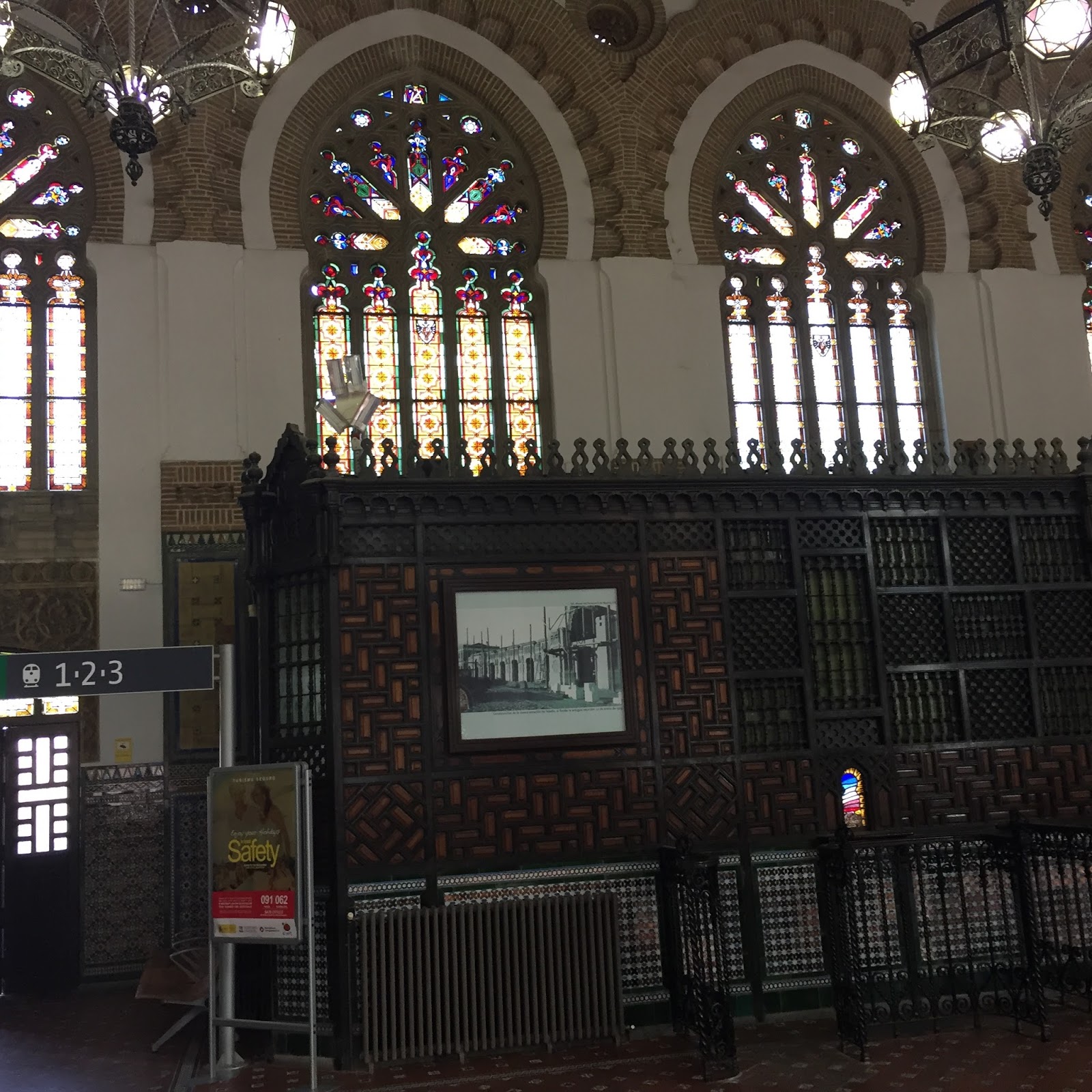
That said, I walked down to the train station, bid the turtles a brief adios, and got on a train that took a bit over an hour to get to Toledo. Again, the scenery was almost nonexistent, but once we got there, it was obvious why a city had grown up there, surrounded as it is by a river. But the first thing I had to do was get out of the train station. That was easy enough, but the station was gorgeous.


Although compared to the rest of the city the station is obviously recent, it deliberately recalls the work of the Mudéjars, Muslims who stayed in Spain after the reconquista, the taking of the former Arab state of al-Andaluz by the Spanish. This, and the vibrant Jewish community the city had supported, was part of what I came to see.

Yawn. Another city on another hill. Taken near the railroad station. 
This time the cab driver took me through the park again, but he had to: Toledo is seriously pedestrianized, and its drivable streets aren't real intuitive. I'd picked my hotel carefully: it was the only one that mentioned that it was in the heart of the old judería, the Jewish neighborhood, which proved to be a smart place to be from a number of viewpoints. For one thing, it was away from the tourist crush. For another thing, signs all over town point to the synagogues, and just a few feet away was the Maria Blanca synagogue, which I hustled off to see. This had been built by the Mudéjars for the local Jews and then, after the Expulsion, had been turned into a church dedicated to the purity of the Virgin by a fanatical priest. Now it's been reclaimed as a historical monument, and the Arab influence is everywhere.

The main sanctuary is marked off by these pillars
 Outside, there's a small building with an art gallery in it, and that's where I headed next. A friend in Austin had told me that a friend of hers sometimes worked there, spoke English, and gave a great tour of the judería if you asked for an appointment. Her name is not Naomi, so that's what I'll call her: tour guides are heavily regulated in Toledo, mostly for good reasons (and there are tons of tourists on tours you'll encounter as you walk the streets). Leading an unlicensed tour can get you a massive fine, so if you're headed to Toledo and want the tour, let me know and I'll let her know. We made an appointment for the next day.

I had the rest of the day to wander around. The medieval city part of Toledo -- the part on the hill -- isn't all that large, and my next stop was the Sephardic Museum, housed in another former synagogue, El Tránsito.

Impossible to photograph the main room, but I tried

Upstairs there was this room with these inscriptions. I later learned that the inscription in the roundel was probably Hebrew, but written in Arabic script! 


The inside of this synagogue reflects the wealth of Samuel Levi, who built it (and was later murdered by the king, Pedro the Cruel, who seized his money) and here again the Arabic influence is everywhere. The museum itself tries a bit too hard, presuming no knowledge of Judaism whatever, which, for Spanish visitors, might be true. It's remarkable, though, that as much of the original decoration and structure remains, and it's worth the couple of Euros it costs to get in just to wander around and gaze.

From here I wandered around a bit, going up the hill and looking for other sites that might fill me in on the city's history. My advice is to be careful: even the city-sanctioned sites can be a ripoff. There was a (non-sanctioned) museum in a former monastery dedicated to the Cathars and other sacred military orders who participated in the Crusades. It's run by a crazy deaf guy who hands you a book of translations of the captions on a bunch of pictures set up in the main part of the museum. Not a single authentic artifact around: it appears to be run by a company that produces ripoff "museums" like this and the inevitable Museum of Torture you find in various European cities. You'd learn more from a magazine article on the Crusades. But the church of El Salvador, which is sanctioned, is just as much of a ripoff. It advertises itself as an archeological site with Visigothic and Arab elements, but you go in and walk into the courtyard and up some stairs and see a bunch of stones with no labelling to tell you what they are. You emerge €2.50 poorer and no wiser.

It was okay: I'd already paid the fake Crusader museum €2.50, and I was learning my way around this part of town. I'd eaten lunch next to a church where Toledo's most famous Christian, El Greco, had a painting (didn't go in: €2.50 saved), and marvelled at the huge number of souvenir shops selling swords (Toledo blades! A sign in the train station warns that you might not be able to take "certain souvenirs" as carryon luggage, and this is what they mean) and knives and lots and lots of bits of damasqueño, gold-inlaid steel, an art brought to the city by Jews from Damascus. I came close to the cathedral, but managed to miss it, and the afternoon was ending, so I headed back to the hotel to start to think about dinner.

A quick search on the web indicated that there wasn't much in the judería (and none of it kosher, not that that was an issue for me), but a restaurant called La Orza looked good. I used TripAdvisor's Fork app to make a reservation and went off at the appointed time. Turned out that Fork had made the reservation for the next night instead, but after a bit of sniffing, they found me a table next to a gaggle of obnoxious Germans who alternated their time between arguing which was the best Kenny G album and berating the waiter over various allergy issues. I alternated between hating them and marvelling that my German came back so quickly. But the food was spectacular: a "carpaccio" of fresh boletus mushrooms studded with some kind of truffle cream and a loin of venison with a not-too-sweet glaze. The wine was just as good: a locally-grown wine called Martúe, which will set you back a whopping €6.80 in the local stores and is a stunning blend of Syrah, Cabernet, Merlot, Tempranillo, and Petit Verdot.

The next day at noon, I met Naomi in front of Maria Blanca, and was treated to a tour of the invisible judería. It's invisible, of course, because of 1492, the year Ferdinand and Isabella, co-rulers of a newly-unified Spain, ordered all the non-Christians out of the country, an order that was enforced by the Vatican's faith police, aka the Inquisition. Convert or leave was the order, and many agreed to convert, at least on the surface. It was the Inquisition's job to prove those conversions by trying those accused of continuing to practice Jewish rituals, a practice known as auto-da-fé. If you got that far, you were probably going to be sentenced to death.

According to Naomi, it's thought that the first Jews on the Iberian Peninsula came with Phoenician traders, and stayed on to form an infrastructure for traders. The Romans also brought Jews, who did business tasks, including banking. (I've always loved the fact that Cologne had Jews before it had Germans: it was a Roman colonial administrative center from which the Germanic tribes were, for obvious reasons, excluded). The conquest of Iberia by the Arabs didn't change much: their Islam had been coexisting with Judaism in northern Africa, and the two cultures' preoccupations -- theology, philosophy, mathematics, astronomy, medicine -- meshed pretty well, although the Jews honed in on medicine and their kabbalistic studies had an impact on astronomy/astrology that helped the Arabs' Mediterranean seafaring become more accurate. Toledo had a whole section of its judería that consisted of nothing but kabbalistic synagogues and midrashes (schools). The reconquista forced the Arabs to convert eventually (although as the tons of Mudéjar work in Toledo shows, not immediately), but since the Jews were sequestered in the judería (both by decree and choice), they stayed on until 1492.

Naomi made an interesting point that I hadn't considered: Christian children were by and large not educated unless they were of the ruling classes. Education was paramount in Arab and Jewish society: madrassas and midrashes (notice the similarity in the terms) provided an education for all children, and in the judería, at least, wealthy Jews subsidized the less well-off. In this way, a bright but poor Jewish kid could ascend the ladder of society, lifting his family with him. No wonder the Christian rabble feared and despised them, and the Jews built walls to control who could get in and out of their community, and when.

As we walked the back streets of the judería, Naomi's x-ray vision saw through walls and floors, illuminating very ordinary-seeming things. The wall behind Maria Blanca, for instance, was oriented towards Jerusalem, and after the Expulsion, conversos, the nominally Catholic former Jews, would touch it surreptitiously. Secret signs pointed to a house with a well in it, essential for fire control in the judería.

This ball is just one of several well signs; once you know about them, you see them everywhere in the júderia.

A set of chains is a secret memorial for a Jewish blacksmith who lived in that house and was ordered to forge them to bind prisoners headed to the auto-da-fé -- many of whom were Jews.


Naomi saw through floors: the cellars of the Jewish houses housed some Jews before they could get out of Spain, and many of them buried their treasures there, confident Spain would let them back in. A house in the former judería, then, became a hot item on the post-Expulsion real estate market: Jews were forbidden to take money or gold out of the country when they left, and everyone just knew there were giant hoards of gold in thoes cellars. And there may have been, but the most recent item to emerge from a cellar was a tattered Torah, displayed in the Sephardic Museum.

Some Jews didn't go far: many conversos settled in the hills outside of Toledo, forming all-Jewish -- excuse me, converso -- communities who, over time, forgot about their heritage, at least a little bit. Naomi's visited some of them, and found a baker in one who made an egg bread on Saturdays that, for some reason, always sold out. Why make it then? Why does it sell out? It's a dimly-remembered challah, made with eggs to keep it moist over the Sabbath, when you can't bake a new loaf. A few Spanish scholars are beginning to look into this, and a trickle of money from Israel is helping out.

Most of Naomi's tour didn't lend itself to photographs: the Jews of Toledo are mostly ghosts by now. Even Naomi isn't Jewish by tradition: her father was a Sephardic Jew, but her mother isn't, and Jewish descent is matrilineal. I'm pretty sure she's officialized her Judaism by now; her passion for the subject shows a deep internalization of an ethos that exists proudly in a small number of Spaniards in the 21st century.

All over the judería, I noticed tiny tiles set into walls and paths.

Sefarad

The name of God

The mysterious menorah
I didn't quite get Naomi's explanation of this, but the top one, when all of them are mapped onto a map of Toledo, forms a map of Sefarad, the Jewish name for the Iberian Peninsula. The city did this project to promote the Jewish heritage of Toledo, but they botched it badly: they placed them on the roadway, under trash baskets, and other inappropriate places: no observant Jew would tread on the name of God, but lots of nonobservant tourists (including me before I heard the explanation) would and did.

I was astonished how much I'd learned in a short time, and Naomi had to get back to work and pick her daughter up from school, so I thanked her profusely and gave her a tip, and wished her luck in her ongoing research into a subject that was actually pretty taboo until just recently. As I wandered off, in search of the El Greco House and lunch (not necessarily in that order) it occurred to me that Toledo's really missing a bet not marketing the judería to American Jewish tourists, but later I realized that American Jews are overwhelmingly Ashkenazi (Eastern European and, according to Naomi, more focused on rules and laws), not Sephardic (more focused on mysticism and science, she said). Before I could muse further, an outdoor cervesería with inviting food hove into view, and I sat. Lunch was a mind-blowing thing called a timbal de codorniz, which Google seems to have as any round, layered cold tapa. Mine had (I think) pickled rabbit and green peas in an aspic and was just what the doctor ordered.

It turned out that the El Greco House was just past the Sephardic Museum, and by this point I figured I had to give the Christians a little something of my time, and if there was a Toledan Christian deserving of it, it would be El Greco, who was, as his name shows, a Greek from Crete who came to Spain after training in Venice. He was sure that with his skills, he could get all kinds of gigs, especially in what was then the capital of Spain. He was wrong: the very things that make people consider him a master today repelled the authorities, and although he kept on painting, he never made as much money as his more conventional contemporaries. His stock was at an all-time low when the Toledan Marquis of Vega Inclán decided to celebrate him by turning El Greco's house into a museum. There were a couple of hitches: the property wasn't actually El Greco's former house (nobody seems to know where it was), and it turned out not many of his paintings were available to buy, since they were in the Prado, the Metropolitan Museum, and elsewhere. The Marquis got what he could, including a full set of portraits of Jesus and the Apostles (there's another set by El Greco, more conventional in style, in, I think, the Cathedral), slapped them into the house, threw in some period furniture, and then discovered that the house had been built over Samuel Levi's house, and its cellar was intact. (Did he find anything there? Who knows? But it's notable that although it's set back from the road, the museum is next door to the Sephardic Museum in the synagogue Levi built: €5 gets you a ticket to both). I was dead tired from walking by now, and just two blocks from my hotel, so I went back and crashed for a while.

When I woke up, I decided to walk to the train station to get my next day's tickets to Valencia. I exited through the Jews' Gate and walked twenty minutes to the station, got my ticket to Madrid and then Valencia (the guy wouldn't book me on the Valencia train that was eight minutes after the Toledo train got in -- gotta love ol' Renfe! -- so I'd have to spend an hour with the turtles), and walked back via the upper old town, where the Alcázar, the huge fort, was, getting there via a very convenient network of escalators, a very civilized way to ascend to that part of town.

Obviously not the Jews' Gate any more...
That night, I ate at the hotel's restaurant, which was actually pretty good. I had partridge, which is the city's signature dish, and I would have enjoyed it more if it weren't the gaspergoo of the avian world: like the Cajun alleged-delicacy, it seems to have thousands of bones.

The next morning I had a bit of time, and went next door to the hotel and wandered through what I could of the church of San Juan de los Reyes, built to commemorate the union of the kingdoms of Aragon and Castille through the marriage of Ferdinand and Isabella. Built on the site of the kaballists' neighborhood, it apparently has chains liberated from the Christian slaves in Arabic Granada when it was liberated, but all that was open was a chapel and the cloisters, which show more Mujédar influence, its origins long lost to those who built it. Or were they?


Soon enough, it was time for a cab to the station. Next up, Valencia, and more Arabs, Jews -- and Romans, too.

'Bye, Toledo


Site Meter