Saturday, July 7, 2012

In Which Not A Whole Lot Happens


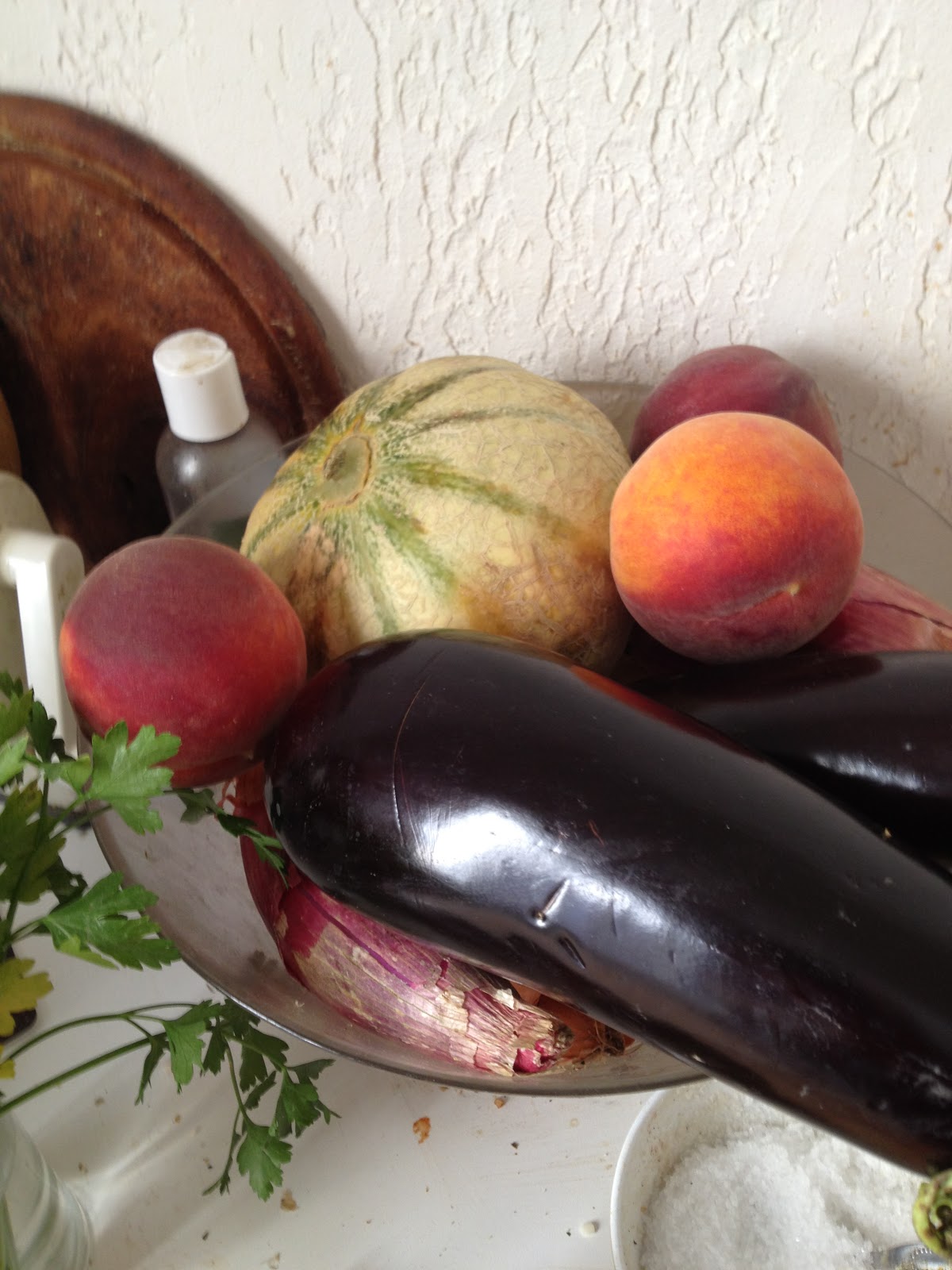
As many of you can tell from the quick grab by my phone-camera here, it's summer. I went to the market today, picked up some stuff, and added it to the stuff that's already here: the red torpedo onion is from making God'spacho earlier in the week. There are yellow and white peaches both, and the first of what promises to be countless melons for breakfast eating. Some parsley, and there you are.

The truth is, I've been absent from this blog for a while, except for the odd recipe, because I seem to have roped a wild bull. I came up with what seemed to be a decent idea for a book, my agent was enthusiastic, I started writing the outline and now the outline is almost as long as a book itself, which means the book itself will be very long. This proposal requires getting up and writing between 1000 and 3000 words every day, staring at huge columns of data and synthesizing it all into a narrative. I told my agent the other day that it'll be finished about the time the last editor in New York goes on vacation. That way it can't sell too quickly and, you know, give me enough money to pay the back rent and maybe move.

Yes, move. One thing this project has driven home to me is that I have to get out of this tiny apartment. There are still boxes unpacked from when I moved in because there's nowhere to unpack them to: a bunch of bookshelves stand, unassembled, gathering dust, in the narrow hallway, on one side of which are my CD shelves, out of order (and maybe with one missing, I've never been sure) and in the dark because I never could figure out how to install the light there. Fortunately, the price of LED flashlights went down enough that I bought one from the bargain housewares display at the supermarket one day, and now when I need a CD from the hall -- or the other batch in the corner behind the stupid pillar that makes a quarter of the office/living room inaccessible -- I can take a light. This is becoming rapidly untenable, and if this book project comes to fruition and I have to import some of my books from storage in Texas, I'm not going to have room to breathe.

I have no quarrel with the neighborhood, really, nor, at last, with my neighbors, of whom I've acquired a few new ones recently. The building across the courtyard is a fairly hideous 19th century pile, which, for some reason, is listed (the plaque calls attention to the beautiful staircase, but you have to take their word for it because you can't just walk in), and in the past week there's been some real action there. Upstairs, the apartment directly across from me seems to be a vacation-rental, since the tenants seem to change by the week. Next door and still upstairs used to be the staid, matronly Alliance Francaise, an organization partly funded by the government to teach French language and culture to foreigners that used to fill up with chubby American kids a couple of times a year, and, in good weather, I'd hear them chanting their lessons. This now appears to belong to a couple with two tween daughters who like to sing, more enthusiastically than accurately, but understandably because the big, empty rooms are great echo chambers. Where the AF has gone I can't tell you, although their plaque is still out front. And downstairs, they've been gutting the apartment next to the violin-makers, and decorating the patio. I snuck a shot yesterday:


These decorative ceramics may or may not adorn the outdoors. There are also numerous plants in pots, which were all added in one day. I can attest that the fertilizer used is from cattle. It was a lovely smell to have in one's house for a day, particularly at dinner. The guy also went and put up a screen over one of the windows in our stairwell, no doubt to keep us from squeezing through the bars and rampaging over his new patio.

But that whole project pales next to the one down the street. As long as I've been here, there's been a huge building, one side of which advertises Citroen cars...


...and around the corner, a hotel once had its entrance.


In recent weeks, a fence has blocked this off, further disrupting what traffic there was on this tiny one-way street, and a demolition crew has gone in. Whether their plan is to demolish the building entirely or gut and renovate it, I can't say, but this all happened fairly quickly. Thing is, you can't tell from these shots, but this is a gigantic building. Back when all its windows were bricked up with cement blocks, you'd be on a neighboring street and see the windows and make the connection. I guess I should check the Google Maps aerial view and see how far it extends. If they take it down, a major part of the block will disappear.


At any rate, the work on the book proposal has eaten up most of my time, leaving me drained and not feeling too bright at the end of it, capable only of cruising the web and reading the newspaper on my iPad. I've walked right past people I know in town without seeng them, forgotten to do things on my to do list, and skipped the last show at the PavPop, of emerging photographic talent, because I forgot it was there. And it's right down the damn street! Oh, but that's not the worst bit. For some reason I was walking down a street just around the corner from my house that doesn't have anything on it I really want to see or shop at except for the Korean place on the corner, and bingo: there was a new laundromat there! No more hauling my clothes long blocks down the rue de Verdun to the skanky laundromat the street bums use! This one's still sort of clean. And it costs just the same. My first thought, of course, was "how long has this been here without my noticing?" I pride myself on being able to note small changes in my immediate environment, so I felt like an idiot.

One brightish bit of news is that someone talked me into applying for Social Security, which I wasn't aware I was old enough for or could get living overseas, but, of course, I am and I can. I applied online and next thing I knew, they sent a letter saying the first payment would kick in sometime next week. This will take some of the economic pressure off, although unfortuntely the payment's not enough to pay the exorbitant rent on the slum here. People who know the rents around here act physically shocked when they learn how much this place costs: it's way above market value, which may explain why the other apartment on my floor, much smaller and less desirable because it fronts on the street, where there's now a very noisy bar, hasn't rented for nearly a year. Who would want to live here?


I've also continued to wonder if I want to stay in France, which is very interesting. Apparently studies of British people who move down here see a decided exodus after the fourth year: a huge number of them move back to England. I can't say I didn't have any expectations, but after 15 years in Germany I wasn't expecting much. But after nearly four years, I have no French friends, no connection to the community, and nothing really making me want to stay. I also have no particular place I want to go, so if nothing else inertia will keep me here, at least a while longer, although the four years will be up in November. We'll see what it's like when the penny-counting phase finally ends with the government checks rolling in every month, when I may again be able to afford a little travel and the occasional bottle of wine and/or restaurant meal.

Meanwhile, I'm doing like the alcoholics do, taking it a day at a time. Wake up, make breakfast, read the news, check the e-mail, and get to work. I do like having daily work to do, even if it takes away from doing this free blog. (The other blog, which actually pays me, has a post up this week about another thing that's been taking up my time, the sword of Damocles hanging over the head of the Well, the online community I've participated in for the past 11 years). This is my daily monastic routine, which I'll miss when this behemoth proposal is out the door and all I have to do is wait and worry until I hear its fate. With luck, it'll sell, and I'll have work laid out for me, and, perhaps, enough dough to make a decision about the future: move elsewhere in Montpellier? In France? Back to the States? At the very least, I hope someone will buy the guitar I have for sale at South Austin Music in Texas soon so I can pay some of this back rent and not get a visit from the police next month. That would be no fun at all.

See? Life in the south of France: it's exactly like life everywhere else, but with better food. And a downside, too, just like everywhere else.

Saturday, June 30, 2012

Eggplant, Semi-Improvised

Good lord, it's not like there's nothing going on around here, but this book project is just taking up all my time and at the end of three hours of putting this proposal together, with all the minute detail-work that entails, and watching it grow to 40,000 words (2/3 of the size of a normal book) and knowing it's just an outline, for heaven's sakes, I really don't feel witty enough to sit down and write an entertaining blog-post about life in Montpellier. Not that I've experienced much of it, since I spend the days sitting here at the desk alternately staring at columns of data and the screen and the courtyard outside, where new tenants appear to be doing heavy renovation. Fortunately, 15 years in Berlin inured me to the sound of construction, but banging and shouting doesn't really make writing any easier.

Fortunately, though, the markets are filling up with great stuff -- I just had some yellow peaches that were so good I can't remember the last time I had any that were so tasty -- and among the things that are coming in are our old friends the solenaceae, that family of New World plants that have made themselves a nice home in southern Europe, and includes tomatoes, peppers, and eggplant. That last one is something people look at and often wonder what to do with, and I'm no exception. I've already covered ratatouille, that local favorite, when I got a bunch of beautiful ivory-colored eggplants and made White Rat. But there's another recipe I've been playing around with, and it came from a guy who uses the handle almanac on the Well, the amazing online community that may or may not just have gotten killed yesterday by its owner, Salon. (I'll have more on that, probably, on my other blog on Wednesday).

Anyway, this guy posted a recipe a year or so ago and I've been messing with it ever since, and, as you'll see, have aspects as yet un-messed-with. But last week I was at the market, saw some actual real live non-greenhouse-looking eggplants, the season's first, and said aha! Time to make Penne al'Almanache! Yes, it's sort of a distant relative of pasta alla Norma, but it's got a couple of things that make it different. Anyway, here'w what you need to make it:


Actually, not all of this counts, but you've got, sort of going clockwise, the eggplants, not the parsley, but the plant next to it which is the Provençal small-leaf basil (although you can use the more common kind -- I just had this lying around), Balsamic vinegar, canned tomatoes, garlic, onion, oregano, and salt.

Now, I'm of two minds about salting and sweating eggplant. A lot of varieties don't need it, and it's hard to tell unless you know just what variety you have on hand whether you need to do this or not. What it does is pull out some bitterness from the eggplant, although I have yet to get any eggplant I considered too bitter. I decided to do it here so I could illustrate it for you. You cut the eggplant into cubes, throw it in a colander, sprinkle it with salt, and toss it, then add a little more salt. Then you let it sit for an hour.


An hour later:


Big deal, huh? Now, I've done this and come away with nice puddles down there, so I figure that was a variety that really needed to be salted. This one, well, that's an hour that didn't need to happen. So I now washed the eggplant to dissolve all the salt on it and then put it in a dishcloth and wrung out the water.


Again, I've had eggplants just drip brown water, but in this case, nothing much. Anyway, I've had the oven on to 400º F/200ºC and so now I take the squeezed cubes, put them in a metal bowl with some olive oil, toss them well, and stick them on a baking sheet. Forty minutes later, the eggplant's ready to rock.


Back it goes into the bowl.

Okay, now it's time to make the sauce. Heat some olive oil, and toss in some very thinly-sliced onions. Stir them around until they get soft and somewhat yellow, then add four cloves of well-minced garlic, and stir-fry that until it's fragrant. Then (aha! A trick!) add some oregano, rubbing it in with your hand, and stir it quickly in the oil. This will make the oregano flavor deeper, as it extracts some of the flavorful oil from the dried herb.


Then hit the mixture with a healthy splash of Balsamic...


...and add your canned tomatoes (plus about 1/4 can or a bit more of water, if your canned tomatoes are as dense as mine are) and basil...


...stir it all together well, lower the heat and cook for an hour. Taste it for salt at the end: enough salt usually escapes the rinsing that you don't need to add any, but this time a tiny bit more actually was necessary.


Not a quick sauce at all, especially if you count the salting and baking of the eggplant. But worth it? Damn right.


This time I just did the regular throw some Parmesan on it and eat it thing. But there's another way I have yet to explore, which is to get some mozzarella and mix that in the hot pasta and sauce mixture and let it melt. The shredded mozzarella you can get in the States to make pizza out of is, oddly enough, better for this than the fresh mozz we get here, although if you can remember to get that up to room temperature and cut it in small pieces, that'll work, too. (It also helps to drain it on paper towels to get the water content down so you don't sog the sauce out too much).

So there we go. You can envy me access to these great eggplants (and the two kilos of what Americans call "heirloom" tomatoes and we just call tomates that I just brought home from a tomato fair near my house run by the amazing Eric le Tomatologue) and I'll envy you a place to live that's big enough that you don't have to eat a foot and a half away from the cooling oven you roasted the eggplants in. But, once again, this didn't cost much, and it's yet another wonderful addition to the Broke-Not-Poor repertoire.

Now I'm beginning to mess around with sardines, raisins, pine nuts, and lemons, so stay tuned. And yes, I really will give you an update as to what's going on around here before too very long, I hope!

Wednesday, June 20, 2012

Midsummer Miette

No, I haven't disappeared. I've been involved in mounting a huge project -- on spec, of course -- which means that I've been waking up, having breakfast, and then sitting down to write for two or three hours each day. There's no end in sight yet, although it will, trust me, end. Then I'll pack it all together, send it to my agent, and hope this time I've got an idea he can sell.

Along the way, there's been very little paying work, a lot of hungry evenings, and hardly any leaving the house. Not good, that not leaving the house. But, if this thing's ever going to get done, necessary. And writing 2000 words a day can wear you out.

Where I sit, though, I get to hear what's going on outside. Not just upstairs, where, now that the windows are open, Madame Merde can be heard in full cry, as can her kids, also crying when they're not making other noise. The oldest has taken to throwing stuff out the window, resulting in two broken windows in the apartments across the way and a lot of toys scattered in the courtyard where they're collected by the kids of the violin-makers. As for the baby, I'm wondering if her second word (she already says "Maman") will be merde, dépêche, or arrête, all repeated endlessly each day.

So without leaving the house, I got to hear Montpellier take the Champions' League title, which, if I'm not mistaken, means they represent France in the international competition. The roaring and the post-game noise was astounding. There's something about football songs, anyway, that unnerves me. Americans don't sing. (Imagine, for a second, what the Dallas Cowboys song would be). The first time I heard a football song, I was walking back to my hotel in Brussels and a tavern I passed was in full roar. Visions of Nazis came to my psyche. Then I realized I was in Brussels, for heaven's sake. There could hardly have been a safer place at that point in history. And then I heard them in Germany.

The next weekend was the Pride Parade, now known as the Diversity Parade, formerly known as the Gay and Lesbian Pride Parade (in English!). I have no idea why the name was changed, other than now it can be called Parade de Diversité and safely back in French, although I understand it's not just about gender identification any more. At any rate, I was dreading that, but the Big Event was evidently not on the Place de la Comédie this year, so hurray, no bad disco music.

But nights have been getting loud as the students drink and yell, the windows have been open, it's been getting warmer outside, and a sign of summer appeared the other day.


The geckos are back. Actually, unless they do that skin-color-changing thing that anoles do, there were two on this particular afternoon. One was running up the pipe, and when my computer printer turned on, it scampered off. Later, this one, much lighter, appeared and hung out.

I'm not sure what happened next, because it got dark and I was elsewhere, but that evening, I turned on the light in the bathroom and a large waterbug ran and hid. Last year, I had maybe two geckos in the house. (I say "maybe" because who can tell them apart?) One was in the office here, and the other I saw darting around the plumbing by the toilet. Both windows are open a lot, so there are lots of chances for dinner to fly in for an enterprising gecko. They're supposed to be good luck. Exactly what I need.

Friday, June 8, 2012

Peas Be With You

Oh, don't worry: I thought for a long while before posting that as the title. So many bad puns, so little time. But actually, it's the "so little time" that impelled me to post this today. Around here, fresh green pea season is almost over, and, although some people don't get it, this is one of my favorite vegetables and I'm always looking for new things to do with the short season when perfect peas are in the market. Thing is, frozen peas are almost as good, and a lot of the recipes I see mandate using them instead. But the gap between "almost" and "fresh" is just big enough that I celebrate pea season.

So this year, I did some paglio e fiena ("hay and straw," where you're supposed to use equal portions of red and green pasta to support a cream sauce with shallots and peas and ham and Parmesan) and a superb mattar paneer (peas with pan-fried Indian cheese), and...I still had some left over. So when I stumbled on this recipe, I told myself a) it couldn't be that good and b) it was so simple and cheap I still had to try it. Well, one out of two isn't bad, so the third time I made it I grabbed the camera, knowing that it's still pea season in parts of the U.S., and if it's not you can use frozen. Not as good, I don't think, but I may well try this later in the year.

Anyway, here's what you need to make it.


Clockwise from the peas, we have the peas (well-thawed and with as much water as possible removed if you're using frozen), some parsley, pepper, olive oil, tuna in olive oil, and butter. The potatoes in the bowl to the rear aren't part of this.

You start by heating some olive oil, and then melting an equal amount of butter in it.


Then you add your peas.


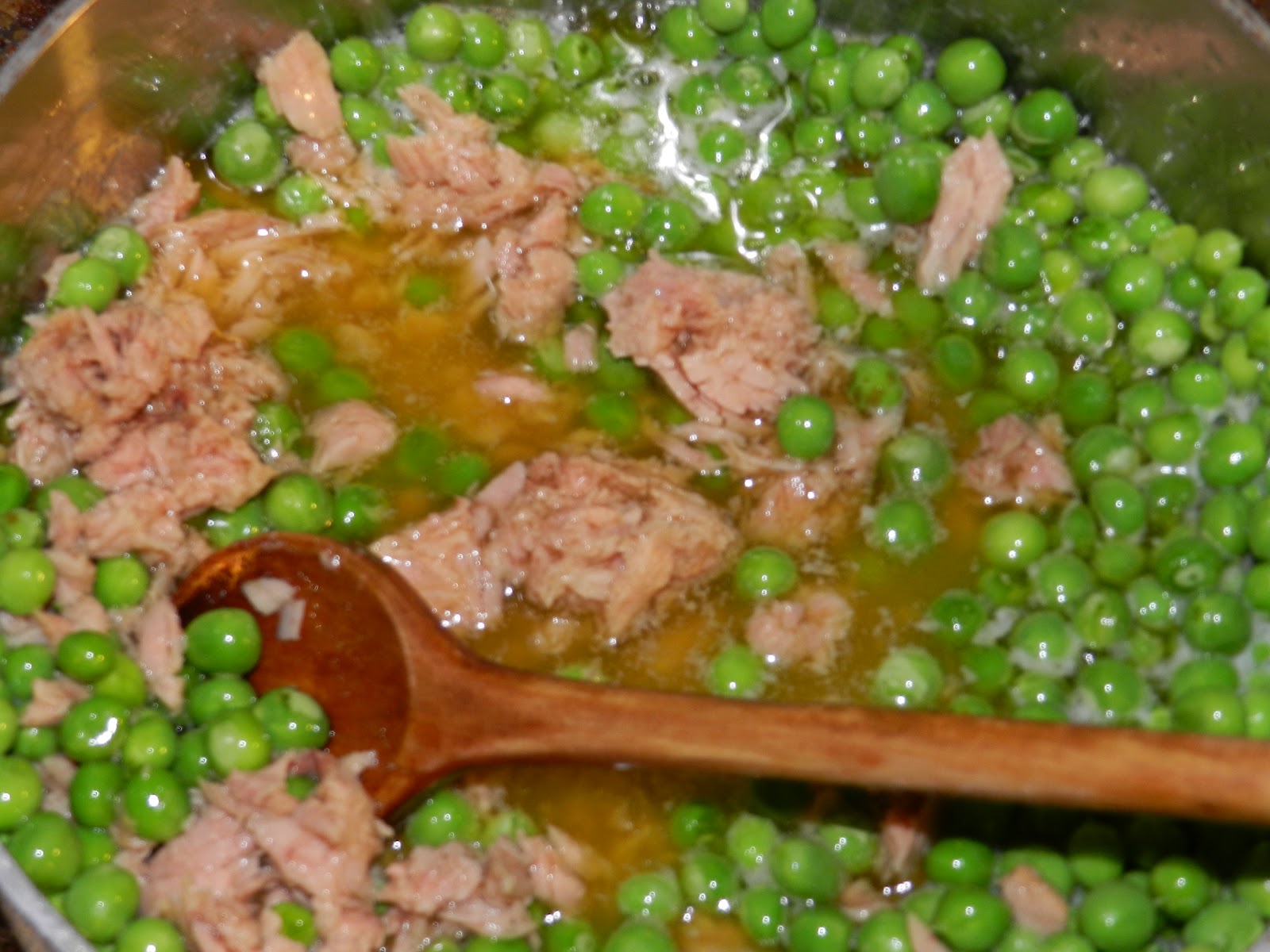
Lower the heat and cover, so they partially sauté, partially steam. This will take a couple of minutes, no more. If in doubt, eat one to judge the texture.

Next, add the tuna. Break it up if you need to.


You should, by the way, have your pasta water boiling right about now. You should use a broad, flat pasta, like fettuccine or what I used, tagilatelle.

Anyway, when the sauce is cooked and the tuna's warm, throw in another couple of tablespoons of butter, some parsley and a little pepper...


...stir it around, add your pasta and stir it again, and there you are. I told you it was simple! It had just never occurred to me that this is a kind of deconstruction of that bane of my childhood, tuna-noodle casserole, stripped down to the good parts.

Oh, and no cheese: there's tuna in there, remember.


And if the evening's warm enough, a nice rosé goes real well with this. A Languedoc, of course!

Monday, June 4, 2012

History On My Doorstep

A couple of months ago, a guy came into the (now-departed) English Corner Shop and announced he was leaving town. He'd been a regular customer, and was saying good-bye. "Yeah, they've covered up the dig and now the tram-line's going in." As it developed, he was an urban archaeologist from England who'd been part of the team excavating by the Babotte before the tram dug the area up. "We found a lot of information about where the roads had previously been," he told me, "and some information about what went on in the neighborhood there, such as what kinds of trades had been practiced and so on. No sexy artifacts, I'm afraid, but the town's learned a lot about its history, which is what they pay us for."

At that point, I remembered that there was a "parc archéologique" on the other side of town from the Corner Shop, and, although I'd walked through it a few times, I'd never stopped to figure out just what had been excavated, although I knew that the tram-station excavations for the Corum stop in 1999 had unearthed it all. So today, realizing that I was missing the historical journeys with E and J while E's leg healed (he was getting muscle cramps which made it difficult to drive), there was a hunk of local history just down the street that I could easily take a look at.

Actually, there was a lot of stuff. The most important to the history of the town itself was the Porte du Pila St. Gely, built between the 14th and 15th centuries, which was one of the most important gates to what was then a walled city.


This is a reconstruction, but you can see the wooden drawbridge. The roads from Nimes converged nearby, and this was the checkpoint you had to pass to get into the city. The gate itself had two paths, one for wide vehicles like carts, the other for pedestrians, which you can sort of see here.


I was actually trying to get the foundation there, but that's the wide track over across from the narrow track, where I was shooting from.

Here it is from the other side, once you're in.


That's the Corum, the opera-house/convention center in the background.

And, once you were in, you could rest at the Hospital of the Holy Spirit, established by Gui de Montpellier in the 12th century.


Gui (1168-1208) was probably the brother of the local ruler, Guilhem VIII (1156-1202), whose palace stood near where the Palais de Justice is now, over by the Peyroux. Gui, for his part, wasn't ever going to be the big cheese, so, as younger brothers did in those days, he became a monk and founded the Order of the Holy Spirit, and went to Rome to lobby for its recognition by the Vatican. He succeeded, and this hospital was an important stop on the pilgrimage to Compostella in Spain. Like all the hospitals along that route, it had a medical function, of course, but was also a place of rest, and the brothers of the Holy Spirit presumably could take care of spiritual matters for you. It was one of several in town, but the only one which has a bit of it surviving: above shows the rough outline of its chapel, another thing the tram excavations uncovered.

Outside the city walls was where the dangerous stuff took place. Montpellier was famous for its pottery for a long time, and in fact there's an exhibition dealing with that at both the Musée Fabre and the museum down at Lattera at the moment, for those who are interested -- and you can now get to the latter by tram. Excavation for the tram came up with the foundations of four pottery kilns, and they're right at the foot of the stairs leading from the Esplanade.


That's three of 'em; not sure where the other one is. On display behind filthy windows on the handicapped elevator's shaft are some pieces of local pottery. They didn't photograph too well, but this one's an excellent example:


Across the tracks is something I'd looked at forever without realizing that it was more than a neat illusion. Here it is from the Esplanade.


And from across the street.


It's a piece by an artist named Betka Siruckova called "The Carnival of the Animals," and as such is a nice play on words: it stands at the entrance to the Beaux Arts neighborhood, so called because it's where the École des Beaux Arts is. But it wasn't always called that: this was the slaughterhouse district, and Siruckova's paying homage to the various kinds of animals slaughtered there as well as punning on the word "carnival," which comes from the Latin carne vale, "farewell to meat," which is what the carnivals of the days before Lent are all about. At any rate, it must have been a good place for the slaughterhouses, because the stream called the Verdanson passes in front of this building, and it was easy enough to build sewers in the middle of the street and let the offal and blood drain into it.

There's surprisingly little history here organized as well as this particular little spot, and a lot of it needs interpretation that the locals aren't providing. Just the other day, a reader made a wonderful comment on an old post I totally blew (read the comments and you'll see what I mean, although I do want to thank Olivier for his diplomacy!) which alerted me to the fact that the medical school here was largely run by Protestants, something I'm going to have to chase down now.

Not that I don't want to get out in the countryside and clamber around looking for Romans and ruined monasteries and all, but sometimes this stuff really is right in your back yard.

Saturday, May 26, 2012

Confessions of a Clam Smuggler

If you're a friend of mine in the U.S. and have come to visit in the nearly 20 years I've been living in Europe, you've heard the request when you tell me you're coming. There are just some groceries you can't get here, and, although things have improved, I still make requests. Cornmeal, for instance. It's not that there isn't corn in Europe, but it's just the wrong grind. We have a very fine one which Turks (and, I think, others) use to make a gruel, and a coarser one which is sold as polenta. The one I want for cornbread falls right in the middle. So a bag of cornmeal, preferably Lamb's, is welcome. When strawberries are in season, as they are now, I used to ask for some Grape Nuts, but these days I have a good supply rescued from the English Corner Shop's closing. Their price, too, was a big change from that shop in Amsterdam where all the homesick American, British, and German expats go, where I used to buy Grape Nuts for a whopping €7 a box. Another old favorite, Zip-Loc bags, has also fallen off the list, since whoever owns it has licensed that technology to several European companies, and I can now buy them at the corner supermarket.

But that leaves an old favorite: canned clams. As far back as I can remember I've loved spaghetti and clam sauce. I used to buy cans of Progresso white clam sauce as soon as I started cooking for myself. Eventually, though, I realized that it was stupid to pay that much for something I could likely make better myself, and when the first edition of Marcella Hazan's Classic Italian Cooking (which you can buy from the Amazon gadget over on the right, along with many other great cookbooks, of which I get a tiny percentage of the purchase price) came my way, I found what I was looking for. She noted in the introduction to the recipe that it had two things that you never find in Italian fish recipes, butter and Parmesan, but the recipe would suffer without them. I whipped some up. It rocked. I had other pasta-and-clam recipes, including one that I found in the New York Times where the sauce and the pasta were finished up by encasing them in foil and baking them, which I sure wish I had today, but this one quickly became my favorite.

Then something odd happened. Hazan combined the two volumes of Classic Italian Cooking into one volume, called Essentials of Classic Italian Cooking, and...the recipe vanished. Another one took its place, and it wasn't nearly as good. Fortunately, I had the old one memorized by then, and it remains my go-to recipe today. When, that is, I can get clams. Which I can't.

But, but, you say, you live practically on the Mediterranean! And yes, I can get those little clams, which are sweet and delicious and I know the old trick of scattering them around a pan and covering it until they open and there's a broth there and scooping them out and preserving the broth and making the clam sauce that way. And I've eaten in Italian restaurants where the "sauce" is a heaping handful of those clams in the shell mixed in with the pasta, which has to be one of the most annoying things it's possible to eat, because you have to fish around for the clams and stick the shells somewhere and meanwhile everything else is getting cold. But surely, you say, there are clams available in a jar or something. And yes, or at least there were in Berlin, where the Italian grocery store had them. They cost about €6 a jar, and there was almost no broth. They were commendably salty, but expensive. And I haven't seen them at all here in France.

Thus, I ask visitors to bring them. I loaded three cans into my luggage in Brooklyn in early April. They are, alas, gone now. And I say alas because of a sad fact about spaghetti with clam sauce in my life: it's become the ultimate broke-not-poor food. When the food starts running out and the check is far away, or, worse, there is no check on the horizon, there's almost always a can of clams stuck away. The first can of this last batch went when there was still plenty of food around, but I hadn't had this dish in so long I wasn't going to wait. It was good. The other two, though, succumbed to the usual protocol, the last one about a week ago as things got really touch and go. And now there are none. Surely one of you has heard the siren song of the Languedoc and is planning to drop by this summer...

But for those of you in the U.S. (or anywhere else you have access to this to-me exotic foodstuff), you probably wonder about Marcella's Forbidden Clam Sauce recipe. Fine: as part of our ongoing Broke-Not-Poor Cuisine series, I present it to you now.

* * *

Here's what you need to gather together to make this: 


There's parsley, white wine (sauvignon blanc), olive oil, shallots, red chile peppers (optional, but more photogenic for our purposes here) and one can of clams. Not shown is the Parmesan, which is still in the fridge, or the garlic, for some reason. 

The first thing you do is chop the shallots and saute them in olive oil. Yes, you can (and I have) use yellow onions, although they're not as good. You cannot (I discovered one day) use red onions and have this taste very good. (I ate it anyhow, of course, because it was what was for dinner). 


When they've gotten transparent, add the garlic and stir it around the oil briefly. Then you add some wine. How much? Enough to float the bits of sauteed stuff off the bottom of the pan; maybe a bit more. At this point, you also add the chile peppers and a couple of tablespoons of chopped parsley. 


Don't turn down the heat. Let this come to a slow boil and boil it for a few minutes, until the wine's reduced by at least half. Then add the juice from the can of clams. 


Let this boil, too. The wine and the clam tastes are blending, as you'll smell. You should start your spaghetti (actually, linguini by preference and tradition) at this point so it'll be ready when the sauce is. After it all boils down, it's nice and concentrated. Then add the clams and let them heat up.


Now, take it off the heat, and take a hunk of butter and a whisk and whisk it in to emulsify the sauce. 


And you can figure out the drill from here: drain your cooked pasta, and mix it with the sauce and some Parmesan, top with more Parmesan, and dig in. 


Dang, that's making me hungry just looking at it. Fortunately, I have a little food in the house now, thanks to a small check, and so I'll be photographing another recipe tonight. Tomorrow will feature the weirdest thing I got from the English Corner Shop's demise: a turkey, which I'll be sharing with E, since his wife J, who's vegetarian, is out of town. And that should leave me with some leftovers to make turkey enchiladas with. 

Oh, yeah, that's another thing I smuggle from the States and request from visitors from Texas: corn tortillas. But that's another thing entirely. 

And, better-nourished than I've been for a week, I'll bang away at yet another book proposal. I'll beat this broke-not-poor thing yet!

Thursday, May 17, 2012

Massive May Miettes

Ah, the surprises just keep on coming: I woke up this morning and realized that it's Ascension Day, the holiday that, in almost 20 years of living in Europe, always catches me by surprise. Maybe it's because after Easter in the States, we figure that, with Jesus dead at Easter, we're finished until Christmas. Or maybe it's because they don't celebrate Lincoln's Birthday over here. The other thing is, in the States, obsessed as we are with work, we round off the holidays, so that the day off always falls on a Monday. Here, if a holiday falls on a Tuesday or a Thursday, the Monday or Friday affected by it is called a pont, a bridge. It essentially means a four-day weekend.

We had one a couple of weeks ago, and since this time I knew in advance it was coming, I was ready with the camera and headed off to the extensive war memorial which lies behind the Pavillon Populaire.


These complex floral offerings are laid with much pomp every year on May 8, V-E Day. It's an indication of how distracted I am these days that I actually wondered for a minute why I'd never been aware of this holiday before moving to France. Oh, wait. Maybe because I was living in...Germany?

And shortly before this, someone went through the city to the plaques honoring resistance fighters who'd lived in a building or, in some cases, been shot dead on the spot, and hung bouquets from them. A visitor noted that in these days of European unity, the plaques in Paris have been rewritten to say "shot by the enemy," but I noticed that's not the case here: "les allemands" take a lot of blame, both for killing people in the streets, and for deporting them to camps and killing them there. There's a memorial with ashes from the camps right next to the war memorial, too.


But after this comes Ascension Day, and what that essentially means is that summer has started, even though it's not all that warm yet and nobody's taking vacations for a while. But the first affordable cherries were in the market on Tuesday, melons will be right behind them, and one hears that the grape vines have got delicate shoots on them which, if the wind doesn't snap them off, will soon be strong enough to support clusters of fruit.

*  *  *

Speaking of which, I've been meaning to mention a couple of wine atrocities I've seen reently. There's a local company that's putting out a rosé-grapefruit juice blend, which they're selling at one of the serious wine shops here in town, and that's intriguing, although not intriguing enough to spend money on. But a friend on Facebook recently posted a photo of a can of wine (not that that's necessarily bad for your run-of-the-mill wine) whose label proclaimed it "genuine French wine -- with melon flavor!" Even that's not the worst idea I've seen this year. That has to go to Chocovine, which I discovered in a HEB in Texas. Described as "Rich Dutch chocolate and fine red wine," it looks like a chocolate version of the barium milkshake you drink for X-rays and probably tastes almost as good. Theoretically, I can see the wine and chocolate thing. But not in the same bottle. 

*  *  *

I was walking on the Esplanade the other day when I realized I was hearing an unfamiliar sound. Turning around, I noticed that the fountains were working. They get turned off in the winter, of course, to keep the pipes from freezing and breaking, but recently, we've had a pretty serious drought, and the city passed a rule that no fountains that don't recirculate their water are allowed to operate until the drought is over. We had some rain not long ago -- and a lot more is forecast for this weekend -- so maybe they loosened up. There didn't seem to be the usual exuberant display, though, so I guess the drought's not over. That is, however, one of the things I like about living here: there are tons of fountains here, the most famous of which is the Three Graces out on the Comédie, but there are lots more tucked away here and there around town. That, apparently, is what the great fake Pont du Gard aqueduct, the Arceaux, and the big temple-like water-tower in the Peyroux park are for: to bring water and distribute it to the fountains around town. But what most interested me was discovering that I'd only noticed the lack of the sound when I unexpectedly heard it again. 

* * * 

Generally, I ignore the art that gets shown at the church in Ste. Anne. It's a real nice space, but the committee which decides what gets shown there usually chooses one of the many state-supported artists of the region and splashes big stuff by them around the former sanctuary. It's maybe not as bad as what I've seen in Sète at the CRAC, but it's produced by artists at a lower level than show there. But I'd been seeing a poster for the current show around town, which I'd noticed because of its stunning ugliness. 


The Eye and the Heart, the poster announces, is an exhibition of "curiosities and masterpeices from the collections of Montpellierians," and since I was looking for something to blog about after the W. Eugene Smith show at the Pav Pop, I figured it'd be good for ten minutes and a laugh. I was wrong. 

We've apparently got some serious art collectors here. Constrained either by money or availablility, the more adventurous ones have gone into some really unexpected places. For security reasons, I guess, the collectors aren't identified, although there are hints. For the first time, access to the space is tightly controlled: you have to take a little plastic chip when you come in the door and surrender it on your way out. I have no idea how this makes the artworks more secure, but you don't say no to the heavies who are hanging all around this show. Grab a booklet, too: you'll need it to decode the jammed rooms. 

The first works you're likely to see aren't very impressive: a wall of distinctly second-rate works entitled "Modernity," by artists like Kees van Dongen, Francis Picabia, Jean Arp, and Wifredo Lam, apparently all from the same collection. Then a couple of large works against one wall that are more like magazine illustrations, and a text piece by the impenetrable Sophie Calle, a breakup letter sent by e-mail, written in English by the unidentified sender, and annotated with framed footnotes in French by the artist, who is shown in a photograph above the texts, impeccably dressed, reading a single sheet of paper in some elegant surrounding. Annoying. 

But the next thing I happened on cheered me up a lot, disgusting as it was. A pair of paintings by the Congolese painter Chéri Samba, which I can only describe as highly politicized surrealism with a healthy touch of traditional African sign-painting technique. His "Amoureux Chatie" ("Chastized Lovers") is a disturbing scene with a bunch of things happening at once. In one corner, a naked woman is ripping the clothes off of another woman and commenting that at last she's found her rival. The main part is a man with his pants pulled down, being grabbed by the hair by a young woman, held by a young man, while an older man takes a hand-drill to his bleeding rectum. There are cartoon-like balloons coming from everybody in English, French, and Lingala, and in another corner, a well-dressed man comments that what's happening is horrible and if he were a soldier he'd arrest them all, but, unfortunately, he's only the artist. The other painting is more obvious: a grotesquely fat Zairian guy is being examined by a white doctor and commenting that it's the duty of anybody in the country who becomes wealthy to also become very fat. 

These two paintings flank a doorway which leads to a small room in which we see the library of Doctor P., which is decorated with an amazing and impeccably-displayed mixture of ancient and modern art, much of it Peruvian, although there are also pieces by Robert Crumb and Enki Bilal and a wonderful Dutch artist, Pat Andrea, whose creepy "new subjectivity" paintings I'd never run across before, but will now keep an eye open for. (There's a large painting of his in the same room, but not part of the good doctor's collection). Then, outside the room, there are more Congolese paintings, this time by Moke, an artist who lived in a large market in Kinshasa, and set his realistic and surrealistic paintings there. Being simpler and less dependent on text than Chéri Samba's work, these are even weirder and more exciting. The large "Marché des Oignons" has enough enigmatic story in it to keep you busy staring at it for some time, and the bizarre inhabitants of "La Ninja sur la Route" sticking their tongues out at each other must mean something or other, but I wasn't able to figure it out. These are some of the most exciting paintings I've seen in some time, and I'm rather amazed that the several exhibitions of contemporary African painting I saw in Berlin didn't have either of these artists in them -- and even more amazed to find out that Chéri Samba's dealer was a gallery I used to walk past daily in that city! 

Next up is a really bizarre room, "The Cabinet of François." Here, 100 works (if you count the two wooden African statues flanking the door) by all manner of people are crammed onto the walls -- at least where the sink and toilet aren't. Only two people at a time are allowed in here, and I never got all the way in. In part, I didn't want to, both because of the huge confusion of all the stuff on the walls and the fact that, on the other side of the rope, a rather fat man, not in a security uniform, was sitting in a chair, just staring. Was this François? Did I want to go into his bathroom while he was there? He wasn't talking to anyone, nor did he seem to be inviting conversation. The stuff on the walls includes a piece of American folk art by one Roy Finster, who seems to be connected somehow to the late Rev. Howard Finster, and there's other folk art from Africa and Mexico, along with French comics and fine artists. Overwhelming and disturbing, with that guy sitting there. 

There's lots more, too. The center of the sanctuary is given over to some very large African pieces, most from one community in the Ivory Coast, but also one huge mask/hat from the Dogon people of Mali. There are several skateboards with pinups on them by one Madelaine Berkhemer, and a small collection of photos, including a large nude study by J. M. Engström which is oddly riveting, although the trick (and it's a good one) is that only the woman's face is in focus. 

L'oeil et la Coeur is the best group show I've seen since I've lived down here, and it's good for a couple of hours. I left wondering if the Musée Fabre would ever put together a collection of contemporary central African art from Collector B. and Collector D.'s collection and other French collectors' holdings. But they're not that daring, I don't think, so I'll have to go back to this one before it leaves on June 11. Just remember to hand in your chip at the exit: these security guys look even meaner than the guards at the Fabre -- and that's saying something. 

L'oeil et le Coeur, Carré Sainte-Anne, 2, rue Philippy, 34000 Montpellier. Open every day except Monday, 11am-1pm and 2pm-7pm. Entrance free. 

 
Site Meter