Showing posts with label History. Show all posts

Wednesday, October 19, 2016

Valencia: Catastrophe In Paradise

The coating of hucksterism that comes with tourism is annoying, albeit in my case, in a selfish way. I'd have preferred to stroll the streets of Toledo making discoveries on my own and with Naomi as a guide to the unseeable, but that's simply not possible. It is possible, of course, that less-concentrated doses of what I was seeing could be found in the countryside, in villages and smaller cities. But the purpose of this trip was just to dip my toe into Spain and see what I might want to see again. In Toledo, I'd missed many of the churches, the Alcazár, and more. In Madrid, I obviously need to visit the Prado again, filtering out the stuff I'm not interested in, and return to the Reina Sofia when I'm more in the mood for the artistic revolution of the early 20th century.

So I was good and ready to re-enter Toledo's magnificent train station and head into the wild unknown. Not, of course, totally unknown: I'd been in the province of Valencia before, in January, 2011, to do an interview at a rock festival in Castellón, and, since it was my first trip to Spain, I stayed an extra day to wander around, which I certainly did. In some ways, Castellón was kind of rinky-dink, a small provincial city, and in other ways it was fascinating. I bet myself that the provincial capital, Valencia, would be better, so I added it to this trip because, I saw, it also had a bunch of the history I was trying to figure out.

It took a while to get there, changing in Madrid and being welcomed by the turtles, then getting on another train which started out in that dull, flat, brown terrain but, as we approached the Mediterranean, sprouted some lovely mountains, rivers, and lakes. Then came the industrial outskirts of a city and bang, we were in Valencia. I liked what I saw from the cab as we sped to the hotel, and I definitely liked the hotel.

What's not to like?
The Hotel Caro was to be my splurge on this trip, and boy did I make the right choice. You want archeology? We got archeology: the building was the former residence of one Marquis de Caro, and in gutting it to put the hotel in, they found all kinds of stuff. Eating breakfast in the restaurant, there were weathered stones on either side of the passage into another room. Most of the relics are captioned, and this just happened to be the gate in the wall of the Arab city. In my hotel. (Breakfast was excellent, and not even the party of 10 screaming Dutch tourists could ruin it. It had all the usual breads and cold cuts and cheeses one gets in Spain with some unusual stuff, of which my favorite was a two-inch pickle sliced in half and filled with that excellent Spanish tuna, a dish that became problematic when it was time to eat it: the pickle was hard, and the tuna squished out when any pressure was applied to the pickle. Tasted good, though. But sloppy.)

And by "the Arab city," I'm invoking Valencia's history. It was settled when the Romans found it, I guess by Iberio-Celts. The Romans made quick work of them and established a trading outpost, Balancia, with Jews helping manage the trade. The city was destroyed in 75 BC by Pompey during the Roman Civil War, and the city, remote as it was from the eastern Mediterranean, where the action was, remained empty (or mostly so) until somewhere between 5 BC and 5 AD, when Visigoths stumbled upon it: a mostly-built port right on the Mediterranean! Cool! They had a huge party, and at the end of it threw all the leftovers and crockery down a dry well, for which archaeologists thank them. Next came the Moors, who stayed for centuries, although El Cid's army recaptured it between 1094 and 1101, only to be driven out again. In 1238, Christian Spaniards conquered it, and have held on to it ever since.

It was mid-afternoon when I arrived, so I went for a walk to see where I was. The hotel was tucked away on a quiet back street, but it was easy enough to find (one great thing about Roman-built cities: the roads are built to a grid, and it's pretty easy to find your way around, at least if you have New York in your head), so I felt free to ramble. And I did, camera in hand.

No idea. A block from the hotel. 

The Cathedral has an octagonal spire. Thanks, Arabs!

Serrano gate and towers

The Basilica at the end of a street
Like Barcelona, Valencia is home to some of the coolest street art in the world. This guy is omnipresent.

"In the kingdom of the blind," which I didn't know was a quote from Erasmus (and maybe isn't: don't believe everything you read in the street!).

The bullet holes in the Quart towers made me nostalgic for my old neighborhood in Berlin when I first got there, before they erased the evidence of the battle. These were inflicted in, I believe, 1833, when the French wanted in. 
Here he is again, a particularly nice one. I shot many more.

And am I right that this is a Banksy?
As I reached the end of my walk, I suddenly realized that I'd circumnavigated the old town, and was just a block or two from my hotel. I was also bushed: it was still summer here (as it was in the rest of Spain, actually), so I retreated to the hotel room after getting dinner suggestions from the always-helpful front desk. I was told there was a tapas joint just down the street, and I got a couple of other suggestions, which I researched as I relaxed.

Still tired as dinnertime approached, I walked to the tapas place, although I actually wanted a full meal. But I forgot that there are tapas places and tapas places. I ordered the "three queens" (marinated white anchovies, regular anchovies, and sardines: incredible), a plate of grilled vegetables with romesco sauce (the waitress warned me it was very big, and it was) and one of their tostas, a big slice of grilled bread with a topping; in this case three local sausages. To go with it, I noticed some local beers, one of which, XIII Hombres, called itself an "American IPA." Not only was it, but it was absolutely amazing. I had another.

The next day I arose lazily, took my time showering, and turned on my iPad to see what the e-mail had brought. And what it had brought was very bad news, indeed: I had asked a nearby friend to check the house every now and then because although I'd held my mail, UPS and FedEx don't do holds, so there was a possibility of a package on the front step. The friend had been called away by a death in his family and was in Buffalo, and he'd delegated the porch watch to another guy. This guy had shown up and seen water pouring out from under the front door, photographed it, and sent it to Buffalo, where it got forwarded to me in Valencia. I immediately sent it to my landlord, who went over to see what was happening, and what was happening was horrible: the toilet near my office had blown a gasket, and was shooting water out at a quick pace. It had flooded the entire house to a depth of 1 ½ inches, and caused ceilings to fall in and floorboards to warp. Anything that was on the floor, which included CD boxes and the entire inventory I'd had for sale at my Amazon store, was soaked. The closet opposite the toilet contained all my t-shirts, meaning what I had with me was all that I knew were wearable.

As I thought about it, I realized that there was nothing I could do. I didn't have renters insurance because I'd been almost dead broke when I'd moved back to the US, and then I'd just never thought of it. The damage was most likely done in the first couple of hours, as the paper fibers soaked up the flood. Even if I'd been in Austin, I might have been elsewhere when it happened. It was done. I didn't know just how badly, but it was done. I had another night paid for in my hotel, a couple more in Tarragona, and a last one in Barcelona, so I might as well finish the trip. Dealing with it would have to wait until I got back. I made a note to find a hotel in Austin, and then did what any rational human being would do when such a spiritual crisis hit: after breakfast, I went back to the room and prepared to go to church.

The dome of the Mercado Central
Valencia's Mercado Central, the central market, is one of the largest in Spain. Unlike the ones in France it doesn't open in the early morning and shut at 2; it opens at 9 and stays open until the early evening.  There are over 1000 vendors, most of whom seemed to be out in full force on the day I went. And there was an amazing variety of stuff.

Pimentón is what we call paprika, and the Spanish take it very seriously as an important ingredient in their cooking. The heat levels aren't particularly scary, but the deftness with which a good cook adds it to a dish is. 

Does anyone know how you're supposed to eat these little crablets I saw all over Spain (but not on menus)?

Live eels, swimming vigorously. 

I hear those red shrimp are incredible. I'll find out how incredible next time. 

Tiny eggplants of some sort. No idea what to do with them. 

Beans and more beans
Believe it or not, this is a pretty mediocre selection of olives and pickles for Spain, and the only reason I shot this is they were so compactly displayed. 
Fresh cheeses. You have to know what basket-imprint means what variety of cheese: they mature in wicker baskets that leave the impression of their weave on each piece. 

I bought some ham and lomo (cured pork loin) and a bunch of spicy chorizo (a cold-cut, not like the Mexican kind we get in Texas) from a nice lady at the Francés stand, and some equally sealed-in-plastic olives from a stand called Oiled & Salt (it's legal to bring the meats in if they're sealed), and headed back to the hotel to drop them off.

Believe it or not, after that long trek through the Mercado, I wasn't hungry: I'd indulged myself at breakfast on purpose. And, just a block from the hotel was a promising-looking archeological museum, so I headed over there. It turned out to be a continuation of the stuff found under my hotel: mostly Roman remains, a whole lot of the feast pottery from the Visigoths, and the remains of a small Visigothic chapel, which is thought to be where the city's first saint (whose name I didn't write down) was martyred. L'Almoina, as this center's called, is a modern building built over a 20-year dig, illuminated by a glass ceiling looking down on it all from the plaza outside. It's got ruins of the crossorads of the two main streets of the Roman city, the Arab fort, and various tombs. It's also got technical problems, making many of the explanatory videos either distorted or just plain not working, and when I was there there was a crew of filmmakers blocking access to a lot of stuff and shooing the few visitors away.

One thing I'd loved in Castellón, unexpectedly, was the art museum's entire floor of Valencian ceramics. This art came to this part of the world with the Arabs, and I fell in love with the primitive designs. I wanted to see if I could score a piece -- reproductions are still being made in the traditional designs -- so I also wanted to see what the Museum of Ceramics had to offer. This is in one of the most over-the-top houses I've ever seen, evidence that in the 18th and 19th centuries, the Spanish nobility had waaaay too much money.

It was kind of hard to shoot, but you get the idea

The interior is ghastly, too, and the museum personnel distinctly unfriendly, a novelty for Spain. But, over in one room, they had some of the plates I'd admired:


 The other major piece of folk art there is a Spanish tiled kitchen.


But there was nothing for sale, either there or in the surrounding neighborhood, that I could see. I was somewhat less enthusiastic about buying a piece, too, when I reflected that I didn't know where I'd be living and I didn't really want to lug it around with me back in Austin.

So I decided to check out the municipal art museum, and realized when I crossed the river that I was actually slightly hungry, so after a nice dish of fried calamari and a beer in the adjoining restaurant, I went into the museum itself and saw some wild medieval altarpieces and even wilder baroque ones and some more ecclesiastical art (Spanish depictions of Christ tend to center on the Easter story, with him getting whipped, crucified, pierced by the lance, wearing the crown of thorns, and being taken off the cross, and he bleeds like an overripe tomato: the blood gushes in torrents), a couple of nice Goyas, and a lot of people in uniforms staring at me. I was touristed out: hotel time again.

Dinner, later, was at the same tapas bar with the same huge portions and a couple of beers from the XIII Hombres brewery that were a bit gentler. I remember a tremendous gazpacho, a seafood salad, and...something else. (The tapas bar, incidentally, is called Bar Almudin after the street it's on, and the huge Arab building across the narrow street, al-Mudin, and Bar Almudin has been there since 1932). I realized that there was some anxiety humming in the background, and tried to sort it out. Some of it was the usual "the vacation is ending" stuff, and there was also the certainty that I had no idea what was going to happen next, once I got back. I'd taxied to the railroad station in the afternoon and had my ticket for tomorrow's trip. I'd go to Tarragona, but I really wanted to stay in Valencia. I had a feeling I hadn't even scratched the surface and that there was much yet to discover and enjoy. But the vacation was, in fact, ending, and I was being propelled into the future, like it or not.

15th century tiles in my room in the Caro

Tuesday, October 18, 2016

Surrounded By Jews -- ¿In Spain?

Next stop Toledo. If I could manage it, that is: the brave concierge at my hotel spent 2 ½ hours negotiating the Renfe website trying to get a ticket, and the best he could do was to get a confirmation number for me to show the ticket agent. To be honest, if the cabbie hadn't taken me through the park, I would have known how close the station really was and done it in person, but we agreed it was an educational experience and he might be asked to do it again.

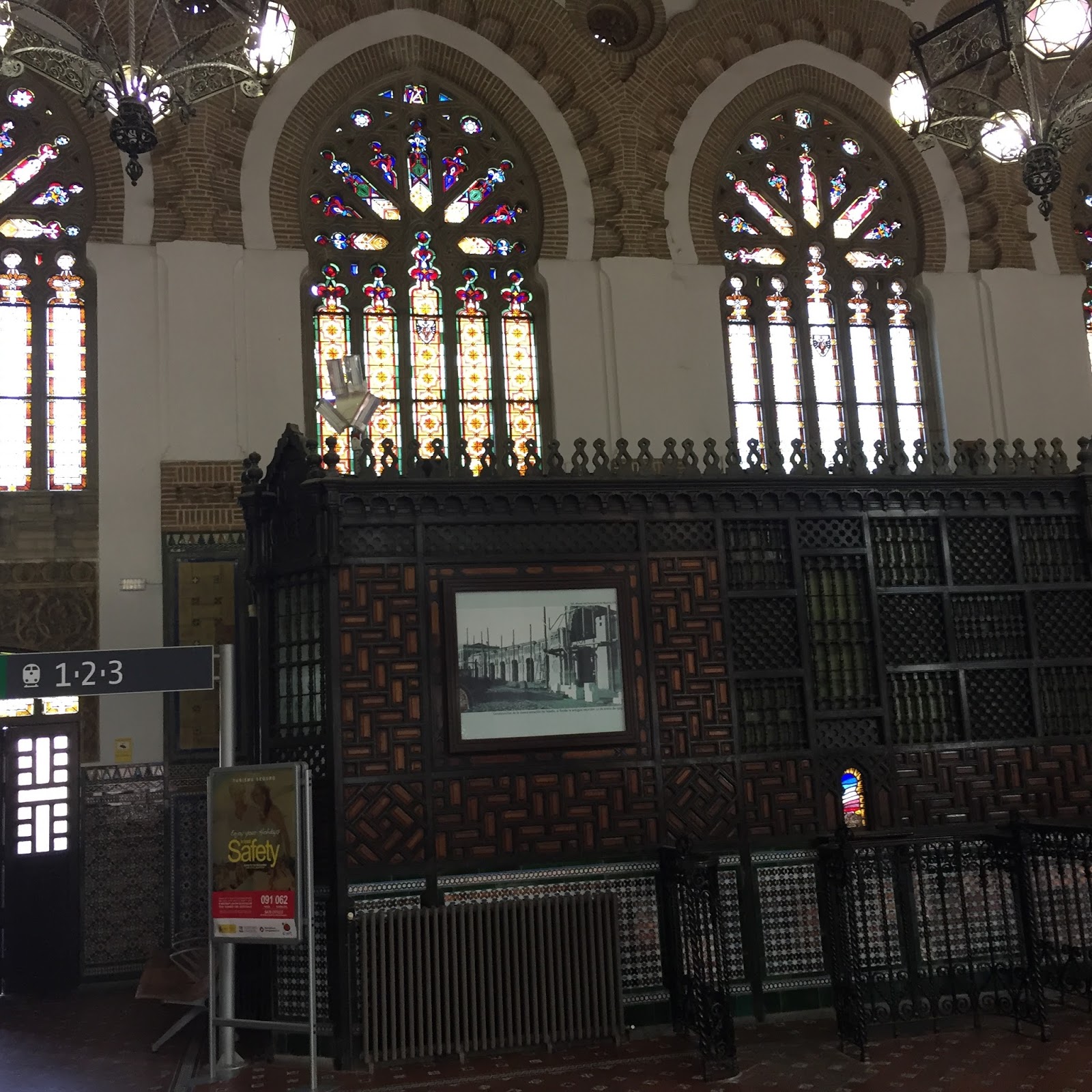
That said, I walked down to the train station, bid the turtles a brief adios, and got on a train that took a bit over an hour to get to Toledo. Again, the scenery was almost nonexistent, but once we got there, it was obvious why a city had grown up there, surrounded as it is by a river. But the first thing I had to do was get out of the train station. That was easy enough, but the station was gorgeous.


Although compared to the rest of the city the station is obviously recent, it deliberately recalls the work of the Mudéjars, Muslims who stayed in Spain after the reconquista, the taking of the former Arab state of al-Andaluz by the Spanish. This, and the vibrant Jewish community the city had supported, was part of what I came to see.

Yawn. Another city on another hill. Taken near the railroad station. 
This time the cab driver took me through the park again, but he had to: Toledo is seriously pedestrianized, and its drivable streets aren't real intuitive. I'd picked my hotel carefully: it was the only one that mentioned that it was in the heart of the old judería, the Jewish neighborhood, which proved to be a smart place to be from a number of viewpoints. For one thing, it was away from the tourist crush. For another thing, signs all over town point to the synagogues, and just a few feet away was the Maria Blanca synagogue, which I hustled off to see. This had been built by the Mudéjars for the local Jews and then, after the Expulsion, had been turned into a church dedicated to the purity of the Virgin by a fanatical priest. Now it's been reclaimed as a historical monument, and the Arab influence is everywhere.

The main sanctuary is marked off by these pillars
 Outside, there's a small building with an art gallery in it, and that's where I headed next. A friend in Austin had told me that a friend of hers sometimes worked there, spoke English, and gave a great tour of the judería if you asked for an appointment. Her name is not Naomi, so that's what I'll call her: tour guides are heavily regulated in Toledo, mostly for good reasons (and there are tons of tourists on tours you'll encounter as you walk the streets). Leading an unlicensed tour can get you a massive fine, so if you're headed to Toledo and want the tour, let me know and I'll let her know. We made an appointment for the next day.

I had the rest of the day to wander around. The medieval city part of Toledo -- the part on the hill -- isn't all that large, and my next stop was the Sephardic Museum, housed in another former synagogue, El Tránsito.

Impossible to photograph the main room, but I tried

Upstairs there was this room with these inscriptions. I later learned that the inscription in the roundel was probably Hebrew, but written in Arabic script! 


The inside of this synagogue reflects the wealth of Samuel Levi, who built it (and was later murdered by the king, Pedro the Cruel, who seized his money) and here again the Arabic influence is everywhere. The museum itself tries a bit too hard, presuming no knowledge of Judaism whatever, which, for Spanish visitors, might be true. It's remarkable, though, that as much of the original decoration and structure remains, and it's worth the couple of Euros it costs to get in just to wander around and gaze.

From here I wandered around a bit, going up the hill and looking for other sites that might fill me in on the city's history. My advice is to be careful: even the city-sanctioned sites can be a ripoff. There was a (non-sanctioned) museum in a former monastery dedicated to the Cathars and other sacred military orders who participated in the Crusades. It's run by a crazy deaf guy who hands you a book of translations of the captions on a bunch of pictures set up in the main part of the museum. Not a single authentic artifact around: it appears to be run by a company that produces ripoff "museums" like this and the inevitable Museum of Torture you find in various European cities. You'd learn more from a magazine article on the Crusades. But the church of El Salvador, which is sanctioned, is just as much of a ripoff. It advertises itself as an archeological site with Visigothic and Arab elements, but you go in and walk into the courtyard and up some stairs and see a bunch of stones with no labelling to tell you what they are. You emerge €2.50 poorer and no wiser.

It was okay: I'd already paid the fake Crusader museum €2.50, and I was learning my way around this part of town. I'd eaten lunch next to a church where Toledo's most famous Christian, El Greco, had a painting (didn't go in: €2.50 saved), and marvelled at the huge number of souvenir shops selling swords (Toledo blades! A sign in the train station warns that you might not be able to take "certain souvenirs" as carryon luggage, and this is what they mean) and knives and lots and lots of bits of damasqueño, gold-inlaid steel, an art brought to the city by Jews from Damascus. I came close to the cathedral, but managed to miss it, and the afternoon was ending, so I headed back to the hotel to start to think about dinner.

A quick search on the web indicated that there wasn't much in the judería (and none of it kosher, not that that was an issue for me), but a restaurant called La Orza looked good. I used TripAdvisor's Fork app to make a reservation and went off at the appointed time. Turned out that Fork had made the reservation for the next night instead, but after a bit of sniffing, they found me a table next to a gaggle of obnoxious Germans who alternated their time between arguing which was the best Kenny G album and berating the waiter over various allergy issues. I alternated between hating them and marvelling that my German came back so quickly. But the food was spectacular: a "carpaccio" of fresh boletus mushrooms studded with some kind of truffle cream and a loin of venison with a not-too-sweet glaze. The wine was just as good: a locally-grown wine called Martúe, which will set you back a whopping €6.80 in the local stores and is a stunning blend of Syrah, Cabernet, Merlot, Tempranillo, and Petit Verdot.

The next day at noon, I met Naomi in front of Maria Blanca, and was treated to a tour of the invisible judería. It's invisible, of course, because of 1492, the year Ferdinand and Isabella, co-rulers of a newly-unified Spain, ordered all the non-Christians out of the country, an order that was enforced by the Vatican's faith police, aka the Inquisition. Convert or leave was the order, and many agreed to convert, at least on the surface. It was the Inquisition's job to prove those conversions by trying those accused of continuing to practice Jewish rituals, a practice known as auto-da-fé. If you got that far, you were probably going to be sentenced to death.

According to Naomi, it's thought that the first Jews on the Iberian Peninsula came with Phoenician traders, and stayed on to form an infrastructure for traders. The Romans also brought Jews, who did business tasks, including banking. (I've always loved the fact that Cologne had Jews before it had Germans: it was a Roman colonial administrative center from which the Germanic tribes were, for obvious reasons, excluded). The conquest of Iberia by the Arabs didn't change much: their Islam had been coexisting with Judaism in northern Africa, and the two cultures' preoccupations -- theology, philosophy, mathematics, astronomy, medicine -- meshed pretty well, although the Jews honed in on medicine and their kabbalistic studies had an impact on astronomy/astrology that helped the Arabs' Mediterranean seafaring become more accurate. Toledo had a whole section of its judería that consisted of nothing but kabbalistic synagogues and midrashes (schools). The reconquista forced the Arabs to convert eventually (although as the tons of Mudéjar work in Toledo shows, not immediately), but since the Jews were sequestered in the judería (both by decree and choice), they stayed on until 1492.

Naomi made an interesting point that I hadn't considered: Christian children were by and large not educated unless they were of the ruling classes. Education was paramount in Arab and Jewish society: madrassas and midrashes (notice the similarity in the terms) provided an education for all children, and in the judería, at least, wealthy Jews subsidized the less well-off. In this way, a bright but poor Jewish kid could ascend the ladder of society, lifting his family with him. No wonder the Christian rabble feared and despised them, and the Jews built walls to control who could get in and out of their community, and when.

As we walked the back streets of the judería, Naomi's x-ray vision saw through walls and floors, illuminating very ordinary-seeming things. The wall behind Maria Blanca, for instance, was oriented towards Jerusalem, and after the Expulsion, conversos, the nominally Catholic former Jews, would touch it surreptitiously. Secret signs pointed to a house with a well in it, essential for fire control in the judería.

This ball is just one of several well signs; once you know about them, you see them everywhere in the júderia.

A set of chains is a secret memorial for a Jewish blacksmith who lived in that house and was ordered to forge them to bind prisoners headed to the auto-da-fé -- many of whom were Jews.


Naomi saw through floors: the cellars of the Jewish houses housed some Jews before they could get out of Spain, and many of them buried their treasures there, confident Spain would let them back in. A house in the former judería, then, became a hot item on the post-Expulsion real estate market: Jews were forbidden to take money or gold out of the country when they left, and everyone just knew there were giant hoards of gold in thoes cellars. And there may have been, but the most recent item to emerge from a cellar was a tattered Torah, displayed in the Sephardic Museum.

Some Jews didn't go far: many conversos settled in the hills outside of Toledo, forming all-Jewish -- excuse me, converso -- communities who, over time, forgot about their heritage, at least a little bit. Naomi's visited some of them, and found a baker in one who made an egg bread on Saturdays that, for some reason, always sold out. Why make it then? Why does it sell out? It's a dimly-remembered challah, made with eggs to keep it moist over the Sabbath, when you can't bake a new loaf. A few Spanish scholars are beginning to look into this, and a trickle of money from Israel is helping out.

Most of Naomi's tour didn't lend itself to photographs: the Jews of Toledo are mostly ghosts by now. Even Naomi isn't Jewish by tradition: her father was a Sephardic Jew, but her mother isn't, and Jewish descent is matrilineal. I'm pretty sure she's officialized her Judaism by now; her passion for the subject shows a deep internalization of an ethos that exists proudly in a small number of Spaniards in the 21st century.

All over the judería, I noticed tiny tiles set into walls and paths.

Sefarad

The name of God

The mysterious menorah
I didn't quite get Naomi's explanation of this, but the top one, when all of them are mapped onto a map of Toledo, forms a map of Sefarad, the Jewish name for the Iberian Peninsula. The city did this project to promote the Jewish heritage of Toledo, but they botched it badly: they placed them on the roadway, under trash baskets, and other inappropriate places: no observant Jew would tread on the name of God, but lots of nonobservant tourists (including me before I heard the explanation) would and did.

I was astonished how much I'd learned in a short time, and Naomi had to get back to work and pick her daughter up from school, so I thanked her profusely and gave her a tip, and wished her luck in her ongoing research into a subject that was actually pretty taboo until just recently. As I wandered off, in search of the El Greco House and lunch (not necessarily in that order) it occurred to me that Toledo's really missing a bet not marketing the judería to American Jewish tourists, but later I realized that American Jews are overwhelmingly Ashkenazi (Eastern European and, according to Naomi, more focused on rules and laws), not Sephardic (more focused on mysticism and science, she said). Before I could muse further, an outdoor cervesería with inviting food hove into view, and I sat. Lunch was a mind-blowing thing called a timbal de codorniz, which Google seems to have as any round, layered cold tapa. Mine had (I think) pickled rabbit and green peas in an aspic and was just what the doctor ordered.

It turned out that the El Greco House was just past the Sephardic Museum, and by this point I figured I had to give the Christians a little something of my time, and if there was a Toledan Christian deserving of it, it would be El Greco, who was, as his name shows, a Greek from Crete who came to Spain after training in Venice. He was sure that with his skills, he could get all kinds of gigs, especially in what was then the capital of Spain. He was wrong: the very things that make people consider him a master today repelled the authorities, and although he kept on painting, he never made as much money as his more conventional contemporaries. His stock was at an all-time low when the Toledan Marquis of Vega Inclán decided to celebrate him by turning El Greco's house into a museum. There were a couple of hitches: the property wasn't actually El Greco's former house (nobody seems to know where it was), and it turned out not many of his paintings were available to buy, since they were in the Prado, the Metropolitan Museum, and elsewhere. The Marquis got what he could, including a full set of portraits of Jesus and the Apostles (there's another set by El Greco, more conventional in style, in, I think, the Cathedral), slapped them into the house, threw in some period furniture, and then discovered that the house had been built over Samuel Levi's house, and its cellar was intact. (Did he find anything there? Who knows? But it's notable that although it's set back from the road, the museum is next door to the Sephardic Museum in the synagogue Levi built: €5 gets you a ticket to both). I was dead tired from walking by now, and just two blocks from my hotel, so I went back and crashed for a while.

When I woke up, I decided to walk to the train station to get my next day's tickets to Valencia. I exited through the Jews' Gate and walked twenty minutes to the station, got my ticket to Madrid and then Valencia (the guy wouldn't book me on the Valencia train that was eight minutes after the Toledo train got in -- gotta love ol' Renfe! -- so I'd have to spend an hour with the turtles), and walked back via the upper old town, where the Alcázar, the huge fort, was, getting there via a very convenient network of escalators, a very civilized way to ascend to that part of town.

Obviously not the Jews' Gate any more...
That night, I ate at the hotel's restaurant, which was actually pretty good. I had partridge, which is the city's signature dish, and I would have enjoyed it more if it weren't the gaspergoo of the avian world: like the Cajun alleged-delicacy, it seems to have thousands of bones.

The next morning I had a bit of time, and went next door to the hotel and wandered through what I could of the church of San Juan de los Reyes, built to commemorate the union of the kingdoms of Aragon and Castille through the marriage of Ferdinand and Isabella. Built on the site of the kaballists' neighborhood, it apparently has chains liberated from the Christian slaves in Arabic Granada when it was liberated, but all that was open was a chapel and the cloisters, which show more Mujédar influence, its origins long lost to those who built it. Or were they?


Soon enough, it was time for a cab to the station. Next up, Valencia, and more Arabs, Jews -- and Romans, too.

'Bye, Toledo


Sunday, September 25, 2016

It's Almost Time...


In a couple of days, I'm going to disappear to rest up between the promotion of my Michael Bloomfield book, which I've been doing for the past month, and the -- much bigger -- promotion for this, my first physical book under my own name in 33 years.

A lot of people have asked me where they can pre-order it, so here's the skinny on that. First, though, some explanation. At this moment (ie, as I write this, on September 25), the pre-orders won't get you a discount. I seem to remember Amazon telling me that a book I'd pre-ordered from them might drop in price, and since I wasn't going to be charged until the book shipped, the amount I paid would reflect the price on the day it was shipped. You may or may not get a deal like this. You will if you wait, most likely.

What I vastly prefer for you to do is to patronize your local independent bookstore, because giants like Amazon threaten their existence. Indies tend to know their local communities and select the books they sell accordingly. An alarming number of them are literal mom-and-pop stores, family businesses. They mean a lot to your community, and any writers who may live in your community.

If you want an inscribed copy of the book, you're going to have to see me in person. I really, really, don't want to drive to the post office to mail one off to you, and no, I don't get hundreds of free copies  when the book comes out. You can get inscribed -- or merely signed -- copies ("inscribed" means my writing "To Joe: I promise I'll pay you that $10 one of these days" or something; "signed" means just my signature) at my November 6th appearance at the Texas Book Festival here in Austin or at the release party at Book People on November 19th. Book People will also have signed books for sale after that, and they'll be available via mail order.

I also hope that there will be a modest book tour, although publishers no longer do them as a matter of course. I'd like to do a West Coast tour via Amtrak -- San Diego, Los Angeles, San Francisco/Berkeley, Portland, Seattle -- and an East Coast one of Washington DC, Philadelphia, New York, and Boston/Cambridge. The only way this'll happen is if people in those cities ask for an appearance at a bookstore, and the bookstore contacts the publisher. So if you get to work, that might work out.

Meanwhile, for those of you who need to do this on-line, here are links to the pre-order sites:

Amazon
Barnes & Noble
Books-A-Million
IndieBound
and Book People in Austin.

I've written the pitch for Vol. 2 (1964-2000), and my agent will be arm-wrestling the publisher while I'm away. I'm hot to get started on that one, which will be pretty controversial and just as much fun to read as this one is.

And if you're just tempted to get only one, remember that Christmas is just around the corner!

Sunday, July 10, 2016

On Returning, Part...Uh...

Lord, it's been a while since I touched this thing. I have to keep reminding myself it's not just a travel diary, but, then, what else has been of interest recently? I've been contemplating using my new camera to keep a log of the critters that have been in and out of the house, but I'm waiting for a moment when there's a critical mass of critter-to-photo data. Anyway, the summer's only just settled in. I'm sure there'll be more.

As for the rest, I'm mainly just hanging around waiting for the books to come out. Not a lot to write about there. I'm reading, doing very little writing, taking the opportunity to grab DVDs from Netflix while they're still trafficking in physical media, and, well, that's about it.

But it was that last bit that inspired me to write something today. A friend recommended a film, suspecting that I might have a reaction to it. Since none of the things I actually want to see on my Netflix queue are coming very quickly, this one got delivered last week and I watched it last night.


Having been elsewhere during his ascent as a filmmaker (although I think I got screwed by Mother Jones under his leadership), I'd never seen this one, but the premise intrigued me: Moore visits ("invades") a bunch of mostly-European countries, "stealing" good ideas to take back home as the spoils of his invasion. Thus, we learn about why Finland's educational system rates as the highest in the world, how workers in Italy get so much time off but still manage to be productive and competitive with other economies, why the French take school lunches and sex education so seriously, and so on. So I watched it, and fired off this e-mail to the guy who suggested I watch it. I've edited it somewhat, but this is mostly first-draft, top-of-the-head stuff.

* * *

On your recommendation, I checked out that Michael Moore film last night. Knew most of it, of course. Some random comments. 
 
As you might expect, I looked for counter-arguments and/or hidden nuances behind the rosy pictures he presented. Here are a few of them. 

FRANCE: Despite the nutritional benefits of those school cafeterias, he tiptoed around the big issue, which is that they also have to accommodate Jewish and Muslim students by observing dietary laws. The good news is, Kashruth and Hallal are almost identical. The bad news is, nativist right-wingers are using this as a wedge: several schools in more right-wing parts of the country have refused to stop serving pork. This became a major issue in Denmark, actually, where the Right is blooming like the Occupation never happened. 

ITALY: Yeah, that lifestyle looks good, but a lot of Italians don't pay the taxes that support it and it's a good question how much longer they'll be able to keep going unless some serious enforcement among the titans of industry takes place. On the other hand, Berlusconi is obviously dying, and I would imagine his type of "legit" "businessman" (ie, non-mafia) is also becoming a thing of the past, since there's no postwar economy to build up and make obscene profits from these days. 

GERMANY: Yes, they're hyper-vigilant about any possibility that fascism will return. So much so that neighbors like Austria and Denmark worry about the effect on free speech and the foreigner-in-the-street wonders why the few undeniably positive things that can be said about German culture and history are so rarely mentioned. In fact, that's one of the things that made life there finally unbearable for me. Well, that and the food and the weather. But the fact that they've hidden the remains of the Old Synagogue in Berlin always spoke volumes to me: starting in the 18th century, it spawned a revolution in Jewish thinking, leading to a renaissance in German intellectual life, German business, and, not coincidentally, the birth of Reform Judaism. But not a peep about that on site, and Libeskind's much-vaunted Jewish Museum, like much contemporary German thinking, continues to present Jews as victims. 

(I'm having zero luck finding the photos that went along with this blog post and hope they're still recoverable, and the post makes far less sense without them, but whaddya gonna do?)

NORWAY, FINLAND & SLOVENIA: One thing missing here is the lives the ordinary people live, and the spaces in which they live them. Mile after mile of postwar identi-housing, very small living quarters, dreary public spaces. Of course, some of this is inherent in the physical properties of the countries themselves. My guess is that prison in Norway isn't quite as cheerful in February as it was when Moore and his crew visited, and yes, the old town of Ljubljana sure is pretty but I'd guess that a ten-minute walk in any direction from the central square puts you smack in the middle of a bunch of Tito-era kleenex-box buildings. And it's nice that the Finns enforce equality the way they do, but it's a very small population they're dealing with, so micro-solutions work. 

TUNISIA: Moore's surprise ending may well present an over-optimistic view of the situation here, the one country in the film that I don't have as much first- or second-hand knowledge as I'd need to comment with any authority. The reactionary Islamist forces aren't as benign as the old man with bad teeth who comments here, especially the ones operating out of the country's neighbors like Algeria and Morocco. My optimism is a bit more guarded than what's on display here. 

The film seems to naively suggest that these solutions -- made, as several Europeans note, out of American ideas (Thomas Dewey, among others, I imagine) -- could work if applied here. The problem with that is that they *are* in fact American ideas, and they've been tried and discarded here. Not always for good or even desirable reasons, or with enough of a trial period to make a reasonable assessment of their viability or worth, but there is definitely a large, well-funded, powerful opposition to them. Barring a catastrophe, our grandchildren will die of old age before even modest progress will be made along those lines. In other words, I continue to believe that this country is doomed. Self-doomed, at that. 

As I am not the first to mention, Moore is a very clever polemicist and propagandist. It's just that it feels nice to be in the choir being preached to. For a change. 

Moore does not look well. He's gargantuan, and it's all fat. Expect we'll be losing him soon.

* * *

If you think the above touches on my ongoing deep ambivalence about my repatriation to the US, well, you don't win a prize. For a long time after my last blog post, way back there in April after returning from France and Spain, I struggled to make clear an idea that had formed during the trip, and finally it came to me. I had returned from a civil society to a highly uncivil one. This goes way beyond the events of this past week here, the various cop shootings and shootings of cops, or the candidacy of the most manifestly unsuited candidate for President in American history. For me the annoyances are far more granular: the way people drive, the astounding amount of self-absorption, the refusal to give an inch in compromise, even when all that's gained is getting to the red light faster. I try not to let it get to me, and I fail a lot. I got too used to something different, and it's not that I'm having trouble adjusting, it's that I resolutely don't want to adjust. 

I'm pretty sure by the time we figure that all out it'll be way too late. As for me, I have two books coming up that I have to promote, as well as another one to plan and, I hope, write. So for now, I have to stay where I am, get out when I can, and put one foot in front of the other. Live like the alcoholics, as I always tell people, one day at a time. And plan my escapes wisely: I may well be house sitting in Jersey City and then go to Montreal next month, and I'm planning a trip to Spain at the end of September and the beginning of October. Then back to taking it as it comes. Which is okay, given that I'm living somewhere I don't particularly like. But hell, I've done that before, and at least I'm pretty capable of expressing myself in its native language. 

Sunday, April 17, 2016

Not about to trust to fate, I got a fairly early start on Sunday, with a plan to see some of the ruined castles of Cathar country. Again, this was a part of the world I'd never seen, and I had no idea what to expect. But then, expecting nothing usually brings the information to you cleanly.

It was much easier to get out of the Center of the World than it had been getting back into it, and Sunday was much sunnier and brighter than Saturday had been, which meant that the huge mountain one can see so clearly from Perpignan hung in front of me as I drove out, its massiveness still about ¾ covered with snow, which gleamed against the blue sky. Of course, I got lost almost immediately, which is to say I somehow missed a turnoff to the route I'd written down -- hardly "lost," since it's pretty easy to find your way despite the occasional deviation from the route if you're equipped with a trusty Michelin yellow map (#344, Aude, Pyrénées-Orientales in this case) and the navigation system of a Peugeot 2008, which, although I couldn't program it, showed the names and locations of towns. You could just say okay, I'll aim for there, and I'll know where I am on the map.

Plus, the distances weren't as great as they looked on the relatively large-scale map. Somehow, I had headed southwest instead of northwest, and my job was to find the large D117 road. Heading north sent me through some hills on one-lane roads through tiny villages. In one of them, a band dressed in traditional clothing was waiting for everyone to show up, at which point they'd head into the village for a fair or something. Others snoozed Sunday away; the streets were pretty much deserted.

After what seemed like hours, I found the highway and had overshot my destination, a town called Maury, by so much that I had to backtrack, but after missing a turn in Maury and getting stuck in a tiny side-street which took all my driving skills to do a 180º turn, I saw the signs to my destination, Chateau Quéribus. This isn't the most famous of the Cathar castles, but it's probably the most dramatic.

Yes, you do have to walk up there
Calling it a "Cathar castle" is a bit inaccurate. The Cathars were a Gnostic sect, a spinoff of the Catholic Church who believed that people could know God directly, and had no need of priests or saints to intercede for them. In France, they were the first small-p protestants, protesting against the siphoning off of money and resources to Rome, and with a message that resonated with rural communities in the hills and mountains. This, of course, pissed Rome off -- not to mention the French crown, which depended on military and financial support from Rome, and the Inquisition was let loose to rid the country of the scourge of these people, a crusade against the so-called Albigensian Heresy of Catharism. Since Cathars lived semi-communally, entire communities were threatened by the Vatican's thugs, and many people fled to places whose fortifications and remote locations protected them. Chateau Quéribus was one of them: built sometime around 1000 CE, and 728 meters (2388.5 feet) above sea level on the highest peak for miles around, it was intended as a border defense against Spain, but its commander was sympathetic to the Cathars and in about 1244, it gave shelter to a bunch of them, including important clergymen. The castle protected them until 1255, at which point Inquisition forces under French command defeated the knight Chabert de Barbaira, who was defending the structure. The Cathars who'd been living there, meanwhile, sneaked further into the hills to other refuges.

There are a number of other castles nearby, all of which have histories with the Crusade against the so-called Albigensian Heresy, but this one, I'd decided, would be first. The road up there is narrow and twisty, and ends at a parking lot with a wooden shed from which tickets (and walking-sticks, and other souvenirs) are sold. You have to hike up a trail to the castle. So I did.


Fortunately, any good castle has defensive positions where you can catch your breath


Getting closer


Another defensive position. That mountain's the same one I saw from Perpignan, and a sign up here called it Roc de France, which the map locates on the French/Spanish border SSW of Perpignan


Once you finally climb to the top, there's a door. It's pitch black inside, but eventually a pillar and a couple of narrow spiral staircases emerge from the murk, and although I started up one of the staircases, my childhood acrophobia hit bad, and I backed down. Outside, I noticed you could climb the hill a bit to another door, and as I did, a couple came out of it, speaking English. I asked them what was in there. They'd been in the so-called Pillar Room, too, and climbed the stairs, only to come out here. From what I can gather from aerial photos, this means that the largest part of the structure is inaccessible to the public. Which meant walking back down, acrophobia in full effect. 

I finally hit the parking lot, rather disappointed by everything but the view: besides the defenses, I had no insight into life at Quéribus, which had gone on until 1659, when it was abandoned as no longer necessary. It was a good walk, I suppose, but I didn't feel particularly enlightened. In fact, I realized upon thinking about it, what I felt was hungry. The village which had existed to serve the fort, Cucugnan, was still there, and was a short drive away and, more importantly, the only place for miles where I could get lunch. Surely it was a tourist trap -- they have you, and where else are you going to go? -- but I drove there anyway. There was parking at the base of the village, and a restaurant/hotel nearby. One glance at the menu meant I wasn't going to be eating there: tourist food, probably largely frozen, but cheap. I walked on to the more settled part of the village and saw signs for a restaurant called L'Auberge de Vigneron, which also rents rooms. Their menu was also cheap, but the food looked edible: and so it was. Much as I wanted to dig into their cassoulet, there was a 30-minute preparation time and anyway, I was wary of eating too much at lunch and getting logy on the remaining drive. There was a terrace, populated largely by middle-aged British women, and I sat out there and enjoyed a selection of local charcuterie -- sausages, hams, a little pâté, local bread, a tiny glass of cold creamed asparagus soup, and the most perfect accompaniment to all of this possible, a little jar of shredded pickled apple. There was no reason to expect anything this good, and suddenly the hike up the mountain was worthwhile. I ate slowly, enjoying the sunshine, the view of Quéribus in the distance, and a sound like the world's most boring gamelan orchestra, which was made by dozens of belled sheep below us, grazing in their field.


Not exactly the view from the terrace, which was around the corner


The road out of Cucugnan gave me the choice of two more Cathar strongholds, Chateau de Peyrepertuse to the west and the Chateau d'Aguilar to the northeast. I'd already been disappointed by one, and I'd lingered over lunch too long, so I decided to start heading to Narbonne, although on back roads. The signs alerted me to something I hadn't realized: I was in the Corbières, a small mountain range that, at its lower altitudes, is one of France's great secret wine-growing appelations. And so, as I twisted along the narrow road, signs for wineries began to appear. 

Random Corbières landscape: note vines.


I was still pretty high up, and at one point passed a place where a wind-farm was going in, its entrancce marked by a warning to the trucks bringing in the parts: MANOEUVRE IMPOSSIBLE. In other words, get it right the first time. And now I was really glad I'd picked Sunday for this trip: I didn't want to share the road with these guys at all. 

I could well have stopped at the Chateau Aguilar, and in retrospect probably should have. I've also been chided for not hitting Peyrepertuse. My response is that I'll do both of them next time, now that I have at least a basic idea of what the terrain is like. And the map told me I'd be on minor roads all the way to the outskirts of Narbonne, so who knew what rockslides or other problems might await. It was awe-inspiring all the way, and scary enough that I couldn't pull over to shoot photos. 

In contrast to Perpignan, the approach to Narbonne was easy, and parking was, too -- plus, it was free until 9am on Monday. I had no problem finding the hotel, and announced to the lady at the desk that I had a reservation and gave her my name. Turned out she was British. But she knew the town well, so she had a couple of ideas about restaurants that would even be open on a Sunday. A late-afternoon stroll renewed my orientation of the city (I'd been here before in 2009) and at a decent hour I had a good dinner of présalé lamb (the animals graze near the ocean on grass made salty by the wind off the ocean, and their meat really is "pre-salted"). 


Narbonne's historic center from near the market

Narbonne's cathedral, which you can see in the distance there (the tower on the left is the bishop's residence, the grey one to its right is the cathedral) was the last stop of the Catholic bishop who once ruled from Elne, and as such, is the easternmost stop in Catalan France, a cultural boundary evident in the fact that there are almost none of the signifiers of Catalan culture around in the food, the language (we're switching to French here, but up in the hills it once was Occitan not Catalan), or the religion (not many Cathars to chase here, I think). 

I felt a certain foreboding. Tomorrow I'd drive the short distance to Montpellier, where I'd lived for five years. Friends were expecting me, and memories were potentially about to ambush me. I'd booked four days; too many or not enough? 

Next: Montpellier: You Can/Can't Go Home Again


Site Meter