Showing posts with label books. Show all posts

Wednesday, November 8, 2017

Rye Bread and Ghosts

Yes, I'm well aware that it's been six months since I've posted here, but it's been pretty crazy. I'm trying to get this second (and final) volume of The History of Rock & Roll done -- it's due in July of next year -- while negotiating Life Itself (as Austinites know, we lost a dear friend earlier this year, and I spent some time with her during her last days in San Antonio) and the trials of squeezing out the last drops of a book advance that I predicted would run out in November. And I was right.

But I had a shining light to follow: in March, at SXSW, I was asked by a friend from Finland if I'd like to do a keynote at their Musiikki & Media conference in early October. I've never been to Finland, and I was assured that Tampere, the city where the event was was "sort of Finland's Austin" (only, one presumes, without edible Mexican food), and, furthermore, that I could get a round trip from Helsinki to Berlin cheap on Air Berlin, so I could add on a cheap trip to my past to the whole experience. Which is pretty much what happened. So here's the story, with pictures.

* * *

The route the Finns sent me on started with that damn non-stop flight to Heathrow, one of the two non-stops to Europe from here (the other being to Frankfurt). Heathrow is a vision of Hell at any time, not to mention after a 9-hour flight on a plane with rather limited legroom, and of course no matter where you're going, you have to change terminals, so you have to go through security again, where the ill-tempered British security minions yell at you and hurry you along. This time I was so hassled by them that I thought I'd lost my house keys until an accident at my hotel in Tampere revealed that I'd tossed it into my computer bag along with my loose change as someone was yelling HURRY HURRY HURRY at me. Whew. 

But first I was headed to Helsinki, where by a fortuitious error I'd booked two days in a hotel to recover before heading to Tampere. Paid for them, too. And I'd accidentally picked a very nice hotel: Radisson Blu Plaza, which is in part the former corporate headquarters of an old company whose product I couldn't quite figure out, but featured stained glass windows and heroic decorations. 

Workers, the lifeblood of any company
Another error -- not nearly as fortuitous -- was not knowing that Finland is two whole time zones away from Central European Time, which is what I'm used to in Spain or Germany. To say I was particularly gazorbled when I pulled into the hotel at 6pm is no understatement. I also had a problem: I'd no-refund paid for those two days, but the conference wanted me in Tampere the next day. Fortunately, my train wasn't until later, so this gave me time to be a little more liberal with my checkout time -- and meet Pekka Lainen, something of a superstar on Finnish public radio, who'd be interviewing me for the keynote. We hashed over what we'd be talking about over lunch (I passed on the chile con carne tacos and ordered fish -- Arctic char, to be exact) and as he said good-bye, the rain stopped for the first time since I'd arrived and I grabbed my camera and walked to a square Pekka had mentioned over by the University. It's overlooked by a huge white church, which, since the sun was out, gleamed beautifully. 


This is Constitution Square, and since I had a train to catch, I didn't explore much, but I did notice across the street the oldest building in Helsinki. 


As you may be able to see if you click the picture, it dates from 1785. That's right: the entire nation of Finland is celebrating its 100th birthday this year. It used to be Russia. And thereby hangs a tale, which we'll get to in a minute. 

I got back to the hotel, packed, and caught my train. It takes about 90 minutes to get to Tampere from Helsinki, and it rained intermittently the whole way. Before it got too dark, I looked at the countryside and the occasional town. The architecture is quite different from western Europe, and one feature I thought rather silly: metal ladders on the roofs which led to the ground. It occurred to me that these were fire escapes, and they'd get hot if the house was on fire. Really dumb, until I had a flash: they weren't fire escapes. They were snow escapes. Yes, they get a bit of snow in Finland in the winter, as you may have heard. 

The hotel where the conference was held was also the hotel where I was put up, a huge tower, the largest or second-largest structure in Tampere (it was hard to tell; the explanatory text was in Finnish, a language with no cognates in English, but fortunately every public bathroom I used had a little man or woman cutout, because if it had just been the word I'd have been out of luck). Naturally I went the wrong way, and, being still very gazorbled, took a cab when I walked across town to the other hotel the chain maintains in Tampere. There was a mandatory welcome party, I grabbed a meal in the hotel restaurant and eventually crashed.

Tampere from the 13th Floor (Yes, there were Elevators)


Jet-lag got me up early, so I checked my mail and Facebook and...uh-oh: Pekka was planning on catching a train in Helsinki at the time our interview was scheduled to start! Fortunately that got straightened out and he arrived on time. It was a great interview, and went way over our time limit. The discussions continued in the hotel restaurant, and by the time it was all over, it was mid-afternoon. This was a good thing: my return to Helsinki wasn't for another day. I had 24 hours to see what was in Tampere. I mentioned this on Facebook, and a Finnish woman I know suggested the Lenin Museum. The Lenin Museum?

But there it was on the map, so off I went. A relic of the Russians was nearby.


Now, if I remembered the map right...

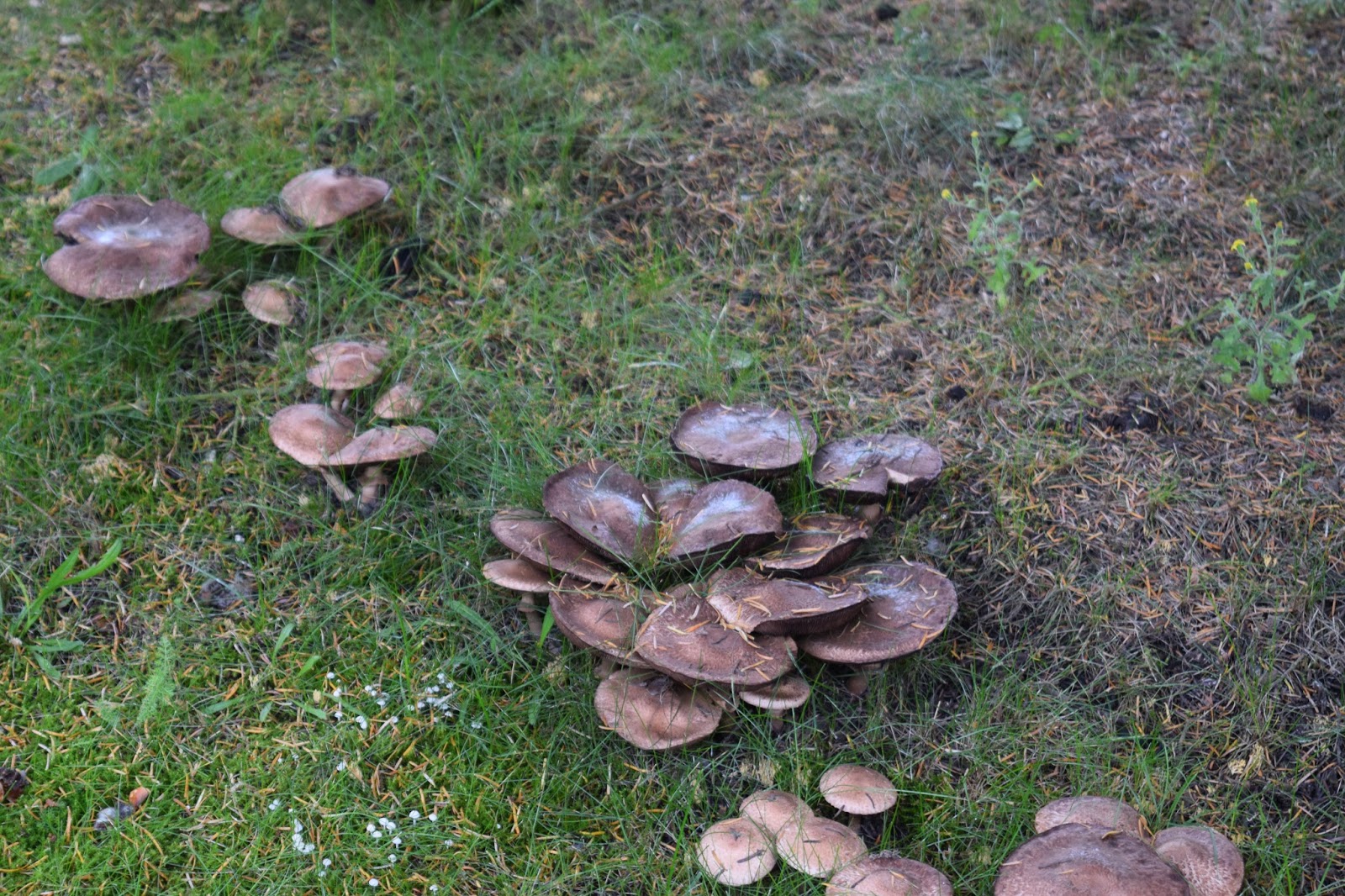
I didn't. I took a wrong turn and kept walking. There was a park. I remembered a park from the map, so I kept walking. There were mushrooms. Big mushrooms.

You can't tell from the photo, but this guy was close to two feet tall.

Each lobe was the size of my hand.

And these were like mini-pizzas

Eventually, I came upon a sewage treatment plant, which was way wrong. Had a nice view, though.


But none of this was supposed to be there. I turned around, and for the first time I remembered that my phone was in my pocket, so I dialled up Google Maps. I had a 37-minute walk ahead of me. The day was overcast, wet from the previous day's rains. I was still jet-lagged. I walked and walked and after about 20 minutes of slogging through industrial wasteland and alongside a freeway, I arrived just down the hill from the Russian church at a place where I should have turned right instead of left. The phone said I still had 18 minutes to go. I don't know if it was a combination of jet-lag and diabetes or what, but I was exhausted and starving. I lurched onto a traffic island and felt myself losing my balance as oncoming traffic sped inches away from me. I threw out an arm and embraced a traffic sign. When the light changed, I trudged in the right direction and sure enough: there was a park. I had to sit down, but soon enough felt good enough to soldier on. An arm of the park I'd sat in divided a street on the right, and I walked where the phone told me to. And there was the Lenin Museum, confusingly enough in the administrative building of the state theater. And, a quick look at the map told me, the market hall was just a few minutes away, so, knowing that I needed to eat, I headed in that direction, and found it. Right inside there was a lunch counter, and the woman behind it spoke simple English. I ordered what she said was chicken in a cheese sauce with mashed potatoes. It wasn't like any chicken in cheese sauce I'd imagined, but it was very good, and not just because I was hungry. The rest of the food hall, I discovered, was mostly lunch counters, but then, I doubt there were many crops in early October.

Okay, time for Lenin. The building was fairly opulent, and I eventually learned that it had been the union hall for all the industrial unions in Tampere, where Finland's heavy industries created factory equipment and locomotives. I'd even passed an ancient locomotive in the industrial section I'd wandered through. In the early 20th century, Tampere's workers were unionized and were very interested in the communism/socialism brewing elsewhere in Russia, so when a couple of Bolshevik thugs knocked over a bank in Estonia (another Russian province), they realized they were too hot for Petersburg, where most of the rest of the Bolsheviks were and fled to the small provincial city of Tampere, where the union guy welcomed them at the opulent union hall, all polished wood and marble. One of the thugs was a Georgian named Josep Dzhugashvili, who seemed hot to get the revolution going, so the Finns sent word to Germany, where Lenin was hanging out, and he got on the famous sealed train to Tampere. The unionists introduced him to the bank robbers and he soon decided it was time to go back to Petersburg and get this Party started. When he arrived, he was greeted in an office at the union hall, which is now the Lenin Museum. There's actually not much in it, the major artifact being Lenin's cane (although it's not even his cane, but an exact replica traded to Tampere's mayor, who brought the original to Moscow on a friendship tour some years ago), and there's this corny bit:

Red marks the spot!
I'm pretty sure you can't read what's on the red spot on the floor, but it says that this is the exact spot where Lenin and Stalin first met. The corny bit of Lenin in the sidecar ("Have your picture taken on the motorcycle!") and the life-size Stalin figure (my friend JJ Gordon, during his acting career, performed a one-man play called I Am Joseph Stalin, about one of the doubles Stalin used, and I have to say that I never met Stalin -- thank heavens -- but this thing's the spitting image of JJ) give you something of the flavor of the place. Cool gift-shop, though, if you don't have enough Commie crap.

The reason this is Finland's 100th birthday is because once the Bolsheviks took over the Russian government, they thanked Finland by giving it its independence. Of course, they also changed their mind, which resulted in yet another 1917 revolution, and that's given as the reason Finnish, inscrutable as it is, is the national language. (Actually, Swedish is the second official language, which means German-speakers can sort of make out some signs).

The next day, I returned to Helsinki, and spent the night, flying off to Berlin for a short visit, my first to the place I'd lived for 15 years for eight years. I understood it had changed. Uh, yeah.

* * *

Dude, where's my apartment?
It's really hard to take a picture of what's not there, but since Berlin has always been a city of vanished places, I got kind of good at it there. This one takes some explanation, though, because it's not a very good picture of something that's not there. Okay, my old apartment was impossible to find unless you knew the secret. The yellowish building in the center of the picture was Borsigstr. 2. Next door on the right was 1, and next door on the left was 4. I was in 3, which, for reasons known only to the city of Berlin, referred to the building behind 2. Somehow, my landlord sold off the driveway you'd walk down to get to it, the tiny vacant lot on the side of the driveway, and part of the parking lot behind the building to developers, who put up the grey building, which is now allegedly a four-star hotel. I need not remind anyone who visited me at this place that my apartment was barely even a one-star one. The note on the grey door, which was never open during the 11 years I lived here, says that access to 3 was through the hotel garage. 

That was only the first shock. Although I could probably have found cheaper and better accommodation, for nostalgia's sake I chose the hotel on the corner (to the left and all the way up the block), Honigmond. Honigmond started as a bar during Communist days, the Borsigeck. It was the favored watering hole for the students at the theological seminary in the church two doors up from my place, and back then, the church and divinity students were secret centers of dissidence, as was the theater. Borsigeck was also a favorite of another bunch of malcontents, actors. The code word for meetings was "playing chess at Borsigeck." After the regime change, a bunch of Borsigeck folks bought the bar and renovated it in turn-of-the-century elegance, and made the kitchen into one that produced excellent German food, with a weekly menu that also had Italian touches. I first ate there with my editor at the English-language magazine whose offices were not too far away, Checkpoint. It had just reopened, and we thought that, as far off the track as it was, it was doomed. Hardly. It was a neighborhood joint, our secret. Once they acquired the whole building and turned it into a hotel, I wondered what the breakfast was like, but I never found out. Eventually, they bought two more buildings to add to the hotel. It made me happy; I ate and drank there a lot, and when I started my communication company, Berlin Information Group, we'd commandeer the back room on Tuesday nights, which were very slow, and have our meetings there until someone talked a developer into giving us free office space a couple of blocks away.  So you see why I picked the hotel. 

But Honigmond the restaurant died earlier this year. The space has far fewer tables, and it is now Neumond. And on Neumond's dinner menu, amidst all the gussied up dishes, is that signifier of Euro-hipsterdom gone bad: a fancy cheeseburger. I had breakfast there my first day (very generic) and went elsewhere from then on. (Yes, I'll get to food in a minute here). 

But beyond all this there was an onslaught of change to absorb. My friend Nikki picked me up at the airport and after I checked in, we went for a walk just to check it out. Torstr., on whose corner I almost lived (it's a major street, so it was good to have a couple of buildings muffling the noise), had been a collection of this and that, a couple of bakeries, kebab stands, a television repair place...that sort of miscellanea. There were a couple of restaurants, especially late in the game, with an excellent if terminally trendy Chinese place, the super-snotty Bandol (I was denied entrance once because I was wearing jeans, which was so out of place in that neighborhood that I just laughed at them), and an excellent Italian place. Now, it's wall-to-wall restaurants, of which the only one I recognized was Bandol. Some of them, I was told, were quite good. Many appeared to be hipster-yupster in appeal: a great number of people with money from elsewhere in Germany have arrived, and it's unlikely I could even manage to aford an apartment on a side-street. By the time we made the grand circle, I was dizzy. Nikki drove off and I went uptairs to think. 

The next day I kept walking, this time below Torstr. in the so-called Scheunenviertel, which had been filled with emigrants between the wars and featured the Neue Synagogue, a prominent Reform congregation that was accidentally bombed by the British in World War II. When I lived there, it was where the edgy galleries were, a couple of odd bars, and our magazine offices, and, later, the studios of JazzRadio, where I did three shows a week for about 8 years. I took a lot of shitty photographs. But not all of them were bad. 

The Empty Apartment
For some reason, I'd never gotten a good shot of this memorial to the deportation of the neighborhood Jews. Or maybe this is better than the ones I took because the greenery's had eight more years to grow in. I could have framed it better, though. 

I think the reason the photos were so bad, though, was because I wasn't looking at what was there, which is, well, kind of important. I was looking at what I remembered, and that made accurate documentation imposible. Okay, and the early-morning light was off; I never got up this early when I lived there. But it's also that there were ghosts. Things I expected to see that weren't there. The hotel was quite close to the apartment of my short-lived ex-girlfriend, Lady Drunkula. She may still be there if she isn't dead, which she might well be; it'd only be a question of whether someone murdered her, she had an accident while drunk, or she drank herself to death. I'd walk past places and memories came back to me despite myself. I found I didn't much enjoy this. 

To be honest, though, I returned without much of a plan, many of the people I wanted to see were out of town or busy, and I realized that the next visit would have to be planned a bit differently. And there should be one, but maybe not too soon. 

One thing that went off brilliantly was that the same day I went below Torstr. I also went to the Bode Museum to look at their room of Tilman Riemenschneider sculptures. The Nordrhenisch school of wood-carvers appeal to me greatly, and I've seen plenty of their work over the years, but Riemenschneider is a cut above. The Bode doesn't even have a lot of them, I discovered. I'd remembered a lot more when I was rushing through the Bode for the first (and until now only) time I'd gone there, writing it up for one of the many guidebooks I'd worked for, and since everything in Berlin is always under construction, there was a room with at least one of his pieces that was blocked off. But the room that had ones was fascinating. I'm not even a sculpture guy, but these knocked me out. 

Venetian dude

Another Venetian dude

No idea dude
And then there was Riemenschneider. The masterpiece was the four Evangelists. 

All together


And, of course, the band of angels.


Most of the rest of the museum is later stuff that doesn't appeal to me, much of which isn't first-rate (that'd be off by Potsdamer Platz in the Gemäldegalerie), and I went and overdosed myself by buying a ticket good for all the museums so I could see what they'd done to the Neues Museum, which had a hole you could (and some did) drive a truck through due to wartime bombing. It's now been patched up, rebuilt, and houses Greek and Egyptian things, including that bust of Tutankhamen's wife (and sister) Nefertiti. Bet you thought that was in the Metropolitan, eh? In the basement was a nice show about the beginnings of civilization in China and Egypt, their similarities and differences as demonstrated by objects. As is the custom in Germany, though, the museum was grossly overheated, I was getting tired, and so I went back to the hotel after an increasingly more cursory glance at this exhibit. 

My proposed last-night mass meetup wound up being Nikki, two of her boys, Uwe, her ex, who is also the father of one of the kids, and my friends John and Aimee, at a bar Uwe was running (and has since left) called Kegelbahn. It was pretty low-key, especially since John and Aimee had to leave early, but at one point we were all at the table nursing our beers and I said "You know, this place has ruined me. I just can't get used to the States." And...well, I can't. It's not just our grotesque, evil President, or the utter alienation of the new, bloated Austin. It's a way of living that overlays the entire country I've seen since I've been back. I just don't like it. If it were mere culture-shock, it would have worn off. And it hasn't. I'm not sure what I'll do, exactly, but I can't budge for another couple of years, while I write this next book and promote it when it comes out. I didn't really have any choice in returning: there were things here I needed to use for the book. But once I don't have that choice...

* * *

A FEW CULINARY NOTES:

Finland is probably not high on your list of countries for destination dining, but should you have to do there, you shouldn't regret it. One thing I noticed immediately was that the bread there is extraordinary. This is because it's mostly rye; wheat doesn't grow too well, so it's not as much used in the national cuisine. At breakfast in the hotel, I got that immediately, including a crispbread covered with seeds that I brought back with me. The cheeses were good, too. 

I had dinner at some fine places. My friend Karen in Berlin suggested Seahorse, in Helsinki, whose business card advertises "Finnish food and culture since 1934," which would be better for someone who, unlike me, does not have a deep, visceral distaste for beets, root vegetables being another of the mainstays of local agriculture. I had some herring, some of which had a camphor flavor (not bad, but weird), and then a "Scandinavian hash" of ham and potatoes that wasn't too memorable. Cheap and friendly joint, though. Another place I enjoyed quite a bit was Kuu, which means "month" in Finnish (it's the suffix of the names of all the months, the waitress explained). The salmon cured in aqavit with a crayfish sauce was super, and the reindeer stew (had to have it once!) was very well done, letting the distinctive flavor of the meat play off the berry-studded wine reduction brilliantly. A mixture of locals and Japanese tourists, superb service, highly recommended. My third dinner was at Bryggeri, which, as you can tell from its (Swedish) name is a brewpub, but one with extraordinary food, matched with the in-house beers. I had a bit of a cold so I remember I started with their cheese and charcuterie plate, but my taste buds faded before the main course so I don't remember what I had. And the receipt is in Finnish. Recommended, though. Bryggeri is also near the harbor, which is where you'll find the market hall, which has far more food than restaurants (including a pancake place with the motto, in English, "A pancake a day keeps the sadness away," which tells you everything you need to know about Seasonal Affect Disorder in Finland), where I got a nice snack of a slice of superb smoked salmon which I munched as I walked around. 

In Tampere, I ate twice at the hotel restaurant (not particularly recommended, although there was nothing wrong with it) and once at Tiiliholvi, a place which also seems to have a branch in Helsinki. This was very nice, although I was the only person in the place when I went. A soup of root vegetables was a fine Finnish start, and the "duck two ways" turned out to be breast meat and liver, each with its own sauce. They brag that they have the best wine cellar in town, and if the glass of Les Douves Latour Carnet (I was intimidated by the "Latour" part, but it was affordable) was anything to go by, they're right. It was not only a perfect accompaniment, but a profound wine -- and, as I discovered on my return, a $20 bottle if you can find it. 

In Berlin, after the Honigmond disappointment, I went down the street to a place that had opened when I was living there. I hadn't liked it, thinking it pretentious but not cooking to meet its pretentions, so I never went back. But this time, it appeared that the spirit of the old Honigmond had just picked up and walked a block. True, Alpenstück has white tablecloths, but the Radeberger beer is just as good, and the bread, well, that's different. The reason is that they've expanded across the street, clearing out a hairdresser and a bar (Smily :-) der Friseur and Cheer's -- a copy-editor's nightmare in 3-D) to put in a bakery-cafe, whose first-rate breads and pastries would have been a real boon to the 'hood back when I was living there. 

Quite the adventure, and now I'm back in the USA, where hamburgers (and cheeseburgers) sizzle on an open grill night and day. But I know I'll be back to Berlin. And who knows, maybe Finland. 

Saturday, December 24, 2016

Notes From An Attic: The Never-Ending Vacation, Maimondes' Autograph, Promoting The Book, And More

Two months since I've touched this blog? Apparently so. And a very odd two months it's been. To recap: in early October, while on vacation in Spain, I received photos of water seeping outside the door to my house, which water proved to be the result of a toilet valve failing and 48 hours' worth of uncontrolled release of water. The landlord quickly shut it off, but sheetrock, ceiling, and wooden floors all needed replacing. He predicted three weeks or more.

More. If the most optimistic forecasts are correct, I'll have been out of the house for three months by the time I get to move back in. Christmas and New Years will be elsewhere. Fortunately "elsewhere" isn't as onerous as it might be: after a week and a half in a horrible, expensive, poorly-run "extended stay" hotel, a Facebook friend offered me one of his airbnb properties, this not being the high season, and I moved into an attic on his property. It has its down side.

First rule: don't be tall. Photo credit: Special K
Also, I packed for a three-to-four-week stay here, which meant I grabbed a few clothes and some kitchen stuff that was either in excess of what I needed or not enough. There's a stove (oven doesn't work) and a microwave, but cooking has been a problem. When the weather got cold, I had to buy some new shoes (fine: the winter shoes I bought in January sucked, and REI will take them back) and a down jacket thing (already have one, but can't get to it). Fortunately, the place is centrally located, which means I can walk a lot of places, and driving isn't quite the pain it is down south, where you have to drive places to get places. You kind of have to get out of where you are before you can start going where you're going, if you see what I mean. Here, it's a lot more like living in a city.

So I'm still living out of a suitcase, eating out much too much for my comfort (both dietary and financial), but things could be worse: the main focus of the past couple of months has been assuring a smooth launch for The History of Rock & Roll, Vol. 1, which has certainly been interesting. Fortunately, so far most of the reviews have been very positive, and I've mostly done interviews with really intelligent people, like Gil Roth, whom I'd never heard of before, and Michaelangelo Matos, whom I had. There have been some radio interviews, most notably on KQED's Forum, which had the most chaotic, ill-prepared, ignorant host I'd ever dealt with. He'd never so much as opened the book, knew nothing of its subject, and couldn't keep the conversation on track. Unfortunately, I had a severe attack of cedar fever just as the mike went live, so I wasn't at my best initially, either. Fortunately, I recovered. The host...maybe not so much. And there was the Bellowing Celt who called in, completely bonkers. I'm still shaken, but I suspect that's the worst of it.

That cedar fever, too, has slowed me down some: there was a cold snap in Austin and the trees went wild. Me, I went to New York and Montreal, where it was cold enough, caught some kind of flu in all the subways and airplanes and trains and whatnot, so I had to deal with that and the cedar disease when I got back. I haven't been very active, to put it mildly. Oh, and in November there was the Texas Book Fair, where all the music book writers were up against one another, so who do you think got the crowds: Thomas Dolby, me, or the woman who wrote a biography of Guy Clark, beloved late Texas songwriter, who, instead of having a panel in the Capitol building, had the Paramount Theater at her disposal, and had several local high-profile songwriters on board to do some of Guy's songs? I got to the signing tent, there was a huge line...but not for me, of course: her publisher had sensibly augmented Barnes & Nobel's supply. B&N only had 30 books for me to sign, and five were for the store. There were a lot more at Book People, though, for the official release event, and I even had to go down again to sign another raft of them there. (They have 'em on mail-order, too, if you want one).

Still there, newly renovated for your Manhattan office address. Brill himself was in the menswear biz. 


This is all pretty un-chronological, I see, but at the end of November, I went to New York for a week on a project totally unrelated to the book (but got a bit of promo, if you can call five minutes' worth of interview on an AM New York Jesus station "promo": who knew New York had a Jesus station called THE ANSWER? Who knew New York had a Jesus station at all? What can the listenership of an AM station like that be?). Before I left, though, I decided to go to a couple of museums as long as I was in town, and it really felt good.

MOMA had the first US retrospective of Surrealist painter Francis Picabia, whom I'd mostly known as a major pain in the ass to the entire Paris art scene throughout Cubism, Surrealism, and beyond. It wasn't until after I saw the show that I learned that at the age of 15, Francis, son of a wealthy man, learned to paint so that he could copy his father's collection of old Spanish paintings, replace them with his copies, and sell the originals to dealers so he could buy expensive stamps for his stamp collection. That, however, is consistent with the rest of his life, as is the excerpt from one of his writings that gives the show its title: Our Heads Are Round So Our Thoughts Can Change Direction. His thoughts certainly did: austere drawings of machines that actually do nothing, colorful abstracts, odd cartoon-like stuff, bland but disturbing hyper-realist oils, some of them sourced from soft-porn magazines, during the German occupation of France, and, if your feet are tired, you can sit and watch a film he and René Clair made called entr'acte, which was shown during the intermission (entr'acte) of an Erik Satie ballet. It's exhausting and goofy, and the show made my day. Heads off to Picabia!

The show I knew I wanted to see, however, was up at the Met, and I devoted a day to it: Jerusalem, 1000-1400, Every People Under Heaven.  It was a bit odd: having not quite returned from a trip to Spain to try to get a handle on the three-culture Christian-Jewish-Muslim culture there, from which Crusaders went off to try to "reclaim" the Holy Land, here I was in New York watching the story from the other end of the telescope. It's not a particularly arty show, because two of the religions involved weren't much on representational art, and also because a lot of the prize exhibits are books. Delicate and tending towards fading, they're displayed in darkish rooms, and you really have to want to look at them -- and you need to to get the show's message.  Here's a beautiful illuminated manuscript, obviously French 14th century, groaning with gold leaf, showing a biblical scene. The lettering's in Hebrew, though, and it was used by the Jewish community of Tours. Here is a deluxe fold-out map of Jerusalem, prepared for tourists -- or, rather, for a tourist, since it's hand-lettered and hand-illustrated. Of course, the guy who did it had never been there, but it's still amazingly accurate. Over here, a letter asking that some hostages be freed -- the caption says such letters are quite common from this period -- signed by Maimondes! That gave me an electric shock and once again reminded me that this story I've been chasing -- whatever it is -- spreads over a huge area. I have to say, the show is huge, painstakingly fair to all sides, and not only fills in a lot of blanks on the three-culture story for me, but also shows that the idea of the tourist trap is millenia old: lots of the stuff on display was made for pilgrims to take back to Europe with them. Only open until January 8, so get down there if you can.

Most of the rest of my time has been spent waiting for the house down south to be finished. At some time after the first of the year, I'm confident that my publisher will make an offer for Vol. 2 of the book, and I can get back to doing what I do best: writing. I may attempt a couple of signing tours -- I'm trying to work one up with Amtrak so that I can take the train up the West Coast -- which I'll have to finance myself. But that's in the future: right now I want to move back into my house, sit on my couch, sleep in my bed, and cook in my kitchen again. Three months is too damn long. When you're walking up Madison Avenue (to the Grand Central Oyster Bar: some things never change) and you realize that you're taking a vacation from your vacation and soon will be on a train to Montreal to visit friends as a vacation from the vacation to the vacation, you realize how much you miss having a home.

Of course, I've been feeling that way for about two years now, and the recent election only firmed up my decision to leave again once this next book is finished. I could, and no doubt will, go into that in some detail. But not today. Today is Christmas Eve in the attic. I have to stockpile some food for the weekend. Ho ho ho, y'all.

Sunday, September 25, 2016

It's Almost Time...


In a couple of days, I'm going to disappear to rest up between the promotion of my Michael Bloomfield book, which I've been doing for the past month, and the -- much bigger -- promotion for this, my first physical book under my own name in 33 years.

A lot of people have asked me where they can pre-order it, so here's the skinny on that. First, though, some explanation. At this moment (ie, as I write this, on September 25), the pre-orders won't get you a discount. I seem to remember Amazon telling me that a book I'd pre-ordered from them might drop in price, and since I wasn't going to be charged until the book shipped, the amount I paid would reflect the price on the day it was shipped. You may or may not get a deal like this. You will if you wait, most likely.

What I vastly prefer for you to do is to patronize your local independent bookstore, because giants like Amazon threaten their existence. Indies tend to know their local communities and select the books they sell accordingly. An alarming number of them are literal mom-and-pop stores, family businesses. They mean a lot to your community, and any writers who may live in your community.

If you want an inscribed copy of the book, you're going to have to see me in person. I really, really, don't want to drive to the post office to mail one off to you, and no, I don't get hundreds of free copies  when the book comes out. You can get inscribed -- or merely signed -- copies ("inscribed" means my writing "To Joe: I promise I'll pay you that $10 one of these days" or something; "signed" means just my signature) at my November 6th appearance at the Texas Book Festival here in Austin or at the release party at Book People on November 19th. Book People will also have signed books for sale after that, and they'll be available via mail order.

I also hope that there will be a modest book tour, although publishers no longer do them as a matter of course. I'd like to do a West Coast tour via Amtrak -- San Diego, Los Angeles, San Francisco/Berkeley, Portland, Seattle -- and an East Coast one of Washington DC, Philadelphia, New York, and Boston/Cambridge. The only way this'll happen is if people in those cities ask for an appearance at a bookstore, and the bookstore contacts the publisher. So if you get to work, that might work out.

Meanwhile, for those of you who need to do this on-line, here are links to the pre-order sites:

Amazon
Barnes & Noble
Books-A-Million
IndieBound
and Book People in Austin.

I've written the pitch for Vol. 2 (1964-2000), and my agent will be arm-wrestling the publisher while I'm away. I'm hot to get started on that one, which will be pretty controversial and just as much fun to read as this one is.

And if you're just tempted to get only one, remember that Christmas is just around the corner!

Saturday, August 20, 2016

Midsummer East Coast Tour, The U.S.

File under "offer you can't refuse": my agent, David, asked me what I was doing around the beginning of August. His wife is from Hawaii, and every year they head down that way with their kid and visit the in-laws. Would I be interested in house-sitting for him in Jersey City? Oh: and cat-sitting a ten-year-old cat. How hard could that be? Jersey City is a couple of stops on the PATH rapid-transit system from Manhattan, and although it was August, there'd be stuff to do there. My publisher for The History of Rock & Roll, Vol. 1 was having a typical publishing August -- ie, not doing much -- and wanted to sit down and chat about the book. Playing around with Google Maps with a vague idea of renting a car and going somewhere for a day came up with all kinds of interesting suggestions. And best of all, it'd be free, at least up until the last day, when I'd hop on Amtrak and head to Montreal for a few days.

So I said yes.

David's house is about a mile from the PATH station, Little India, and many other attractions. I was determined not to over-plan anything, except to nail down a lunch with the publisher and explore JC. I'm still planning to leave Austin as soon as it makes sense -- ie, not for a while yet -- and wanted to see what the place was about.

After a conversation with last-minute details (which I should have taken notes on) I went back to the Ramada (the only hotel except for that weird Indian one I stayed in a couple of years ago in that part of town) and crashed. The next morning, I checked out, carefully picked my way down JFK Boulevard, and arrived at the place I'd be occupying for the next ten days. No sooner had I arrived than Maud, the cat who I'd been assured would mostly sleep while I was there, emerged and started yowling, hissing, and spitting at me. No matter that, over the rest of my stay, I would feed and water her and clean her litter box, she didn't ever warm to me. Far from it.

Maud, none too happy
I actually had no clear plan for touristing, except I did want to go to the Cloisters, the Metropolitan Museum's collage of medieval buildings in Ft. Tryon Park at Manhattan's northernmost point. I hadn't been there since I was a teenager, and by now I've seen lots of stuff of the sort it contains, as well as having visited the church in St. Guilhem le Désert where they got one of their cloisters. Plus, I heard they had a piece by the Master of Cabestany.

My first day, though, was spent finding a grocery store and familiarizing myself with the surrounding neighborhood. There would be a farmer's market the next day at the PATH terminal in Journal Square. Didn't expect much from that, but it'd be worth looking at. I took a quick look around Lincoln Park as the sun set and walked back to the house.

Monument to the early settlers of JC who fled the Irish potato famine, Lincoln Park
There was no doubt where I wanted to eat that night: Deccan Spice in Little India is one of the best Indian restaurants I've ever enjoyed. Thing is, I forgot something important about them: as you approach Newark Avenue from JFK, you see their sign, so naturally you suppose the restaurant on which it hangs is Deccan Spice. It's not. Deccan Spice is two doors down, and if you're walking up Newark Avenue, there's a sign facing your way on the right building. I chose the wrong restaurant, and paid for it: it's called Home Kitchen, although it also has another name, too. The menu is confusing, but not as confusing as something I thought I spotted on the way in: a Bible, a picture of Jesus, and a rosary with a crucifix on it. The chicken dish I had was very ordinary, except for the effect it had on my intestines an hour later. That was impressive.

That farmer's market was also a surprise the next day: only one farmer was represented, along with a Puerto Rican food truck and a bakery, but the vegetables looked top-notch. With the idea of making a salade niçoise, I bought lettuce, a red potato, some green beans, and some black cherry tomatoes. Now all I needed was some good tuna and I was ready to rock. And I knew where to get that: David's printed guide to JC mentioned Carmine's Italian Deli, where he said cops and firefighters went to get sandwiches. It wasn't far.

Not, that is, if you read the address right. Instead, my brain told me it was on a nearby street, albeit a fair walk down that street. So, after walking the mile back to the house and resting up a bit, I started walking down that street. And walking. And walking. Finally, a sign I was looking for came into view, but not Carmine's. Cool Vines was the wine shop David had mentioned, so I went in and looked around. They seem to import everything in the shop themselves, so there was nothing I recognized, which was good and bad. The proprietor was a bit sniffy, but I bought a couple of interesting-sounding bottles and walked all the way back to the house. I sat around until I got hungry and realized there was no vegetable steamer in the house with which to make the salad. I consulted the list again, and started walking down that same street to downtown JC in search of Razza, an upscale pizza joint. For some reason, pizza was just what I wanted, and there was apparently no old-school pizza joint in JC any more. Razza more than fulfilled my expectations. Let's just say that I rarely eat all of the crust. I ate all of the crust. The heirloom tomatoes with a chive vinaitrette was also a perfect opener. And let's face it: after all that walking, I was ravenous. I took a cab back and collapsed into sleep.

JC Astrology #1
I was annoyed enough the next morning that I'd made so many mistakes that I decided to do something I knew how to do: go to the Cloisters. And I did. It was a beautiful day for it, too: the Hudson's palisades were as lovely as I remembered them, and Ft. Tryon, or at least its site (Washington thought he could invade New York City from there and boy was he wrong), a cool and quiet place to spend time.

Note to Founding Father: you can get there from here, but it's not a good idea.
The Cloisters' collection had been added to considerably since I was there last, and I was gratified to see that I could pick out pieces from places I'd spent time, most notably Catalonia, Germany (a bunch of Tilman Riemenschneider wood carvings) and of course the Eastern Languedoc.

And there it is: the cloister from St. Guilhem le Désert!
There was a lot of stuff to see, and yet the place was small enough that I believe I saw it all. One note I made was that the familiar yellow Valencian pottery that had unexpectedly entranced me all those years ago in Castellón was using identical colors to Moorish pottery made in the same vicinity. I found this exciting because I will be in Valencia in a little over a month and am hoping fate steers me into more information about this. I realized after visiting the Cloisters that I seem to have picked up a hobby after all these years: figuring out the three-part society of pre-expulsion Spain, as the Moors, their fellow North Africans the Jews, and the Spanish worked out a way to live together, albeit with some tension. I attribute this to the pieces that clicked into place this spring in Girona.

And here's the Master of Cabestany's piece, considerably larger than I thought.  If he existed, this is by him. 
I left the Cloisters feeling great: between the weather, the views, and all the stuff I'd just seen, I was in a good mood. I pulled out my phone to send the Cabestany picture to a friend in Austin and a grandmotherly black woman with a teen in tow asked me if I were playing Pokémon Go. I told her no, I was trying to send a photo, but had just discovered I couldn't, and also told her that seeing me with my phone was a rare sighting indeed. She clearly approved. I walked a bit further and came upon a setup where a photographer was erecting lighting and tripods and such and a tall, thin black man had a drone in his hand. A couple in full wedding gear were sitting waiting and suddenly I put the pieces together. "If you don't mind," I told the drone pilot, "I'm enough of a geek that I'd like to watch this." "Sure, just stay out of the shot." Easily done from the bench once the couple stood up and too their places. The drone hovered in front of them and then shot out over the Hudson River. Then it hovered a bit and he brought it in, more slowly, as they waved. Man, they don't do wedding videos like they used to.

Bride, groom, drone

Sunday, January 24, 2016

Go East, Part Two

Whatever it was I caught on the plane coming to New York had dissipated by the end of last week, and Monday, since it was a holiday, my friend, the street photographer/union activist Mike Lee, came to visit. Mike used to live in this neighborhood, and we took a long walk, talking about this and that, catching up over lunch at the most wonderful old-school Italian joint imaginable, which we just happened to walk into. Both watching our carbs, or I would have suggested splitting a pizza, but as it was, I had mixed shrimp and scungilli (that's conch, folks) in a Fra Diavolo sauce: it doesn't get more old-school than that. No, I'm not going to divulge the name of this place yet because I'm going back for dinner this week.

We walked as far as Caputo's, an Italian deli that makes its own mozzarella daily (except Monday, when it's closed) and then we cut across on some side-street and headed back to the apartment. It was sunny, but cold, and with a lot of wind, making it worse. I saw places I hadn't seen before, the famous Brooklyn row-houses, one after another.


I was trying to figure out what this all reminded me of, and then it hit me, later: this was like Greenwich Village's pleasanter quarters in the years I first discovered them, but at a (relatively) affordable price. I probably still can't afford to live here, but it feels comfortable, and the mixture of hip (but not hipster) and family and old-time Italian is very appealing. Maybe it's time to play the Lottery. 

Tuesday was about packing: I'd bought a ticket on the Acela, the so-called high-speed train Amtrak runs between Washington and Boston, to spend a couple of days seeing Boston for the first time in oh, maybe 40 years. An old friend from Austin, Stewart, had moved there and fallen in love with the place, posting odes to cold weather and snow on Facebook that would've gotten him lynched back home. Turns out this may be deep-seated with him: doing research, he discovered that his first ancestor in the United States had a farm in what is now Harvard Yard! 

Well, I packed, but I also panicked. I'd used Amtrak's phone app to buy the ticket, and then couldn't get at it. I had apparently forgotten the password, and repeated inquiries got no help from Amtrak. Fortunately, there was an e-mail, and when I found it, I discovered the train was at 3, not 3:30, as I thought. This was going to be the test of my new iPad Pro, which is like my laptop but lighter and with fewer apps, but suitable for the Web and e-mail, as well as having the New Yorker and a bunch of Kindle books to read: a perfect travelling companion. Which I dutifully put in its bag and left on the couch, as I discovered as I was entering the subway station. 

The train trip was uneventful, with some immensely fat guy asleep next to me the whole way. Of course, you never see the most scenic parts of where you are, but I was fairly thrilled by the maritime activities in New London, Connecticut, and a sand beach a bit further up the route. We crawled a lot of the way -- word is it that Amtrak doesn't have much in the way of high-speed rails on this leg of the route -- but as soon as we got a glorious scarlet sunset, we started jamming. 

Best I could do
Boston was even colder and windier than Brooklyn, but the subway stop I needed was only a couple of stops away from the station, and then there was what seemed like an interminable walk down Charles Street to the hotel. 

But what a hotel! Only a dozen or so rooms, and Stewart (a chef by profession) told me he'd heard good things about the restaurant. It hardly mattered: I was so cold that if I'd been told the hotel restaurant was awful, but the place across the street would give me the best meal of my life, I'd still have dined in. It was cold out there! And as it was, I got the best meal I've had all year, although I did remind the staff that the year was only 20 days old. There was a charcuterie plate with a homemade pâté (served too cold, a common failing, but time will take care of that) that I loved and a duck liver mousse that was extraordinary. Then I had their take on what's becoming a welcome cliché, the iceberg lettuce with blue cheese dressing. This was little gem lettuce with various add-ons and a "blue cheese compote," with a bit of what they described as Serrano ham subbing for the bacon that's usually there, and which I don't think was Serrano ham. Whatever, it was good, and I was getting stuffed, so I was happy that the portion of leg of venison with "heirloom carrots" and mushrooms was as good as it was -- and enough to finish the job. With it, I had a Languedoc wine, Chateau L'Hospitalet, that matched everything perfectly. (I know, Gérard Bertrand is not a well-loved figure in Languedoc wine, but there's a pretty stellar wine list in this restaurant and this was a good compromise between affordable and correct). This was an expensive meal, but well worth it, and well worth having to subsist on celery sticks for the next week if I have to. 

The next day, I met Stewart to hit a couple of art museums. The first was the Isabella Stewart Gardner House, site of the largest unsolved art-heist in America when a couple of guys disguised as cops lifted a Vermeer and about 39 other paintings about 40 years ago and a scandal erupted when it was discovered that security was virtually nil in the place, a sprawling pile designed after an Italian villa. Mrs. Gardner was left $1.5 million when her father died (not such a huge amount in today's crazy art market, but this was the late 19th century) and immediately decamped with her husband to Europe to start buying art. She got decent advice and went back year after year, stuffing it in her villa willy-nilly. When her husband died she came into more money and continued collecting until she died. Her will stipulated that the house be open to the public, but there would be no rearrangement of anything at all, no labels on the works, no change of any kind. The minute you step into the place you can tell one thing: she was mad. Some of the art is good, a lot is mediocre, some is just plain bad. There's a Rembrandt self-portrait that's more important for documenting the way he looked when he painted it than for any particularly artistic merit (mind you, I'm not much of a fan of his, and I do wonder how the "cops" missed this one, because I identified it right off). The place is dark, disordered, claustropobic, and I was happy when we headed towards the door. 

Except we didn't, and I'm glad. The place has an active trust that's bringing in money, and at one point they had Renzo Piano enclose it in a sort of glass box, as well as create a second building in the enclosure. This has a gallery that pays host to travelling shows or shows curated by the foundation, and at the moment has a show dedicated to the Italian Renaissance artist Carlo Crivelli, aka Cucumber Dude for the number of cucumbers that appear in his paintings. I'd read a rave about it in the New York Review (or maybe the London Review of Books; I can't find it in either), and was happy to catch it. His weird gourd obsession aside, he had a masterful eye and sense of color, and although there aren't that many paintings of his surviving, the bunch here are lovely, and, given the chaos next door, well-displayed. It closes tomorrow, so I'm very glad I saw it. 

Next up was just around the corner -- well, nearby, anyway. Stewart is a member of the Museum of Fine Arts, and breezed us past the admission desk with his card. I'd still have paid, I realized as we were leaving. This place is as chockablock full of great stuff as the Metropolitan Museum. Its collection starts later, with the Italian Renaissance, its Egyptian collection isn't nearly as big, but although I'm not sure I saw everything I would have wanted -- the building is in a confusing shape, thanks to a rotunda whose ceiling is covered with a huge John Singer Sargent fresco. Its American collection, particularly from around the time of the Revolution and the early days of the Republic, is, unsurprisingly, tremendous, as (also unsurprisingly) is its collection of Sargents, including "The Daughters of Edward Darley Boit," which Stewart tells me was as controversial as his "Madame X" in the Met. It's displayed flanked by the gigantic Chinese ceramics it portrays. And one of the coolest things in the museum is a humongous Roman statue of the goddess Juno -- well, it wears her head, although that seems to have been added later, albeit during Roman times. Juno stood in a garden in the Boston suburb of Brookline until it was donated to the MFA, at which point it was transported by helicopter and deposited, through the roof, at its present location via a nail-biter of a helicopter ride, all documented at her base. 

I wish I could be as kind about its contemporary collection, but there are very few first-rate works in it, if what was on display is anything to go by. Of course, I was also experiencing art burnout by this point in the afternoon, as any reasonable person would. Clearly, this is a collection shaped by the Boston Brahmins of years past, with an admirable spirit continuing into the present, but perhaps without the vision of the Met or the talent of MOMA and the Whitney. 

Thursday was my last day in town, so Stewart showed me some of the tourist attractions which, it being colder than humanly imaginable, were pretty thin on tourists. I realized that I had a strong affection for pre-Revolutionary and Revolutionary tombstones, dating back to family vacations in Vermont where my father became convinced that where Revolutionary War veterans were buried there'd be copious blueberry bushes. This is irrational, but he was right almost all of the time, and he had two willing helpers with kid-sized hands to harvest them. Needless to say, there were no berries out at this time of year, and in Boston probably at any time of year, but we tromped through the Old Granary Burying Ground and I snapped away. 


All manner of famous people are planted here -- Samuel Adams, Paul Revere, John Hancock -- and as you can see it's quite a collection of funerary art, American style. 

After I dragged Stewart to another graveyard, he insisted we go warm up at the Boston Athenaeum, just up Beacon Hill. He's a proud member of this, too, and spends some of his days doing research here. What, exactly is it? The best I can do is that it's a venerable private library with impressive holdings of periodicals (I saw bound Harper's and Atlantic Monthlys going well back into the 19th century, and no doubt they have the entire run) all housed in a building dripping with art (part of the reason the MFA was built was to house the Athenaeum's collection, which it then grabbed when it became a separate institution), serving, for most of its existence, a rarified stratum of Boston society. After all, a lot of people in Boston have access to libraries at Harvard and MIT, whose collections must duplicate some of this stuff, and there's also the Boston Public Library, which probably has a book or two. And, in fact, the membership at the Athenaeum was literally dying off when the trustees mounted a membership drive that coincided with the digitization of the collection (a mighty undertaking, I bet) and a revamped lecture and concert series that seriously lowered the median age and boosted the membership rolls. It subscribes to a huge number of magazines, which was heartening to see for an old magazine-head like me, including everything from Toad Suck to One Story (which prints one story per issue) to Petite Propos Culinaires (the number of scholarly food magazines was impressive, too). I'm still trying to wrap my head around it. 

We then took a leisurely stroll up Beacon Hill so I could see where Stewart lives, and as we passed one building he noted it was subsidized housing and he was on a list to get into it. It was astonishing enough that he could afford to live on Beacon Hill at all, but I was flabbergasted that in this age of real estate greed the city of Boston would have this large, beautiful building available for lower income residents. After all, right around the corner are some of the older buildings, one of which houses John Kerry and his wife. 

Next up was the show I most wanted to see. The Institue for Contemporary Art is way the hell out on a pier (don't worry, it's being developed for high-dollar residences with breathless marketing hype on the fences keeping people out of the building site) with a commanding view. Leap Before You Look is an exhibit about Black Mountain College, and back when I was being pressured to figure out what college to apply to (despite mostly mediocre grades), Black Mountain was my choice. There were great composers, painters, and not so many writers, but it seemed like a place where I'd meet the kind of people I wanted to meet, some of whom, I devoutly hoped, would be girls. And I would have, had the institution survived past 1957, when I was in third grade and not thinking much about girls at all. One of its first stars were Josef and Ani Albers, on the run, as were several other early faculty members, from the Nazis. The Albers were Bauhaus veterans, and it shows, not only in their work, but in the way they and the other faculty approached the learning process. The college wasn't very rich, and students helped grow their own food and constructed some of the campus buildings while learning painting, dance, design, textiles, and pottery. John Cage, Robert Rauschenberg, Elaine and Willem de Kooning, Merce Cunningham, Buckminster Fuller, Lou Harrison, Ruth Asawa, Robert Motherwell, the names go on and on, a roll-call of '50s avant-garde luminaries. Which were students and which were faculty? One takeaway from this show, which it's at pains to point out, was that it destroyed the hierarchy of the arts, and, along the way, the teacher-pupil hierarchy. In the end, a very Bauhaus idea. I'm sure I would have loved it, but experiments like this don't last. It sure looks like it was, well, not fun, but something bigger than that, while it lasted. Later, I went to the bookstore and they had a Black Mountain college pennant and a t-shirt, but at $40, that was a lot of mazuma for a t-shirt, so I let it sit. And as we left the Black Mountain show, we were presented with this installation:


Just what I needed. 

Dinner plans were to go to Legal Seafood, a Boston institution that, according to a friend of Stewart's, was good despite its having turned into a chain. I wanted good old New England Atlantic seafood, but hell, it wasn't even 5:30. So we jumped onto the MTA and headed to Harvard Square, where there was a branch of the restaurant plus The Harvard Bookstore, which Stewart assured me I'd like. It's not the official university store -- that's the Harvard Coop -- but an independent book store with everything from a zillion new and used books to a machine that can access obscure books and print and bind them right in the store. Much as I love Book People in Austin, I wish we had something like this there, too. We spent tons of time there and when we emerged from the used/remainder section in the basement, an author was giving a reading/talk. Right then and there, I decided I want to do one there when my book comes out, although I doubt my publisher will do much in the way of a tour. I think I'll be coming to the New York area, though, and this is just a train-ride away. 

We managed to spend enough time at Harvard to work up an appetite, and Legal was only a few icy blocks away. I had a kind of Yankee cioppino, where lobster replaced the crab. Most of the shellfish in it (as with the steamer clams I'd ordered for an appetizer) was overcooked, sad to say, but the broth was great -- I got tomato, white wine, and herbs -- and there was enough left over for Stewart to take home for lunch the next day -- and to torment his cat with. 

The next morning I hopped on the Acela, and saw the stuff I'd missed in the dark. This is the part of the country in which I grew up, although time has done a good enough number on it that it doesn't twang my heartstrings with nostalgia, and I doubt I'd want to move back to it. Brooklyn, however...

I had been following the news, which told me that a gigantic blizzard was coming, so as soon as I got home I put up enough food for two days -- or so I thought -- and hunkered down. The first day was no picnic, and I didn't go out into the blowing mass of snow, but today's okay if you're not going to take a long walk, and I'm sure tomorrow will be, too. 

Plus, I've got another week here!
 
Site Meter