Showing posts with label Repatriation. Show all posts

Saturday, December 24, 2016

Notes From An Attic: The Never-Ending Vacation, Maimondes' Autograph, Promoting The Book, And More

Two months since I've touched this blog? Apparently so. And a very odd two months it's been. To recap: in early October, while on vacation in Spain, I received photos of water seeping outside the door to my house, which water proved to be the result of a toilet valve failing and 48 hours' worth of uncontrolled release of water. The landlord quickly shut it off, but sheetrock, ceiling, and wooden floors all needed replacing. He predicted three weeks or more.

More. If the most optimistic forecasts are correct, I'll have been out of the house for three months by the time I get to move back in. Christmas and New Years will be elsewhere. Fortunately "elsewhere" isn't as onerous as it might be: after a week and a half in a horrible, expensive, poorly-run "extended stay" hotel, a Facebook friend offered me one of his airbnb properties, this not being the high season, and I moved into an attic on his property. It has its down side.

First rule: don't be tall. Photo credit: Special K
Also, I packed for a three-to-four-week stay here, which meant I grabbed a few clothes and some kitchen stuff that was either in excess of what I needed or not enough. There's a stove (oven doesn't work) and a microwave, but cooking has been a problem. When the weather got cold, I had to buy some new shoes (fine: the winter shoes I bought in January sucked, and REI will take them back) and a down jacket thing (already have one, but can't get to it). Fortunately, the place is centrally located, which means I can walk a lot of places, and driving isn't quite the pain it is down south, where you have to drive places to get places. You kind of have to get out of where you are before you can start going where you're going, if you see what I mean. Here, it's a lot more like living in a city.

So I'm still living out of a suitcase, eating out much too much for my comfort (both dietary and financial), but things could be worse: the main focus of the past couple of months has been assuring a smooth launch for The History of Rock & Roll, Vol. 1, which has certainly been interesting. Fortunately, so far most of the reviews have been very positive, and I've mostly done interviews with really intelligent people, like Gil Roth, whom I'd never heard of before, and Michaelangelo Matos, whom I had. There have been some radio interviews, most notably on KQED's Forum, which had the most chaotic, ill-prepared, ignorant host I'd ever dealt with. He'd never so much as opened the book, knew nothing of its subject, and couldn't keep the conversation on track. Unfortunately, I had a severe attack of cedar fever just as the mike went live, so I wasn't at my best initially, either. Fortunately, I recovered. The host...maybe not so much. And there was the Bellowing Celt who called in, completely bonkers. I'm still shaken, but I suspect that's the worst of it.

That cedar fever, too, has slowed me down some: there was a cold snap in Austin and the trees went wild. Me, I went to New York and Montreal, where it was cold enough, caught some kind of flu in all the subways and airplanes and trains and whatnot, so I had to deal with that and the cedar disease when I got back. I haven't been very active, to put it mildly. Oh, and in November there was the Texas Book Fair, where all the music book writers were up against one another, so who do you think got the crowds: Thomas Dolby, me, or the woman who wrote a biography of Guy Clark, beloved late Texas songwriter, who, instead of having a panel in the Capitol building, had the Paramount Theater at her disposal, and had several local high-profile songwriters on board to do some of Guy's songs? I got to the signing tent, there was a huge line...but not for me, of course: her publisher had sensibly augmented Barnes & Nobel's supply. B&N only had 30 books for me to sign, and five were for the store. There were a lot more at Book People, though, for the official release event, and I even had to go down again to sign another raft of them there. (They have 'em on mail-order, too, if you want one).

Still there, newly renovated for your Manhattan office address. Brill himself was in the menswear biz. 


This is all pretty un-chronological, I see, but at the end of November, I went to New York for a week on a project totally unrelated to the book (but got a bit of promo, if you can call five minutes' worth of interview on an AM New York Jesus station "promo": who knew New York had a Jesus station called THE ANSWER? Who knew New York had a Jesus station at all? What can the listenership of an AM station like that be?). Before I left, though, I decided to go to a couple of museums as long as I was in town, and it really felt good.

MOMA had the first US retrospective of Surrealist painter Francis Picabia, whom I'd mostly known as a major pain in the ass to the entire Paris art scene throughout Cubism, Surrealism, and beyond. It wasn't until after I saw the show that I learned that at the age of 15, Francis, son of a wealthy man, learned to paint so that he could copy his father's collection of old Spanish paintings, replace them with his copies, and sell the originals to dealers so he could buy expensive stamps for his stamp collection. That, however, is consistent with the rest of his life, as is the excerpt from one of his writings that gives the show its title: Our Heads Are Round So Our Thoughts Can Change Direction. His thoughts certainly did: austere drawings of machines that actually do nothing, colorful abstracts, odd cartoon-like stuff, bland but disturbing hyper-realist oils, some of them sourced from soft-porn magazines, during the German occupation of France, and, if your feet are tired, you can sit and watch a film he and René Clair made called entr'acte, which was shown during the intermission (entr'acte) of an Erik Satie ballet. It's exhausting and goofy, and the show made my day. Heads off to Picabia!

The show I knew I wanted to see, however, was up at the Met, and I devoted a day to it: Jerusalem, 1000-1400, Every People Under Heaven.  It was a bit odd: having not quite returned from a trip to Spain to try to get a handle on the three-culture Christian-Jewish-Muslim culture there, from which Crusaders went off to try to "reclaim" the Holy Land, here I was in New York watching the story from the other end of the telescope. It's not a particularly arty show, because two of the religions involved weren't much on representational art, and also because a lot of the prize exhibits are books. Delicate and tending towards fading, they're displayed in darkish rooms, and you really have to want to look at them -- and you need to to get the show's message.  Here's a beautiful illuminated manuscript, obviously French 14th century, groaning with gold leaf, showing a biblical scene. The lettering's in Hebrew, though, and it was used by the Jewish community of Tours. Here is a deluxe fold-out map of Jerusalem, prepared for tourists -- or, rather, for a tourist, since it's hand-lettered and hand-illustrated. Of course, the guy who did it had never been there, but it's still amazingly accurate. Over here, a letter asking that some hostages be freed -- the caption says such letters are quite common from this period -- signed by Maimondes! That gave me an electric shock and once again reminded me that this story I've been chasing -- whatever it is -- spreads over a huge area. I have to say, the show is huge, painstakingly fair to all sides, and not only fills in a lot of blanks on the three-culture story for me, but also shows that the idea of the tourist trap is millenia old: lots of the stuff on display was made for pilgrims to take back to Europe with them. Only open until January 8, so get down there if you can.

Most of the rest of my time has been spent waiting for the house down south to be finished. At some time after the first of the year, I'm confident that my publisher will make an offer for Vol. 2 of the book, and I can get back to doing what I do best: writing. I may attempt a couple of signing tours -- I'm trying to work one up with Amtrak so that I can take the train up the West Coast -- which I'll have to finance myself. But that's in the future: right now I want to move back into my house, sit on my couch, sleep in my bed, and cook in my kitchen again. Three months is too damn long. When you're walking up Madison Avenue (to the Grand Central Oyster Bar: some things never change) and you realize that you're taking a vacation from your vacation and soon will be on a train to Montreal to visit friends as a vacation from the vacation to the vacation, you realize how much you miss having a home.

Of course, I've been feeling that way for about two years now, and the recent election only firmed up my decision to leave again once this next book is finished. I could, and no doubt will, go into that in some detail. But not today. Today is Christmas Eve in the attic. I have to stockpile some food for the weekend. Ho ho ho, y'all.

Sunday, July 10, 2016

On Returning, Part...Uh...

Lord, it's been a while since I touched this thing. I have to keep reminding myself it's not just a travel diary, but, then, what else has been of interest recently? I've been contemplating using my new camera to keep a log of the critters that have been in and out of the house, but I'm waiting for a moment when there's a critical mass of critter-to-photo data. Anyway, the summer's only just settled in. I'm sure there'll be more.

As for the rest, I'm mainly just hanging around waiting for the books to come out. Not a lot to write about there. I'm reading, doing very little writing, taking the opportunity to grab DVDs from Netflix while they're still trafficking in physical media, and, well, that's about it.

But it was that last bit that inspired me to write something today. A friend recommended a film, suspecting that I might have a reaction to it. Since none of the things I actually want to see on my Netflix queue are coming very quickly, this one got delivered last week and I watched it last night.


Having been elsewhere during his ascent as a filmmaker (although I think I got screwed by Mother Jones under his leadership), I'd never seen this one, but the premise intrigued me: Moore visits ("invades") a bunch of mostly-European countries, "stealing" good ideas to take back home as the spoils of his invasion. Thus, we learn about why Finland's educational system rates as the highest in the world, how workers in Italy get so much time off but still manage to be productive and competitive with other economies, why the French take school lunches and sex education so seriously, and so on. So I watched it, and fired off this e-mail to the guy who suggested I watch it. I've edited it somewhat, but this is mostly first-draft, top-of-the-head stuff.

* * *

On your recommendation, I checked out that Michael Moore film last night. Knew most of it, of course. Some random comments. 
 
As you might expect, I looked for counter-arguments and/or hidden nuances behind the rosy pictures he presented. Here are a few of them. 

FRANCE: Despite the nutritional benefits of those school cafeterias, he tiptoed around the big issue, which is that they also have to accommodate Jewish and Muslim students by observing dietary laws. The good news is, Kashruth and Hallal are almost identical. The bad news is, nativist right-wingers are using this as a wedge: several schools in more right-wing parts of the country have refused to stop serving pork. This became a major issue in Denmark, actually, where the Right is blooming like the Occupation never happened. 

ITALY: Yeah, that lifestyle looks good, but a lot of Italians don't pay the taxes that support it and it's a good question how much longer they'll be able to keep going unless some serious enforcement among the titans of industry takes place. On the other hand, Berlusconi is obviously dying, and I would imagine his type of "legit" "businessman" (ie, non-mafia) is also becoming a thing of the past, since there's no postwar economy to build up and make obscene profits from these days. 

GERMANY: Yes, they're hyper-vigilant about any possibility that fascism will return. So much so that neighbors like Austria and Denmark worry about the effect on free speech and the foreigner-in-the-street wonders why the few undeniably positive things that can be said about German culture and history are so rarely mentioned. In fact, that's one of the things that made life there finally unbearable for me. Well, that and the food and the weather. But the fact that they've hidden the remains of the Old Synagogue in Berlin always spoke volumes to me: starting in the 18th century, it spawned a revolution in Jewish thinking, leading to a renaissance in German intellectual life, German business, and, not coincidentally, the birth of Reform Judaism. But not a peep about that on site, and Libeskind's much-vaunted Jewish Museum, like much contemporary German thinking, continues to present Jews as victims. 

(I'm having zero luck finding the photos that went along with this blog post and hope they're still recoverable, and the post makes far less sense without them, but whaddya gonna do?)

NORWAY, FINLAND & SLOVENIA: One thing missing here is the lives the ordinary people live, and the spaces in which they live them. Mile after mile of postwar identi-housing, very small living quarters, dreary public spaces. Of course, some of this is inherent in the physical properties of the countries themselves. My guess is that prison in Norway isn't quite as cheerful in February as it was when Moore and his crew visited, and yes, the old town of Ljubljana sure is pretty but I'd guess that a ten-minute walk in any direction from the central square puts you smack in the middle of a bunch of Tito-era kleenex-box buildings. And it's nice that the Finns enforce equality the way they do, but it's a very small population they're dealing with, so micro-solutions work. 

TUNISIA: Moore's surprise ending may well present an over-optimistic view of the situation here, the one country in the film that I don't have as much first- or second-hand knowledge as I'd need to comment with any authority. The reactionary Islamist forces aren't as benign as the old man with bad teeth who comments here, especially the ones operating out of the country's neighbors like Algeria and Morocco. My optimism is a bit more guarded than what's on display here. 

The film seems to naively suggest that these solutions -- made, as several Europeans note, out of American ideas (Thomas Dewey, among others, I imagine) -- could work if applied here. The problem with that is that they *are* in fact American ideas, and they've been tried and discarded here. Not always for good or even desirable reasons, or with enough of a trial period to make a reasonable assessment of their viability or worth, but there is definitely a large, well-funded, powerful opposition to them. Barring a catastrophe, our grandchildren will die of old age before even modest progress will be made along those lines. In other words, I continue to believe that this country is doomed. Self-doomed, at that. 

As I am not the first to mention, Moore is a very clever polemicist and propagandist. It's just that it feels nice to be in the choir being preached to. For a change. 

Moore does not look well. He's gargantuan, and it's all fat. Expect we'll be losing him soon.

* * *

If you think the above touches on my ongoing deep ambivalence about my repatriation to the US, well, you don't win a prize. For a long time after my last blog post, way back there in April after returning from France and Spain, I struggled to make clear an idea that had formed during the trip, and finally it came to me. I had returned from a civil society to a highly uncivil one. This goes way beyond the events of this past week here, the various cop shootings and shootings of cops, or the candidacy of the most manifestly unsuited candidate for President in American history. For me the annoyances are far more granular: the way people drive, the astounding amount of self-absorption, the refusal to give an inch in compromise, even when all that's gained is getting to the red light faster. I try not to let it get to me, and I fail a lot. I got too used to something different, and it's not that I'm having trouble adjusting, it's that I resolutely don't want to adjust. 

I'm pretty sure by the time we figure that all out it'll be way too late. As for me, I have two books coming up that I have to promote, as well as another one to plan and, I hope, write. So for now, I have to stay where I am, get out when I can, and put one foot in front of the other. Live like the alcoholics, as I always tell people, one day at a time. And plan my escapes wisely: I may well be house sitting in Jersey City and then go to Montreal next month, and I'm planning a trip to Spain at the end of September and the beginning of October. Then back to taking it as it comes. Which is okay, given that I'm living somewhere I don't particularly like. But hell, I've done that before, and at least I'm pretty capable of expressing myself in its native language. 

Wednesday, February 3, 2016

Go East, Part Three and Last

Obviously, with being under the weather much of my first week here and in Boston for part of the second, I had to make up for some lost time if I was going to be a good tourist. So after ascertaining on Sunday that the streets were going to clear up some, I figured I was smart enough not to try for any museums on Monday and so instead wandered around Brooklyn some more. This time I headed for DUMBO, which seemed to be down the hill, and looked around. There was another view of the Statue of Liberty, another hunk of downtown Manhattan, and a couple of old buildings I found myself wondering about.

Now an ice-cream shop, which used to be what?
I walked the streets, noticing the rampaging gentrification and idly musing about how the vibe reminded me of SoHo in the late '80s. There was St. Anne's Warehouse, which is now a theater, and I vaguely recall a Lou Reed connection, like that was where he put on one of his latter-day multimedia pieces. There was the looming hulk of the Manhattan Bridge, not nearly as charming as its neighbor, Roebling's more famous bridge.

Brooklyn offers a yellow YO in the distance
There were some pizzerias, a very popular restaurant whose motto was "You don't cook; we do," which I didn't go in, and a big used bookstore. A lot of it, to be honest, was too industrial to be interesting, and the snow hadn't been cleared as much as it had been up the hilll, so it was a kind of a slog. Old-timey and new seemed at a precarious standoff.


Looming at one frontier of the neighborhood was the Eagle Warehouse building, which I couldn't get a decent shot of because of the sun. It's a lovely building, and the plaque on it says it was erected by a famous architect on the site of the Brooklyn Eagle, the newspaper Walt Whitman edited, after it had gone out of business. (Walt's also got a plaque on the building). No longer a warehouse, it's now apartments.

A dragon, not an eagle. See? You can't trust the media!
And across the street is a nice old bank, one of the first cast iron buildings in Brooklyn, which is now a pizzeria.


But the one thing it was, was wet and cold, so I mounted the hill -- turns out I'd taken a way long way around -- and contented myself with having made the discovery. There's every indication that this part of town would be far more charming in the summertime. 

The next day I set off for the Brooklyn Museum to see the Coney Island show. I didn't dawdle around the house, I didn't waste half the afternoon reading the Web, I found the direct subway line to the museum, got on the train, got off at the right stop, mounted the stairs and there was the museum in front of me. My adventures with unknown public transportation generally aren't so successful, and I felt good that I didn't have to turn around, switch trains, or anything. I did, however, have to return, because the Brooklyn Museum is closed on Monday and Tuesday. So I wasted the other half of the afternoon reading the Web. 

Determined, however, to make something of the day, I decided to take myself out to dinner. I'd passed a very interesting-looking joint called Henry's End on my way back from DUMBO. It appeared to be kind of old-school (no fancy stuff, some classic dishes) and kind of new-school (well-chosen ingredients, interesting preparations). I wound up going there three times, and having great meals each time. The first night I had the duckling with wild mushrooms, which was phenomenal (and plentiful), the second, a special of a kind of breaded chicken breast roulade stuffed with mushrooms and blue cheese napped with a beige sauce that might well have had cognac in it, and the third time their take on veal piccata. The first night there was almost nobody there, except for a lively table of four, one of whom looked very familiar -- is Marshall Brickman still alive? The second time was on Friday, and the place was packed. I got into a conversation with the couple at the next table, both of whom were Brooklyn natives, and I said that I'd been wandering the area and liked a lot of what I'd seen and that I might be interested in moving there, whereupon the woman, in classic New York style, said "I'm glad to hear that," and produced a card, saying "I happen to be a real estate broker!" Okay, Emily, you'll be my first call. And my last meal there was my last dinner in town, and I couldn't think of anywhere else I'd rather go. As befits a high-end neighborhood, it's a neighborhood joint, but kind of high-end, and has been there since 1973. If you must spread the word, use some discretion who you spread it to. 

The next day, I had a meeting with my agent to get a sense of what will happen when on the road to Nov. 1, publication day for my book. I was determined to get some authentic New York pizza into me, but he had to stay on Manhattan because he had appointments later, and almost apologetically he chose Lombardi's, in SoHo, which claims to have been serving pizza since 1905. If that's true, then they may well be America's oldest surviving pizzeria. Whether they're the first American pizzeria is an argument I don't really want to get into, but my reference book says that both Totonno's in Coney Island and John's on Bleecker Street were started by former Lombardi's employees. I can state from empiric evidence, though, that they know how to make a pie. 

After we had our talk and parted ways, I decided that it was warm enough to walk to the new Whitney Museum to see what the foofaraw about the Frank Stella show was about. Next to the Picasso sculpture show at MOMA, this was the big show in town, and I guess the weather had scared off the tourists, because there was no problem getting in. The Whitney still has some of those iconic works from the '20s on that they're famous for, but I have a real problem with the highly-interpretive labels, which are annoying. If you read anything but the name and title of the work, you're forced into someone's idea of what's going on. I'd like some bare-bones stuff: who the artist is, the circumstances in which the art was made, stuff like that. I'll make up my mind what's happening. There may have been more of this in the Stella show, but the big statements from him that are in each of the rooms are jut so down-to-earth and sensible that you have to just laugh at the art historians tying themselves in knots. There's a short dialog in which an interviewer asks Stella if those pieces that escape the wall are paintings. He says of course they are. A sculpture is just a painting that came off the wall and stands there.  I found myself taking no notes as I walked around, lost in wonder at this guy's ability to reinvent himself and plunge into whatever new idea takes his fancy: he's 80 this year, and is currently working with CAD software and 3-D printing, which, after you've taken in all the stuff here, is no surprise whatever. 

I took a much better picture, but somehow it's lost. This doesn't really get the scale as much, sorry.
Stella's remarkable Moby-Dick series, his work with all manner of materials and colors, his progression from a kid in his 20s making rigorously thought-out black paintings to things that leap off the wall, from geometry to seeming anarchy, it's all here. I compared the show to being on drugs: you don't really know what to say while it's happening, and it stays with you for a long time. Unfortunately, it's not staying at the Whitney much longer, and closes on Feb. 7. If you're in the vicinity, it's well worth your time. (EDIT: Hey, Texans just got lucky! This show moves to the Ft. Worth Contemporary Art Museum from April 17 to Sept. 18. I'll go see it again, that's for sure!)

The next day I went to a museum pretty much around the corner from where I was staying, the New York City Transit Museum. I had two goals in mind: one, to see the museum, of course, and two, to see if I could get one of those dime-sized tokens with the Y cut out of the middle that my dad used to bring home and toss into his change drawer. They fascinated me as a kid, although of course now it's all done with a magnetic strip on a Metro Card. The museum is in a closed-off part of the Court Street station, into which representative subway cars from all eras of the city's history, starting in 1905, are parked. It's got all the old turnstiles, all the old ads, a long section on the building of the lines (several sandhogs digging the tunnels under the river were involved in blowouts that shot them into the air -- and many of them lived) emphasizing that it was a job that'd take anyone, so that blacks and recent Irish and Italian immigrants could get jobs. You do, however, have to be a serious nerd to linger over the old rolling stock, but I saw what I came for and hit the gift shop, where I found that there were no loose tokens, but stuff made out of them, so I bought a key holder whose padlock-shaped base has one of those little tokens embedded in it. I wasn't pleased that the stock description next to the bar code said "key holder w/antique token." Antique my ass!

It was nice enough to keep wandering, so I told myself I'd head to Caputo's, the Italian place that makes its own mozzarella, to see if they had salt-cured anchovies. It was a long walk, especially after the museum, but I got there and found that a can of the same anchovies I have here would cost the same as ordering them from Amazon, which I'd rather not do. Also, with my radically decreased consumption of pasta and pizza at home, I'm not going through them as fast as I used to. I passed and started wandering again. I needed some lunch, but what? I saw a place that called itself a "Jersey pork butcher," that offered Italian delicatessen, and walked in. It was a place a friend of mine has mentioned often, notable by its ridiculous names for sandwiches. I forget what they called an eggplant parmagian sandwich, but that was just what I wanted. It was still hot when I got to the apartment, too! 

The next couple of days involved some business stuff, some maintenance (I had to do my laundry), and planning the last few days in Brooklyn. Along the way, I found a nice unpretentious sort of northern Italian joint, Rucola, which was an invigoratingly long way from the apartment, meaning I was burning up those carbohydrates as I walked to and from there. Dean Street has some very old wooden houses on it, although the restaurant's in a brownstone. The roast chicken turned out to be a masterpiece, and I recommend it. 

On Saturday, I wanted to get a pair of shoes, specific shoes I'd seen advertised and thought might be something I could wear in more formal situations, since my shoemaker of choice seems to be Nike, not always the right choice. My New York radar seemed to be working great: I found the shoes and started walking until I hit Union Square, where it occurred to me to call my friend Mike, with whom I'd gone on a wander in Brooklyn the week before. He had just sat down with his girlfriend to have lunch at the White Horse Tavern, so I just started walking. That's not a section of town I'm familiar with from childhood, but somehow I managed to walk straight there passing a couple of things I'd never seen before, including a house with a plaque honoring Charles Ives, who'd lived there, and a tiny triangular plot of land with some very old gravestones in it, which turned out to belong to an ancient Portugese synagogue. Amazing. At the White Horse, the three of us sat around talking and when they were finished with lunch, we set out walking downtown on Hudson Street, which soon turned into terra incognita for me. We walked and walked, with Mike expatiating on some of the history we were passing, which was increasingly being hemmed in by these huge buildings that I'd seen from Brooklyn, new buildings I had no names for. There was also a condo in TriBeCa which I'd seen ads for, one of those buildings being built for the oligarchs and .01 percenters. It looked like a stack of glass blocks poised to fall over, easily one of the ugliest buildings on an increasingly uglifying island. Eventually we reached Battery Park, although it was too dark to see anything there, and thoughts turned to where I could have dinner. In that general vicinity -- Mike works down there, so he knew the area well -- there are a couple of protected blocks of very old houses, including Fraunces Tavern, where Washington bid farewell to his troops after the Revolution, and, much later, some Puerto Rican nationalists blew the hell out of one of the rooms. The place turned out to be huge inside. The museum was closed, but the various bars -- there's a beer-specialist room, a virtual museum of whiskey, and several dining rooms -- were open. We had a beer -- mine was a stout, actually -- while making up our minds what to do next, and it turned out that the whole bar/restaurant thing had gone broke and been rescued by a craft brewer from Ireland called Porter House, whose stout I was drinking (there was an oyster stout on the menu, but it wasn't in yet). Eventually a live band started playing and drove us out into the street, where we wandered looking for a restaurant without any luck. We wound up in the Fraunces again, and all had a beef pot pie that was very nice, although maybe a bit heavy on the thyme. But it was value for money, and not what you expect from a place that has definite tourist-trap vibes around it. I'd go there again. We wandered a little more and I saw the U.S. Stock Exchange, heavily armored now against bombs, and the Federal Building with its huge statue of Washington, since it's where he took the oath of President. 

My last destination on this trip was that Coney Island show at the Brooklyn Museum, and I'd left it until Sunday, a day when it might have been mobbed. I'd never been to this museum before, and I have to say it impressed me. They're changing a lot of stuff around, and a lot of it is closed, but I got to see a very good show of stuff from their African collection, which is very impressive, a collection of feminist art, the centerpiece of which is Judy Chicago's The Dinner Party, and a collection of historic interiors which includes two early Brooklyn houses in their entirety. But the Coney Island show blew my mind. 

The smiling face of the Steeplechase

According to the wall caption, Coney Island's heyday was the first half of the 20th Century, and some of the graphics support that. I would wager that today's children would be more scared than enticed by the Steeplechase's grinning trademark, and a number of film excerpts, too, show it when it was a place to meet girls (the theme of several films) and engage in a day of innocent fun. There was also the boardwalk and beach, for perhaps less innocent fun, although Weegee's famous picture of the beach crowd during a heatwave (he got on a tall ladder and had them all face his way) shows that privacy might have been a bit hard to achieve on some days. And there was a kind of desperation to the fun, which I think comes out in the numerous Reginald Marsh paintings of the place, and is very explicit in Henry Koerner's scary oils. (Red Grooms, who I hear is Bob Dylan's favorite painter, has a couple of pieces in this show, too, including a multilayered reconstruction of Weegee's photo on glass). The show digs into the sociology and the response by fine art and fine art photography to this massive collection of rides, fortune tellers, taffy-sellers, and dance pavilions. This, for instance, is from the teens:

Iconic Islanders
I didn't know that Mae West grew up in Coney Island, where her father was a prizefighter, nor that Jimmy Durante started as a piano-player in a cabaret that offered drag shows to a racially-integrated audience. But horror and fun mixed closer together than they'd dare do in this time of trigger warnings and helicopter parents. This was another icon:
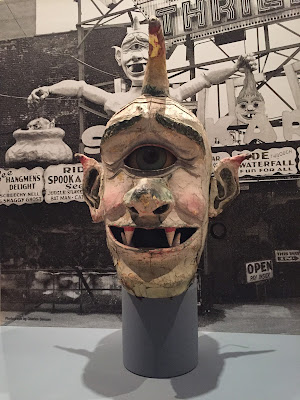
Hello, boys and girls!
The fact that age has had its way with this demon just adds to the icky affect of its cyclopean gaze. 

And then, around the end, where the amusement park was in stark decay and only minority kids were hanging around the ruins (and, some of them, making art), came a wonderful surprise: an installation about Coney Island by a remarkable graffiti artist who briefly worked in my neighborhood in Berlin, and whose new pieces always gave me a thrill when I'd encounter one: Swoon. 

Swoony, baby!

It's kind of hard to depict this, since it's her usual paper work, some of it X-acto cut, some charcoaled, all of it in 3-D and standing up. It binds the past and present of Coney Island together, and is a great end for the show. You've got a little more time with this one: it closes March 13. Go.

Which is what I had to do next: go. Monday saw me cleaning up the apartment, packing, running into the city to celebrate, a couple of weeks late, National Hot Pastrami Sandwich Day at Ben's, a new place to me (it started on Long Island, apparently), with a friend who works at the New York Times.

I had been gone three weeks, and really needed to get back to Texas. I mentioned in an e-mail to my agent that I had to go home but on some level didn't want to and he replied that I wanted to go home but was wishing that home were somewhere else. And he nailed it: very probably, moving back to Austin was the only thing I could have done in October 2013, given my circumstances. While I'm not even sure that moving back to the U.S. was a smart thing to do, I'm very sure that Austin, while it'll do for now, isn't the place for me any more. Walking the streets of Brooklyn was somehow soothing: my family has a long history in the Northeast, and that's where, eventually, I should probably be. It won't be now -- I hope there's a second volume of the book in the future -- but I suspect it'll happen. Brooklyn, the Hudson Valley, maybe even somewhere in New England or (perish the thought) New Jersey. But this trip shook me, and in a good way. I have a lot to do in the coming months, but now I have this to think about.

To be continued in the months to come.

Wednesday, June 10, 2015

Our Digital Overlords Speak

For some time, I've been promising a second half of the post I did about my ambivalence about returning to the U.S., and this isn't it. But the other day, I read a statement that seems bland enough on  its surface, but horrifies me and has unsettled me ever since I read it. It goes, I think, deep into what bothers me about returning to this country and points to a mind-set that is all too prevalent and deeply dangerous. And, of course, immensely popular in certain circles.

The May 18 issue of the New Yorker has a story by Tad Friend called "Tomorrow's Advance Man," a profile of Marc Andreessen, the man who essentially invented the web browser and is now a partner in a16z, a venture capital company that provides money to tech startups. Andreessen is odd-looking, with an almost perfectly egg-shaped head that doesn't show up in the Wikipedia image below because I think he has to be facing the camera for it to register. The New Yorker's picture is arresting, and so is the article, although having so little connection to what it's about I found it rocky enough reading that it took me three nights to plow through it.

Marc Andreessen: Satan or Savior? (Or just deluded guy?)
The quote that got me going is this, which Friend quoted from Andreessen's Twitter feed. "Posit a world in which all material needs are provided free, by robots and material synthesizers...Imagine six, or 10, billion people doing nothing but arts and sciences, culture and exploration and learning. What a world that would be."

You betcha. And I will fight to my last dying breath to see that it never happens.

My blood ran cold as I read that over and over. Does he really believe this? Yes, I believe he does. So do lots of other people, mostly people, like him, who are phenomenally wealthy and have made that wealth in the tech boom. It enables them to trample people in the name of making money to achieve this literally incredible world, because in the end, it's for your own good, helping to bring about your liberation via technology. Just work with for us a while. You'll see. It'll be great.

What this statement elides, of course, is the raw material you're working with. Increasingly, funds for education are drying up across the United States. The privatization of elementary and secondary education is, if not complete, rapidly becoming the default. In what public education still exists, things that I took for granted as a kid -- art and music classes, school band, athletics -- are, if they're even available at all, only available if parents can pay for them. What a discovery that was: my initial exposure to the wider world of music, besides what I heard in church and on the increasingly infequent times my mother played Chopin on the piano, was at school. I learned to play an instrument (badly) and then went on to play it (badly) in the school band, which was a very empowering and educational experience that has stayed with me through the 50 years since I graduated from high school. And athletics! The bane of my existence, but for a different sort of kid, a chance to show off another kind of talent, an excellence that could, under the right circumstances, lead to a professional career (as could music, of course). You mean to tell me that a potential NBA star might be lost because his parents couldn't afford to pay for him to be on his high school basketball team? (I've already had middle-school kids come by my house selling stuff to pay for their school band).

This non-education (you can read elsewhere about the horrors of the Texas school systems and some of the idiocy they pass off as history classes) produces, not to mince words, stupid people. Stupid people who consume and do nothing else are a danger to our republic, and that's who you'd get under Andreessen's dream society. They won't know how to do arts (and do we need more, instead of better, artists of all kinds? Doesn't the current boring state of pop music show us that we don't?), and they'll never be able to produce the kind of critical thinking necessary for science (leaving aside the matter of being taught junk science like climate change denial and creationism), let alone have access to educational institutions where vital science is being done. Culture? More cable TV and reality shows?  Exploration? Isn't that the same as science, or is it just inventing more apps? As for learning, that's just not possible when you don't know how to do it, and as long as ignorance keeps the status quo, it's not going to change.

I see this way of thinking every year at SXSWi, and I see the people who think it, so this profile wasn't quite the opening of a box of horrors that it might have been. But thinking that more apps are advancing human society is a deeply flawed idea. Okay: Facebook. That was something that really did change things. The reason we know Mark Zuckerberg's name is that he made something that a lot of people tried and failed to do. Google releases a Facebook-killer every couple of years: remember Orkut? Anyone figured out Google + yet -- and still use it? Wasn't there one between them that was just so insanely complicated that people abandoned it immediately? Remember Friendster and all those other ideas that cratered? So respect where respect is due. So now Uber and Lyft. Apps that make their owners money by hiring serfs to do the heavy lifting, perform the actual service. I've used each (once), and probably will again when I need to get to the Austin airport, because one of the many things Austin doesn't have and never did or will is workable public transportation. What if some Zuckerbergian kid comes along, analyzes the differences between Uber and Lyft and figures out a way to enhance the experience (say by working out the problem of insurance and finding a way to pay drivers better and perhaps incentivize them -- hey, I'm just making this up) and come up with another app, call it Ryyd, that takes off in a Facebookian way with the public? Uber and Lyft are, in short order, dust. That's the danger -- or, if you'd rather, risk -- of software.

Friend's article is full of these companies, established, emergent, and dead, which a16z has worked with or avoided investing in. A surprising amount of them, however, depend on underpaid grunt labor working without any health insurance or unemployment benefits and the like. When Friend pointed this out to Andreessen, he said "Maybe there's an alternate way of living, a free-form life where you press the button and get work when you want to." Except for having the button malfunction a lot, Marc, that's the way most of my circle are living now. A lot of them had jobs or occupations that the Digital Overlords destroyed: newspaper reporters or magazine journalists, musicians, record company executives, teachers, taxi drivers... But nobody's working on the button, because if they can invent the app, they can get rich quick, and that's what matters, right? Not the destruction of others' lives. That's called "disruption," and if you don't look at the faces of the people getting evicted, if you ignore that their kids are starving, it's way cool, right?

I'm also pretty sure it's too late to turn this around, at least in this country. With unfettered, well-funded, powerful forces in charge of our government, an utterly broken educational system teaching to the test, high culture no longer extant or solely about money, popular culture being made either by algorithms or people who can afford to work for nothing, print dead, our great cities dormitories for oligarchs, and endless war, the United States is a pretty horrifying place to behold.

Me, just before the ship I'd been on sank, I stepped onto a lifeboat labelled book contract, and I hope to use that to do more books and other things related to my writings until I can figure out a next move, which will likely be more writing, definitely not in Texas, and probably not in the U.S. That's a ways off, though, so I put one foot in front of the other and, like I say, live like the alcoholics, a day at a time, except I can have a beer in the evening. I'll avoid Austin as much as I can, having no particular reason to engage with it, and hope I wake up tomorrow as healthy as I was this morning. It beats pushing that button, hoping for a treat.

Sunday, November 23, 2014

On Returning

I'm usually pretty good about this: marking anniversaries of milestones in my life. August 12: I moved to Germany. Late October: I moved to France. October 23: I moved back to Texas. So why didn't I jump on this first anniversary of that last event to put up a blog post?

Several reasons. Mostly, I've been way too busy to do it. That's the good news. But in small part, because I'm ambivalent about having done it. Let's see if I can explain.

The daily vista
Shortly after I moved into this place, I set up a work area that hasn't changed noticeably since then. I bought and built a desk, which had a defective drawer, so I can't use that helpful aspect of it. And I set it up by a window, which is what I've pretty much always done, everywhere I've lived. The outdoors isn't a distraction so much as it's something to look at while I'm gathering my thoughts. More than once I've been absorbed in writing something, then gotten up to get a drink or just to stretch my legs and suddenly notice that it's rained. Didn't even notice.

But I'm under no illusion about how lucky I am. I arrived in the US minus a credit rating, due to the fact that for twenty years I'd lived in places where that information was between you and your bank (and the police, who have access to most, but not all, of your data), and that's all. "He's a ghost," one prospective landlord told my realtor during my search for a house. "It's like he doesn't exist." By a miracle, a friend of a friend (who was my realtor's husband) with whom I'd almost gone into business (said business proposed by the same realtor's husband) had outgrown his house and was renting it out. He was plenty sceptical, because of the no credit rating, but he took a chance.

Which made me scared. I'd been trying to sell a book that, it seemed to me, was a natural. I was sure my agent could do it, but I was hoping he could do it soon. It was the reason I'd moved back here, or one of them: I wanted access to UT's arts library, which I'd used before. There were other reasons, too. I tried, but couldn't seem to master Catalan, which I needed if I were going to move to Barcelona, which was Plan A. The hard disc was full. Oh, I might have been able to do it if I'd just moved there and taken a class, and I'd seen classes that encompassed both Catalan and Spanish. I might, just might, have been able to do it. I didn't actually know anyone there, but I could probably have made a few friends. And I did like the place. But...with no language, not a good idea.

The days passed, and the book didn't sell. Soon, I was in debt to my landlord. That was not a good thing. I was going to have to live like I could become homeless at any moment, because that's the reality in America, particularly in Texas. I still had no credit rating, and if I lost this place, I would have to live in my car. I wasn't much looking forward to that, and eked out day to day. Fortunately, my "broke, not poor" habits made it possible to feed myself fairly well, but they put a damper on having a social life. But I was living from day to day, and that's not what I'd hoped would happen.

My stuff arrived from France, and I started slapping it onto shelves. Unfortunately, there weren't enough shelves. There still aren't.

90º shot from the previous. More (but not much) in the garage.
It's the same way with the CDs: I desperately need to get them shelved and sorted. So far, though, I haven't gotten the shelves or advertised for help:

And there are many more on the facing wall. 
But, a year after I moved in here (Nov. 8, as it turns out, so this post is actually only a couple of weeks late), I have probably got enough money to make it through the coming year. The feeling of being able to pay my bills, to pay my rent, on time, is entirely new to me. And I like it.

Yes, I sold the book, finally, as I've mentioned here. And now I'm writing it. Another reason not to blog: when I sit down and start working, I eat up all my writing energy, although the results, I have to say, have been pretty nice for a first draft. But that was in August, and the money didn't reach me immediately. When it did, I took off on a vacation, sorely needed: after returning, I couldn't wait to tear into the book.

But really, what that means is that my new life didn't actually start until early October. when I got back from the vacation. Just this week, I replaced the transmission in my car, the last major expense of the change. Now, it's just write and write, picking up some extra money on the side from radio work and teaching the informal class at UT, and hoping nothing else goes wrong.

So now that I've been back a year, how does it feel? People keep asking me that. Well, I'm ambivalent, like I said. Turns out I didn't actually need the UT library -- or not yet, not for a couple of years if everything goes right -- but somehow, my psyche gave a sigh of relief at not being illegal any more. France and Germany (and possibly Spain) are no more eager to have undocumented immigrants than the U.S. is, but it does help to be a middle-aged white guy so the racist immigration authorities don't notice you. But Obama's executive order doesn't affect me personally in the least.

Austin, as anyone will tell you, isn't Austin any more. It's a generic American city made unusual by its weather (we had a very mild summer, for which thanks), its live music scene (to which I am profoundly indifferent), and its youth (I was told that the median age here is 28). It is perhaps a tiny bit more cognizant of the issues facing America, but mostly the people who haven't been squeezed out (and who did the squeezing, along with the real estate developers) are as solipsistic and entitled as they are in other hip capitals. The other night I went out to dinner with friends, one of whom has a leg in some kind of cast and crutches, and while we waited to be seated, two men sprawled across a seat made for four, oblivious of the fact that there was a guy on crutches standing right next to them who could have used the seat. (Later, inside the restaurant, they were at the next table and I overheard enough of their talk to realize that they were in the tech sector: no huge surprise). Although Austin voted pretty liberally in the midterms, it's still in a state with a Neanderthal for governor, another on the way, and represented in Washington largely by the kind of people who make people in other countries fear the United States. And I live in a nation that is preparing to sell off its national parks to extractive industries, further our endless war in the Mideast, make sure children aren't educated or taught critical thinking, and all but ban science. And I can't do anything about that because too many of my fellow citizens are too engaged with entertaining themselves to look up from their devices and see what's happening.

All things considered, I guess I'd rather not be here, "here" being both the U.S. and Austin. But I do have work to do, and this is where I am, doing it. I don't want to move again any time soon, either next door or across a continent, so for today, here I am. As for where I'd rather be, I can't answer that. There are days when I miss France fiercely, even knowing I'm not welcome to live there. There are days (admittedly rare) when I even miss Berlin. I miss being able to get on a train and (if I've planned right) for very little money going to somewhere quite different from where I started. I miss efficient public transportation, something Austin will never have, in part to the Koch Brothers "investing" in defeating proposals to build it. I miss the outdoor market at the Arceaux in Montpellier, and the seasonal changes in the produce -- and the fact that, unlike at Austin's "farmers markets," that produce is priced within reach of the average person. (This summer, tomatoes cost literally twice what they did in France). I miss affordable wine that actually tastes good, and I miss a good variety in things like juice and yogurt at breakfast. I miss being in a place with a deep sense of history.

Is there anything that's gotten better? Yes: besides the physical plant of my house with its gleaming and useful kitchen, which has enabled me to cook better than ever, there's Central Market, the enlightened grocery store where I buy the majority of what I do cook there. I don't have to wonder about meats and vegetables and what would be a good replacement: what you see is what you get, and last night, it being stormy, I cooked up my very first pot roast and it was amazing. I also have access to books in English when I need to buy them, in a browsable bricks-and-mortar bookstore with another browsable books-and-mortar record store right across the street. The Chinese and Vietnamese restaurants aren't "Asia" restaurants, and so I patronize them when I can and recognize what I get. There's the inestimable joy of getting bills and notices in a language I understand thoroughly, not just pretty well, so that, for instance, I can easily make out that the $20 hike in my monthly Internet bill is due to a decision to adopt a new deal from my provider that I supposedly made on Nov. 11, even though it was a holiday. And I can protest it in my own language, too, for all the good it'll do me. (Although I have to say the English help line at France Telecom Orange has some brilliant folks working for it). I'm a lot closer to a lot of my friends, even if I do have to fly (which I abhorred even before they shrunk the plane interiors so that I fear an embolism every time I get in one) to see them; it's too bad I'll probably not live long enough to see decent train service in this country. Of course, your grandkids may not, either.

I'm choosing to keep my hopes small and my energy high, and work hard at what's before me without the need to seek out anything more (while still being open to other things, just not with the aching sense of need I once had). Like the alcoholics, I'm taking it a day at a time in my new old place (and, unlike them, enjoying a craft beer after dinner), looking to make it newer with a modest screen to show movies on and maybe a couple more chairs for the dining table (I still only have two), and confident that change will come when it's supposed to. Meanwhile, I do give thanks that I've got work and a decent place to live. Tune in tomorrow, but with luck, it'll be the same, if not better.

Monday, August 25, 2014

Dog Days

It's that time again. And, inevitably, people are complaining. Look, I want to say, you knew it was Texas when you moved here. And, as summers here have gone in the recent past, it really hasn't been that bad this year. Of course, it's not over yet, either.

I used to look at the state capitol building when I lived here last and imagine the workers dealing with all that heavy stone, laying the floors, installing the woodwork, in the depth of a Texas summer. My old house had two window-unit air conditioners and there were days when I was just immobile in the living room as the unit wheezed in cold air. The kitchen didn't have one, and as I remember I ate out a lot, or else ate salads. The refrigerator worked fine; my landlord's brother owned a used appliance store. There was even an ice machine. The electric bills were frightening, especially once I went back to freelancing. The office had the other machine, so sitting in it was okay, and it connected to the sleeping porch/bedroom, a room lined with windows that was just wonderful before and after the summer and winter weather. So life wasn't too bad once you got used to not doing too much. It could have been worse: I could have been working construction.

But then I moved to a place without air conditioning entirely. You didn't need it for the 45 or so days of summer in Berlin, of course, but really, summer in southern France wasn't so bad, except maybe for a week at its height. Which would be right about now. The French cleverly invented shutters, big wooden doors that you could close without closing the windows, so that air could circulate.

The place I live now has central air/central heat, CACH, as the real-estate listings have it, and what I discovered over the winter is that the house is very well insulated. I'd unthinkingly step into the garage and suddenly it was winter, just as now I walk in there and it's like an oven. (Well, it does face east). I've got the thermostat set for 79º, which is about right. The temperature at night slips below that most of the time so that I'm not running the compressor all the time, and the well-insulated interior keeps use at a minimum, although it steps up during the afternoon.

As it should: these past couple of weeks, we've been into the three-digit range. Today's high is forecast for 102º, low of 79º. These are the dog days, the days when Sirius the dog star is above us. Might be: I rarely go out at night, and anyway, the city illumination in the distance would negate seeing it, even if I did know a damn thing about stars, which mostly I don't.

No, boy, it's not about you.
"Cane Beagle" by Ale300885 - Own work. Licensed under Creative Commons Attribution-Share Alike 4.0 via Wikimedia Commons


This weather, though, has all kinds of side-effects. For one thing, it hasn't rained decently in some time. There's a general drought on, which has been going for the better part of the decade, although,  again, it's been atypically wet since I got here. I gave thought to starting a garden, or at least plants in planters, on the back deck, and a friend even presented me with four tomatillo plants he'd kind of impulse-bought during a road trip. They throve nicely (although the chile seeds I got from a friend in New Mexico never sprouted because apparently they don't in peat pots) until one day they didn't. This is something I remember from my previous residence, too. One day, the leaves start looking bad and no amount of watering will change that. In what seems like minutes (but is actually a couple of days), the whole plant goes from plasmolysis to death. Bang. 

Things aren't much better in the critter community. I was planning to write a post in which I was upbraided by the local blue jay family for writing about such lowly critters as bugs and turd-laying toads when there was such a splendid display of avian-Americans available to me. Which is true, even if the blue jays' latest family caused a bit of panic when the kids were learning the ropes and several times flew at the screen in the open window a couple of feet from my head here on the desk, but managing to grab the mesh with their claws just in time and take off again. I don't know which of us was more alarmed. When the lawn in the back yard was going, so were the bugs, including the first lightning bugs I'd seen in decades, and so were the birds eating the bugs. Corvids were popular: there were grackles, of course (Austin's famous for grackles: ask anyone with a car who's parked under a tree they use for sleep), but also cowbirds (which may or may not be corvids, but are structurally similar) and starlings. Grey doves made the scene, with their annoying cooing sounds, but also their ability, unique in the avian world, to suck up water through their beaks. No leaning back and gargling it down for them. My most treasured avian-American visitor, though, was a woodpecker of some sort -- I still haven't identified it properly -- with a body covered with bars of black and white, and a bright read topknot. His station was one of the trees, where he'd cleverly knocked a wound. The wound bled sap, the sap attracted ants, and the woodpecker had dinner. And I shouldn't neglect the cardinals, of whom I have two, male and female. At one point I thought I might have a wounded baby cardinal back there and went out to check. Nope: some bird had found a bright red cigarette lighter in the street, where it had been run over, and brought it into the yard. 

(Although there's sure no complaining about this guy, who may have been dead, for spectacular color. He landed in the driveway, shed a lot of the red, and then disappeared)

There are mammals, too: squirrels and a cat. An old cat. Black and white, and acts like he owns the neighborhood, which in some respects he does. I know when he's around because the jays tell everyone he is. I saw him just yesterday, walking stiffly across my front yard. So as to keep on the good side of my avian-American friends, I pay him no attention: no feeding the predator. 

But the weather in the past couple of weeks has cut back on all this activity. I suspect water is at the bottom of all of it: there just isn't any here because it hasn't rained. My guess is that most of the critters are hanging out near any creek or even backyard swimming pool that's got wet in it. Yesterday I almost hit a squirrel who was attempting to cross William Cannon Boulevard, a four-lane road with a center divider. He was walking oddly, and I think his tiny brain was kind of baked, but it worked well enough that, as the traffic came on, he changed his mind and went back to the starting place. I wondered what was going on, but again, the thought was water. There are no birds in the back yard, few bugs at night, the grass is largely yellow, the leaves on the trees contracted but not plasmolized. 

As the day ends, instead of the colorful sunsets of a few weeks back, we get a sort of annoying yellow light and then darkness. What it portends is the same thing the Weather Service tells me: "abundant sunshine," which sure is a nice way to put it. And hot. 

Well, I knew it was Texas when I moved here. Now for the electric bill. 


Photo by Stephen Wolfe Licensed under Creative Commons Attribution 2.0 via Wikimedia Commons


I'm going to be looking out the window while writing anyway. He'll be back. 

Saturday, June 21, 2014

Midyear Migas

Sorry about the long silence. It's been over a month since my last post. At first, I was holding off until the second half of the dancehall tour happened, but circumstances intervened (Steve's now got his own dancehall to manage!), so that's on hold. Then things started going south around here, and since I like to keep the tone of this blog away from complaining and doom and gloom, I (wisely, I think) refrained from posting any of it. Suffice it to say that the book I spent a year researching and writing a proposal for, a proposal my agent loved and submitted over the course of nearly a year and a half to over 20 publishers and imprints, failed to find favor with any of them. Since one reason I moved back to Austin was that the arts library at the University of Texas has much of the stuff I'll need to write this book, I began to wonder why I moved back. I don't have much in the way of a social life here, I've lost all interest in live music, and only one of the people I've invited over for dinner accepted.

But there are things that'll be turning around in the next 30 days, unless my landlord decides not to renew my lease (somebody tell me why I took the 8-month option instead of the 12-month option, please). In that case, since I still don't have a credit rating and nobody will rent to you without one, I'll be on the street, my stuff in storage. I'm hoping that doesn't happen: my course at UT starts up again on August 1, and there are already six people signed up, and there's a project in the works that should be unveiled before that that I hope will solve all the current problems. But more on that when I'm ready to unveil it. All I know for certain is that on Monday I go to the dentist and wind up with new teeth, so for the first time in a decade, I'll be able to bite and chew like a normal person. Which means I can take on some barbeque and not have to arrange dinner around its chewability factor.

Anyway, excuse the absence, and let's move on to the very few things there are to write about here.

* * *

First, yes, food. I continue to navigate my way around American foodways, and continue to be confused. Not, of course, that anyone seems to cook any more. Too many times, I've headed off to the supermarket and returned with stuff that's already prepared, or half-way so, and heated it up and dumped it on a plate. That's in part due to the fact of the audience of one, but also due to the fact that too many times I head to the market with no idea of what I want to make. See dental problems, supra.  Now, I'm writing these words after returning from the closest farmer's market, Sunset Valley, which is held on Saturdays. To someone who went twice weekly to the market in France, it's a huge disappointment in terms of variety. Of course, I'm grumpy enough to wish that the musicians would just go away, ditto the handcrafts people and the prepared-foods people. I've heard that Tacodeli is a fine place indeed, but I don't go to the farmer's market for tacos.  Or kombucha on tap or all the other gluten-free, vegan, blahblah stuff. I want fruit and vegetables. 

Of course, I may not know the cycles of the growing season yet (and the Austin Chronicle discontinuing Kate Thornberry's farmer's market because the crazy dame asked if she could be paid for it doesn't help), so every couple of weeks I head up there to look around. Occasionally I get eggs, and then I walk around seeing who's got what. Lotsa squash today, and some of the most overpriced tomatoes on the planet: so-called heirloom tomatoes were €3.50 a kilo in France, and here they're $3.95 a pound.  Plus, nobody seems to know what kind they are. Bah. Looks like there's some okra already, but that's not high on my list at the moment. At least the ragged grey bundles of kale are gone. So the result of today's expedition is shown below. 


One humongous bundle of basil ($3.50!) and one tiny melon ($3!). But some of that basil will become pesto, and the main reason I bought the melon was because it was the first one I saw that wasn't the size of a basketball (you think I'm joking? Okay, a soccer ball. Seriously). Those cost a buck more, but I doubt they have much flavor. At any rate, there's far too much of them for me to use up, so later this afternoon, I'll go buy some Mexican ("key") limes to squeeze into the center of half of that some morning for breakfast. Still, compared to the bounties I used to photograph in France, this ain't much. 

Next impossible-to-figure question: why is there only one kind of juice in the store (orange), which exists in about 40 different forms (with pulp, some pulp, no pulp, added calcium, etc etc)? What's the deal with pulp? Who cares? Why put calcium into orange juice? Why can't I buy less than 1.75 liters? I sit back and remember being able to get mandarin juice, pineapple-lime juice, strawberry-orange juice, blood orange juice, and many other flavors, all in one-liter containers, made by Tropicana, an American company. Ah, well, maybe some day. 

* * *

Speaking of cooking, since I notice that Mick Vann has posted a couple of long pieces on his knives (here's the first of the series; there are two more), I'll post a shorter one on mine. When I left France, I was using three knives, two Henckels, a big chef's knife for chopping and a smaller one for mincing up garlic and carving tomatoes and the like, and a beautiful Japanese knife that was razor sharp, which I used for turning, for instance, herbs into powder. The Japanese knife had a serious injury early on in France as I cut into a saussicon sec from the market and hit the metal brad that's used to seal it closed, which had inexplicably migrated into the meat. This hurt, I gotta say. I'd bought this knife in the market in Kyoto at the legendary Aritsugu store, and I'd taken exquisite care of it up to the moment when it hit that metal and the edge got dinged badly. 

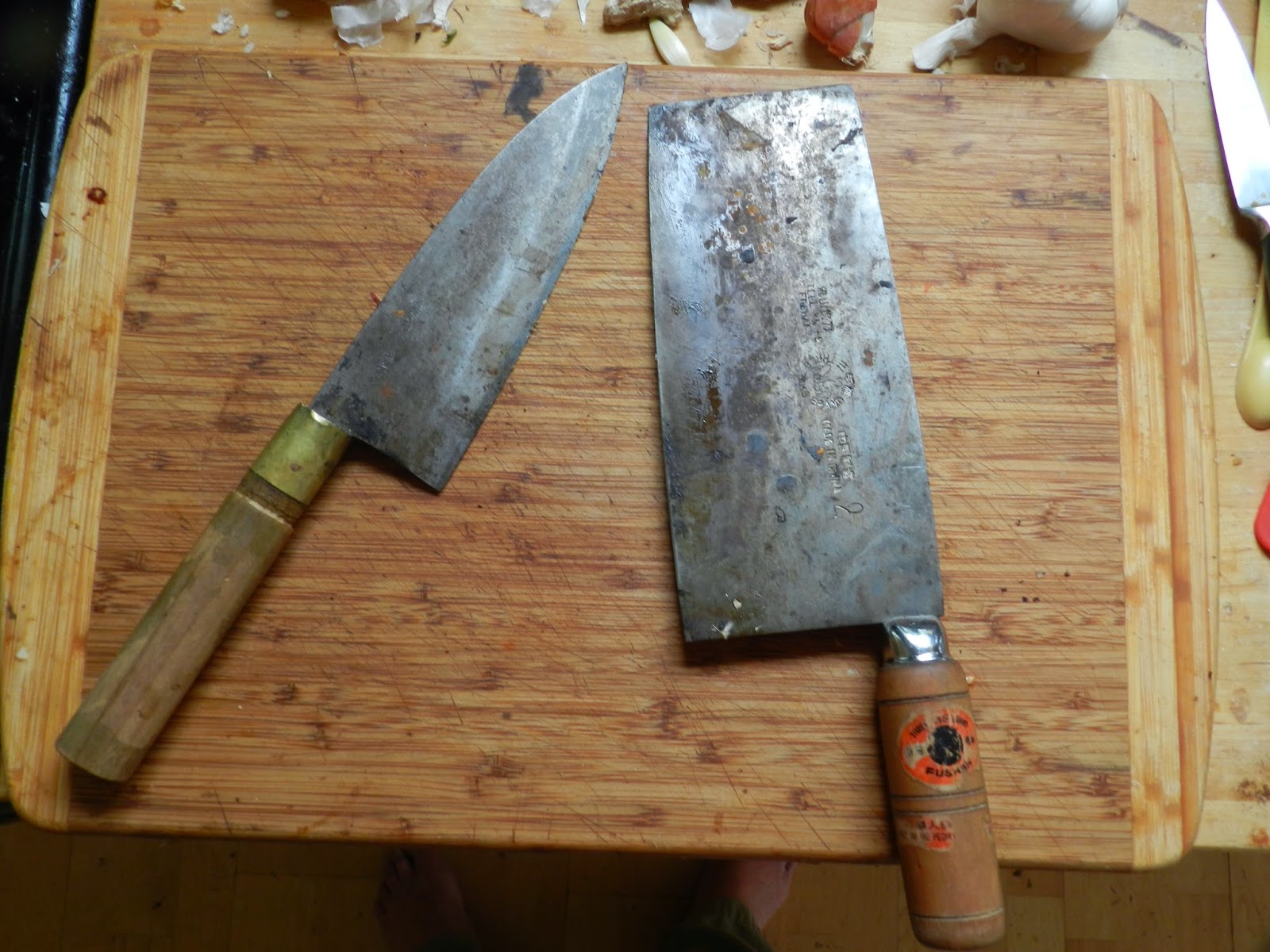
Then, when I moved, I wrapped those three knives up and shipped them with the rest of the kitchen stuff, which, since it took months for the movers to get here, meant I needed knives in Austin. Fortunately, in King Tut's Tomb, aka the stuff I'd had in storage for ages, there were two Chinese knives, bought years ago and almost never used. One was a cleaver, the other a flesh-cutting knife.

Meat knife, cleaver (L-R)
Now, there had been times when I wanted a cleaver, and all of a sudden I had one. To my great surprise, it did great service when it came to, for instance, chopping stuff really fine: ginger, garlic, onions, etc. I haven't dismembered a chicken with it yet, and I don't know if it'll do that, but I use it pretty much exclusively for chopping at the moment. And since I've been doing a lot of Chinese food here since I moved back, it's come in very, very handy. Enough so that the big chef's knife more or less just sits there.

The other knife, though, its acquisition lost in the haze of time, was a revelation. When I was at Aritsugu in Kyoto, there was a saleslady who spoke impeccable English. I was admiring a number of knives there because I was looking for, well, what I got: a fine-chopper, but razor-sharp enough to cut tough stuff like meat. She explained that the vast majority of what they carried was for sushi, and so the blades were shaped for that: |/. The straight edge helped cut thin, even slices. (For comparison, a French chef's knife would be \/, and the cleaver ||.) They only had one or two French-style blades, and she showed them to me and I chose one, which she sent back to the master to hone perfectly. (She also asked if I wanted my name in Japanese for free and for reasons I still can't figure, I declined). Anyway, this knife-of-unknown-origin is clearly a |/, and when it comes to slicing meat for Chinese food, it just glides through it. Flank steak is no problem, and it laughs at chicken.

If it helps, the meat knife seems to be a Shigemitsu from Sakai, Japan, which means I probably bought it in San Francisco's Japan Center in 1970. The cleaver is a Three Rams brand, no doubt acquired in San Francisco's Chinatown at some point, or maybe at Austin's legendarily smelly, cramped Oriental Market on Airport Boulevard.

And a little secret: I had a friend who was a chef for many years, and every day he took to work a nice selection of really beautiful knives, all in a cloth doohickey with slots for each of them that rolled up and was tied shut. Then he would proceed to use two, maybe three, of them. "They don't respect you if you don't have an impressive collection," he said, "but hell, how many do you need?" Exactly.

* * *

Finally, a cretur update, which the delicate may wish to skip. 

As the weather warmed up, I began to notice a small grey gecko living in the wood trim of the garage, who'd walk around close to the house and gorge himself on ants from one of the anthills near the front door. He'd disappear fast when I walked by (although one time he was so busy gobbling ants I almost stepped on him). But he vanished, and one morning I found an odd turd in the driveway. Not quite an inch long, but pretty fat, and in the shape of a J. I wondered if that might have been the gecko, but also worried what kind of animal might have deposited it. I do have something of an attic in this place, and would prefer it keep devoid of opossums, raccoons, and squirrels, not to mention rats. 

So imagine my alarm when another, identical, J appeared on the back deck. I enlisted some more savvy friends to help me figure what it was, and it took no time at all: toad. Really? A toad with an intestine big enough to leave that? Dang. Anyway, I haven't yet laid eyes on Turdy, as I've been calling him, but it did remind me of the evening I was sitting on my porch in my old place here, enjoying a summer storm passing over, and listening to the stereophonic frog chorus that lived in two nearby culverts. One was tenors, one basses, and they'd alternate and then sing together. I can't imagine any female frog in Texas resisting them. Anyway, my ears were open, and I heard this intermittent squeaking sound, like someone making annoying noises on the outside of a balloon. Squeeeek. Long pause. Squeeeeeeek. What was weird was that my ears told me it was coming from a few inches away. The next time it happened, I found it: there was a crack in the concrete of the porch and something was emerging. More of it appeared with each squeak. Finally, there was a huge push and a toad emerged, fully three inches long. How it had pushed itself through that crack I don't know, but I saw it happen. It sat there, inflating a bit and, after a couple of tentative steps, hopped off to the nearby creek in search of what the frogs were in search of. I've since read about toads who've lived in suspended animation for upwards of a century, sometimes put as a joke in a cornerstone of a building. Many of the ones who do this are the famous Texas Horned Frog, or horned toad, as depicted on Texas license plates. What's ironic about that is they're just about extinct. I've been in their habitat a lot and never seen one outside a zoo.  Anyway, Turdy likes it near lights that attract bugs, evidently, so he's welcome to hang, even if I don't see him. 

And, just to reinforce stereotypes, I found another cretur a couple of weeks ago. When I moved in here, I sprayed the garage with some kind of fog that, it alleged, stayed live for months. Sure, I told myself, as long as it kills what's already there I'm cool with it. But it appears that it does work, because one fine morning I found this dandy, who hadn't been there the day before. 


Yes, that's a quarter
Everything is bigger in Texas! Admittedly, I drove over him with a handcart as I was trying to get a bookshelf into the house, but it didn't hurt him much except to detatch one of those huge antennae. These roaches are so-called tree roaches and are much happier outdoors than they are in your kitchen, and will frequently run for an open door or window if given encouragement. You do not want to smash one, since they contain, um, plenteous soft filling. 

* * *

So there we have three short items on the year's longest day. Wish me luck for Monday, and stay tuned; there's about to be some action around here. 
 
Site Meter