Showing posts with label Pic St. Loup. Show all posts

Tuesday, August 23, 2016

Midsummer East Coast Tour, Canada And Back

Why the train is relaxing.
There are better times to visit Montreal than the ones I've visited in the past. When I lived in Europe, I'd go as I left the country after SXSW, stopping in New York, then heading north. The trouble was, late March up there is like early February in other places, and I've had to make my way through loads of snow and slush just to get from one place to another. Not to mention the time the train back to New York froze and the rescue vehicle coming to fix it fell over on its way up from Albany. But summer, summer's very different.

In fact, this year, Montreal was suffering higher temperatures than New York, which was odd indeed, and I was beginning to regret having packed the jeans jacket I figured I'd be needing. Not to worry; it rained the day I spent on the train, and by the time I got there, it was considerably milder.

This was to be a quick trip, to come down from the New York experience before heading back to Texas to start doing publicity for one of the two books I have coming out this year, so I wasn't in any particular rush to do anything when I got off the train except check into my hotel and get dinner. Fortunately my friends Terry and Patricia had done research on the latter and were at the station to hustle me into a cab. Dinner turned out to be up a side street around the corner from the hotel in a restaurant called Bonaparte. It was first-class: absolutely traditional French cooking -- I had a goose-leg confit with a mushroom ragout, and Terry and Patricia had skate wings and veal -- done perfectly. The big surprise was the wine: it was an extensive list, so I stuck to what I knew, and picked a Pic-St.-Loup I'd never heard of from a winery that seems to be brand-new. A glance at their website doesn't show the wine we had, which had a Japanese name, but I know the area they're located in, and the rest of their stuff looks very interesting.

On the way to the restaurant we noted a video projected on the side of one of the buildings: a black woman was running towards us, fleeing a wall of flames. Terry said there was a 19th century woman who was accused of arson who'd become a symbol of racism and sexism. On the way out, though, she'd been replaced by a young Jackie Robinson, who'd gotten his start in the minor leagues in Montreal. Apparently there are a number of these things around the city, called Montréal en Histoires, with an app that can help people discover where and what they are.

Terry was anxious that I see the Pompeii exhibition at the Museum of Fine Arts, so Sunday we hustled down there to discover a line out the door and down the block. So much for that, but there was also the Redpath Natural History Museum at McGill University, right nearby. Terry described it as an instructive look at an institution of a previous century struggling to catch up with changing attitudes, particularly in its cultures-of-the-world section. I knew what he meant: the natural history museum in New York features quotes from Theodore Roosevelt about Manliness and Duty set in metal letters right in the marble walls, and as I waited for my ride to Nyack, I gazed at the huge bronze statue of him outside, on his horse, leading the inferior races -- an Indian in a big warbonnet and a mostly-naked Negro -- into a glorious future. They may have to deal with that some day. But for some reason the Redpath was closed on Sunday.

Trying to salvage the day, we headed to the Fur Building, a nearly block-sized structure downtown that had held the warehouses for furs, back when that was one of Montreal's biggest businesses. Today, the fur companies have left, and artists and galleries, happy to have such huge rooms with long windows at their disposal, have moved in, along with a couple of dance studios, martial-arts instructors, and yoga studios. We'd been there before, and the galleries never seem to be open at once, so you pick your way down the hall to see what's open. Of course, it was August, hardly high season in the art world, so there wasn't much to see. A couple of galleries were open, but I doubt they were showing their A-list clients. There was an amusing video shot under some elevated subway tracks, the images heavily treated, and one mysterious and effective installation where objects were placed in square columns of frosted glass. Some of them were moving, some not, and the amount of visibility on each side varied. It was clever, which was more than you could say about most of the rest of the stuff.

Having arted, we made it back to my hotel, rested our feet, and finally set out for an experience we knew would be deeply satisfying: dinner at Cuisine Szechuan, which I consider one of the best Chinese restaurants in North America. Since the last time I was in Montreal, Terry and Patricia have befriended the owner, who happened not to be in this time. Still, the place was superb again, and since they turned the ordering over to me (except for starting with both Szechuan-style -- in a tart sauce with Szechuan pepper and toasted sesame seeds -- and Hunan-style -- in a peanut-based sauce -- dumplings, traditional favorites going back years in this place) we wound up with a bunch of stuff nobody had had before: a meatball soup with glass noodles, crispy chicken with a lot of stir-fried vegetables and a sauce I'd never heard of before, and a casserole of eggplant and fried tofu in a garlicky sauce. (I think there was one other dish, but it's not coming back to me: it was one of the ones whose leftovers they packed up for the next day's breakfast). Two great meals in two nights.

Terry and I got into the Pompeii show on Monday, and it was very much worth it. A lot of what one goes to see at Pompeii isn't exactly moveable, nor were all the first-class artifacts taken on the road for this, but the show (which I can't seem to find moving elsewhere, although it showed in Toronto last year) brilliantly exposes daily life in Pompeii (and the other two towns that got hit by the eruption of Mt. Vesuvius, Herculanaeum and Stabiae, the latter a tiny resort town that never gets mentioned) through intelligent labels and well-lit displays. Sports, sex, business, daily life, all get their rooms, and then one walks into a room with a dramatically-lit cast of a dog that died in agony and the four walls projecting the progress of the disaster, the chronology of which we know because the Plinys, father and son, were living nearby and went to rescue friends of theirs from the eruption. Pliny the Elder's lungs got filled with volcanic dust and he died during the rescue, while his son, when it was over, wrote a detailed letter to the historian Tacitus about what had happened. It's a dramatic use of space: after we've seen all the artifacts, the decorations, the silverware, the shrines to the household gods, the statues of unknown people, we're in the destruction. The next room has casts. Everything was covered by ash so quickly that people were suffocated, and when the ash hardened, their bodies disappeared. When these hollow areas are discovered, casting material is poured into them and the cast is excavated. There are men, women, a child, all at the moment of death. In the next room, a film shot by U.S. Army personnel stationed in the area documents a 1944 eruption, the latest major one.

After this bravura display, the rest of the museum could have been a letdown, but it wasn't. A fine Toulouse-Lautrec show had many of his familiar images, but put them into the social context of his circle and Bohemian Paris in general, and was just large enough. The permanent collection, like those in many regional art museums, is largely filled with the best work of second-tier artists, enjoyable in its way. At least that was true for the older stuff: downstairs there is some first-rate stuff by "name" modern and contemporary artists and some surprises by folks I'd never heard of, not all of whom were Canadian. There was a separate gallery for Canadian stuff, a design gallery, and lots more, but I began to get art burn after a while, so we left and headed to the Redpath, which was quite a let-down after what we'd both seen and, yes, trying its best to put things into the current cultural context.

I was pooped, so we headed back to the hotel to meet Patricia, who'd been studying at Terry's office at Concordia University. She was going to take a French proficiency test, passing which will mean she can work in Quebec. Make no mistake: French is the first language in Montreal, even if it isn't for a lot of its population. It's a shred of cultural identity for Quebec to hold on to, and they do so like pit bulls. We took a bus to Point St. Charles, the tough Irish working-class neighborhood that's very slowly gentrifying, so I could see the current progress on their house. (Others who are interested should check out Terry's blog on the subject). We had no idea where to go for dinner, so we decided not to go far. Across the street, as a matter of fact. Chez Dallaire is a hipster bar in a non-hipster zone, but it seems to attract enough people to keep going and has added a small but interesting menu. Across the street is a place I have yet to try, Boom-J's, run by an affable and savvy Jamaican. So while it's a bit premature to suggest the Point as a destination for dining, I bet in five years it'll have some great stuff to offer. As for now, we had pork rillettes in a little glass jar for appetizers and "grilled cheese" sandwiches for the main course: toasted high-quality bread enveloped a wad of smoked meat -- Montreal pastrami -- and had a tangy cheddar-like cheese melted over it. Along with the craft beers they pour, a satisfying meal. These guys look like they'll make it.

Happy diners, Chez Dallaire


Having had a "sandwich vietnamien" that was made from canned tuna in the museum, I was anxious for the real deal, and Montreal's Chinatown was just down the street from my hotel. With Terry and Patricia sidelined by work for much of the day, I'd have time to find the place Terry had told me about when I was expressing my disappointment with the museum sandwich: real Vietnamese banh mi. I had Terry's instructions with me, but no such place was in evidence. I walked the streets of Chinatown, untempted by the Chinese places (I'd just been in the best of them), and finally settling for a place with a specialty of "soupe tonkinoise," which, because Quebecers don't like foreign languages, means pho. This place had a line in front of it when I first passed, but by the time I'd scoured the rest of the neighborhood, it had calmed down, and despite its weird name (Pho Bang New York, possibly connected to a New York restaurant also called Pho Bang) I went in and had a pho that had the best tasting broth I've had in a long time. It's at 1001 Boulevard St-Laurent if you're in the neighborhood. And another cool thing was stepping into a tiny shop to see if they had gong fu shoes, which make wonderful house slippers, and not only finding them, but finding big enough ones to fit my feet, a sign that Chinese people are indeed getting biger. Ten bucks Canadian, too. Can't beat that.

The latter half of the afternoon was meeting up with Terry and taking a whirlwind tour of the magnificent Atwater Market to pick up groceries he needed and admire the just-in Quebec strawberry crop, which I wished I could teleport back to my place in Texas. The tomatoes also looked great. After depositing this at the house, we decided to visit another gentrifying neighborhood, this one with a lot of history. For a long time, much longer than was healthy, Terry was married to a woman he'd met in college (we both went to Antioch). I performed the ceremony, in fact, with my Universal Life Church credentials. Eventually, the marriage fell apart, divorce papers were filed, and much ugliness ensued, with the bright spot being Terry's deepening affair with one of his students, Patricia, whom he followed to Japan, where she was teaching. During Terry's previous marriage, they'd lived in a suburb called Verdun, where I visited many, many times. It was gritty, working-class, and not that easy to get to on the Metro, either. But it did have potential, and now some of it is being realized. Terry remembered that Wellington, a main street a quick bus ride away, had a number of good restaurants on it, so we headed down there. Alas, it may have had, but like many pioneers, they'd gone out of business or been forced to change menus. True, there were two Indian places, which I certainly would have appreciated way back when, but we stumbled on a fish joint that doubled as a market: Queue de Poisson. They do excellent fish and chips, the grilled monkfish I had was perfect, and there's a good selection of Canadian craft beers. (A note on these: Quebec microbrewers seem to be chasing French beer as an ideal. Folks, French beer just sucks. Try to embrace a teeny part of your English -- or even American -- heritage for at least a couple of your beers. Thanks.) Once again we ate outside, once again the young folks who ran the restaurant did a great job. First Point St. Charles, then Verdun. There's hope for Montreal yet.

Sunset, Hudson, NY railroad station


I said good-bye to Terry and Patricia when they got off the bus and then rode it the rest of the way to my hotel. The next morning, Amtrak took its sweet time getting me to New York, but I managed dinner and a good night's sleep, then spent the next day shopping for salt-cured anchovies (at Eataly, of all places, and a good sight cheaper than in Oakland) and got to JFK with lots of time to spare.

I was headed home, and happy about that. Less happy, though, that that home was in Texas. Not that I'd gotten any inspiration where to go next (which won't be for a while). Jersey City has pockets that are real nice, and much larger areas that just exude despair. I hadn't seen enough of Nyack, Hoboken was out of the question, and forget Canada. Still looking. I've got time.

Saturday, October 5, 2013

T Minus Two And One Day: Paralysis

Hang on: not so fast!


What I did for the move yesterday:

Nothing.

What I've done so far today:

Nothing.

What still needs to be done:

Not quite everything. And it's the "not quite" that gives me hope. There's a lot of stuff that I shouldn't be doing: packing the books and so on is included in the moving price, and were I to pull them all off of their shelves, I'd have nowhere to put the boxes. If I had boxes. Also, it's kind of hard to pack things I'll be needing in, say, the next seven days. Or ten days.

And some of the stuff I've needed to do has come to pass: I got a quote from the mover, along with an official letter of what they will and will not do for that money. It's about as much as I thought it would be, although I'm now trying to trim it down just a bit by deciding not to take some stuff I thought I'd take. And I have to put together a letter with some questions in it for him.

Another thing I've done is to photograph my CDs. Which, given that they're wedged into an area not quite big enough to hold me, has been a pain.

Don't worry: there's an in-focus version of this
Some, like the ones above, I photographed by lowering the camera by its strap. The lack of space in this house is absolutely amazing. But bit by bit, and with the help of my couch, I've gotten most of them, although there are more yet to shoot. I only get a couple of hours when the light is right for this: for the sunny South of France, this is one dark apartment -- and fall is upon us, too, which means less bright light.

There, that's better!
Another thing I've done is to engage the services of the amazing EP. EP was a high school kid who somehow met Chuck and Judi, who ran the English Corner Shop a couple of years ago. An Apple computer genius (not from the genius bar: he disdains them because "they are not real geniuses"), he helped them with all their technology problems and then, when it came time to move, he proved himself omnicompetent there, as well. At one point, he bought all my dead computers, fixed them at home, and made a pretty penny. Now that Chuck and Judi are happily settled in Ecuador, they suggested I contact EP, who's between school and college, and he came over the other day, looked around, and had a bunch of good ideas. Another thing he has is a mother who works at Brico Depôt, which may or may not be the same company as Home Depot, but sells moving boxes for the things I want to pack myself, like all this crap on my (physical) desktop. And although they're cheap enough, she gets a discount.

So I'm not entirely procrastinating, although the place looks more or less like it did when I typed my last post. I've also made arrangements: I've booked two nights at a hotel for my last two nights in town. The movers will, I hope, come on the 18th. On the 19th, the charity will come take everything that's left. On the 20th, well, I'm free, because it's a Sunday and you can't do anything on Sunday in France. I just hope I can get into a decent restaurant for my last meal in Montpellier. On the 21st, I've got another Senior Super-Saver First Class train ticket to Paris, a hotel not far from the station, a ticket to the Centre Georges Pompidou for the Roy Lichstenstein show I've wanted to see so badly (fitting that a year that started with Philip Glass comes to an end with Lichstenstein), dinner with a friend from the Well at a Cameroonian restaurant, and, the next morning, a short walk back to the train station where the Air France bus to Charles deGaulle will deposit me at my terminal.

(Oh, about that ticket: SNCF, the national railway, totally rebuilt the Montpellier station, and it's a lot nicer place. For the most part. I was expecting an easy job when it came to picking up the ticket I'd bought online, and walked into the huge room labelled "Billeterie" with my receipt only to be met by a bunch of computer terminals, inexplicable screens on the wall, and a small area in the middle with humans in it. I wandered around confused, tried to get the ticket via my credit card from a machine which refused it because, like all American cards, it has no chip, and finally located a woman who was handing out tickets with numbers which, when they came up on one of the screens, gets customers to a human. It took forever. In the old place, there was a bank of SNCF people at a counter and you stood in line. The lines were frightful. They also moved with incredible speed. Yesterday was the longest wait for a ticket I've experienced here. Let's hear it for technology!)

I've also begun to think about Austin, perusing a clever personalized web page of rentals a realtor friend has made for me, as well as cheating on her with another realtor and, of course, Craigslist. I've indulged in some fantasy furniture shopping and found at least one couch that looked right. I'm utterly baffled about the music situation, though: I hope someone sells what I used to call "stereos," ie, amplifiers into which I can plug a CD player and the turntable that's been sitting in storage for the past 20 years (now that I've given all my vinyl to my archive at the University of Texas), and maybe a movie playback unit of some sort. I've got the same excellent speakers (University Seniors) my dad bought me when I went away to college in storage, too. Oh, and there's also health-care...

Enough! Two weeks is plenty to deal with this, and I'm still here. I went to the market this morning and the fall bounty is beginning to come in, with the last of the summer (I scored a melon and three peaches, but I doubt that'll be possible much longer, let alone the tomatoes, which looked kind of scraggly) hanging in. We had some very dramatic thunderstorms last night -- orange alert! -- and this morning the air was so clear as I walked to the market that I realized I could probably read the date on a dime being held by a guy on top of Pic St. Loup, with good enough lenses. Of course, I also realized that it'll be a long time before I'm back there, or able to go find that castle on l'Hortus. There's a lot of sadness on the horizon, I can see, when it really kicks in that I'm not here any more.

One day at a time, like the alcoholics say. Be here now, like ol' Dick Alpert says. Better get some lunch, like my stomach says. Wonder if those pears I got on Tuesday are ripe yet?

Saturday, June 15, 2013

The Mystery of the High Castle

If it should ever occur to you to visit me here in the beautiful Sud de France, and should you have the time and the money, and should various other factors work in our favor, I'd ask you to rent a car (assuming you lived in the U.S. or Canada or outside France, at any rate -- that way you get unlimited mileage instead of 250km) and I'd take you on my Languedoc's Greatest Hits tour.

That's how I spent yesterday, and, save for one snag at the end, it all went very well. And, fortunately, the person I was showing around was of a very inquiring turn of mind, so we saw and did a lot of things.

The tour always starts in Sommières, a small town, formerly walled, which has a Roman bridge from the first century AD leading into it, a castle of sorts (pretty ruined, and not open to the public) looming over it, and a couple of decent places to have lunch. Yesterday, I didn't think I was going to get across the bridge, because there was a profusion of odd waterfowl, including a pair of black, black swans, who kept giving photo opportunities. At one point, a huge mammal appeared, nearly two feet long, leisurely boogie-ing downstream in the river. It looked to me like a muskrat, but...do they have muskrats in France? Anyway, he was determined and it was odd to see his hind legs propelling him along as his nose and most of his body stayed dry.

Sommières Market Square and Beyond
I've posted lots of pix of this town, which does a brisk trade in British tourists and the sorts of things they buy, but with its lazy river, medieval superstructure, and quiet vibe, it makes a nice start to the tour.

Leaving Sommières, I head down a road that leads through wine country, and, eventually, to Pic St. Loup, a mountain visible from downtown Montpellier. It has a twin, l'Hortus, a "limestone escarpment," which makes it, technically, not a mountain. On the side facing the Pic, it has sheer limestone cliffs, in which, apparently, have been found Neanderthal dwellings. There is a winery, Domaine l'Hortus, which produces some very wonderful and affordable wines, although that could be said about the whole Pic St. Loup area. It's been "discovered" by the wine world, but there are still bargains to be had.

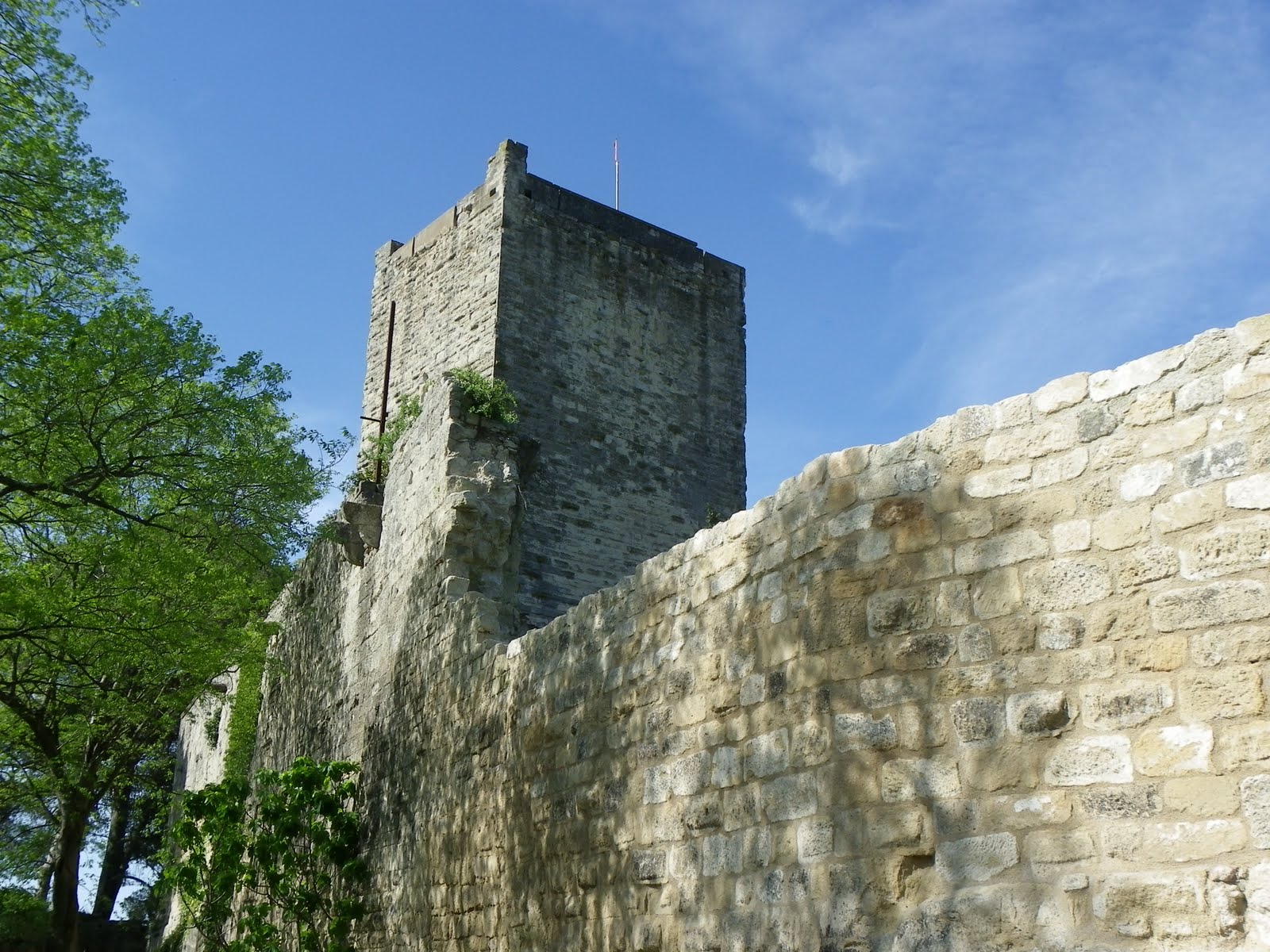
It's possible to climb the Pic all the way to the top, where there's allegedly a small chapel founded by the saint who gave the mountain its name. I've never done this, but the mountain is quite dramatic just from the side of the road. But it's l'Hortus which continues to fascinate me. The main reason for that is that I thought I once spotted a huge castle on it -- but only for a second and, because I was driving, only out of the corner of my eye. The place where this apparition appears is not conducive to taking one's eye off the road, though, and until yesterday I never got a good look.

Fortunately, as I said, my passenger was very interested in all kinds of things, and we found a convenient place to stop. We got out of the car, and through the trees, with the aid of my trusty zoom lens, I was able to snag a couple of pictures.


Very Mysterious
Now, this is out in the middle of nowhere. What you can tell from these two photos is that the building has buttresses and that the windows are arched. It doesn't look at all recent.

A little further along, we spotted a fine place to pull off the road and got out and found a better vantage point. Here, it was possible to get a shot of the entire ruin.

Even Mysteriouser
It may, with enough time, be possible to hike up to this thing, but I'm not sure how. (Remember, all of these pictures are at almost the maximum of my 36x zoom). Anyway, as you can maybe feel if you stare at the pictures long enough, it was nice and warm out there. I'm wondering if there's not a way to this place from the top of l'Hortus, and if it's possible to get closer to it.

Now that I've established just where it is, I notice there's a very tiny village up there called Le Fesq, and a road (D122) that may pass not far from the castle. I need a higher-resolution map than Michelin can provide, though, and even then the historical context will be missing. Who built this? Why? When? Who trashed it? It's pretty clear that the roof's been blown up.

NOTE: Later, after posting, we found it: this long essay is in French, but this is it.

At any rate, the rest of the trip -- the quiet of the tiny Romanesque church in St. Martin de Londres, the UNESCO sites of Pont du Diable and St. Guilhelm le Désert -- went well, but we arrived in St. Saturnin too late for me to buy a six-pack of the IV Pierres rosé from the Domain d'Archimbault, dammit. Making things worse, at the superb visitors center that serves Pont du Diable and St. Guilhelm, my friend got to taste the IV Pierres white, a masterpiece of a white wine, which this region isn't exactly known for. But not me. No, I was driving.

Not that I'm complaining. I saved that for the trip back into town, Friday afternoon Montpellier rush hour, which was just about as much fun as it sounds like. But we got away with €8.50 worth of gas for the whole thing, which I found remarkable.

So now I need your help. If anyone has some details on the castle/fort/thing I'd like to have them. And I'd also like more of you to come visit before I leave France, which is going to happen at some point. Great food, wine, scenery, and castles guaranteed.

Saturday, October 20, 2012

Early Fall Miettes

Just a few items here, because I'm in sort of a time crunch.

First, I took a couple of American tourists on my famous Languedoc's Greatest Hits tour, the one that hits Sommières, goes between Pic St. Loup and l'Hortus, up to St. Martin de Londres, the Pont du Diable, and St. Guilhem le Désert, and finished up, as I did a couple of months ago, in St. Saturnin so they could do some wine-tasting. We got there kind of late, were very happy to see that Mme Cabanes was still open at Domaine d'Archimbault, decided to skip Virgile Joly, and went over to the cave cooperative of the St. Saturnin wine collective, which was still open. The young woman in there was looking at the skies with some trepidation, but was happy to practice her English on the tourists. We obviously did things in the wrong order, because nothing she poured was anything near as good as Mme Cabanes has, but she did offer two interesting bits of lore. "It's difficult doing a tasting when the weather's like this," she said. "The air is thick, heavy, and it will probably rain. The wines never taste at their best when it's like this." In fact, I'd already noticed this over at Domaine D'Archimbault: there was a kind of mugginess that hadn't been there last time. "The other time you should never taste wine," she continued, "is during the harvest. That's even worse than now; some of the wines can actually taste bad. I have no idea why this is, but it's true." She assured us that the cave cooperative was finished with their harvest, though.

Incidentally, if you're visiting Montpellier and would like to take a day to do this tour, don't hesitate to ask. I love getting out of town, and the route of this tour is pretty flexible, which means there are lots of other possibilities of things to see.

* * * 

I got an e-mail the other day from a woman named Marielle Lopez, informing me that she had opened a shop selling Mexican handicrafts and art objects not far from my house, and that starting Friday, she'd have a Dia de los Muertos display there, and would I be kind enough to tell the other Americans in town about it? Sure, I said, be happy to put it on my blog. So yesterday, after I did some other stuff, I wandered over with my camera. The place was locked up tight and there was a sign in the window saying that it was closed for the day. Okay, I said, I'd go back tomorrow. And I did, about an hour ago, and the place was still locked up, although there was a woman in there looking at fabric samples. She was ignoring me, so I shrugged and walked away. As I made my way up the hill, though, I ran into a couple of people I knew, Claude and Florence. Florence, way back at the start of this blog, was featured for her unusual art which takes its inspiration from Mexican calaveras, where skeletons take the parts that people take, a big part of the Day of the Dead tradition. I mentioned that it was the second day in a row I'd found the place closed, and it turned out that they were on their way there to finish the window display, which was the Dia de los Muertos altar. Ms. Lopez, apparently, had just had a baby, which wasn't supposed to be due until November 10, but came last night instead. 

So I caught up with Claude and Florence, and took some pictures. Kind of hard to get the window, both because it wasn't finished and because there wasn't much room. 


There are other calaveras scattered around -- a nice display of Mexican folk art -- as well as some lucha libre guys. 


And, for that Franco-Mexican touch, some of Florence's pieces, although not as cool as the ones she had at her gallery show. 


All in all a nice little show, so if you're over on the other side of the hill from me, stop in and take a look: Modarte, 15 rue Pila St. Gely, 34000 Montpellier.

* * * 


Meanwhile, Monday morning I'm headed to Barcelona for the day, and Tuesday morning I'm flying off for a week in San Francisco for reasons I can't divulge at this time. I'll fly back into Barcelona on Halloween, and return here the next evening. An unexpected break, visits with friends in San Francisco, Petlauma, and Berkeley, some Chinese food I don't have to cook myself, and who knows what other adventures await. More, perhaps, from the road, or, for sure, when I return. 

Sunday, August 19, 2012

Little Town, Big Wines

It's always nice to get visitors in mid-summer, and when my old friends from Berlin, Ben and Yuhang, said they were on the way, I was glad to hear it. They'd been at my going-away dinner at Wok Show, the Chinese restaurant Yuhang had discovered and encouraged to serve real Chinese food instead of "Asia cuisine," and they're both wacky and full of fun. Yuhang is pregnant, so no wine tasting for her, but Ben's brother Micah was visiting from Chicago, and was along on this trip, and they had a rented car, so I was hoping they could stay another day and I could give them my Languedoc's Greatest Hits tour.

And I admit it: I also had an ulterior motive. The rosé wine I'd had at the Estivales a couple of weeks ago, Domaine d'Archimbaud's Les IV Pierre, had made a real impression on me and after haunting all the usual places looking for it, I realized I'd have to go to where it was made to find some more, and if I did this trip just right, we could hit St. Saturnin, where it's made.

So the first day I did a credible job doing the walking tour and showing them the history of Montpellier, and finding an okay place to have dinner. They were staying over behind the train station, literally with the tracks across the street, in one of the funkiest apartaments I've ever seen here, with a friend of Micah's who promotes hip-hop shows at the Rock Store, a friendly young guy named Clément who likes Americans to call him Clem. We hooked up with him and his friends after dinner at the Beehive, the wonderful English pub over near St. Roch church, which was a reminder of the only disappointment of the day: missing the annual St. Roch celebration, which happened sometime on Thursday afternoon. Good old St. Roch: a saint's day on August 16, which is always in the running for the very hottest day of the year.

At the end of the evening, the contingent decided that a tour the next day was in order (ending up at the Estivales in the evening), so we met and took off about 11:30. It was later than I usually like to leave for this tour, but once we got to Sommières, I saw it had the great advantage of our getting lunch there rather than at the pizzeria I usually use at the second stop, St. Martin de Londres. The Moroccan joint we went to, chosen as much for the amount of shade it offered as anything, was perfectly wonderful, although they were out of a lot of menu items. It was burning hot, so we did a quick turn around Sommières, jumped in the car, and found the road to Pic St. Loup and l'Hortus -- and thence to St. Martin -- in no time.

That drive remains one of my favorites, and this time I paid attention to looking for a hallucination I had last November: I thought, just as l'Hortus becomes impossible to see, that I'd seen a multi-story building attached to it. I did: it's there. It comes and goes so quickly that I couldn't even approximate how old it was or what it could have been. So there's another project: there's a new visitor center at Pic St. Loup, which I'd like to see, and then I'd like to find out something about this odd building.

St. Martin de Londres was its usual quiet self, no tourists at all, and the 11th century church just as cool in the midday sun as always. After a visit and a ramble through the village as we headed back down the hill (Micah is on a mission to scratch every cat in the Languedoc, apparently, and the village cats had absolutely no objection to this), we headed off to the Pont de Diable visitor center to determine if it made sense to take the shuttle bus to St. Guilhelm le Désert. Given that the parking lot was almost totally full, the answer was a resounding no, even if the majority seemed to be people swimming in the Hérault River at the beach there. After a look at the explanatory exhibits in the visitors' center (pointing out the need for the bridge as a connection between St. Benedict's church in Aniane and St. Guilhelm's up the hill), and a quick trip to the bridge, we jumped back in the air-conditioned car and headed to St. Saturnin. A guy who overheard us while the troops were cooling down with ice cream in the visitor's center assured us it was ten minutes away by car. I'm real glad we didn't encounter him driving on the way over.

Photo by Ben Perry


St. Saturnin is remote. Looking at the road map, you'll see that, if you're heading north, after a while, both of the roads out of town just stop. The reason it's there is wine: lots of St. Saturnin wine in the supermarkets, all from the caves cooperatives, most of it pretty good (and definitely cheap) but no better. This article gets it about right: nothing special. It's the end of the road, except it's not, exactly.

Photo by Ben Perry
There's one main street, and in the building down there where the road turns, you'll find one of the two winemakers in town who don't use the caves cooperatives. (The other is the famed Virgile Joly, who was on his way to Montpellier to set up at the Estivales). Marie-Pierre and Jean-Pierre Cabanes bought the Domaine d'Archimbaud some time back, and in 2009 separated from the CC to make a transition to organic wines. The estate itself has supposedly been used for wine off and on since 1313, and today its 12 hectares grow syrah, grenache, mourvèdre, old-vine carignan, vigonier, and muscat. They're best known for their great big red, La Robe de Pourpre, aged 12 months, 50% syrah, 30% grenache, 10% mourvèdre and 10% carignan, deep, complex, the kind of thing, as I mentioned as we tasted it, that you want to get in the winter, when you've got a nice leg of venison roasting in the oven. "Or," Mme Cabanes suggested, "mousse au chocolat!" It costs a whopping €12.50, and I know a couple of places I can get it here in town. They also make a wine called L'Enfant Terrible, which is sold out for this year, so we didn't get any of that, and then there's Le Tradition, which is the same composition as the Robe de Pourpre, but just a bit less showy. There's a leathery nose to these two reds which seems to be a house trademark, and when the evenings cool down here, I'm going to investigate both of these at my leisure.

We started the testing with the other Les IV Pierre, a white, of all things (one thing Languedoc is not noted for is white wine), which had been awarded a gold medal in this year's Concours des Vins de la Vallée de l'Hérault. Who knows how those things are judged, but this vin de pays (80% vigonier, 10% white grenache, 10% muscat) has an eccentric composition but a wonderful smoothness, with the same mineral opening I noted in the rosé followed by stone-fruit, but mellowed by a floweriness that would make it go, as Mme Cabanes suggested, with fish or white-fleshed meat (poultry, rabbit). After all the time I've spent investigating the local wines, I'm surprised to say that I might well find myself spending €9.50 for a bottle of this some time down the line. And, of course, there was the rosé, the reason I'd come. Mme Cabanes informed me that there were two wine-shops near my house (ones I, of course, never think to go to) which stock all of their wines including this one, so that's good news. And €6.50 was a much easier price than the ten smackers they'd been obligated to charge at the Estivales.

After sticking our purchases in the car, we wandered through what remained to see of the village.

Photo by me
Just to the left of this shot is a small street which leads up an incline, ending at what appears to be a very old church, but one which is so oddly placed that it's almost impossible to figure out what it looks like, socked in on all sides by other buildings, except at its rear which is rounded like Romanesque churches are. There was a pile of wood by the church (which was closed) and a sturdy-looking Weber grill nearby, so I decided that whoever St. Saturnin was, he was into barbeque -- my kind of saint.

Also on this street is what appears to be a very lovely and affordable hotel, L'Hotel du Mimosa, and across the street a very nice-looking restaurant, Le Pressoir, which apparently has a 130-bottle wine list. I can't think of a better place to be based for a couple of days' driving around some of the region's most beautiful countryside.

It's straight ahead! Photo by me

I put those fantasies on ice, though, as we returned to the car, drove back to Montpellier, and inserted ourselves in the chaos of the Estivales, which, I'm afraid, really is too crowded after a given point. I love the opportunity to taste small wineries' products (we nabbed a couple, an amazing Terrasses de Larzac red called La Tête dans les Étoiles and a very nice rosé from a Pic St. Loup producer called Château de Lascours, both of which are currently being researched) but the fight to get to where you can buy some food -- or, later, to get within pouring distance of a tasting-glass of wine -- and the incessant terrible music (anyone who wants to flatten the tires of Las Vegas Wedding's van is okay with me) takes away the fun. The best procedure would seem to be to arrive early -- the event opens at 6:30 -- get your tastings (and, if you want to eat early, a few things for dinner) and then go somewhere else for your evening meal. In fact, if I hadn't been so exhausted by the whole day, I would have recorded the ambient noise from my apartment and posted it here so you could see what I sometimes have to put up with.

Ben, Yuhang and Micah and I said good-bye, and I trundled home. The next morning, I got up to go to the market rather late, and arrived closer to noon than my usual 11am. Imagine my surprise to be greeted by Yuhang. Their 8am departure hadn't quite worked out, so I helped them shop for road food (peaches, small heirloom tomatoes, melons, some of Mimi's good saucisson sec) and we said good-bye a second time. Thanks to the Perry Three for the wonderful ride. I really did need to get out of the house, and what a way to do it!

Now...who's next?

Photo by Ben Perry


Wednesday, February 22, 2012

Outsidering At Vinisud '12 And Elsewhere

Two years ago, I was excitedly looking forward to Vinisud, the Mediterranean wine trade show which happens every two years here, and which, the "Mediterranean" notwithstanding, is largely a showplace for Languedoc, Provence and Rhône Valley wine. Unfortunately, in the weeks leading up to Vinisud '10, sinus polyps caused me to lose my sense of smell and taste, as documented elsewhere on this blog. So this year, with the faculties working much better (I still don't think I'm 100% healed, but this will do), I was really looking forward to it. Not only is it a great opportunity to see all the local wineries under one roof without having to drive hither and yon (and then miss them), but this year, the Outsiders were doing a tasting -- one that was as out of the ordinary as it could be. And, with the weather warming up, it was sort of a harbinger of spring, even though, as I keep having to remind myself, it's still February here.

So bright and early Monday, I headed down to the Mercure Central hotel in the deserted section behind the old city hall, and joined a bunch of other folks waiting for the shuttle out to the Parc des Expositions. I'd gotten an invitation from someone through Les Vins de Charlotte, the new little wine shop near me which I wrote about earlier, and a friend from New York who was in town got me a second one, which I handed off to E, so he could continue his education on local wines -- and red wine in general. We agreed to meet at 2, and a third party, Michael, a young guy who distributes wine in Germany, was going to join us, thanks to his knowing a couple of my friends in Berlin. A merry time was in the offing.

Meanwhile, though, I figured I should wander around and get the lay of the land, which isn't easy: the Parc des Expositions, like most trade-fair facilities, is made up of several freestanding halls, linked together by pathways, and each containing a theme: Provence, for instance, takes up all of hall 10, while hall 5, right next to it, is the Spain/Italy/Portugal ghetto, along with "other countries." That connects to Hall 1, Hall 6, and Hall 11. Halls 2 through 4 don't seem to exist. So you can see how this gets confusing, especially once you've begun tasting. I held off on that until our crew assembled in the early afternoon and still spent most of my time trying to figure out how to get from one place to another. Square mats on the floor used their corners to point in the general direction of the other halls, but after being walked on for most of a day, they became askew and, thus, generally unrealiable.

I was trying to get to the AOC Languedoc halls, 7, 8, and 9, so that I could chase down some wines that interested me and find some old favorites to see how they've fared. Somehow, I always managed to get back to Hall 6, which was dominated by Corsica's huge banner hanging in the air with its scary slogan:


That gets filed under "Please use a native speaker when making these sorts of decisions," although I have to admit, it's the same in French. Maybe in Corsican dialect it sounds less threatening.

One thing I'd kept hearing, especially from Jean-Michel at Les Vins de Charlotte, is that in the past couple of years, Pic St. Loup has been discovered as a major source of fine wines, and it's driven the price up. Certainly, the display at Vinisud bears this out:


It was hard to photograph this: there was a door inbetween, leading to the enclosed area where a couple dozen winemakers offered their wares and in the center, a chef gave three hour-long demonstration-lectures on "Fusion Food and the Wines of Pic St. Loup." Yup, sounds like Pic St. Loup has arrived, all right. Meanwhile, I like the silhouettes of the Pic and its faithful limestone companion l'Hortus on the enclosure.

At 2, we assembled at O'Vineyards' stand, as planned, and Joe O'Connell gave us a generous tour of his wines. He's an American, with a French-Vietnamese wife, and a son, Ryan, who is a dynamo for both proselytizing for Languedoc Wines (he has a blog, Love That Languedoc Wine, which I started reading early on to educate myself about this region) and for using social media and the Internet to promote your winery. For all his contagious enthusiasm, though, very few have taken his advice, at least given the overall numbers. Meanwhile, the reason he proselytizes like this continues to exist: nearly all small winemakers skate on the edge of poverty, no matter that some of their wines sell for (relatively) big money. Maximizing the potential, you have to do several things simultaneously. The O'Connells manage it with Joe making the wine, his wife Liz running a B&B on the property, and Ryan making his own wines, giving tours, and doing the cyber-wine thing. (It's actually not that simple, because everyone does everything, but the point is that there's a lot more you have to do to keep your winery's head above water, and the old joke about how to make a million dollars farming -- start out with five million -- applies).

One thing O'Vineyards is good at is branding, with everything featuring that O', and everything with a characteristic sturdiness which then finishes in a firm blaze of flavor. Their efforts have been rewarded by the Hotel de la Cité, Carcassonne's noted luxury hotel, putting their Proprietor's Reserve on the menu. It's a remarkable, complex but friendly wine -- and it's not cheap. Still, they've made it to the point where now Ryan has been able to buy some outside grapes to fashion his new wine:


This has to sit a while, but as a wine for a non-special occasion, as something to drink with some down-home cooking, it's going to be excellent.

There's a problem, though, and it is one which hangs over all of the halls at the Parc d'Exposition: you can't get O'Vineyards wine anywhere in Montpellier. I remember a couple of years ago, Ryan filled the car with bottles and came down here, hitting store after store, and being told, yeah, good wine, but it's from too far away. How far? You can drive the 150 km to Carcassonne in an hour and a half, or so says Google. And while it's true that the geology of this region is pretty tumultuous and that terroir changes every mile or so, these micro-distinctions don't do anyone any favors. I'm all in favor of supporting our local winegrowers, of course, but it sure would be nice if a few wine shops in the bigger towns here would take the risk of stocking a little broader selection from this huge Languedoc-Roussillon area.

We thanked Joe for his superb tour and E and I pushed on to a couple of winemakers I wanted him to check out. Or, rather, that he'd already checked out. Regular readers will remember that it was E's birthday last year that wound up in our getting in the car and driving to St. Chinian, having been inspired by the bottle of Les Eminades we'd enjoyed that evening. It turned out that, of course, Les Eminades had a stand in the St. Chinian area of Vinisud, and since we hadn't met the young couple who run it last year, it was easy enough to do that now. Patricia and Luc Bettoni turned out to be both enthusiastic and extremely knowledgeable, as well as in possession of some very old plants -- their Carignan vines are 110 years old, the Grenache between 30 and 60 years old, and the Syrah and Cinsault 40. That explained part of the great complexity they achieve with their wines, and another part, Patricia explained as she guided us through their four reds, has to do with sunshine management.


While we were tasting, all hell broke loose as a large number of people in robes carrying signs started parading through the hall. I only managed to get a couple of blurry shots, including this one with an embarrassed woman looking to empty her spittoon only to be blocked by the parade:


I'm still not sure exactly what was going on here, but it appears that these are members of organizations dedicated to the winemaking efforts of various Languedoc AOCs, chevaliers devoted to celebrating the area's food and wine.

Our next stop was my old favorite, Mas de la Serrane, whose wines I've enjoyed for years, thanks to their distinctive complexity, wide variety, and comparative affordability. I was already very familiar with all but the highest-end wine they make, Antonin & Louis, which I'd had but not particularly enjoyed. "It's broken; it just doesn't work," a wine expert told me a few years back, but I'm happy to report that whatever it was that was the problem seems to have been fixed.

"I get it," said E, as we hightailed it to the Outsiders' tasting, "it's like a family. All the wines have something in common, something which unites them, but they're all different." Exactly, and we'd just been afforded three excellent demonstrations of that fact.

The Outsiders tasting was definitely going to be something different. Ryan had been talking it up for weeks on Facebook, and so had the indefatigable Louise Hurren, publicist for a number of Languedoc wineries and another proselytizer for the area's top wines. In the short speech he gave before we got going, Ryan gave a hilarious presentation of word-clouds used by the tasters in the Wine Spectator's notes for its top-rated wines -- all of which were bland but enthusiastic. He then crunched some comments on his own wines into machine-generated reviews and machine-generated words. The point was simple: there are more ways of communicating ideas about wine than the standard, and exhausted, vocabulary of today's wine journalism allows. To this end, they had assembled 24 pictures -- a bunch of kittens, a Swiss Army knife, a bunch of ice-cream cones, a Lego guy, a firebomber, an ancient Citroën truck -- and asked us to taste the wines and, instead of making a comment, match each one with a picture, or a couple of pictures. Michael, the German guy, had joined us, and we were sitting next to each other. I was curious about what he'd do, as a professional, against me, who's only not been allergic to wine for 20 years and missed over a year's education to taste failure. We got pours of a Domaine de Cébène 2009 Felgaria from Faugères. We tasted. We spit. We tasted some more. We scribbled numbers in the tasting book. We compared notes.

We had picked the exact same picture: the multicolored ice cream cones. "Okay," said Michael, "this is interesting." What was also interesting is how utterly different from the mainstream virtually all of these wines were. Not just Jonathan Hesford's odd "mistake" MO2 wine, which was sort of orange and got matched to an odd face-shot which was half female, half male, but things like Château d'Anglès' Grand Vin Red (can't get more ordinary than a name like that), which got matched to the Swiss Army knife, Château de Combebelle AOC St. Chinian Rouge (old books), and my favorite, Domaine Jones' Fitou Rouge 2010 (four Renaissance portraits).

Everything was on the same high level, and I was approaching taste-bud fatigue. Also, no matter how much you spit, alcohol does get into your bloodstream through your tongue and mouth lining, so now that it was 5pm, I was about tasted out. Yesterday, I begged off because I had my other blog to write, and briefly considered going in today when I realized that I still had enough residual sensory information to process that it probably wouldn't increase any of it very much. But I'm very happy that it worked out that way: too much tasting beats not being able to taste hands down.

* * * 

There was a larger issue, too, which began coalescing as I sat at home after Vinisud and thought about all that had happened. The Outsider issue stuck in my mind: as the webiste says, the members of the group come from all over -- the UK, New Zealand, Sweden, the U.S., other parts of France -- and predominantly not from winemaking backgrounds. They came down here and got to work, and many of them discovered that they were "outsiders" in another way: the French can be cold and clannish, particularly, it appears, when a sacred part of their culture is being threatened by "outsiders." Not, it should be emphasized, the other small winemakers: lots of these people belong to organizations which purchase farm equipment in common and share it out, and lots of them exchange tips (and bottles) with their winemaking neighbors. No, it's others who seem they'd rather you weren't there.

And I felt relieved hearing these stories, because after three years here, I've felt the same thing. It's different from the experience I had when I first moved to Germany: the Germans, many of them, were friendly towards Americans for obvious reasons. But not in France. My solution has been simple: ignore it. I know it's not all French people who feel this way, so I'm not offended. And I know another thing: the day E and J and I went to Ambrussum, we were walking along and J said "You know, of all the places I've lived, I've never felt so much at home as I do here." Which is a pretty odd statement for someone living under these conditions -- and yet I knew exactly what she meant, even if it's supremely difficult to articulate it myself.

I like it here, and I'm going to stay if I can. I'll be an outsider the whole time and I don't care. There's enough of this place for us all to share and enjoy our own pleasures, and, I bet, enough friendly French people, hard as they are to find, to clue us in to some of the nuances. All of this takes on a greater meaning now that I'm readying my annual trip to the States. I'll be leaving Sunday to visit a friend in Paris, then flying to New York on Monday. I'll also hit Texas, California and, well, the end of the trip hasn't been figured out yet. The next few posts will be from the trip, and I'm happy to have the break.

But I'm really looking forward to coming back here in April. As an outsider. Go figure.

Tuesday, September 13, 2011

Into The Unknown, On Monday

So E contacted me because he wanted to take a drive. He's got visitors coming, and was looking for short day-trips, and I have one I do for first-timers which involves going to Sommières, then driving to St. Martin-de-Londres, which takes you between Pic St. Loup and L'Hortus, the limestone escarpment "across the street" from it. From St. Martin, it's off to the famous St. Guilhelm-le-Désert, the Pont du Diable, and Aniane for education about the Terrasses de Larzac terroir. Turned out E and J had never been to most of that, so we decided to do it on Monday.

Note to people who've never been to France: France is closed on Mondays. True, the post office and banks are open, for the most part, but basically, France is closed.

So yesterday when I got to the train station, where I was to join them, E was alone; apparently J had decided to stay home. He had planned to pick up a couple of quiches to eat, so we wouldn't really have to stop for lunch, but I told him that one thing about this part of the country is that just about any bakery you stop in has some local specialty for sale, and it's always better to try that. I was remembering my last trip to St. Martin, when I'd ducked into the bakery on the market square there and come out with some fantastic pastry with ham and cheese in it that set me back €1.50. I don't even remember what it was called. So he didn't bother with the quiches. (Fine with me; cold scrambled eggs doesn't do much for me).

One of the huge disadvantages of Montpellier is getting out of town. It takes forever. But once we got past Castelneau-le-Lez, we were in the clear, and rolled on to Sommières. Fortunately, E had been there several times, so we didn't need to stop and do the tourist thing there, and, once we got to town, we went left instead of going across the Roman Bridge, and headed straight to the road to St. Martin.

The mountains performed as expected: it really is an awe-inducing sight, and this time I concentrated on looking at l'Hortus instead of Pic St. Loup going through its changes. The trip to the Dordogne had made me more aware of prehistoric dwellings, and I was wondering if l'Hortus' Neanderthal site was visible from the road. I saw a couple of suspects, but nothing definite, and then something utterly unexpected: a fort of some sort built into a corner of the mountain. This came and went so quickly I didn't really have time to check it out, but, not for the first time seeing old fortifications, I found myself wondering who was defending what from whom. That there was a commanding view there was no doubt. But what were they looking for? Given the history of this region, there's certainly more than one answer.

At any rate, we got to St. Martin, parked the car, and hiked up the hill to the famous Romanesque church. For the first time in all the years I'd been coming there, the church was open  (it closes at noon, opens again at 3), and its interior is gorgeous, albeit pretty much unadorned; the proportions alone give off a wonderful feeling of comfort. Adding to that were four little old ladies, who were singing unison hymns of some sort. They seemed to be in some sort of French, and totally acappella. Amateurs all, they still knew how to fill the space with their sound, which comes with a fairly robust echo for such a small space. Just your typical magic moment in Languedoc.

We went back to the town square and noticed both bakeries were still closed. This might have had something to do with it being Monday. Did I mention that most of France is closed on Monday? We walked back to the car, and I said we'd get our lunchtime pastry in St. Guilhelm. The question was how to get there, so I unleashed E's super-detailed map, and was looking for the way to the road there when two young guys came up and unlocked the car near us. "Where are you going?" they asked, and I said St. Guilhelm. "If you go there via the road to Montpellier, there's a lot of construction," one of them said. "You'd be better off taking another route. Hey, I know: why not go via St. Jean-de-Buèges?" He grabbed the map, and sure enough, it was kind of the long ways around, but there was a little town up there. "That's where we're going: just follow us!" Hell, why not? We had no plans. So we did.

We went up. We went up a lot. We went over a mountain ridge. We started going down. Then we went up some more. Limestone towers poked out of the woods. I'd seen these sorts of rock formations before, when I'd gotten lost somewhere else not far from here, and recalled that there are also natural bridges in the vicinity. I knew that below us was the Hérault River. Somewhere: it was a long ways down. Finally, we crossed it, and started going up again. I had no idea whatever where we were. I also knew that that wasn't a problem: I had a basic idea what direction we were going in, and could steer us towards the Mediterranean -- and the freeway -- if I had to. Plus, we had a map. A very detailed map.

So the only thing to do was groove, stay on the road, and trust that it would take us to St. Jean-de-Buèges. Finally, the landscape opened up, and there, right by the side of the road, was a picnic table. We had no picnic, but surely there was a bakery where we were going. And man, was the view amazing. Off to the left was this:


Look, a vineyard! We were near civilization! And over to the left...


Wait! Was that a village poking its head out next to that huge piece of limestone? It was indeed. Was it the village we were headed to? It was indeed. And so, heading down, down, down, we found ourselves headed in just that direction. We stopped outside of town, and I grabbed a couple of shots.


I kind of like the picture-within-a-picture aspect of this, but it's also the best shot I had at the Château, the fort/whatzis on top of the hill. The two guys we'd met in St. Martin had arrived, and were walking into town, having left their car well outside. As we drove in, it turned out that there was a lot more to St. Jean-de-Buèges than was immediately visible, though, and there was even a parking lot. This was well signposted, but E did something I thought was silly but turned out to be a good idea. He asked a local woman with a blue blouse who was sitting on a bench where the parking was and she said "Just a little ways up this street and to the right." Just where I thought it was, in other words.

It was also next to the local cave cooperative, where the local winegrowers brought their grapes. It wasn't in operation (did I mention that France is closed on Mondays?), but there was much evidence of what the building was:


Those of you who have enlarged the photo to look at it will see the grapes that didn't make it into the trough, to be screwed into the crusher. None of you, however, will be able to smell it. This is really too bad. There was a kind of tourist center-cum-grocery store across the street from this which had a plaque which gave a weird version of the history of the village, although the one on the village's own website (French only) is much better. I wanted to put my fist through the window (the place was closed, it being Monday) and grab a bottle of Château St. Jean-de-Buèges, since the odor of the grapes was still with me, but I restrained myself.

We wandered around the town. It was another world. As you can see from the town history, it was once a center of silk production, but that got zapped by frost in 1956, and it never recovered. No, it would appear that the major industry here is gîtes, which is French for B&Bs. Pretty much anything that isn't a gîte is for sale. Because the Buège is a river, it's been tamed to run through the town, and the place is mighty green and cool as a result. That, plus the thick walls, meant that when we stepped into this street to walk to the church, the temperature dropped a good ten degrees Fahrenheit:


The church was as old as the one in St. Martin, but it was closed.


We wandered around some, but there wasn't much more to see. On the way to the car, we met some recently-arrived tourists who wanted to find the source of the Buège, which was a ways out of town. When I looked at the map to see how to get us to St. Guilhelm, I saw the road there, and by chance, as we drove out, we saw them again, and stopped to show them the map. Someone was behind us, though, so I told E we'd better move on, and he pulled over. Within seconds, the woman with the blue blouse was there. "Okay, where do you want to go?" she asked the tourists, and they told her. "Now," she asked us, "where do you want to go?" and we said St. Guilhelm. "Over the bridge," she said. Like there was another road.

But I realized that these people, these older folks you see sitting around these villages in twos or threes, it's not only polite to say hi to them as you pass, but it'll mean that they'll come to your rescue when or if you get lost. (These people are sometimes also joined by a cat, but it's no use cultivating the damn cat, because you'll get treated with the same contempt cats always treat people with).

At any rate, there seemed to be only two roads: the one we came in on and another one. So we took the other one.

Hoo boy.

It's called the D 122, and it will take you to places you've never been before. On my map, it's mostly a red dotted line, which, in the comfort of my slum apartment, I see is Michelin's way of saying "difficult or dangerous road." It's one-lane, and it's about 20km long. It ends in a town called Arboras, so keep that in mind: it does end. There is nothing there. E mused that, although his car is in good shape, an accident or a flat tire or something would be, um, a major inconvenience. It winds ("Don't worry: I learned to drive in Switzerland!"), it goes up and down, and, if you have the luxury of looking, it has some of the most spectacular scenery I've yet seen here. Far-off peaks, walls of limestone, forest and garrigue, and not one single person. Well, that's not right: after about an hour, we passed a house perched in the middle of nowhere with a post box. Given how long we still had to go, we decided he must be the most hated person in the region as far as the post office is concerned.

Every fifteen minutes or so we'd pass a sign indicating we were on the D122 and there would be a number, lower each time. But that number was a kilometer. Fifteen minutes of winding crazy road to travel one kilometer! At long last, we were dumped in Arboras. As we took stock of which way to go, E exclaimed "That was great!" So if you're going to do this, do it with a Swiss person who loves twisty dangerous roads. As with the Cirque de Navacelles, I'm glad I did it, and I'm glad I wasn't driving.

As we got closer to the end of the road, vineyards started appearing, some with familiar names, and this just increased as we twisted down into St. Saturnin, through Montpeyroux. Occasionally, one of the tiny trailers behind a diesel-stinking tractor would hold us up, another carefully-selected bunch of grapes going to the crusher. This seems to be the height of the vendage, and the word I've heard is that it's a small, but superb, crop this year. We'll find out soon enough, but the few vineyards we saw that were unpicked sure looked good: big fat dark grapes hanging in classic pyramidal form.

Okay, we missed St. Guilhelm-le-Désert and its UNESCO church (which was probably closed anyway because it was Monday), and the Pont du Diable down the hill from it, and we also missed Aniane, where I've still never been when it's open (it was Monday, after all), where I want to check out the wine scene (it's the gateway to the Terrasses du Larzac, one of the best-kept local secrets in terms of amazing wine) and visit the olive oil mill, because that's where my olive oil comes from. But instead we hit the freeway and zoomed back to Montpellier, very happy indeed with what we had seen. I mused some about St. Jean, its tower which was supposed to be protecting someone from somebody (but who would march over all that landscape to get 300 people making wine and silk?), and how one lives in a place like that year round. But it was a magic place, and when you're leaving, I suggest going back up the hill the way you came and finding the fork in the road that'll take you to St. Guilhelm. Unless you have a Swiss at the wheel.

Wednesday, April 13, 2011

A (Short) Day Out

Word came down from on high that Geezer Pete was going to pay a visit. About time, I thought; I hadn't seen this guy in years and years, and, since he'd moved from the idyllic Buckinghamshire countryside to a remote location far from the nearest "big town" in Scotland (said town is Dingwall, in case you want to shake your head with disbelief that anyone would move there on purpose), I hadn't seen him. That's been eight years.

Naturally, I assumed that he'd come to his senses after eight winters in remote Scotland, and was thinking of moving down here, so for his two-day getaway, I planned a day of showing him the glories of Montpellier (to be perfectly honest, a day's glory, unless there's something decent on at the Musée Fabre, which there almost never is, is how much this town can give the curious tourist) and a day in a rented car exploring other bits and pieces of the Languedoc. I figured we'd start in Sommières, then hit St.-Martin-de-Londres, then Aniane, and then see what time it was and where we were and go further in one direction or another. I could use a day out of town, actually.

As I expected, he was enthralled with Montpellier itself. Never hurts to ask your guests to arrive on Tuesday morning and whisk them off to the market at the Arceaux. Not much new and fresh there, but the strawberries were reliably red and the asparagus deeply green, and there was a lot of both. There's a farm which shows up on Tuesdays which often has really unusual stuff, and they certainly didn't disappoint this time: they had a basket of cabbage flowers, and another of turnip flowers. A lady shopping there told me you cook cabbage flowers like asparagus and use turnip flowers in a salad. If I'd been cooking that night for myself I'd have tried that advice on, but I decided it'd be a better idea to hit a restaurant. Anyway, my apartment is so small I can't have dinner guests. The walk around town was fine, the sun performed as expected, and Pete kept saying "I can see why you like it here." Later, we stopped for a glass of wine at L'Acolyte, where we sat outside and watched the passing scene, and then moseyed down to Le Chat Perché, whose menu, I'd noted a day or so earlier, had been revised after a long spell of no change. It was as good as ever: Pete started with fresh pea soup with crumbled bacon and had seiches a la plancha, those local cuttlefish sautéed to perfection, afterwards, and I had a great foie gras terrine with a layer of apricots through its center perched on toasted pain d'épices followed by chicken medallions napped with a cream of crayfish-tail sauce. (No, I didn't have quite enough crawfish in Louisiana, thanks.

Today's plan was for me to get up extra early (7am) and be ready to head to the car rental agency at 9 to pick up a car. Which we did: by 9:30 we'd found our way out of the horrid traffic jam of downtown Montpellier and onto a road which, while not the one I was looking for, got us to where we were going, ie, Sommières, in good time. It was a brilliant day to be out, with seemingly every wildflower native to the region, including scarlet poppies, in full blossom, and warm sun cutting a slight chill. Once we found a place to park in Sommières, we wandered around the medieval market square, and then headed up the hill to the castle. I'd seen this hunk of stone overlooking the city, but didn't know a thing about it.


We weren't the only folks up there; a class of schoolchildren and a couple of teachers with them were listening to a woman giving a presentation, but it was easy enough to read the plaque set into the wall you could look over and see the whole town, and to pick out the landmarks on it.


We wandered along the castle wall, looking to see if there were a way in, and noticed that it was pretty much in ruins.


Pretty ruins, but ruins nonetheless. Finally I reached a sign with the plans of restoration noted on it, which plans seem to be a bit behind. We turned around and headed back to where the kids had been, and Pete mentioned that they'd gone through an iron gate, so we, too, did so and found our way inside the castle's walls with the kids. The woman who'd been lecturing them came over and said "I'm from the Department of Patrimony, and we've opened this especially for the kids. You're welcome to join our tour, but otherwise you're not authorized to be here, sorry." We decided not to hang with the kids, and descended into the village on a warren of tiny, narrow streets.


Quite the picturesque town, Sommières.

Back in the car, we tried to puzzle out the route to the road that'd take us between Pic St. Loup and l'Hortus, the giant limestone escarpment just across from it, and got lost a couple of times in the countryside. A bit (well, a lot) of backtracking later, we finally found it, but not until we'd crossed Sommière's Roman bridge four times. As I remarked as we waited for the light on the bridge to turn green, it makes me a little nervous that the handiwork of people who died about a century after Christ did was all that kept me from falling into the river, but it's the only way into and out of the town, so there we sat.

Springtime made the drive to the mountains even more spectacular than it normally is, and as we came around the corner of Pic St. Loup, and down into the garrigue, Pete noted that the nature of the countryside had changed utterly between where we'd started and where we were now, and I told him that there was more to come, although really, the drive past Pic St. Loup is the closest to Disneyland that the trip would probably get. We drove through several major wine terroirs, and soon enough we were in St.-Martin-de-Londres. We parked by the graveyard, and walked up the hill to the 11th Century church, which was, as usual, closed. Some day I'm going to get into that damn church and see what it looks like inside. Taking a different way down the hill in St.-Martin than I usually take, I stopped to take a picture of Pic St. Loup framed by the village houses.


Back down in the market square, I bought a ham croissant for lunch and as we sat down while I ate it, Pete told me he felt terrible: "wavy" and nauseous, and in bad need of lying down. He didn't look so hot, so we went in search of a pharmacy, but didn't find one. (The shop with the cross on the sign we headed to at one point turned out to be a veterinarian, where we agreed he'd have stepped in if it had been open). But the rest of the trip was aborted, we boogied back to Montpellier and its horror traffic (30 minutes of the trip were spent mired in tramline 3 construction trying to get back to the train-station where the Avis joint was) and, at 2:30 in the afternoon, the trip was over.

Right now, Pete's back at his hotel napping, and I hope he's okay. The trip just left me wanting more, I have to say: it's amazing out there in the boondocks just now, with the blooming fields and countryside adding a grace-note of perfection to the sights. I wish someone would show up tomorrow wanting to see more and whisk me away from the desk here, but instead Pete's taking a plane to England, and I'll be back here transcribing interviews. Still, it was nice while it lasted.
 
Site Meter