Showing posts with label Photos. Show all posts

Friday, April 5, 2013

Unpacking: Miettes and Other Observations From the U.S. Tour '13

For a number of reasons, this year's trip didn't lend itself to being blogged in great detail. Ah, but that's okay. I know you folks don't care about my personal and spiritual journeys, the little epiphanies that make up daily life. No, what you're really wondering is what did he eat? So...that and more follows.

* * * 

Actually, I didn't have many more food revelations in Austin, and in fact one evening I even had cold leftover pizza for dinner! Other than that, it was mostly returns to old favorites or stuff that doesn't bear writing about. Some of this, of course, is due to my current dental woes, the next big project to be worked on. 

Odds are, however, that I'll be back before this time next year, so I'll probably be blogging that. 

Meanwhile, what's sticking with me is my journey back to France, which happened over a week ago. I've known for a long time that it's not a particularly smart thing for me to be on the road for over three weeks at a time, and this was no exception. By the time I got to New York on the way back, all I wanted to do was leave. I saw some friends for dinner one night, and that was fun (although several were missing from the usual crowd), but the next day I mostly stayed in the hotel room and counted the hours til I could go to JFK. I was looking forward to Barcelona, and, eventually, to being back here in The Slum. Go figure. 

* * * 

I was more pooped than I'd figured, but at least I got out to the Good Friday procession I photographed in the last post. The prose accompanying that was supposed to be zippier, but the so-called high-speed Internet at my hotel was anything but. When I post a picture here, it can take as long as a minute to upload, since some of them are big files. Those pictures took between 12 and 35 minutes each. I complained to the lady at the desk as I was checking out and it appears she listened: she took a day's use off. (And Swisscom, the company that charges an absurd €17 for this "high-speed" service, actually had the temerity to send me a customer satisfaction questionnaire. Which I filled out, of course.) Anyway, between the endless wait for the pictures to upload and my jet-lag, I wasn't as inspired as I might have been. Sorry. 

That first evening, I had the address of a tapas bar that had been recommended to me, but I wasn't about to venture into a new part of Barcelona. Instead, there was a Slow Food-connected restaurant on the corner, so I decided to splurge a little. Mata Mala turned out to be a very pleasant surprise. A huge, spacious room with texts as decoration, selling wine and cooking equipment as well as meals, it also has a tapas bar. Everything is dedicated to local recipes and sourcing, and the waitress not only spoke English, but was extremely knowledgeable about everything. I started with an onion soup that had some cabbage and -- nice touch! -- pieces of pear in it. The soup bowl arrived with the ingredients laid out in the dry bowl, and then the broth -- which was much like the broth of the classic French onion soup -- was poured from a pitcher onto them. A quick stir, and there you go. The waitress also did something unexpected. She asked me if I'd like some bread with it, and then brought a basket of excellent bread. I'd noticed on the menu that bread with olive oil and salt was €3.95. This was €1.00, without the olive oil and salt. The soup was then followed by an incredible rabbit cooked in vermouth.


It was garnished by the biggest green olives I've ever seen, big old mouthfuls, each of them. The vermouth is a nice touch: lots of bars in Barcelona advertise that they make their own, and this seems like it's worth investigating at some point. I know very little about vermouth except that it's essentially a fortified wine, and I've done some cooking with it long ago. (In fact, I just remembered one thing I made that may make me purchase another bottle...) This was rich and complex. It was also accompanied by a bottle of Alonso del Yerro, a 2010 tempranillo, that was just as rich and complex as the rabbit, with undertones of spice and earth that were still developing as the meal went on. And no wonder: I doubt I'd have ordered it if I'd seen the label first. It weighed in at a whopping 14.7%! A magnificent meal and, should one not spend as much as I did on the wine (which was half the entire bill), surprisingly affordable. Barcelona has a bunch of good restaurants in it, so it almost seems like a shame to keep going back to the same ones, but Mata Mala will see me again. 

* * * 

In Which I Learn A New Word In Spanish: If only the next day had been as wonderful as that meal was. All that remained was to pick up my ticket back to Montpellier. I'd ordered and paid for it on line once my schedule for the end of the trip, which had never been fixed, became clear. It had been bad enough changing the New York-Barcelona ticket on Delta, none of whose online stuff was working (they even told me to go to the wrong terminal at JFK!), so I figured this would be easy: I had two codes which, when presented with the card I'd bought the tickets with, would result in the issuance of my ticket. I'd even gotten a nice bargain: first class tickets for the same price as second class. So I took the subway to Barcelona Sants Station. 

First, I stood in the wrong line. Then, I stood a while longer in the right line. The ticket agent spoke no English or French, but he refused to give me a ticket. "Go to France," he said, and then took to ignoring me. Ridiculous, I thought. I'd bought a ticket on Renfe, the Spanish national railroad, in Montpellier, so why couldn't I get a Renfe/SNCF ticket in Barcelona? I went to the Customer Service department. There, nobody spoke English, either, but "No" is easy enough to understand. I protested: I'd spent €80 on the piece of paper in my hand! Where was my ticket? The woman at the counter and her boss stared at me, then extended their arms with the palms of their hands facing down. Putting their fingers at a 90-degree angle to that, they made little sweeping gestures with them. "Fuera, fuera," they said. 

"Get lost. Go away." 

I remembered that, a couple of years ago when I'd missed a connection in Barcelona, the tourist information people had been very friendly and helpful, so I went and stood on that line. The woman there didn't really speak English, nor could she figure out why I couldn't get Renfe to give me a ticket. But I had to wait until her colleague, who spoke much better English, she assured me, came back. This took about 15 minutes, during which I helped a couple of English tourists understand how to get to the airport, thereby helping out the tourist info lady. Finally, the other woman returned, and her English was worse! But a tall, elegant Spanish woman who'd just been helped said, in virtually accentless English, "I speak English. Perhaps I can help." And she did. I told her what my problem was, she translated, the tourist info lady then went off with me to some machines to enter the code. Which didn't work. Back to the Customer Service desk, where the same two unfriendly people were, and they told her that it was impossible. Finally, she deposited me with a ticket seller who told me that the only thing I could do was buy another ticket -- for a little over €80 -- and issued one for me. Same train, same time. But it cost me €160 to get home. Of course, when I was back, I looked at the ticket I'd bought. The first half, to Figueras, was non-refundable. The Figueras-Montpellier ticket was non-refundable after the time of departure. The moral of this was simple: have a hard ticket and don't expect any cooperation between Renfe and SNCF. You don't want to get fuera-fuera'd. 

* * * 

The rest of the day consisted of going to the Corta Inglés, the huge department store on the Placa Catalunya, to buy boxes of chicken broth (a product utterly unavailable in France!) and some ham chips to season food with, then hiding in my hotel room from the hordes of tourists until it was dinner time. 

Fortunately, I was in good enough mental shape to attempt a trip to a neighborhood I'd never been to, Born, for a visit to the Bar Celta, famous for its Galician-style octopus. Yes, it's a tapas bar, but the prices were so low I wasn't sure I'd ordered enough. The waiter, though, had good impulses, and here's 3/5 of what I ordered. 


Padrone peppers, ham croquettes, the famous octopus. Let's not forget the anchovies:


Again, those mammoth olives. And, although oil-cured, these weren't those aggressively fishy, super-salty anchovies you get in American pizzerias. Gotta figure out how the Spanish do it. The star of the show wasn't the surprisingly underflavored octopus for which the joint's renowned, though. It was something that, I calculated, I hadn't eaten in 43 years, and I'd already started in on before I thought of photographing and then decided not to. Razor clams! These were tiny next to American ones, but no less flavorful. Quickly cooked, then doused with olive oil, they were sweet and nutty. What a meal! I'll be back to this place, too, next time. 

I had a 6am wake-up for the train, and still had to pack, so I walked back to the hotel and collapsed. The next morning, I was all too ready to leave. The incident at the train station had affected me disproportionately, and made me wonder if I really did want to move to Barcelona. I can't make that decision now, at any rate: I don't have the money or enough information. But it did puncture the fantasy some. Still, isn't that what fantasies are for? 

At least the trains on Easter Sunday were deserted, and I looked off into the Pyrenees as we sped along towards France. Summer wasn't even a hint yet. And the year ahead is more of a mystery than ever. 


Sunday, August 19, 2012

Little Town, Big Wines

It's always nice to get visitors in mid-summer, and when my old friends from Berlin, Ben and Yuhang, said they were on the way, I was glad to hear it. They'd been at my going-away dinner at Wok Show, the Chinese restaurant Yuhang had discovered and encouraged to serve real Chinese food instead of "Asia cuisine," and they're both wacky and full of fun. Yuhang is pregnant, so no wine tasting for her, but Ben's brother Micah was visiting from Chicago, and was along on this trip, and they had a rented car, so I was hoping they could stay another day and I could give them my Languedoc's Greatest Hits tour.

And I admit it: I also had an ulterior motive. The rosé wine I'd had at the Estivales a couple of weeks ago, Domaine d'Archimbaud's Les IV Pierre, had made a real impression on me and after haunting all the usual places looking for it, I realized I'd have to go to where it was made to find some more, and if I did this trip just right, we could hit St. Saturnin, where it's made.

So the first day I did a credible job doing the walking tour and showing them the history of Montpellier, and finding an okay place to have dinner. They were staying over behind the train station, literally with the tracks across the street, in one of the funkiest apartaments I've ever seen here, with a friend of Micah's who promotes hip-hop shows at the Rock Store, a friendly young guy named Clément who likes Americans to call him Clem. We hooked up with him and his friends after dinner at the Beehive, the wonderful English pub over near St. Roch church, which was a reminder of the only disappointment of the day: missing the annual St. Roch celebration, which happened sometime on Thursday afternoon. Good old St. Roch: a saint's day on August 16, which is always in the running for the very hottest day of the year.

At the end of the evening, the contingent decided that a tour the next day was in order (ending up at the Estivales in the evening), so we met and took off about 11:30. It was later than I usually like to leave for this tour, but once we got to Sommières, I saw it had the great advantage of our getting lunch there rather than at the pizzeria I usually use at the second stop, St. Martin de Londres. The Moroccan joint we went to, chosen as much for the amount of shade it offered as anything, was perfectly wonderful, although they were out of a lot of menu items. It was burning hot, so we did a quick turn around Sommières, jumped in the car, and found the road to Pic St. Loup and l'Hortus -- and thence to St. Martin -- in no time.

That drive remains one of my favorites, and this time I paid attention to looking for a hallucination I had last November: I thought, just as l'Hortus becomes impossible to see, that I'd seen a multi-story building attached to it. I did: it's there. It comes and goes so quickly that I couldn't even approximate how old it was or what it could have been. So there's another project: there's a new visitor center at Pic St. Loup, which I'd like to see, and then I'd like to find out something about this odd building.

St. Martin de Londres was its usual quiet self, no tourists at all, and the 11th century church just as cool in the midday sun as always. After a visit and a ramble through the village as we headed back down the hill (Micah is on a mission to scratch every cat in the Languedoc, apparently, and the village cats had absolutely no objection to this), we headed off to the Pont de Diable visitor center to determine if it made sense to take the shuttle bus to St. Guilhelm le Désert. Given that the parking lot was almost totally full, the answer was a resounding no, even if the majority seemed to be people swimming in the Hérault River at the beach there. After a look at the explanatory exhibits in the visitors' center (pointing out the need for the bridge as a connection between St. Benedict's church in Aniane and St. Guilhelm's up the hill), and a quick trip to the bridge, we jumped back in the air-conditioned car and headed to St. Saturnin. A guy who overheard us while the troops were cooling down with ice cream in the visitor's center assured us it was ten minutes away by car. I'm real glad we didn't encounter him driving on the way over.
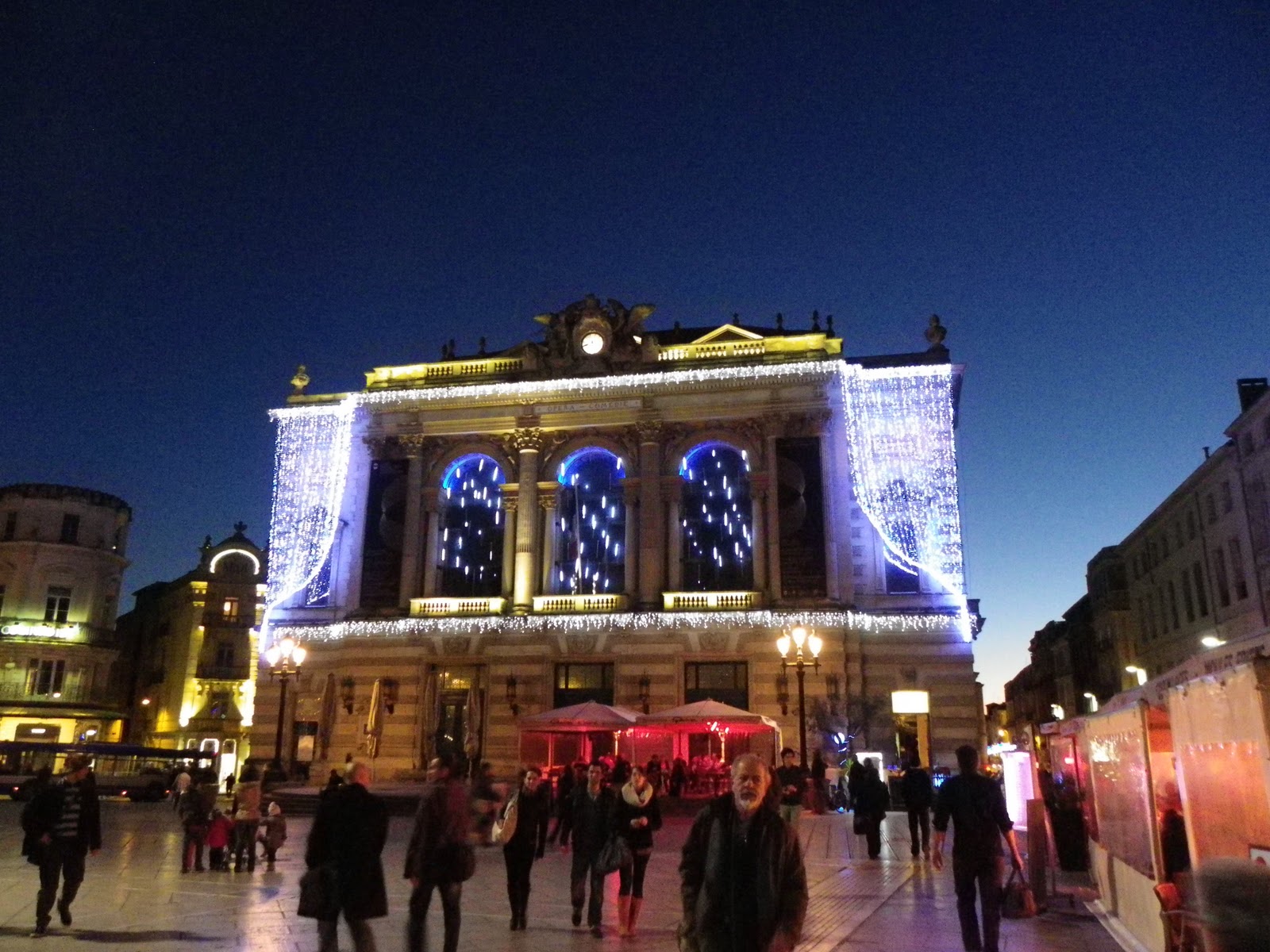
Photo by Ben Perry


St. Saturnin is remote. Looking at the road map, you'll see that, if you're heading north, after a while, both of the roads out of town just stop. The reason it's there is wine: lots of St. Saturnin wine in the supermarkets, all from the caves cooperatives, most of it pretty good (and definitely cheap) but no better. This article gets it about right: nothing special. It's the end of the road, except it's not, exactly.
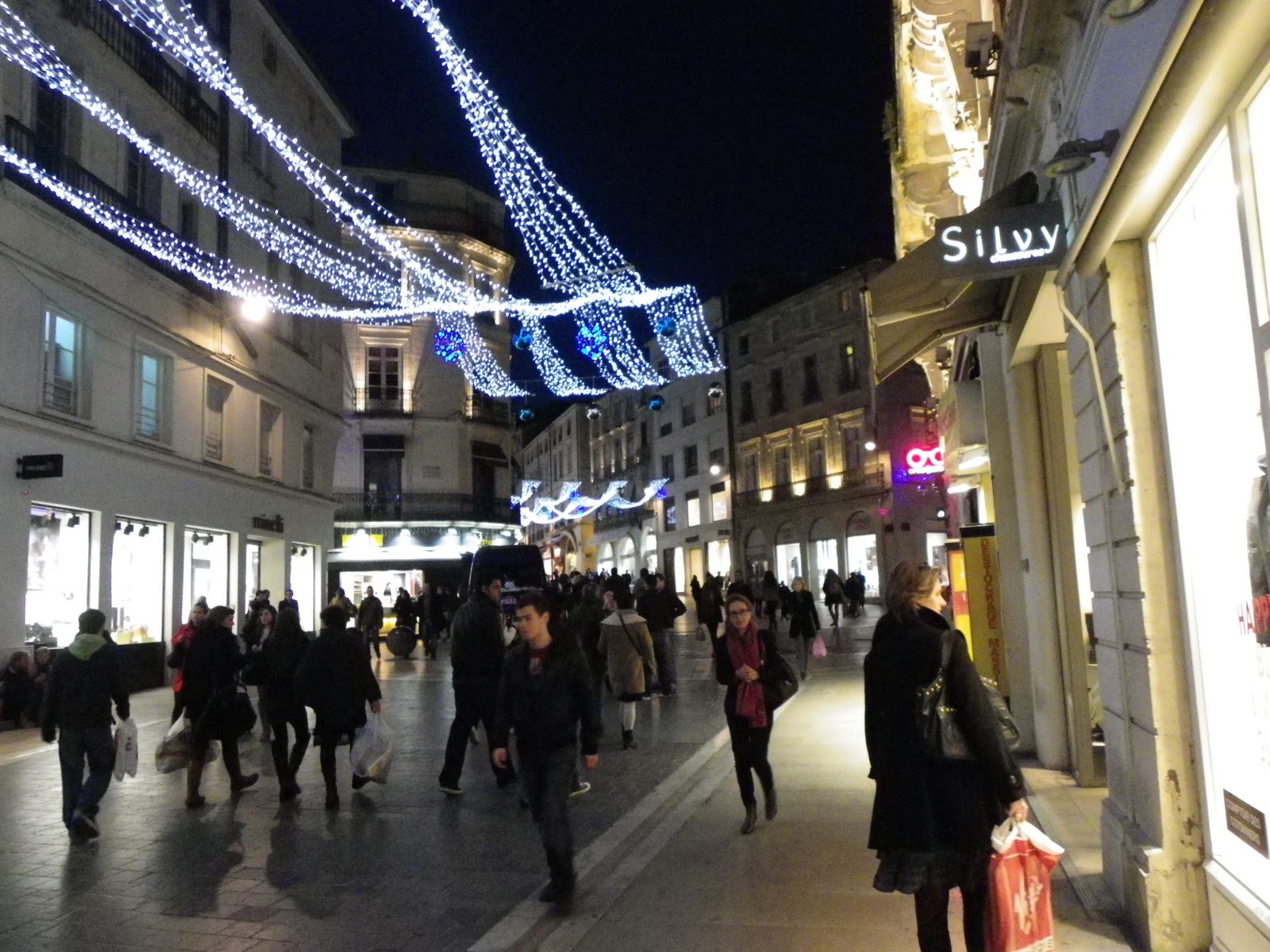
Photo by Ben Perry
There's one main street, and in the building down there where the road turns, you'll find one of the two winemakers in town who don't use the caves cooperatives. (The other is the famed Virgile Joly, who was on his way to Montpellier to set up at the Estivales). Marie-Pierre and Jean-Pierre Cabanes bought the Domaine d'Archimbaud some time back, and in 2009 separated from the CC to make a transition to organic wines. The estate itself has supposedly been used for wine off and on since 1313, and today its 12 hectares grow syrah, grenache, mourvèdre, old-vine carignan, vigonier, and muscat. They're best known for their great big red, La Robe de Pourpre, aged 12 months, 50% syrah, 30% grenache, 10% mourvèdre and 10% carignan, deep, complex, the kind of thing, as I mentioned as we tasted it, that you want to get in the winter, when you've got a nice leg of venison roasting in the oven. "Or," Mme Cabanes suggested, "mousse au chocolat!" It costs a whopping €12.50, and I know a couple of places I can get it here in town. They also make a wine called L'Enfant Terrible, which is sold out for this year, so we didn't get any of that, and then there's Le Tradition, which is the same composition as the Robe de Pourpre, but just a bit less showy. There's a leathery nose to these two reds which seems to be a house trademark, and when the evenings cool down here, I'm going to investigate both of these at my leisure.

We started the testing with the other Les IV Pierre, a white, of all things (one thing Languedoc is not noted for is white wine), which had been awarded a gold medal in this year's Concours des Vins de la Vallée de l'Hérault. Who knows how those things are judged, but this vin de pays (80% vigonier, 10% white grenache, 10% muscat) has an eccentric composition but a wonderful smoothness, with the same mineral opening I noted in the rosé followed by stone-fruit, but mellowed by a floweriness that would make it go, as Mme Cabanes suggested, with fish or white-fleshed meat (poultry, rabbit). After all the time I've spent investigating the local wines, I'm surprised to say that I might well find myself spending €9.50 for a bottle of this some time down the line. And, of course, there was the rosé, the reason I'd come. Mme Cabanes informed me that there were two wine-shops near my house (ones I, of course, never think to go to) which stock all of their wines including this one, so that's good news. And €6.50 was a much easier price than the ten smackers they'd been obligated to charge at the Estivales.

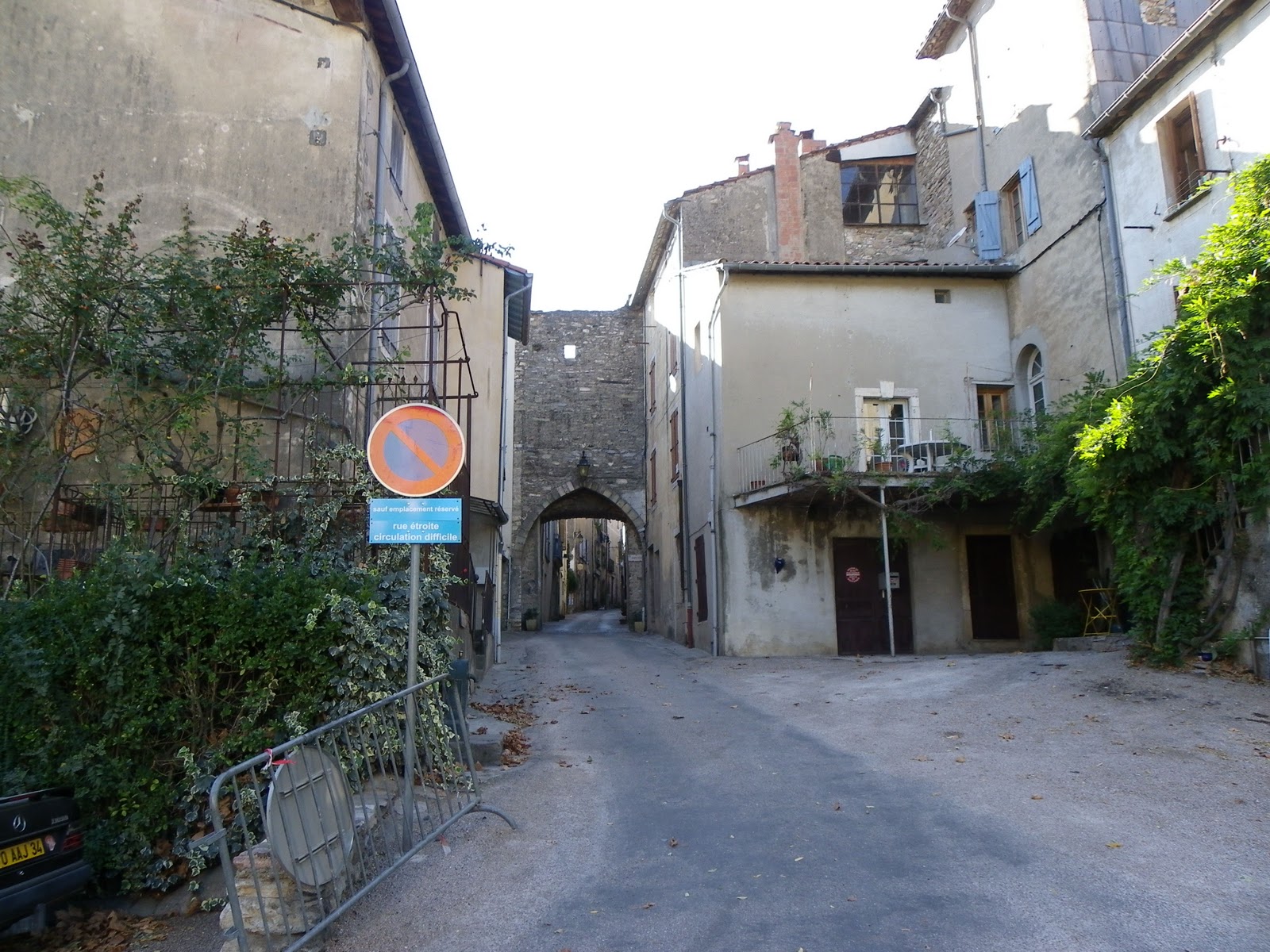
After sticking our purchases in the car, we wandered through what remained to see of the village.

Photo by me
Just to the left of this shot is a small street which leads up an incline, ending at what appears to be a very old church, but one which is so oddly placed that it's almost impossible to figure out what it looks like, socked in on all sides by other buildings, except at its rear which is rounded like Romanesque churches are. There was a pile of wood by the church (which was closed) and a sturdy-looking Weber grill nearby, so I decided that whoever St. Saturnin was, he was into barbeque -- my kind of saint.

Also on this street is what appears to be a very lovely and affordable hotel, L'Hotel du Mimosa, and across the street a very nice-looking restaurant, Le Pressoir, which apparently has a 130-bottle wine list. I can't think of a better place to be based for a couple of days' driving around some of the region's most beautiful countryside.

It's straight ahead! Photo by me

I put those fantasies on ice, though, as we returned to the car, drove back to Montpellier, and inserted ourselves in the chaos of the Estivales, which, I'm afraid, really is too crowded after a given point. I love the opportunity to taste small wineries' products (we nabbed a couple, an amazing Terrasses de Larzac red called La Tête dans les Étoiles and a very nice rosé from a Pic St. Loup producer called Château de Lascours, both of which are currently being researched) but the fight to get to where you can buy some food -- or, later, to get within pouring distance of a tasting-glass of wine -- and the incessant terrible music (anyone who wants to flatten the tires of Las Vegas Wedding's van is okay with me) takes away the fun. The best procedure would seem to be to arrive early -- the event opens at 6:30 -- get your tastings (and, if you want to eat early, a few things for dinner) and then go somewhere else for your evening meal. In fact, if I hadn't been so exhausted by the whole day, I would have recorded the ambient noise from my apartment and posted it here so you could see what I sometimes have to put up with.

Ben, Yuhang and Micah and I said good-bye, and I trundled home. The next morning, I got up to go to the market rather late, and arrived closer to noon than my usual 11am. Imagine my surprise to be greeted by Yuhang. Their 8am departure hadn't quite worked out, so I helped them shop for road food (peaches, small heirloom tomatoes, melons, some of Mimi's good saucisson sec) and we said good-bye a second time. Thanks to the Perry Three for the wonderful ride. I really did need to get out of the house, and what a way to do it!

Now...who's next?

Photo by Ben Perry


Saturday, March 17, 2012

U.S. Tour 2012 Part Five: Food, Miettes, a Camel

So you're walking from one place to another at SXSW -- the BMI party to Ray Benson's new bar, to be precise -- and, as often happens, you see a camel:


The camel is in a trailer attached to a truck. It looks unimpressed, something camels are good at.

To be continued.

* * * 

After the gruelling social events, there was, as one would hope, dinner. This time it was at a brand-new Japanese restaurant, Komé, which, fortunately enough, has opened very close to my hotel. I say "fortunately," because although they don't do it in the evening, they have a ramen and udon service at noon, and I've often found myself stumped for a lunch place in this godforsaken corner of Austin, particularly on Tuesdays, when Tâm Deli on far north Lamar, the best Vietnamese lunch joint in town, is closed. 

We ordered omikase style, chef's choice, and I specifically requested gyoza, the pan-fried dumplings, to start, because the ones I'd had in New York were so good. These had equally good filling, but tougher skins. I do wonder how the New York folks do what they do, because theirs were the best I've ever had. But the rest of what we were served -- fatty tuna sashimi, salmon sushi three ways, including a hot one with fat underneath which just dissolved in the mouth, extremely tender beef on a brochette, some beef sashimi in a very tangy garlic sauce reminiscent of some horse sashimi I'd had in Japan ten years ago, and, um, a couple of other things, including a roll made from grilled eel. Those who dared (not I) had a slice of saké cheesecake with preserved ginger for dessert. The whole thing, including alcohol, came to about $50 each before tip, the waitress (Allee, as I remember, although I could be wrong) was extremely knowledgeable, and the whole thing was perfect. They've opened recently, and seem to be doing very well, and I highly recommend them. 

* * *

One thing I've never gotten in anything like a canonical version in Austin is fried chicken, so imagine my delight the next night when I found out that dinner was at Lucy's Fried Chicken. This place has only been open eight weeks, and shows every sign of catching on. There's indoor and outdoor dining, a nice balance between tradition and innovation, and a jukebox with a fine selection of Texas music, new and old. 

I started with the fried deviled eggs, which sound better on paper than they proved in practice: the breading scooted right off of them when they were cut, and you had to cut them because they were way too big to stick in your mouth whole. The deviling part, though, was truly satanic, unlike the polite filling you'd get at a church picnic. Zowee! Highly recommended, structural flaws notwithstanding. Next everyone got fried chicken, duh. To my way of thinking the batter was too darkly fried, and it was also saltier than I'd have liked. Sides included sweet potatoes whipped with "Mexican" Coke (ie, made with cane sugar, not HFCS: I can only get the cane sugar kind in France, but Texans now have to rely on Mexico for the real thing ) and a potato salad with crab boil (a spice mixture) in it. It was fine, and I was pissed when I went outside for two minutes to guide a friend to the table (he had just gotten off a plane and wasn't familiar with South Austin) and returned to find my uneaten chicken and potato salad whisked away. The service was, as they say, attentive and friendly, but maybe a tad too much on the attentive side. Let's hope this institution survives, too. 

*  *  *

The next day, I managed a trifecta, almost a fourfecta, of legendary Texas guitarists. Billy Gibbons, of ZZ Top fame, was rolling out his new line of barbeque sauce at a local restaurant, and I now wish I had stolen a bottle, because I'm not going to be able to get this in France: it was, um, assertive, but in a very good way. I spotted Van Wilks hanging around as we came in, then as we moved upstairs to sample the sauce on some excellent barbequed pork, a trio featuring Jimmy Vaughn began to play. I mingled and hung for a while, but there was stuff to do, so as I left, up the stairs came Billy himself. We hadn't seen each other in decades, and he shook my hand and said "I'll call you in a minute, man." Still haven't heard from him, but I know how long Texas minutes can be. 

That night, eating at the Evangeline Café way south in town, Cajun food, pretty good, but not as good as I make, even in France, it turned out that there was live music after the kitchen closed, and the night's entertainment was Bill Kirchen, whom I first met 42 years ago when he played with the Commander Cody band in California. I had to leave before he started, but we're going to see each other in California next week. 

* * * 

Finally, thanks to Chef George, I can announce that I've found (with his help) easily the best Indian restaurant in Austin. The Maharaja Indian Café isn't going to win any awards for decor or art direction, and you have to order from a counter and then wait for your meal at a funky table, but oh, man, is it ever worth the wait. The folks who run it are from Goa, a former Portugese colony in the south of India, and you just know it's going to be good when you look at the menu and there's a whole entire goat section. Goat four ways! Kozhi Varutha Curry aka Chicken Chettinand, which (I didn't have it) can be skin-peelingly hot and delicious. Goan fish curry! Dosas and uttapams! And cold chaats, incuding Sev Batuta Puri, which are little balls stuffed with potatoes and spices and doused with yogurt and tamarind chutney, and the more sedate (and heavier) Dahi Wada, which are lentil dumplings given the same basic treatment. Boy, if I lived in the neighborhood, the takeout number would be on my speed dial. They've also got a very nice-sounding buffet from 11am-2pm Tues-Fri, and 12-3 on Sat-Sun, with off-menu items (and more of 'em on weekends). 

And if you're in the neighborhood, the same shopping center (8650 Spicewood Springs at 183, by the Big Lots store) has a Chinese noodle joint that's only open for lunch, which I ate at a couple of years ago and almost lost my mind, it was so good. It makes me wonder if the Mexican joint in the strip is also cosmically good. 

Almost makes me wish I was staying another few days...

* * * 

I'm not, though: Monday morning sees me flying to San Francisco for the next chapter of the U.S. Tour, and I bet there'll be more good eats there, along with some nice photos if the weather clears up some. Although rain can be a blessing: Austin's coming off of a two-year drought, and this poor guy didn't get the memo about parking under a tree where grackles roost in Texas: 


If he can see to drive to the carwash, it's going to cost him several trips through. 

* * * 

Oh, and the camel? I dropped off my 1962 Gibson J-50 guitar today, recently restored to a very fine state by master luthier Bill Giebitz, at South Austin Music, where they're holding it for me on consignment ($2800 and worth every penny -- which pennies I'm going to need before this gruelling tour is over), and headed down Lamar towards my next destination. Stopped at the light at Mary waiting to turn left, I saw the camel, happily giving rides in the parking lot across the way. He looked just as unimpressed as he did in the truck. 

Monday, January 16, 2012

2011: The Year In Pictures

One of the things I never expected blogging to do was to get me interested in photography. But from the first day Jesse Sublett showed me his digital camera in Austin and I snapped to how easy it was to use, I was hooked. That was a long time ago, back when I lived in Berlin, and the quality of the pictures sure wasn't all that great -- your phone probably takes higher-resolution pictures than my first camera did. I know mine does. But bit by bit I started figuring out how to use both a camera and the sofware that can tweak the photos to look better and overcome some of the problems not having film causes. And, since I didn't have the cost of film to worry about, I could just shoot and shoot and toss the bad ones. I sorta specialize in bad ones.

Thus, I figured it would be a good idea to sum up the year on this blog every January, showcasing some of the pictures I took, both the ones you did and didn't see. (Don't forget: clicking on the photos will bring them up in a larger format).

Last year ended with the shutter button on my faithful old camera sproinging out on the end of its spring. This, I was reliably informed, was un-fixable. Fortunately, I had just enough to buy a new one, and, when an assignment sent me to Castellón, in the Valencia region of Spain in late January, I had an opportunity to test it out. I got to my hotel, pulled out the camera, and set out to discover this lovely small city.

The camera didn't work. At all. I shot some okay shots with my iPhone instead, but I was furious. When I got back to Montpellier, I took it to a camera shop that was the designated repair location for this area and...well, the denouement is too embarrassing to go into. Let's just say that it wasn't entirely my fault, and that there's a bit of a design flaw in this camera.

Which meant that the first shots the new machine took that were at all interesting happened on my annual pilgrimage to the States. Spring was just happening in Texas, and in mid-March I went to Cajun country to do a few interviews for the book I'm going to write as soon as my agent sells it. On my way to Ville Platte in search of a superb hot sauce I used to buy there, I had a fantastic photo just fall into my lap. I still can't believe I took it.


The hot sauce proved to be no longer made, the old man who made it long retired, and that morning would have been a complete wash were it not for this photo, the boudin at the guy's former store, and a side-journey to Mamou which resulted in yet another shot of another building, which I remember having been some kind of snack bar years and years ago, but which hasn't been anything much lately.


I also got to eat, after almost a decade away, at the area's iconic crawfish joint, Hawk's, which is, as their t-shirts and ads proudly say, "in the middle of nowhere." It is indeed almost impossible to find, even with a Cajun in the car, and at one point we wound up driving into someone's (dry, fortunately) rice field. My friend Dickie laughed at me for sticking my camera into the food, but nine months later, I can click on the photo and remember how good those 'bugs were.


Returning to France, I spent the next three months banging out a book proposal, so there wasn't a whole lot of visual interest produced around here. In August, though, an old friend from New York invited me to visit him and his wife at her reconditioned farmhouse in the Dordogne. It was a lovely spot, and I shot some fairly good pictures around there, given that sunshine wasn't as readily available as it is down here.


I was lucky in that my friend's wife took off for a few days in Paris during my stay and left me one of their cars to tool around the countryside in. It was high tourist season, but tourists are predictable, so it wasn't hard to avoid most of the places they were. One of the nicest places I found was a small town called Elvès, which I think would make a good central point for further explorations of the area. There were some very nice buildings there, but some of the coolest stuff was on doors and walls. I kind of liked this old sign, warning beggars away: 


And this traditional farmer's wreath, made from the principal grains of the region, is hung each harvest as a gesture of thanksgiving. 


Weirdly, one of my favorite shots from this whole trip was taken as I waited for the train that would eventually lead me back home, with the last couple of drops of battery on my iPhone as I waited at the Les Eyzies train station. They just don't build 'em like this any more. 


Not long after I returned, I got an e-mail from some readers of my blog, a couple who'd just moved here after scouting much of southern Europe for a decent retirement spot. E&J may be retired, but they're sure not slowed down, and we've taken to doing a trip into the surrounding countryside on the average of once a week. Since their interests and mine coincide almost totally, this has been a godsend, because I can neither afford a car nor the $3000 it would cost me to get a French drivers license. I've documented these trips from the first one on, but I've also taken so many pictures that there hasn't been room for most of them.

I spend a lot of time shooting into the mountains and valleys, and I must say, this isn't even about skill: Stevie Wonder could take just as good photographs as I do in this part of the world. For instance, after climbing the hill on which Olargues is built, I grabbed these.


The map says these are the Monts de l'Espinouse, about which I know litle, but hey, there's a whole new year ahead of us.

Drinking and driving may be a French national sport, but E doesn't engage in it, which is good: someone has to be sober on these little back roads. Still, one day as we tootled along, I couldn't resist asking him to pull in to one winery, which is one of my very favorites around here, so I could take a nice clichéd photo:


We'll be back for a tasting at some point, though: they might have some wines they don't sell in the shops, and I do like the way Mas de la Seranne makes their stuff. 

Recently, our journeys have taken us to oppida, Roman settlements providing goods and services for travellers along the system of Roman roadways, one of which, the Via Domitia, passed right through this area. There are a lot of remains of these, including the most famous, Ambrussum, which is a must-see for anyone interested in this part of history in this region -- and a place whose ruined Roman bridge got painted by Courbet. 


Okay, his painting was maybe better than that (it had an extra arch, for one thing: it's been washing away for years), but the winter light around here is quite different than the Really Blue Sky gives you in the summertime. Both are wonderful, but somehow this is more subtle.

Oddly, some of the best shots I got were on one of the most recent trips, to the oppidum of Ensérune, which not only resulted in the blog post that was possibly the most fun to write of all of them this year, but some really nice photos. Part of it was because besides its hilltop location, it was near a weird 13th century engineering project which looks like a UFO landing-site. In the annals of almost-great photos, this circle of light hit the circle in the valley moments before the shutter clicked, but the wind had driven it on by the time the picture got taken. Still a pretty nice shot.


The wind, though, did help to make another shot work out nicely, sculpting these trees over the years.


And the vineyards below are patiently waiting for the weather to change.


One thing I want to do this year is to explore some of the religious history around here, because the Languedoc has been home to loads of "protestants," ie, those who resisted the Roman Catholic church over the years, yet the area around here is loaded with abbeys and other ecclesiastical buildings. This speaks to a tension which spilled over into politics, thanks to the relationship between the French king and the Pope. At some point I hope to get a bit further south than I am now to look at some of the Cathars' strongholds, but there's still lots within a day's drive of here to look at.

And you never know when, as happened in the Dordogne, you stumble upon a church whose art hasn't been erased by the centuries of religious warfare which is so much a part of French history...


...or the odd bit of sculpture which hasn't been smashed.


So I'm really looking forward to the year ahead, having culinary, travel, and historical adventures, puzzling them all out, and reporting them to you from the City On A Hill, Montpellier.


Saturday, December 10, 2011

December

I'm glad it's cooling off. Not that Im looking forward to the slightly elevated electric bills turning on the heat will bring (and it's not turned up very high: the African folks downstairs heat their apartment enough so that the rising heat has taken care of me for a while), but if my windows were open, as they are most of the year around, I'd be getting bombarded with Christmas music. That's right, the Hivernales are here, the modest Christmas fair the city moved into the little fake log cabins on the Comédie right after the even more modest wine fair pulled out of them, and now we've got to listen to horrid, mostly American, Christmas music from morning til night. On the up-side, they gave up on the hideous metal tree they've had in past years, and gotten a real one.


This shares space with our local Occupy folks, who started out living in the bandstand on the Esplanade, then moved to the lawn of the park there, and who now camp out just to the right of this picture. They're not properly Occupy protesters, though, but rather Indigné[e]s, according to their sign, thus allying themselves with the Spanish protestors in Madrid and Barcelona who've been at it even longer than the US folks, although I guess that doesn't make the papers in the States. The remaining protestors look kind of iffy, though: what, for instance, is the gigantic teddy-bear supposed to mean?

At any rate, keep walking to the right from this picture, and soon you're in the little village of horrors.


This collection changes from year to year, but not much: there are always the regulars selling stuff that no rational person would want. I can't speak to the jewelry, but it doesn't seem very well-designed. There's wine for sale, but mostly mulled, which is a great way to get rid of sub-standard stuff from your winery. There are ceramics so gaudy they'd radiate ugly through a cupboard door, bric-a-brac and tchotchkes (there must be an equivalent French word) galore, tiny jars of preserves, a booth which takes pictures and -- there's no other word for it -- warhols them into large wall-hangings which mimic Andy's iconic Marilyns and Liz Taylors (except it's your kids), and much, much more. There's food, of course: a stand selling aligot (mashed potatoes mixed with cheese) on which you can get a grilled sausage or an andouilette (a chitterling sausage that smells like a urinal which hasn't been  cleaned in a decade, possibly the only outright disgusting food I've found in France), a "Christmas in the Orient" booth selling falafel and North African pastries, and, of course, the local oysters.


I wish these were better, but they taste mostly of salt and have little of the delicacy good oysters have. On the other hand, the folks manning this booth are from Sète, so they also have tielles (little pies filled with chopped cuttlefish in a spicy tomato sauce) and mussel turnovers.

And, of course, there's sugar aplenty, from hand-made artisinal nougat to the utterly disgusting jelly-like stuff that Haribo sells, displayed by the ton, and sold by weight.


Note, between Spongebob and the doll, the panties made entirely of candy, with which a dedicated cunnilinguist can stage a race between orgasm and tooth decay. Only €15.

My favorite of these booths, though, is one of the ones selling absolutely useless items.


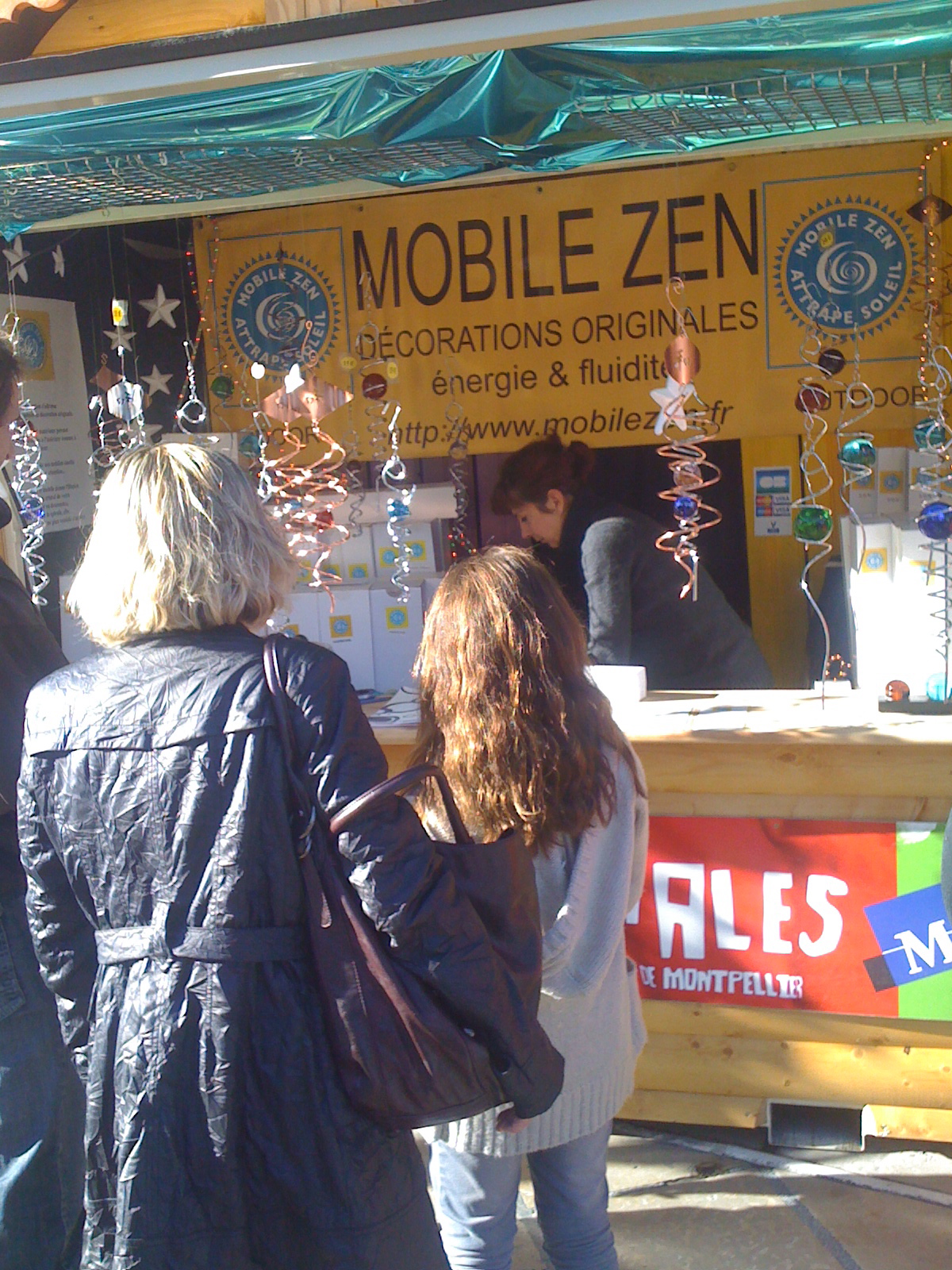
The French have a thing for Zen, which they don't seem to understand, using the word to mean anything odd or relaxing or otherwise indescribable. I once checked into an Ibis Hotel somewhere in France where they were touting their service zen. I wasn't able to make out, from the description, what it was, but from what I know of Buddhism, perhaps staying in a place with real Zen service wouldn't be an unmitigated pleasure.

The Hivernales also attract a fringe, people who don't rent one of the little booths, but sell cheap clothing, shoes, and handbags. It's also attracted the bonbon guys, who have carts on which kittens, pygmy goats, and even a black pygmy pig who wags his tail like a puppy when approached with an apple, stand. The deal is, your kid sees these and drags you over so they can pet the animals and the hustlers then try to talk you into buying a box of hard candy from them. I've been warned not to engage with these people, but I don't eat candy anyway, so it's not likely. My guess, however, is that the animals' lives aren't much better than those of beggars' dogs. The weirdest fringe person I've seen was a guy being moved on by the cops yesterday who had long balloons of the sort you make animals from, but was making some rather deranged abstracts, and a number of crosses. I doubt that the wild look in his eye and his unwashed hair were making sales any easier.

And as hokey as this all is, I have to admit it pays off at night.


The "icicles" on the front of the Opéra Comédie "drip," which is kind of corny, but it's all very festive and cheery, and no doubt the people on the shopping streets are opening up their wallets in fine fashion. It doesn't hurt that Montpellier is a place that everyone in the region has to come at some point or another to do administrative business -- renew a driver's license, deal with taxes -- so it doesn't have to depend on its full-time residents to support some of the more luxurious (Cartier, Hermès) outlets.

The broke-but-not-poor, on the other hand, go about life as usual, hitting the markets to get newly-seasonal stuff. I haven't posted a post-market photo in some time, but it's just not that glamorous in the winter. Still, there's good eating to be had:


In the back is a bag of really fine spinach, which they practically give away at this time of year, and in the front is this "mélange japonaise" salad mix, bitter and crunchy. Three type of pears are in the background, and they'll be with us a while longer, and there are some small broccoli heads which proved very nice. Not shown is a piece of pumpkin I bought and forgot about -- I honestly must learn some way of cooking this stuff, because I hate throwing food away -- nor the nice butternut squash I swear I'm going to figure out something to do with, which I picked up today. Also not shown are things which intrigue me which I haven't gotten around to buying yet: one stall at the market has purple and round carrots, which I've got to try, and at some point I'm going to buy some root vegetables to roast, maybe in some duck fat I indulged in recently. (I can't find lard any more, so I'm going to try substituting duck fat in biscuits tomorrow morning. Wonder how that'll work..?)

Yeah, it's December, and it gets worse in the food department. By February I'll be counting the days til I can get to Austin and inhale some Mexican food, because the local scene will have gotten just a bit bleak by then. But at least at the end of this month, they'll pack up the Hivernales and turn that damn Christmas music off.

And, as with all Decembers, it's a hard month for those of us who are in the writing biz: no new work, difficulty getting paid by those who have hired us, and nothing shaking until sometime early next year. Thanks to all who've helped out with the PayPal button over on the right; it's definitely helped a lot. With luck, the book will sell next year and I can finally turn a corner, get a better apartment, and continue to have exploits here that you'll want to read about.

Friday, October 21, 2011

St. Chinian and the Middle of Nowhere

As good ideas around here so often do, this one started with a bottle of wine. Specifically, the one we got at the restaurant last week for E's birthday. He'd noted over the meal that he felt like taking another drive, and I was fine with that and said I'd look at the map and see what ideas came to me. He wanted to go to the Cirque de Navacelles, a drive which I don't think I want to do again too soon, because those twisting roads can cause havoc with my stomach when I'm not doing the driving. Also, I'd already been there. Hunkering down with a map over the weekend, I had another idea. I'd looked at the website for the wine we'd had, Les Eminades, and noticed that the winery was in Cébazan, and that was on a good road on the way to St. Chinian. I only knew St. Chinian as a wine appellation, but I also knew it had to be a town as well. Why not go check out some of this huge wine-producing area and see what it looked like, since we were already familiar with Pic St. Loup, the Terrasses de Larzac, and St. Saturnin? Anyway, beyond St. Chinian, the road split, and we could head back via a different route, which also included the villages of Roquebrun and Olarges, which Gerry had recommended from his cycling adventures. E was all for it, so we decided to get an earlier start than we usually do and head out at 12:30.

An hour later, we'd passed Béziers, gotten off on the Béziers West exit, and started off into the hills. Grapes were everywhere, which made sense: the 19th century saw the explosion of the Languedoc wine business, as a direct Béziers-to-Paris train made it possible to send gigantic quantities of not-so-hot, strong red wine to the capital in 24 hours, making wine cheaper than ever before up there. Farmers and négotiants made out like bandits until the whole thing collapsed in 1907 with the army out quelling riots in Narbonne, Béziers, and finally a huge demonstration right here in Montpellier. These towns showed evidence of this in their architecture, and had we gone off the main route, I bet we would have seen more ostentation and possibly decaying old chateaux from the boom-times. Instead, we saw some new ones, and some old ones that had been nicely fixed up. As the day progressed, it became obvious that tour buses were no strangers to this road.

We landed in Cébazan at 1:30, puzzled. E had hit Google Maps for a route to the winery -- his plan was to "buy a six-pack" of the wine we'd had at the restaurant -- and there we were, already in town, the "rue des Vins" noted on the download having failed to appear. We parked in what looked like the parking lot of the Cave Cooperative so we could ask them where it was, but it turned out to be the old CC, the new one being next door, and all shiny with steel and glass. And locks: it would be lunch for another half hour. We jumped back in the car and backtracked, finally deciding that it would be off the road leading south to Cruzy. Then we landed in Cruzy, with none of the well-marked winemakers along the way having been the ones we were looking for. We turned around and went back to the main road. I suggested that we take a turn just before downtown Cébazan to investigate the Abbey of Fontcaude, which was listed as being 11th century, but E didn't take to that, so I suggested that we just drive on to St. Chinian and find a good wine-store which could well have it.

Just out of Cébazan, it became apparent that we'd reached the top of a hill and were about to get hit with a view. And that's just what happened. We pulled over next to a monument to some Resistance fighters who'd been killed there and I hiked back up the hill a few feet to grab a shot of the valley we were about to enter.


There was also a huge sign in French, German, and English which clearly lays out the main growing areas in the vicinity and the soil types of each and how that affects the resultant product. Nothing about the history of the area at all. But who needs history when you have wine?

Of course, we didn't have wine yet, so we wound our way down into the valley, noting that there were big signs for wine-stores along the way. Yup, those tourists again. And boy, was I glad it was out of season. So all of a sudden, we found ourselves in St. Chinian, and parked in a park shaded by plane trees. It was hard to figure what to do next, but I just thought we should hike a little ways up the road we'd just come in on and look at what appeared to be a good wine store. Finding the wine we were looking for among the bottles in the window was a nice piece of luck.

It wasn't a good wine store. It was a remarkable one, the Espace Vin St. Chinian. As you can see on this page of their website, they've got 250 square meters offering heaven only knows how many wines, the vast majority of which are St. Chinian (that's them against the far wall, taking a right turn at the back wall) but with a very well-thought-out selection of other fine Languedoc wines, and the obligatory small selection of €100+ wines from Burgundy and Bordeaux. The woman who greeted us knew her stuff, and when E picked up two bottles of the wine we hadn't found over the mountain, and I grabbed two bottles of Mas de la Serrane's Clos des Immortelles, I asked her to suggest a third wine for the rest of the "six pack" (actually a "case" in France is six bottles), and she suggested a third wine, a Pétale Pourpre from the Domaine Pin des Marguerites in nearby Berlou which had the schist, red sandstone, terroir to contrast with the limestone terroir of the Les Eminades. Sold. We got outside, laid the precious cargo in the trunk of the car, and noticed how early it was: "It's so close!" E said with evident surprise. But it is: just because the landscape's so different from where we live doesn't mean it's another planet.

We walked around St. Chinian, but it's really nothing much to look at. There was a weird sculpture or something above a door


but the only building of note was city hall, which has a very well-stocked tourist info center worth checking out on it's right-hand side as you face it.


But with a glance at the map, it appeared Roquebrun and Olargues were both easy enough to get to, so we took off towards the former, going through acre after acre of vineyards bearing names we'd just seen in the wine shop, some of which I recognized from previous encounters at the table. In fact, we missed the main turnoff to Roquebrun, and took a back route that went up and down a mountain, and when we were too high for grapes to grow, it was worth remarking on. But soon enough we pulled into Roquebrun, one of those villages that hangs on a mountain.


And which actually looks like this.


What is most notable about the place is that it's also got rocks that look like buildings. This seems to be a feature of the local mountains, many of which sprout similar formations.


About half-way up to the tower, which we didn't even attempt to get near (not to mention the admission-only garden up there), there's a church, which was nice, but locked. (The garden is all about the local micro-climate, which doesn't cool off much in winter, so a xeriscape exhibition of plants thrives there for those who want to climb up the hill. For those who don't, there's the local wine, which is apparently fantastic, part of the St. Chinian appellation.)


When we got up there, we decided to head back down the hill. There was a nice view, and someone was burning off some vines by the side of the Orb River.


It was no problem getting to Olargues, either: it was just up the road. It was a fortified city, and much earlier we'd passed a sign on the road informing us we were in Cathar country. Roquebrun didn't have the signs of a fortified village, nor did the church appear that way. Olargues, though, might have been, but I'm not sure. The entrance to the old town is guarded by a double gate in the wall (the construction sign is modern; you'd think I'd learn how to use the damn zoom on the camera, wouldn't you?), through which a stout piece of wood could be slammed to deter invaders.


The big attraction here, too, is a tower, but a different sort than the one in Roquebrun. You reach it via an enclosed staircase which sends you up through the middle of the old village


and then you hike a bit up the hill and are confronted with this:


Which consists of this ruined bell-tower


sitting in the middle of a bunch of rubble which extends over a lot of the hilltop, which has breathtaking views of the Espinouse Mountains.


This whole area is referred to as le castrum, with castrum being a Latin word for a fortification. Nothing I've been able to find points to a Cathar connection, but I'm still not sure what the whole thing is about and the museum half-way up the covered stairway was closed, so I'll either have to go back or find a reference that makes some sense about the place. Anyway, that gated thing in the first picture is locked tight, and looking through the gate just heightens the mystery of what it is. It looks like a chapel, but has a legend on it I couldn't quite make out which seems to say it's a tomb.


That's what it looks like through the gate, anyway.

It was getting late, and we were a ways from home, so we headed back to the car and prepared to leave. Didn't happen. E has a peculiar habit of keeping the car key loose, and putting it on the seat before he sits down to drive. Which isn't a problem unless the key hits the upholstery and bounces by chance into the space between the seat and the stick shift assembly. He's a fully-qualified engineer with a doctorate and everything, and between the two of us it took us 30 minutes of pulling the driver's seat back and forth and sticking hands in where we couldn't see what we were doing and finally I spied part of the key emerging from underneath the track the seat slides on and managed to retrieve it.

The drive home started off beautiful, with all the mountains stretching into the distance, but we missed a time-saving turnoff in Bédarieux, the first of a series of seriously ugly towns we came upon, and thus climbed over a bunch of hills to Lunel and finally Lodève before we chould head down to the freeway back to Montpellier. The odometer showed we'd gone 260 km during the trip, which is a bit much, but right up until the end, when that stretch of nasty industrial towns started, it was gorgeous the whole way.

The moral? There's nothing wrong with drinking and driving, provided you do one one day, and the other the other day. The label on a bottle of wine had provided us with a fine adventure.

Oh, and the kicker: the lady at the wine shop in St. Chinian told us how to get to the Eminades winery. That road leading to the old abbey? You turn up there and there's a sign near the graveyard. Oops!

OLARGUES UPDATE: E wasn't happy with our lack of information about Olargues, and did some research the next day. It turns out that most of the original settlement was on the hilltop and it was a fortifed village whose main group of structures dated back to Romanesque times, but that in the 16th Century, Louis XIII was becoming concerned with the amount of power the individual nobles had, so he ordered all the communities like the castrum of Olargues to be razed. Even that didn't stop them, so after the Duke of Montmorency, governor of the Languedoc, proved to be too much of a pain, he was beheaded and, eventually, all the governors had to live at court in Versailles and not among the people they governed.

The other thing he researched was something I'd forgotten (probably because I didn't take a picture of it), which was there was a bright red railroad bridge running across the road into town which, a sign informed us, had been built by Gustave Eiffel. It's now part of a hiking trail, as nearly as I can figure out, but it dates from 1889. There's also another bridge which I think we would have driven into town on if we hadn't come from another direction, yet another Pont du Diable, from the 11th century or thereabouts, whose connection to Satan I can't seem to find.
 
Site Meter