Showing posts with label Via Domitia. Show all posts

Tuesday, April 19, 2016

Europe, Spring 2016, Part Five: Spain Again and Out


I'll admit to a certain relief as I steered the Peugeot out of Montpellier and on to the motorway (which was, along most of its length, the old Roman Via Domitia) towards Perpignan to return it. Maybe if I'd had someone with me to whom I could have shown bits of my past, perhaps driven up to Pic St. Loup and up the tiny road that leads to the ruined castle hanging off its companion escarpment l'Hortus that I thought I'd hallucinated until I actually was able to stop and photograph it. Or maybe I needed the down-time as a day of drawing a deep breath before heading into the last couple of days of this trip.

Spring in this part of the world announces itself with wind. Cold winds sweep out of the mountains and lower the temperature until they're countered by warmer winds from the south, the Mediterranean, and Africa itself. I used to sweep up a fine yellow dust that blew into my apartment, and someone who knew told me that this was sand from the Sahara in Algeria, picked up and transported to coastal France. The winds were in full effect on the highway, and I had to pay attention to stay in my lane, and make sure that the gigantic semi-trucks stayed in theirs. Fortunately there weren't many campers on the road: signs in French, English, Spanish, and German appeared every dozen or so miles warning against violent cross-winds.

But at least I didn't have any problem finding the Center of the World again, even if I did make a misstep finding the parking garage and, then, the rental return. It was okay: I had plenty of time before my train to Girona at 3:17. I was concerned about the scratches -- very concerned -- but just as concerned that Europcar had closed for lunch and there were various customers milling around. My body was sending me signals, so I went to the main waiting room, found some packaged sandwiches, and found a French BLT, speck, lettuce, marinated tomatoes on a seeded baguette. I knew I'd burn off enough glucose toting the case of wine that this wouldn't be an issue. Then I headed back to the Europcar area to wait. Apparently someone had tipped off the cops that someone arriving on the train from Marseille, a teenage boy, might be trouble, and a number of suspects had their luggage searched. Another pair, who looked to be in the demographic, were apparently undercover cops, checking in with the uniforms from time to time.

Eventually the agent reappeared, several families pushed ahead of me and got their cars, and I returned mine. She didn't seem unduly concerned about the scratches and I still haven't heard anything. My American Express card showed only the $100 I'd charged on it, so who knows. And the train to Girona, when I finally got on it, was impossibly crowded and noisy, but it was only 45 minutes, so I arrived in Girona, got a cab despite the fact that my hotel was only a few blocks away (luggage again) and checked in to a once-elegant hotel (cigarette burns on the desk? really?) crowded with British and Scottish golfers. I went out as soon as I'd stashed my luggage to look at the town, but the weather had other ideas and I returned, somewhat damper for the experience, about a half-hour later.

For dinner, I hit the city's oldest restaurant, Casa Marieta, and had some odd pâtés to start, then a dish of squid with green peas, which was interesting. But I'd read a description of the place as "tired," and that's just how it seemed. Surely there was someone doing something more interesting with Catalan food here. Fortunately, there was.

The next morning I set off to see the obvious sights and to figure out what the story was with Girona. I'd read that it had the best-preserved Jewish quarter in Spain and deduced from that, mistakenly, that the Jews hadn't been expelled from Girona with the rest of the Spanish Jews in 1492. A visit to the Jewish Museum set me straight, as well as inadvertantly providing me with a perfect first stop in figuring the place out. The Jewish quarter, El Call, had apparently existed in one form or another since before 1000 CE, and besides becoming a center of trade, it was a center of Jewish intellectual life, epitomized by Mossé ben Nahman (1194-1270), who must have been a busy guy, since he penned famous commentaries on the Talmud, systematized the Kabballah, wrote poetry, practiced medicine, and found a little time to preach at the synagogue, which at the time was located atop Girona's hill next door to the cathedral. He left town in his old age and died in Acre, which the museum puts in Israel, but I seem to remember as a Jordanian city. By the time of Mossé's death, though, Gironans had become suspicious of the Jews, and demanded a wall be built around the Call. Riots and laws persecuting the Jews began in 1381, and a lot of them converted, at least outwardly, but they continued to socialize with the unconverted and also made mistakes when practicing their new religion's rituals. The Inquisition finally came to town to see what was up, mostly because Barcelona, where they'd been working, kept having bouts of plague, and Jews started emptying out the Call. The usual punishment for being a Jew was burning in a bonfire, but so many had left by the time the Inquisition's bureaucracy had found them guilty that straw dolls were used in almost every case. And by 1492, of course, the Jews had all left. The Inquisition proved so popular with the people of Girona that in 1820, during the Riego Uprising (unexplained in the wall caption), the House of the Inquisition was burned to the ground, destroying all its records. With the Jews gone, they'd gone after herbalists, homosexuals, witches, Lutherans, and anyone else they didn't like.

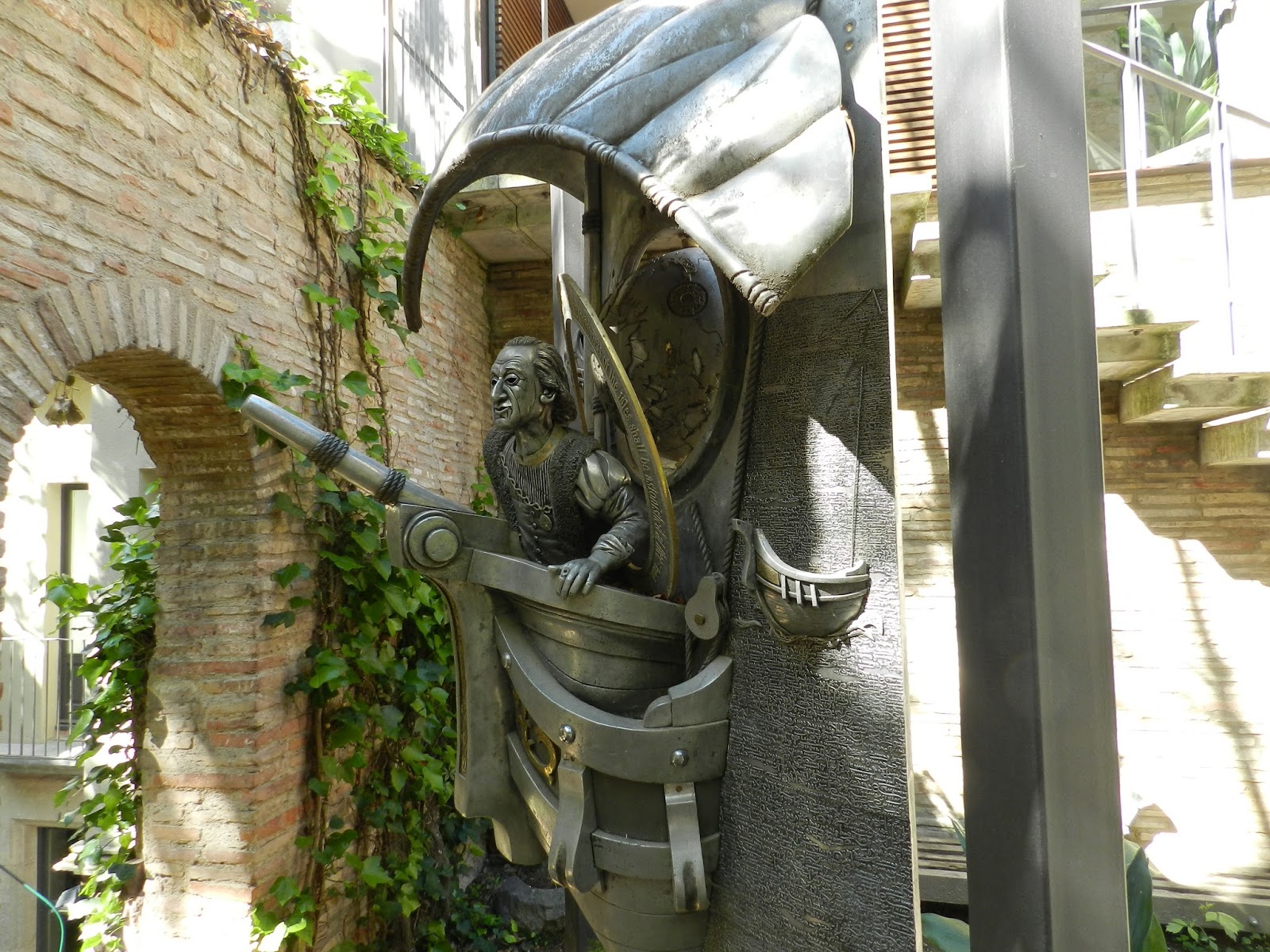
If you wanted to sum up the history of the Jews of Girona, a rather ugly sculpture in the museum's courtyard does a great job:

On one side, the Zodiac, an astrolabe, various navigational instruments, and Mossé with a book...


...and on the other side, Columbus sailing from a Jew-free Spain using those instruments.


It was time to climb the hill, where the rest of the story would unfold, and explore the cathedral and its surroundings. The Museu d'Art is located in one of the buildings where the cathedral's bureaucracy was once housed, including its prison, and it has an impressive amount of mostly older stuff (ie, right up my alley), including a minor work by the Master of Cabestany, a long painted beam of unknown provenance, showing a procession of monks,


Rather badly captured here, but click to enlarge

the ubiquitous lion-eating-a guy carving, 

There's one in Montpellier, too. No idea.
and lots more. Impressive. Eventually, you leave into the plaza in front of the cathedral, where, letting my eyes adjust to the bright sunlight, I saw an act of rather shocking violence: I was noting the seagulls that were up there among the pigeons, because they were about two feet from one end to the other. As I was trying to decode whether or not the cathedral was actually open (it still serves as a cathedral, after all, with several Masses a day) I noticed that one of the seagulls had taken a small black pigeon in its beak and had broken its neck, and was bashing it against the pavement to hasten its death as it flapped its wings, ever more feebly. I'd always known that seagulls were eaters of every sort of junk available, but had no idea they'd hunt live prey. 

Although, in its odd way, it set me up for the cathedral, which is big, filled with Baroque chapels as over-the-top as any Spanish Baroque art can be (and that's plenty, althoug I do like that period's organ music), lots of depictions of martyrdom (Spanish Catholicism is gory) and its treasury has, as its central display, a very old tapestry depicting the Creation. I liked that a lot: it was a cheapo way of teaching the bible to the illiterate masses and it's crowded with bible stories and other goodies, like the pair of Jews at the bottom who serve as an informal logo for the Jewish Museum. 

Outside again, I descended the hill and headed for the grandly-named Archaeological Museum of Catalonia, housed in the former church of San Pere de Gallegants, which has a nice cloister and good paintings in the museum part showing how ancient people lived here (burning the dead, putting them in ceramic vessels, and burying them surrounded by mini-Stonehenges of rocks) and were influenced by the Greeks and, later, the Romans. Christianity seems to have arrived early, around the 4th century, possibly with Roman colonial settlers, and there are apparently small basilicas out in the countryside dating from then, centered around the cult of St. Felix the Martyr, who remains the city's patron saint. 

Next I went to the "Arab baths," so-called not because they were made by resident Arabs (a people who seem missing from the city history, interestingly enough) but because they were in the style the Arabs employed: first a cold dip, then outdoors, then a hot  room for the steam. The building dates from 1194, but there really isn't enough of it to warrant a visit, and it was made less pleasant by a couple of those cult-kids making new-agey music on what looks like an overturned wok with dimples in it. Those suckers are loud!

It was time for lunch, and as I made my way down the street, I passed the City Museum, which would be the perfect knitting-together of the various threads I'd gathered so far, but I wasn't going to miss another meal and get goofy, so I went to a place in the Call and had the one signature Catalan dish I'd missed in my visits to Barcelona: botifarra amb mongetes, which looks like this: 

Right: sausage and beans
It wasn't all that distinguished, but it was just enough to fill the gap, and I was off for my last museum of the day. 

The City Museum starts out with one of the weirder rooms I've ever been in. It was once a Capuchin monastery, and when the monks died, they were arranged in a seated position and placed in the dessicarium. 

Dry up, bro!
When the corpses were mummified by the air circulating around them, they were dressed in their old robes and displayed in another part of the monastery. Memento mori, dudes!

The city museum is big on history and light on artifacts, which was okay by me, and the period between the Romans and the Inquisition is wisely left to other institutions in the city, but come the 19th century and the city's realization that its economic growth was stunted by its still being encircled by the age-old city wall, the citizens decided to tear most of it down so the city could grow. It became a printing center and had a few other industries, but it also suffered badly when it was bombed (by the Spanish government) during the Civil War in 1938. There is an amazing small display of children's drawings of the bombardment, all done in typical primitive kid style with bright crayons, and it reminded me that, starting with that, Spain became ruled by a fascist dictatorship under Generalissimo Francisco Franco, with full support from the Church, and that it remained so until 1975. With the current stirrings of reactionary right-wing politics fuelled by extreme conservative religion in the United States, remembering Spain's history during these times is a disturbing and, I'd say, necessary thing to do. 

After that, I was museumed out, and started strolling back towards the hotel. Along the way, I passed a restaurant that looked interesting enough, wrote down its name (incorrectly, but thank heavens for Google Maps, where I just zoomed in further and further until its name appeared) and, when I eventually got back, I checked out their website. There, I thought, would be a meal worthy of Girona's spirit. 

Because there is a spirit there, as there is in Barcelona, but it's more concentrated because the town is smaller. The place thrums with activity: Lance Armstrong, Gerry told me, took a house here because the hills were great training places for him and his team, and although I'm used to being a minority group as a pedestrian in Austin, not until Girona was I outnumbered by bikers. Had it not been for a book festival in the evening that drew crowds to its entertainment part, between the golfers and the bikers, I might not have seen any civilians at all. I liked this place, and once I arrived at my interesting-looking restaurant (where I'd reserved: you have to, I'd say), Llevataps, the deal was sealed. I started with a warm salad that contained calçots, a uniquely Catalan cousin of the green onion and leek that's usually roasted, touched with a bit of romesco sauce, went on to an absolutely amazing dish of grilled artichokes and razor clams, which concentrated the artichoke flavors while charring the leaves -- a tour-de-force -- and finished up with tender octopus whose method of preparation I didn't note, because by then I was too full and had to regretfully leave half of it behind. With this, I had a bottle of Io Masia Serra, a brilliant combo of Cabernet Sauvignon, black Grenache, and Merlot, one of those creative red blends I've favored recently, and which paired with the artichokes and clams spectacularly. Without question, the best meal of the trip, and not nearly the most expensive. The staff was friendly and the whole experience underscored my belief that Catalonia is well ahead of France in experimenting and creating within the tradition, extending it instead of merely preserving it. I gotta get back to this place. 

Obligatory cliched pic of houses along the Onyar River

Non-obligatory picture of feline residents of the river's edge

* * *

I had no train to meet to get me to Barcelona the next day, but I wanted to get going, even though I knew the hotel wouldn't have my room ready. But I seemed to have trouble getting out of hotels on this trip: construction workers hit a power line in Narbonne, trapping everyone inside (the front door had an electric eye to open it) for an hour or so, and Sunday morning in Girona, there was the city's annual 10,000k run. The brilliant folks who organized it managed to cut off the three big streets surrounding the hotel so no cabs could pick anyone up. This lasted for 90 minutes, with one of the desk ladies getting testier and testier with the cab company, who didn't seem to have any idea if there were a solution or how long the race would last. I hung out in the lobby, watching runners dash in to use the john and then dash out again, and finally the thing ended and a cab took me to the railroad station, where I was offered a fast train and a slow train. The fast train got me into Barcelona ten minutes earlier, so I chose the slow one, which took a different route and went through some lovely countryside. Had I but known, I could have gotten off at the Paseig de Gracia station in Barcelona, two blocks from my hotel. I also realized that, if one left at about 9, one could do a day-trip to Girona from Barcelona. Llevataps is open for lunch, too. 

Monday I checked out, but I also met a friend from Austin who arrived that day to start a trip with his girlfriend that would also take in Florence, where they would do some work on a film they're making. She wouldn't be in until later, so I took him to try to get a cheap phone, then to the hotel/housing agency that handled the apartment they'd rented to get the key, then to the apartment, and then back up to the housing agency's next door neighbor, a stellar northern Spanish tapas joint called Pulperia Bar Celta. A perfect last meal in Barcelona!

* * *

I'd also booked this end of the flight badly, and had to overnight at an overpriced, dingy hotel at Heathrow, a fate I wouldn't wish on anyone. After that, though, I had a long time to think about the trip (and, much as I'd disliked the Austin-Heathrow nonstop on the way out, this flight wasn't nearly as crowded, so I had some room). And I did. Beauty had clearly been encountered and enjoyed -- luxuriated in, even -- both natural and man-made. Love was, of course, unchanged, except for a nagging realization that a lot of women I'd been encountering in the States thought it unseemly that I could still be interested at my advanced age. Of course, my friend who was just starting his Barcelona trip was with a woman ten years younger than me -- and he's nearly ten years older than I am. I landed in Austin to discover a text from him: "What a big lovely city, Paris with a better attitude." Can't say that about the city I'd just landed in, and I'm going to have to cope with that somehow. I'm about to embark on a period where if all goes well I should see some changes in my material and professional life, and I intend to take as much advantage of that as possible. I would dearly love to get out of Austin: it's a bad fit, and had I known, I needn't have come here when I realized I couldn't stay in France any more. This isn't the place to bitch about that now. Just do your work, keep the love and beauty thing in your mind, and keep on. 

* * *

Two days after I got back, I ran out of coffee and headed up to Anderson's to re-fill. The next morning I poured some beans out of the bag into the grinder and took the egg man's rubber band to close it up. It snapped. 

Monday, January 16, 2012

2011: The Year In Pictures

One of the things I never expected blogging to do was to get me interested in photography. But from the first day Jesse Sublett showed me his digital camera in Austin and I snapped to how easy it was to use, I was hooked. That was a long time ago, back when I lived in Berlin, and the quality of the pictures sure wasn't all that great -- your phone probably takes higher-resolution pictures than my first camera did. I know mine does. But bit by bit I started figuring out how to use both a camera and the sofware that can tweak the photos to look better and overcome some of the problems not having film causes. And, since I didn't have the cost of film to worry about, I could just shoot and shoot and toss the bad ones. I sorta specialize in bad ones.

Thus, I figured it would be a good idea to sum up the year on this blog every January, showcasing some of the pictures I took, both the ones you did and didn't see. (Don't forget: clicking on the photos will bring them up in a larger format).

Last year ended with the shutter button on my faithful old camera sproinging out on the end of its spring. This, I was reliably informed, was un-fixable. Fortunately, I had just enough to buy a new one, and, when an assignment sent me to Castellón, in the Valencia region of Spain in late January, I had an opportunity to test it out. I got to my hotel, pulled out the camera, and set out to discover this lovely small city.

The camera didn't work. At all. I shot some okay shots with my iPhone instead, but I was furious. When I got back to Montpellier, I took it to a camera shop that was the designated repair location for this area and...well, the denouement is too embarrassing to go into. Let's just say that it wasn't entirely my fault, and that there's a bit of a design flaw in this camera.

Which meant that the first shots the new machine took that were at all interesting happened on my annual pilgrimage to the States. Spring was just happening in Texas, and in mid-March I went to Cajun country to do a few interviews for the book I'm going to write as soon as my agent sells it. On my way to Ville Platte in search of a superb hot sauce I used to buy there, I had a fantastic photo just fall into my lap. I still can't believe I took it.


The hot sauce proved to be no longer made, the old man who made it long retired, and that morning would have been a complete wash were it not for this photo, the boudin at the guy's former store, and a side-journey to Mamou which resulted in yet another shot of another building, which I remember having been some kind of snack bar years and years ago, but which hasn't been anything much lately.


I also got to eat, after almost a decade away, at the area's iconic crawfish joint, Hawk's, which is, as their t-shirts and ads proudly say, "in the middle of nowhere." It is indeed almost impossible to find, even with a Cajun in the car, and at one point we wound up driving into someone's (dry, fortunately) rice field. My friend Dickie laughed at me for sticking my camera into the food, but nine months later, I can click on the photo and remember how good those 'bugs were.


Returning to France, I spent the next three months banging out a book proposal, so there wasn't a whole lot of visual interest produced around here. In August, though, an old friend from New York invited me to visit him and his wife at her reconditioned farmhouse in the Dordogne. It was a lovely spot, and I shot some fairly good pictures around there, given that sunshine wasn't as readily available as it is down here.


I was lucky in that my friend's wife took off for a few days in Paris during my stay and left me one of their cars to tool around the countryside in. It was high tourist season, but tourists are predictable, so it wasn't hard to avoid most of the places they were. One of the nicest places I found was a small town called Elvès, which I think would make a good central point for further explorations of the area. There were some very nice buildings there, but some of the coolest stuff was on doors and walls. I kind of liked this old sign, warning beggars away: 


And this traditional farmer's wreath, made from the principal grains of the region, is hung each harvest as a gesture of thanksgiving. 


Weirdly, one of my favorite shots from this whole trip was taken as I waited for the train that would eventually lead me back home, with the last couple of drops of battery on my iPhone as I waited at the Les Eyzies train station. They just don't build 'em like this any more. 


Not long after I returned, I got an e-mail from some readers of my blog, a couple who'd just moved here after scouting much of southern Europe for a decent retirement spot. E&J may be retired, but they're sure not slowed down, and we've taken to doing a trip into the surrounding countryside on the average of once a week. Since their interests and mine coincide almost totally, this has been a godsend, because I can neither afford a car nor the $3000 it would cost me to get a French drivers license. I've documented these trips from the first one on, but I've also taken so many pictures that there hasn't been room for most of them.

I spend a lot of time shooting into the mountains and valleys, and I must say, this isn't even about skill: Stevie Wonder could take just as good photographs as I do in this part of the world. For instance, after climbing the hill on which Olargues is built, I grabbed these.


The map says these are the Monts de l'Espinouse, about which I know litle, but hey, there's a whole new year ahead of us.

Drinking and driving may be a French national sport, but E doesn't engage in it, which is good: someone has to be sober on these little back roads. Still, one day as we tootled along, I couldn't resist asking him to pull in to one winery, which is one of my very favorites around here, so I could take a nice clichéd photo:


We'll be back for a tasting at some point, though: they might have some wines they don't sell in the shops, and I do like the way Mas de la Seranne makes their stuff. 

Recently, our journeys have taken us to oppida, Roman settlements providing goods and services for travellers along the system of Roman roadways, one of which, the Via Domitia, passed right through this area. There are a lot of remains of these, including the most famous, Ambrussum, which is a must-see for anyone interested in this part of history in this region -- and a place whose ruined Roman bridge got painted by Courbet. 


Okay, his painting was maybe better than that (it had an extra arch, for one thing: it's been washing away for years), but the winter light around here is quite different than the Really Blue Sky gives you in the summertime. Both are wonderful, but somehow this is more subtle.

Oddly, some of the best shots I got were on one of the most recent trips, to the oppidum of Ensérune, which not only resulted in the blog post that was possibly the most fun to write of all of them this year, but some really nice photos. Part of it was because besides its hilltop location, it was near a weird 13th century engineering project which looks like a UFO landing-site. In the annals of almost-great photos, this circle of light hit the circle in the valley moments before the shutter clicked, but the wind had driven it on by the time the picture got taken. Still a pretty nice shot.


The wind, though, did help to make another shot work out nicely, sculpting these trees over the years.


And the vineyards below are patiently waiting for the weather to change.


One thing I want to do this year is to explore some of the religious history around here, because the Languedoc has been home to loads of "protestants," ie, those who resisted the Roman Catholic church over the years, yet the area around here is loaded with abbeys and other ecclesiastical buildings. This speaks to a tension which spilled over into politics, thanks to the relationship between the French king and the Pope. At some point I hope to get a bit further south than I am now to look at some of the Cathars' strongholds, but there's still lots within a day's drive of here to look at.

And you never know when, as happened in the Dordogne, you stumble upon a church whose art hasn't been erased by the centuries of religious warfare which is so much a part of French history...


...or the odd bit of sculpture which hasn't been smashed.


So I'm really looking forward to the year ahead, having culinary, travel, and historical adventures, puzzling them all out, and reporting them to you from the City On A Hill, Montpellier.


Friday, December 23, 2011

Tunneling Monks, Iberian Celts, Greeks, Romans (Of Course), A Donkey and A Tower (and More)


This is a railroad tunnel. It runs through a hill somewhere west of Béziers. It was dug in 1854. Big deal.

But it is. It's not just any hill. It's a hill which helped shape the history of this entire region, which had an immense economic impact on this whole part of France. And all because some monks decided to drain a swamp in the 1250s. As they were doing it, they were looked over by the ghosts of villagers who had lived on the hill since Neolithic times, and who had already been gone for over 1200 years. It's a pretty wonderful story, albeit a kind of complicated one, so stick with me here as I try to explain it all.

Let's start with the hill, because that's been there longest. E has lately been obsessed with the Via Domitia, as we saw in my last post here, and recently, when a visitor from Switzerland was here, they searched for a piece of it which leads to the hill. We went looking for it again yesterday, because he'd missed it, and after getting off the A9 at the Béziers West exit, we took the road to St. Chinian, but exited it at a rather sleazy turnoff leading to Nissal-lez-Enserune. The road was lined with truckstops and the occasional prostitute, which is something you don't see during the day around here. There were a lot of trucks, too. At any rate, after Nissan, we took a tiny road and found this imposing structure.


Proof that some French farmers make money, but don't acquire taste along with it. But turning off to the right of the lane leading to this place was a road. E pulled out his extremely detailed map and grinned. "Yes! This is it! I missed it before!" Like the tunnel, the road looked like a road.


But the map left no doubt: this was a section of the Via Domitia. So we parked the car and began to walk. And it started looking more Roman after a while.


Then it got funkier...


And finally ended in a bunch of blackberry brambles. We wouldn't have been able to follow it much further anyway: those trees you see in the distance shade the Canal du Midi. And that's another part of the story.

The Canal du Midi was an amazing engineering project undertaken by a minor noble named Pierre-Paul Riquet beginning in 1667, to connect Toulouse with Agde and Sète, via Castelnaudary and Carcassonne. It took them 14 years, and it almost ended in tears at our hill. But they finished it, it brought a wave of economic prosperity to the southern part of France, and, eventually, it was replaced by more modern forms of transporting goods, like the railroad, and, later, trucks. It was kept up, though, and these days well-heeled tourists can take leisurely cruises down it, stopping overnight at houses transformed into hotels with high-quality food. Even in the middle of winter, it looks pretty nice.


It cut right through the Via Domitia at this spot, though, which was good news; I didn't want to walk much further, because there was still the hill to see.

We walked back to the car using access roads to the vineyard, whose owner was out busily trimming the old growth, and noticed that the vineyard bank facing one direction had a totally different set of wild plants than the one facing 90º in the other direction. I picked an herb that smelled familiar, but couldn't place it, and saw a whole bunch of wild strawberry plants. Moles had done extensive work on the soil, and there were holes where I bet there were snakes hibernating; there are vipers in this part of the world.

Back in the car, we backtracked some and followed signs to the Oppidum of Ensérune. Yup, another Roman Motel VI -- except it turned out to be more than that. We parked and paid the lady €7 each to get in, and sure enough, there were ruins.


In the center of the second picture there, you'll see several ceramic things set into the ground, with round holes. These are silos, used for storing grain, and stoppered with a tight-fitting rock. They kept food available for the villagers all year long. The condition of most of the excavations here only reflects the latest wave of inhabitants, though. It was first settled in an organized fashion  by Iberian Celts around 650 BC, although there had been Neolithic settlers before them, and quickly became a center of trade. Greeks started showing up about 200 years later, and a century after that, part of the town was taken over by the Romans as an oppidum for the Via Domitia, and nice sturdy walls were erected to protect it. Then, around 400 AD, the town was abandoned in favor of living at a lower elevation. Certainly it must have been hard to get water up there, although perhaps I missed evidence of a well, and all the farming would have to be done down the hill.

The site's real value, though, is that it has a graveyard which was in constant use for the town's entire existence, probably the best-preserved ancient graveyard in Europe.


Because of the lack of room, cremation was the only form of funeral service, but the ashes were buried with pottery (some of which was smashed in the funeral rites), weapons, and other goods which helped archaeologists, who've been whacking away at this hilltop since at least the start of the 20th century, trace the settlement patterns. The one thing they don't know -- and never will -- is what it was called.

The really big disappointment was the museum, given the excellent documentation of the site itself. One hopes that some of the money the government has used to set up the extremely informative signs around the hilltop will eventually find its way into what is almost a caricature of the lost-in-time archaeological museum. There's no interpretation, and some of the labels are handwritten and faded. The video, though, is pretty good. There's a huge gift-shop and the boss patrols the grounds outside.


But the other thing you can see from this village is one of the weirdest medieval relics in all of France, the Étang de Montady. I tried to shoot it, but it was the shortest day of the year, and the sun was being fickle, so I defer to the mighty BastienM of Wikipedia on this:


If you look closely, you'll see, in the center, a round green area, traversed by what appears to be a road. This depression used to be a swamp, and one day the Bishop of Narbonne decided it should be drained. Some local monks (I have no idea where they came from, except E has determined they were Cistercians) then set about digging a trench. The trench went to the hill, and the monks, not knowing that limestone, which the hill is made from, is a damn poor conduit for water and tunnels dug through it are liable to collapse, dug a tunnel through the hill.


They didn't know it, but they'd discovered that there are different kinds of limestone with different qualities. And, when Piquet found his plans dead-ending at the hill, he despaired: he was already in hot water with the King, who was bankrolling the Canal du Midi, and now he was up against a limestone hill. But some of the local farmers found out about his problem and told him that centuries ago, the monks had done it, so he probably could, too. And so he took a chance, blew a hole in the hill, and the canal's still running through it today.


It's apparently a great place to fish for perch, as two gentlemen were doing as we walked through. Inside, and unphotographable by me, is a little room in the ceiling, which possibly leads to a manhole for emergency evacuation. Or not.

You can see how close the monks' tunnel is to the railroad tunnel in this shot I took which shows their canal and the white pylons in the first picture in this post.


And, since that town on the hill in the distance is Montady, I decided that the monastery which did the work had to be there, and so we set off to check it out.

I was wrong. The closer we got to the town, the more obvious it was that this was just another defense tower like we'd seen in Olargues.


But there was no stopping E, nor did I want to. He snaked up the tiny streets of the village towards the tower, and we were rewarded with yet another astonishing view.


But not as good as these guys got.


The birds launched themselves from the windows in the tower and just hung there. The wind held them motionless for a while, but they inevitably had to regain their purchase on the air, wheel around for a while, and then go back and do it again.

Who knows where the monks who did this colossal feat in the Étang de Montady came from? Who knows what the name of the village which persisted for centuries on top of the limestone hill was? Who can imagine what the Languedoc would have been like if the Canal du Midi hadn't been built? And who knows what further amazing unknown bits of history lie out there for intrepid explorers, armed only with a German automobile, a very high-resolution map, and an intense curiosity to seek this stuff out? Stay tuned; we're already researching the next trip.

Thursday, December 15, 2011

Roman Around

It's been a while, so I was happy to find an e-mail from E in my in-box the other day asking if I'd be interested in going to Ambrussum with him and J. J's had dental surgery, and hasn't been in much of a mood to go out, but her interest in Greco-Roman times around here finally got her out to look at the oppidum over in Murviel-lès-Montpellier the other day, and that coincided with E's interest in the Via Domitia, the Roman road which connected Nîmes with Cadiz starting around 120 BC. Wikipedia lists 11 oppida in France, but I'd always heard that Ambrussum was the good one. Boy, was it ever.

It didn't take long to get there. "Gee, this is hardly a trip," J said as she got out of the car. We'd headed down the A9 to Lunel, taken the exit, and followed the signs to the parking lot. (Hint: if you go, drive slowly once you're off the A9, because the signs come quickly and aren't obvious). The place was deserted, despite the fact, which E had discovered, that it was free until the end of the year. It was warmish, sunny, and a fine day to see what was going on here.

Oppida were rest stations for travellers, stationed about every 15 km along the Via Domitia. You could get a change of horses, a bath, blacksmith and wheelwright services, a meal, and a room. If you were a postal courier, you could pick up the mail for delivery down the line. Up the hill, there was a settlement with protective walls and shops where you could buy supplies. My guess is that Ambrussum was a pretty cushy place to be stationed. On the other hand, it was abandoned around 100 AD, possibly because of flooding from the river.

Of course, like all places that had to be dug out of the ground, it doesn't photograph all that well. Here, for instance, is the inn, and if you look hard, you can make out, over there on the left, the four guest rooms.


Just past this, a path heads uphill, and as you approach the gates of the settlement (or, rather, where they stood) it gets paved:


(Shoes included for scale. Yeah, right.)

Once up the hill, you're in the oppidum's community, and according to the archaeologists who are still working there, there are entryways to where shops and other services once stood. If the reconstructions are accurate, the houses up here were pretty nice, with the living quarters ringing a shaded courtyard.


The hilltop has ramparts facing away from the Via Domitia towards the Gallic settlements. The Gauls were at peace with the Romans during the time the oppidum at Ambrussum was occupied, but hey, they were French, so the Romans figured they had to keep an eye on them anyway.


And it's true that you're high enough up here: there's a real panorama visible from this part of the settlement, with a nice view of Pic St. Loup and other mountains, and one of the signs said that 180º from this view, you could sometimes see the snowcapped Mt. Ventoux over in Provence, but not yesterday. That's okay; the Languedoc mountainscape was real nice.


I think that's l'Hortus on the left close in, but I wonder what that sharp peak right-center is. Notice also that the A9 is right there, following the ancient route of the Via Domitia. Those Roman engineers knew the best way to get places, and there's no reason to change it now.

Down the hill lies the Vidourle River, with the famous Roman bridge providing access to the site from the Via Domitia. It started being knocked down by the locals in the 14th century, and the river has finished most of the job. If you wonder why, look at the size of that log hanging off the thing: that arrived just recently, and possibly with some force.


This Roman bridge is perhaps more famous than the other ones in the area because before the second arch fell apart in the 19th century, Courbet painted it.


Which puts Ambrussum on another Languedoc tourist route, the Courbet Trail.

As I said, this was free, but normal admission is only €4, and well worth it. There's a museum where you start your trip (and buy your ticket) and it's loaded with information both on the site in Roman times and its excavation and preservation, largely at the hand of the 19th century's platoon of gentleman archaeologists, many of them medical doctors who liked to go digging on weekends. In the museum, you learn that this site was occupied since Neolithic times, and even had some Greeks messing around it -- there's a shard of Attic pottery that was found on the grounds.

And J was, as she admitted, wrong: although it only took about 20 minutes to drive here from central Montpellier, the hike around the hill and the riverbank took a couple of hours. On a warm winter day with plenty of sunshine it was pretty easy going, but I'd say that if you're going in the summertime, you should bring some water along (and take it out: they're pretty militant about not littering this site, and I'm totally in agreement), because that hilltop's going to be nice and hot.

E's already talking about going to another oppidum down by Béziers, and that sounds good to me. And while this nice weather's not going to hold forever, there'll be enough of it to take advantage of it when it appears. Stay tuned.

(Oppidum d'Ambrussum, open daily except Monday, February-December, 2pm-5:30pm October-March, 2pm-5:30 Tues-Sat, 10am-12:30pm and 2:30-5:30 April-December, 9am-12pm and 3pm-7pm July and August.)
 
Site Meter