Showing posts with label migas. Show all posts

Monday, September 7, 2015

And Now What Happens Next...

I hit this blog so infrequently these days that I'm a bit ashamed. I do love to write, and here's my personal outlet, but as most of you know, I'm writing a book, and after a few concentrated hours doing that, well, I don't want to write anything.

However two weeks ago, I surprised myself by finishing the first draft. What that means, for those of you who don't have the exquisite joy of making the world's largest jigsaw puzzle out of the world's tiniest pieces (which is an apt way to describe the finding and stringing together all these facts) is that, to employ yet another metaphor, I've built the house, know where all the rooms went and built them there, the floors and ceilings are done, but now I need to do some decoration and landscaping so someone will want to live there. Ideally, this book will be both filled with facts and as readable as a novel. I have models for this but I'm loath to name them because I'm sure that I'll fall far short of them. But you will enjoy it.

It was an odd experience. There was a point when everything I was doing changed and I got a lot more into each chapter, and more entertainingly, than I had before. One of the things I have to do now is to go back to the beginning and start working with that mindset, as well as attending to this list of omissions and elisions: can you believe I neglected to mention Wanda Jackson? Neither can I. Please, nobody tell her; I'll make it good in the rewrite.

It also took nearly a year, a year of waking up, eating breakfast, drinking coffee while reading the news and the Well, and then attacking the stack of books, CD booklets, charts, and miscellanea, sometimes consulting three of them so I could write four words. I'd write for between 60 and 90 minutes most days, checking yesterday's work as a way of getting ready for today's, hoping that the opening I'd given myself to hint at the next bit of the narrative was sufficient to keep it going. At night, I'd read books related to the work, some excellent (Elijah Wald's Dylan Goes Electric!), some dull, and at least one, an authorized biography of Jerry Lee Lewis, disgraceful. Once a week, if I could, I'd take a day off and take care of errands, swabbing the decks, changing the oil, or just plain doing nothing. The only other interruption to the routine was having to do a couple of Fresh Air pieces, both writing and recording them. The recording day would be a day off, since it was usually around noon and on the UT campus. But most of the rest of the time I was writing.

And, as such a routine usually does, it brought me to the end of the first bit of the labor. But I'm not quite ready to get to the second part because my brain's filled up with what went before. So tomorrow morning I'm going to get into my car and start driving. My goal is Clovis, New Mexico, best known as the headquarters of Nor-Va-Jak Studios, Norman Petty's recording operation, where a generation of Panhandle stars -- Buddy Holly most notably -- recorded. The next morning I'll drive a few more hours and be in Santa Fe, staying until I've checked out the Saturday morning farmers' market, and then turning around and arriving back here in Austin on Sunday. I will do nothing music-related, and try to wipe my brain clear so that when I look at what I've accomplished so far next Tuesday morning, I'll be able to get to work with the concentration and energy I've had over the last year. After that, I hope, I'll hand it in and pray that the publisher likes it. I think they will. You will, too.

* * *

Meanwhile, I seem to have lived through my second summer in the new Austin without killing anyone, although there were times I was sorely tempted, and times I was the one in danger: people who drive those behemoth truck/car monsters don't seem much interested in other drivers, and had I been T-boned by the Volvo SUV going 40 mph in the supermarket parking lot the other day, I wouldn't be typing this. Or I wouldn't be driving to Santa Fe because I wouldn't have a car. 

The worst fatalities of the summer here were all plants: that happy picture of green sprouts emerging from the potting soil on my deck didn't last long. More rain came and one day -- really: it all happened on one day -- they all wilted, turned brown, and died. The basil and oregano followed shortly thereafter. That relentless heat isn't so good for plants, nor is the huge amount of rain we experienced anything their DNA is programmed to respond to. I'll try again, although with the chiles or not I can't say, when I get back. The forecast is for cooler temperatures. 

But if the plant life suffered, the animal life did not. Most spectacularly, a very large toad began to guard my back door at night, positioning himself under the light so that handy snacks came his way without his having to exert much effort. 

The Guardian
It's hard to assess scale on a picture like this, but he's about the size of a softball. He enlists a couple of underlings in his dinner party, too: there's a very small gecko who hangs around and doubtless knocks bugs off the wall, and a fast brown anole who does likewise. When I find a tree roach in the house, I go all curling and start sweeping it towards one of the doors. The back door critters get the ones that I throw out from there, although I have no idea if toads eat tree roaches. 

Out the front door are more critters: another brown anole lives by the front door, sort of under the jamb, and I was shocked, surprised, and very happy to welcome a new critter I'd never seen before living on the tree out there: an arboreal Texas Spiny Lizard, a full foot long. 

Photo from Wikipedia. My guy won't stand sill long enough to photograph.
It's pretty wonderful knowing that these -- and, no doubt, other -- critters are out there in the yard, and I purposely didn't have the back yard mowed this summer, because I know that the low ground cover gives habitat not only to these lizards, but to a wide variety of insects that serve as food for them and the birds who visit the yard. Since what I do is sit at this desk and look out at them, it's ensuring myself the free entertainment that comes with the house. And something new I've noticed has been that every now and again a bright green feather falls from the sky. I've been told there are flocks of monk parrots in Austin but that they tend to be so high in the trees one rarely sees them. I'd like to have one of those rare moments because besides liking lizards, I'm a big psittacophile, and sort of like being dive-bombed by the parrot mobs in Barcelona. Those aren't as shy as these here are: they're very visible, and very in your face. 

* * *

In other news, I went to get my blood pressure medications renewed last week and was asked to submit to another blood test because my lipids were "high." I was actually glad to get in to see the doctor because she was leaving on vacation on Monday for a week, so she wasn't around when the chirpy receptionist called me on Monday and said I'd been "diagnosed with diabetes," that I'd have to make lifestyle and diet changes and I should "look up diabetes diet on the Internet." This, I suppose, is how medicine is done in the U.S., and a major reason why I'd rather be elsewhere for medical emergencies: my doctors in Berlin and Montpellier would be livid at such casual, off-hand treatment of a patient. 

So I got yet another pill to take twice daily, and I gather I should cut back on my carbohydrates, but I have so little data to go on that I have no idea if I'm pre-diabetic (as are many people my age) or in full-blown diabetes, where bread is death and so is pasta. I suspect the former, and I intend to get some straight facts and figures before I do anything too radical. And yes, I'd love to exercise, which really wasn't an issue in Europe, since one had to walk places to get things, and, in France, when I realized I'd reached the end of my working day, I'd often just go out and start walking around town. I also had two mile-long hikes per week when I went to the market, and walked to the supermarket every day. You take your life in your hands here, though, where there are no sidewalks and the automotive giants careen down small roads in defiance of the speed limit. Also, years ago, I was warned never to exercise when the temperature was over 91º F (just over 32º C) because it could cause heart damage. I suppose when it cools down a bit I'll drive myself over to the Greenbelt or other appropriate area and find a walking circuit I can take, but the absurdity of driving myself to and from exercise isn't lost on me. But I do like walking: going over the same walk day after day keeps your powers of observation sharp, and so it's good for my business. Among other things. 

* * *

I'm still ambivalent about having made this return to the U.S., and now that the media's ginned up the Presidential horserace again, even more so. There's a part of me that doesn't want to know that people like Mike Huckabee and Ted Cruz and the like exist, let alone have people who follow them and believe what they believe. The plutocrats in the extractive industries are trying to buy the election (and may well succeed thanks to low-information voters and the general depressed intellectual level of the electorate), and what damage they aren't doing is being done by Our Digital Overlords and the so-called "sharing economy," which looks like serfdom to me. A few weeks ago, the New York Times ran a review of a gallery show of political posters, and this was one of the featured images:


This is dated 1935, and, although it doesn't mention some of the of the issues of our moment (I think the 5-day week woman is meant to be black, so she sort of counts), like police militarization, women's heath care, and minorities being stripped of their voting rights, it's breathtaking to see how many of these issues have been nearly eroded away (right to organize, collective bargaining) or are under assault (Social Security) or whose abolition is seriously being discussed (child labor, higher wages, which at the moment means raising the minimum). 80 years, and the battles won and then the victory snatched away. 

Fortunately, the discussion of democratic socialism has entered the picture, and the media ignoring Bernie Sanders to the extent it does is helping that discussion spread. I don't expect to see it instituted in this country in my lifetime, or, really, ever, but if you'd like to get informed so you can contribute to the conversation I recommend the late Tony Judt's Ill Fares The Land, which my friend Nikki was handing out like candy at Halloween a couple of years ago, and which shows the positives and negatives of the American and European approaches. I realize that most Americans aren't interested in how they do things elsewhere, or else we'd have had functioning health care before I turned ten, but there are a few, and a lot of them read this blog. 

So happy Labor Day, even if the idiocracy is trying to tell us this is yet another military holiday or it should be abolished in favor of a holiday on 9/11 -- or even though the rest of the world celebrates it on May 1. Stay strong, I'll try to do the same, and maybe we'll have tiny victories to celebrate in the near future. 

Monday, September 1, 2014

Modest Disappointments

One of the books I discovered when I started to unpack my stuff from storage was T. R. Fehrenbach's classic history of Texas, Lone Star. I was happy to find it: after all these years, perhaps it was time to dive into what most people say is the standard history of this state.

It's a tough slog for a number of reasons, not least of which is that the narrative lurches around out of sequence for much of the book, and several long passages seem to be papers Fehrenbach presented just inserted into the book, making the idea of a flow ridiculous. It could also use way more maps than it has. Still, given the time it was written and the place it was written about, Lone Star is remarkable in a number of ways. Fehrenbach's concept of the "races" of Texas (not the word I'd use) posits that the Anglos who came here came directly from the frontier of Tennessee and Kentucky, and their ancestors had bypassed the civilizing influence of the Enlightenment thinking that was developing in New England and Virginia. They were no to much anti-intellectual as, well, a-intellectual. This put them at odds with the Europeans who moved here, and with the Mexicans who were already here. He makes the black experience sound like hell on earth, even compared to other parts of the U.S. The female experience he doesn't consider at all.

I bring this up not to mock a classic work or pretend that I know better than he (although I certainly would have added and subtracted information were it my book, and if I had the knowledge), but to give some context to what I did last Thursday. The Bullock State History Museum had a travelling show called 1968 that I wanted to see, as did my pal GB, and she, having worked as a consultant on another special show there, had a contact, so she called and got us free entry and a parking pass.

The 1969 show was perplexing, taking up very little space, and cramming stuff into it in a rather claustrophobic way. The artifacts on display -- weird to think of a year from your young adulthood as possessing "artifacts" -- were all over the map. Some of the wacky, zippy furniture and other design elements may have been available for purchase, but few bought them because they looked as ephemeral as they turned out to be. Instant museum pieces, I guess. The war in Vietnam was very well covered, and there was most of a Huey helicopter taking up part of the space, as was part of a space capsule in which astronauts had ridden. The pop culture items were well-chosen (although the dorm room with the dope in one of the desk drawers could have used with a curator who knew how to roll a joint), and the use of video was excellent: short, informative pieces you could watch and then go. The Presidential election had the requisite number of campaign buttons and an oddly moving display, down near the floor, of a bunch of china from the kitchen of the Ambassador Hotel, where RFK was assassinated.

But it was tiny, and before long we were through. "Want to look at the rest of the museum?" GB asked, and, well, of course I did. So off we went.

Lack of space isn't a problem at the Bullock: its cavernous interior recalls the rotunda of the state capitol building, perhaps intentionally. It has an IMAX theater, a conference center, a restaurant, a concert hall, and three floors of exhibits. Which is where Fehrenbach came in handy. The ground floor seems empty, despite a good reproduction of a "dog run" house of the sort early settlers built (I thought I knew what one looked like, but Fehrenbach's description confused me). There's just not much Stuff, and after 20 years in Europe, I'm used to museums with Stuff galore. What it does have, in enormous quantity, though, is text. Text on the walls, text in documents, framed next to more text. But having read the book, this made sense: the Spanish had artifacts, but the Apaches, the dominant Indian tribe in Texas, had none becauses they had no culture, at least not in the way we'd define it. They made no art except to decorate weapons of war, and had no settlements. (Reading Fehrenbach, it seems like a miracle that they survived into the 19th Century, having no technology other than superb horsemanship skills, and, later, some marksmanship with captured rifles; it was like the Mongol hordes surviving into early modern times). As for the early Anglos, their goods were very modest, and the display that made the point that the Colt revolver had won the war against the Apaches was dull: old rusted guns tend to look very much alike, and a display of a couple of disassembled Colts, showing the original model and the model made after the Texas Rangers bailed Colt out of bankruptcy by ordering a thousand or so guns made from their suggestions would have been very welcome.

I started reading the texts, but soon got fatigued by them. GB, for her part, wanted to continue upstairs, so we ascended the staircase to the 19th century, where there was a bit more Stuff. There, the Civil War awaited us, confusing as all get-out, although the video showing comments from Texans' writings during the period had its moments. It, however, showed one of the museum's big problems. In trying to be fair to the Texas experience of Mexicans, women, and blacks, the exhibits often spend time on matters that are either trivial (some of the women's stuff) or odd (you cannot sugar-coat the black experience in Texas, which was right up there with Mississippi as one of the worst places to be a slave -- or, starting a short time after Emancipation, a free black -- and there are very few positive role models among black Texans during this period).

We drifted on, surrounded by text, which was often in black letters against a brown background, and some of that in reduced light to preserve documents and artifacts. GB complained that representative costumes would have been a good idea, there not being any before the 1920s, which I hadn't noticed, but was a good observation. I suggested that in a climate like Texas', preserving clothing against decay for a century or more might have been impossible, but more likely, it was the people themselves who didn't see the point of saving anything. Life was hard enough, after all. When the costumes appeared, they were in one of the ingenious displays that were behind a scrim, with the lighting changing to make it more or less opaque. The change, however, was fairly quick and you couldn't really get a good look at the contents of the window until the next cycle.

By the time we got to the third, and top, floor, I was frankly bored. There was an Exxon-sponsored display about the oil business, which saved Texas when the cattle boom faded, a nice old neon sign from an old movie house called the Texas, some cool stuff from NASA, a video about Texas today starring my old friend Ray Benson (who is, as he'll tell you, a nice Jewish boy from Philadelphia), and, as you exited that room, a small adjunct to the 1968 show called The Years That Made Texas Weird, which was no such thing, but, instead, a tribute to a number of the great local poster artists with a small display of each one's work.

We descended the staircase into the rotunda, checked out the gift shop (filled with stuff you'd want to take home to New York or Illinois), and walked outside where, to our amazement, a thin rain was blowing in. It was, in context, the high point of the afternoon.

* * *

"Hey," said the voice on the phone last night. "Got dinner plans? Want to go get noodles with us?" It was Andrew, whose suggestions on where to get great food around Austin had never let me down, starting with, years ago, a phô place that's now in my neighborhod. It was late afternoon, so I suggested we wait a bit, and he agreed, saying he was going to grill one of his kids about where to go. This son lives up north, where a lot of the Chinese and Vietnamese places are. 

"How about Chicken Lollypop?" he asked a couple of hours later. Um, what? "Noah says it's great and he's been there a lot. It's Indian food." Okay, sure. As I have learned to do, I called up its website, which is why I know it's misspelled. Also how I knew that I had no idea what was ahead, because the menu is too small to read. But you couldn't miss those three words: "INDIAN CHINESE CUISINE."

Now, I knew that fusion was the new thing. I also know that my favorite Austin South Indian vegetarian restaurant has an "Indo-Chinese" section on their menu that I always ignore. I've also seen "Szechuan sauce" in jars at my local Indian grocery store. So who knew what this was? 

The surprises didn't end there. We drove up to a strip mall. A huge convenience store shared space with a hospice. Fortunately, we were headed to the convenience store, in the back of which was a window and a menu on the wall. As it developed most people did, we hung out in front of the menu trying to make sense out of it. There were "House Signature Delights," which featured the eponymous Lollypop, spinach, and Bombay Potatoes. There were sandwiches, soups, and Naan wraps, all of which featured stuff cooked in "Shezwan" sauce. For entrees, you can get chicken, paneer (a kind of Indian cheese that doesn't melt when cooked) or shrimp, as either chili, garlic, ginger, Shezwan, Manchurian, or sweet and sour. Then there are many kinds of fried rice, more or less along the lines of the entrees, a spinach fried rice, triple Shezwan fried rice chicken or shrimp, which features "Yummy in a Separate Bowl," pav bhaji (vegetables, something called Amul butter, and pav, which appears to be a tomato concoction), and naan, which we were told by some diners we shouldn't miss. We ordered the Lollypop (of course), the spinach appetizer, spinach fried rice, garlic paneer and chili chicken. 

We then wandered the convenience store looking for drinks. It was immense. There was a decent selection of craft beers, and all manner of industrial wines, some weird alcoholic jellies, and stubby little bottles of Dublin Dr. Pepper, made in a holdout bottling plant in Dublin, Texas, that refuses to use high-fructose corn syrup as a sweetener. I grabbed one in solidarity: it is Labor Day Weekend, after all. Andrew got a beer, then had to put it back: they don't have a license to let you drink it. 

The food comes in round foil containers like you use for take-out. The Lollypop (four to an order) are like chicken wings: the drumlet from the wing, cut in such a way that you can jam the meat down on the bone, leaving the bone to hold it by, marinated, then probably baked. They were delicious. But, as it developed, hardly a harbinger of things to come. The spinach appetizer was also delicious and pretty copious, sauteed, the menu said, with herbs, some of which were sour. I never did figure it out, partially because it vanished so quickly. The chili chicken was in a bright red sauce with lots of vegetables. The red was, as Andrew noted, a color not found in nature, and the increasingly gelid texture of the sauce belied the presence of that ubiquitous Chinese ingredient cornstarch. For all its flamboyance, it didn't have a hell of a lot of flavor. The sauce on the garlic paneer was lightly garlicky, with herbs and vegetables in the mix, also cornstarched to within an inch of its life. The spinach fried rice, though, was lovely: covered by a thin egg pancake, the rice and spinach was complex, savory, and compulsively edible, although that might have been because the other entrees were so bad and we were hungry. The naan was a disc of cooked flour, unlike any naan I have ever had, or, I hope, ever will. 

I have no idea where this cuisine was dreamed up, although I note that the to-go menu amplifies the provenance by saying "INDIAN CHINESE CUISINE MUMBAI STYLE," and I do regret the fact that in all the confusion we neglected to order a "Shezwan" dish. The man behind the window was upbeat and friendly and very concerned that we were enjoying ourselves. Twice, he noted that the spinach was local, supplied by a man in Buda, and that he went through five pounds of it a day. On the way out, the guy behind the main counter said that they were thinking of opening a place in South Austin, or perhaps downtown. I might go back and have some different stuff if so, but this was one of the most bizarre dining experiences (talking about the food, not Mr. and Mrs. Andrew) I've had in a long, long while. 

Chicken Lollypop, 1005 E. Braker Lane, Austin, 78753, 512-412-1260 or 512-909-9826 for takeout. 

Saturday, June 21, 2014

Midyear Migas

Sorry about the long silence. It's been over a month since my last post. At first, I was holding off until the second half of the dancehall tour happened, but circumstances intervened (Steve's now got his own dancehall to manage!), so that's on hold. Then things started going south around here, and since I like to keep the tone of this blog away from complaining and doom and gloom, I (wisely, I think) refrained from posting any of it. Suffice it to say that the book I spent a year researching and writing a proposal for, a proposal my agent loved and submitted over the course of nearly a year and a half to over 20 publishers and imprints, failed to find favor with any of them. Since one reason I moved back to Austin was that the arts library at the University of Texas has much of the stuff I'll need to write this book, I began to wonder why I moved back. I don't have much in the way of a social life here, I've lost all interest in live music, and only one of the people I've invited over for dinner accepted.

But there are things that'll be turning around in the next 30 days, unless my landlord decides not to renew my lease (somebody tell me why I took the 8-month option instead of the 12-month option, please). In that case, since I still don't have a credit rating and nobody will rent to you without one, I'll be on the street, my stuff in storage. I'm hoping that doesn't happen: my course at UT starts up again on August 1, and there are already six people signed up, and there's a project in the works that should be unveiled before that that I hope will solve all the current problems. But more on that when I'm ready to unveil it. All I know for certain is that on Monday I go to the dentist and wind up with new teeth, so for the first time in a decade, I'll be able to bite and chew like a normal person. Which means I can take on some barbeque and not have to arrange dinner around its chewability factor.

Anyway, excuse the absence, and let's move on to the very few things there are to write about here.

* * *

First, yes, food. I continue to navigate my way around American foodways, and continue to be confused. Not, of course, that anyone seems to cook any more. Too many times, I've headed off to the supermarket and returned with stuff that's already prepared, or half-way so, and heated it up and dumped it on a plate. That's in part due to the fact of the audience of one, but also due to the fact that too many times I head to the market with no idea of what I want to make. See dental problems, supra.  Now, I'm writing these words after returning from the closest farmer's market, Sunset Valley, which is held on Saturdays. To someone who went twice weekly to the market in France, it's a huge disappointment in terms of variety. Of course, I'm grumpy enough to wish that the musicians would just go away, ditto the handcrafts people and the prepared-foods people. I've heard that Tacodeli is a fine place indeed, but I don't go to the farmer's market for tacos.  Or kombucha on tap or all the other gluten-free, vegan, blahblah stuff. I want fruit and vegetables. 

Of course, I may not know the cycles of the growing season yet (and the Austin Chronicle discontinuing Kate Thornberry's farmer's market because the crazy dame asked if she could be paid for it doesn't help), so every couple of weeks I head up there to look around. Occasionally I get eggs, and then I walk around seeing who's got what. Lotsa squash today, and some of the most overpriced tomatoes on the planet: so-called heirloom tomatoes were €3.50 a kilo in France, and here they're $3.95 a pound.  Plus, nobody seems to know what kind they are. Bah. Looks like there's some okra already, but that's not high on my list at the moment. At least the ragged grey bundles of kale are gone. So the result of today's expedition is shown below. 


One humongous bundle of basil ($3.50!) and one tiny melon ($3!). But some of that basil will become pesto, and the main reason I bought the melon was because it was the first one I saw that wasn't the size of a basketball (you think I'm joking? Okay, a soccer ball. Seriously). Those cost a buck more, but I doubt they have much flavor. At any rate, there's far too much of them for me to use up, so later this afternoon, I'll go buy some Mexican ("key") limes to squeeze into the center of half of that some morning for breakfast. Still, compared to the bounties I used to photograph in France, this ain't much. 

Next impossible-to-figure question: why is there only one kind of juice in the store (orange), which exists in about 40 different forms (with pulp, some pulp, no pulp, added calcium, etc etc)? What's the deal with pulp? Who cares? Why put calcium into orange juice? Why can't I buy less than 1.75 liters? I sit back and remember being able to get mandarin juice, pineapple-lime juice, strawberry-orange juice, blood orange juice, and many other flavors, all in one-liter containers, made by Tropicana, an American company. Ah, well, maybe some day. 

* * *

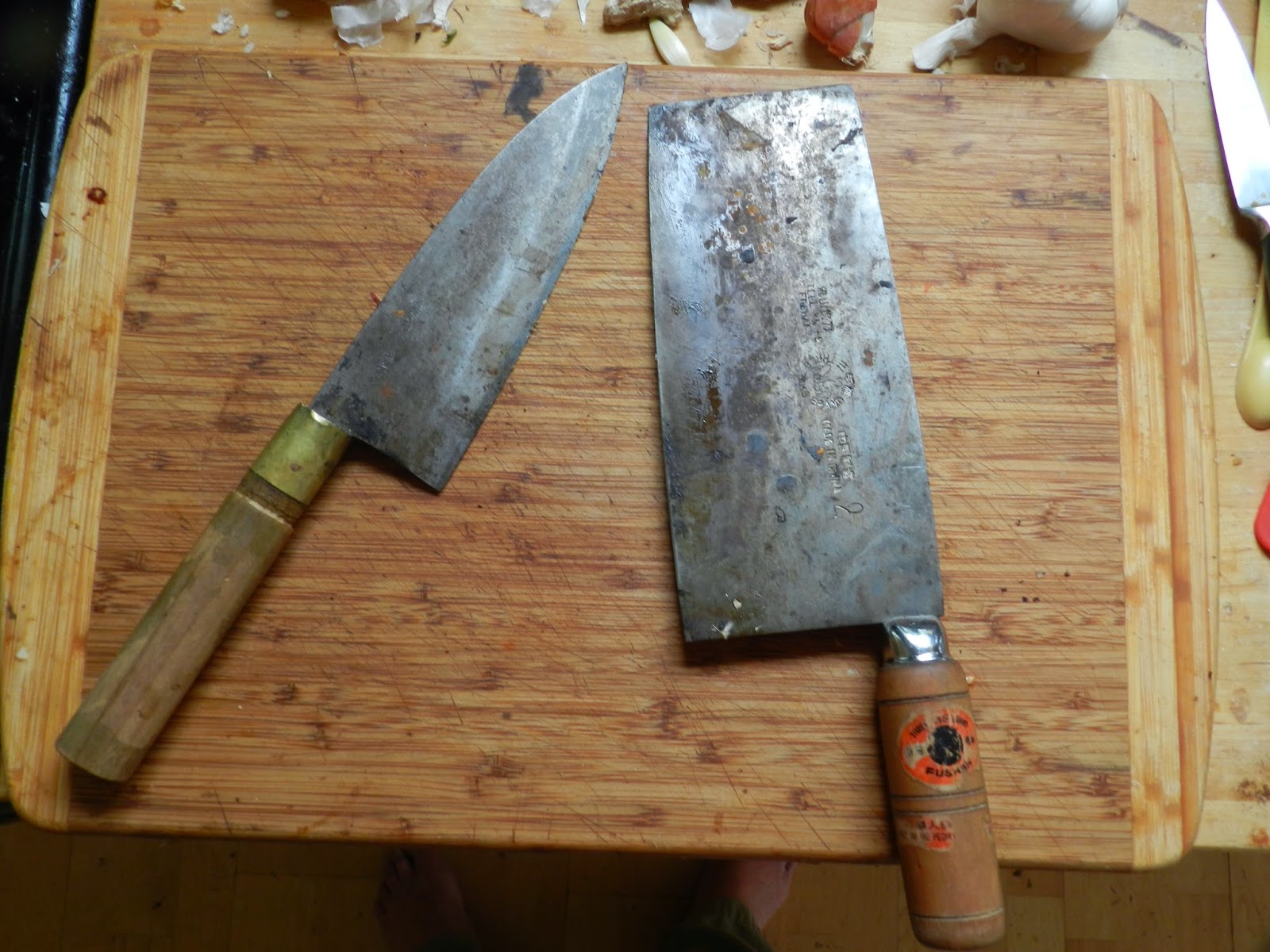
Speaking of cooking, since I notice that Mick Vann has posted a couple of long pieces on his knives (here's the first of the series; there are two more), I'll post a shorter one on mine. When I left France, I was using three knives, two Henckels, a big chef's knife for chopping and a smaller one for mincing up garlic and carving tomatoes and the like, and a beautiful Japanese knife that was razor sharp, which I used for turning, for instance, herbs into powder. The Japanese knife had a serious injury early on in France as I cut into a saussicon sec from the market and hit the metal brad that's used to seal it closed, which had inexplicably migrated into the meat. This hurt, I gotta say. I'd bought this knife in the market in Kyoto at the legendary Aritsugu store, and I'd taken exquisite care of it up to the moment when it hit that metal and the edge got dinged badly. 

Then, when I moved, I wrapped those three knives up and shipped them with the rest of the kitchen stuff, which, since it took months for the movers to get here, meant I needed knives in Austin. Fortunately, in King Tut's Tomb, aka the stuff I'd had in storage for ages, there were two Chinese knives, bought years ago and almost never used. One was a cleaver, the other a flesh-cutting knife.

Meat knife, cleaver (L-R)
Now, there had been times when I wanted a cleaver, and all of a sudden I had one. To my great surprise, it did great service when it came to, for instance, chopping stuff really fine: ginger, garlic, onions, etc. I haven't dismembered a chicken with it yet, and I don't know if it'll do that, but I use it pretty much exclusively for chopping at the moment. And since I've been doing a lot of Chinese food here since I moved back, it's come in very, very handy. Enough so that the big chef's knife more or less just sits there.

The other knife, though, its acquisition lost in the haze of time, was a revelation. When I was at Aritsugu in Kyoto, there was a saleslady who spoke impeccable English. I was admiring a number of knives there because I was looking for, well, what I got: a fine-chopper, but razor-sharp enough to cut tough stuff like meat. She explained that the vast majority of what they carried was for sushi, and so the blades were shaped for that: |/. The straight edge helped cut thin, even slices. (For comparison, a French chef's knife would be \/, and the cleaver ||.) They only had one or two French-style blades, and she showed them to me and I chose one, which she sent back to the master to hone perfectly. (She also asked if I wanted my name in Japanese for free and for reasons I still can't figure, I declined). Anyway, this knife-of-unknown-origin is clearly a |/, and when it comes to slicing meat for Chinese food, it just glides through it. Flank steak is no problem, and it laughs at chicken.

If it helps, the meat knife seems to be a Shigemitsu from Sakai, Japan, which means I probably bought it in San Francisco's Japan Center in 1970. The cleaver is a Three Rams brand, no doubt acquired in San Francisco's Chinatown at some point, or maybe at Austin's legendarily smelly, cramped Oriental Market on Airport Boulevard.

And a little secret: I had a friend who was a chef for many years, and every day he took to work a nice selection of really beautiful knives, all in a cloth doohickey with slots for each of them that rolled up and was tied shut. Then he would proceed to use two, maybe three, of them. "They don't respect you if you don't have an impressive collection," he said, "but hell, how many do you need?" Exactly.

* * *

Finally, a cretur update, which the delicate may wish to skip. 

As the weather warmed up, I began to notice a small grey gecko living in the wood trim of the garage, who'd walk around close to the house and gorge himself on ants from one of the anthills near the front door. He'd disappear fast when I walked by (although one time he was so busy gobbling ants I almost stepped on him). But he vanished, and one morning I found an odd turd in the driveway. Not quite an inch long, but pretty fat, and in the shape of a J. I wondered if that might have been the gecko, but also worried what kind of animal might have deposited it. I do have something of an attic in this place, and would prefer it keep devoid of opossums, raccoons, and squirrels, not to mention rats. 

So imagine my alarm when another, identical, J appeared on the back deck. I enlisted some more savvy friends to help me figure what it was, and it took no time at all: toad. Really? A toad with an intestine big enough to leave that? Dang. Anyway, I haven't yet laid eyes on Turdy, as I've been calling him, but it did remind me of the evening I was sitting on my porch in my old place here, enjoying a summer storm passing over, and listening to the stereophonic frog chorus that lived in two nearby culverts. One was tenors, one basses, and they'd alternate and then sing together. I can't imagine any female frog in Texas resisting them. Anyway, my ears were open, and I heard this intermittent squeaking sound, like someone making annoying noises on the outside of a balloon. Squeeeek. Long pause. Squeeeeeeek. What was weird was that my ears told me it was coming from a few inches away. The next time it happened, I found it: there was a crack in the concrete of the porch and something was emerging. More of it appeared with each squeak. Finally, there was a huge push and a toad emerged, fully three inches long. How it had pushed itself through that crack I don't know, but I saw it happen. It sat there, inflating a bit and, after a couple of tentative steps, hopped off to the nearby creek in search of what the frogs were in search of. I've since read about toads who've lived in suspended animation for upwards of a century, sometimes put as a joke in a cornerstone of a building. Many of the ones who do this are the famous Texas Horned Frog, or horned toad, as depicted on Texas license plates. What's ironic about that is they're just about extinct. I've been in their habitat a lot and never seen one outside a zoo.  Anyway, Turdy likes it near lights that attract bugs, evidently, so he's welcome to hang, even if I don't see him. 

And, just to reinforce stereotypes, I found another cretur a couple of weeks ago. When I moved in here, I sprayed the garage with some kind of fog that, it alleged, stayed live for months. Sure, I told myself, as long as it kills what's already there I'm cool with it. But it appears that it does work, because one fine morning I found this dandy, who hadn't been there the day before. 


Yes, that's a quarter
Everything is bigger in Texas! Admittedly, I drove over him with a handcart as I was trying to get a bookshelf into the house, but it didn't hurt him much except to detatch one of those huge antennae. These roaches are so-called tree roaches and are much happier outdoors than they are in your kitchen, and will frequently run for an open door or window if given encouragement. You do not want to smash one, since they contain, um, plenteous soft filling. 

* * *

So there we have three short items on the year's longest day. Wish me luck for Monday, and stay tuned; there's about to be some action around here. 

Tuesday, May 20, 2014

More May Migas

I had what I can only describe as a stupid revelation the other day when I realized that the main reason I was eating as well as I am is not because of the quality of the ingredients I was buying (when it comes to fruit and vegetables, after all, France led in that area most of the time) but the fact that 99% of the cookbooks and recipes I use were written for Americans using American ingredients. After all, I struggled for years to make cornbread in Europe, trying this version of cornmeal and that version and failing over and over, and eventually smuggling back bags of cornmeal from Texas or whatever US destination I'd been in and parcelling it out like a precious substance -- which it was! -- and never, for instance, using it as the sliding medium on the pizza peel, in favor of semolina.

But now I can get it whenever I want, and my preferred kind (Lamb's) is available in the supermarket down the street for two bucks a bag. (I have no idea why this kind is so much better than everything else I've tried, but all I know is that I asked a friend to mule me some cornmeal when he visited from Texas one time and the results were stupendous).

Diligent research had settled me on the Northern Cornbread recipe from The New Best Recipe, but I was mooching around the Internet one day after I moved back to Texas and found one that looked pretty good. Hey! I told myself. That sounds good -- and I can easily make it. So I did.

Last Sunday's sunrise
The picture here fails to get the intense yellow of the cornbread and cheese, but it looks even better if you click the picture and make it bigger. The recipe is here (scroll down some), and if you play around with it a bit (ie, I omit the garlic, which made no difference whatever in the taste last time, I remembered not to stick the cheese in the batter, which made the cornbread almost indigestible, and I trusted my eyes and nose to warn me when it was done, because I think he has you bake it too long) you, too, may make perfect Texas cornbread. It also freezes perfectly, and if you wrap a defrosted hunk in foil and bake it at 350º for around 15 minutes, you'd almost never guess it was leftovers.

I guess as far as revelations go, that one's sort of a "Duh" moment. Still, at my age you take the revelations you get and are happy you're still getting them.


* * *

I forget who's directly responsible for this, but at long last I have a concise explanation for what it was about living in France that bothered me and why I finally had to move. I do know that it came about because I had read and enjoyed a book called Provence, 1970: M.F.K. Fisher, Julia Child, James Beard, and the Reinvention of American Taste, by Luke Barr, who's Fisher's great-nephew. The book's kind of inside baseball for anyone not fascinated by the subject, but it did remind me that Fisher is a fascinating character. At any rate, someone recommended Two Towns in Provence by her, commenting that I might get more out of it than the average person. 

The book is actually two books, the first, Map of Another Town, about her time(s) in Aix-en-Provence and the second, A Considerable Town, about Marseille. Both are fairly close to where I lived, in Montpellier, although I never visited either during my 20 years in Europe. So I went down to Book People and picked up a copy (which I had to special order, but hey, the  price was the same as Amazon and they're an indie bookstore). One evening I started reading it, and immediately fell under the spell of her prose. All I'd read by her up until then was her food writing, collected in the classic The Art of Eating, and the prose there was also magnificent. But this, this was a different matter. 

The basic story is that as a young woman, Fisher had lived in (and, I think, studied in) Dijon, and had discovered France and its ways there. The man she was married to at that time died young, and she had two daughters to look after. But when they were old enough, the three of them went to France and stayed for a while in Aix, where the girls went to school and Mary Frances Katherine...observed stuff. She talks of this as a map, an ordering of her surroundings that permeates her consciousness, just as Dijon, which still showed up in her dreams, did. Living in a boarding house, she isn't exactly a resident of Aix, and in a chapter called "The Foreigner," she nailed something I'd certainly experienced, but never managed to solidify into words. Here's the passage. The second paragraph, in particular, made me sit up straight and re-read it several times before I could go on. 

In Aix, I came in for a certain amount of the old patronizing surprise that I did not have an "American accent," which I do; that I did not talk through my nose, which I don't; that I knew how to bone a trout on my plate and drink a good wine (or even how to drink at all), which I do. I accepted all this without a quiver: it was based on both curiosity and envy. 

What was harder to take calmly, especially on the days when my spiritual skin was abnormally thin, was the hopeless admission that the people I really liked would never accept me as a person of perception and sensitivity perhaps equal to their own. I was forever in their eyes the product of a naïve, undeveloped, and indeed infantile civilization, and therefore I was incapable of appreciating all the things that had shaped them into the complicated and deeply aware supermen of European culture that they firmly felt themselves to be. 

It did not matter if I went four times to hear The Marriage of Figaro during the [Aix] Festival: I was an American culture-seeker, doing the stylish thing, and I could not possibly hear in it what a Frenchman would hear. This is of course probable; but what occasionally depressed me was that I was assumed to have a deaf ear because I was a racially untutored American instead of simply another human being.

This wall never falls, yet she persists. To do so, she has to create a shell which practically nobody but her girls gets through. She's forced into a selfishness in her relations with others, while accepting that this diminishes her in some ways. But it also allows her to deal with France on her own terms, to do the things she wants to do, and, in its egotism, perhaps makes her the amazing writer she was. France's loss, by all means.

There's still the second half of the volume to go, and I'll jump into it soon. But it's a relief to be reminded that it's not just the draconian demands Americans have to satisfy to get a visa, not just the absurd banking regulations (on both sides) that prevents them, effectively, from having a bank account, not just the absurd bureaucracy that stymied me. No, there was, as they say, something in the water.

I fully intend to go back to France as many times as I can in the future, but I know I can never live there. It was there, after all, that I learned an important lesson: that beauty is as important a factor in making me happy as accomplishment and love and good health, and that, furthermore, it's far easier to make happen. I suspect I'll find that principle espoused in pages of Mrs. Fisher's that I still haven't read because a lot of the time, I think we're on the same road.

* * *

Incidentally, one of the really rewarding things I've done since I've been back has been teaching a history of Austin music course at the University of Texas' "Continuing and Innovative Education" program. I learned a bunch of stuff myself, and not just about how to teach it far better the next time around. I'm teaching it again in August, and I guess enrollment is open, because two people have already signed up for it. I know: Texas in August. But the room's air-conditioned, and there'll be neat photos you've never seen, cool music you've never heard, and UT's air-conditioning, which they're paying for. If you've got to be in Austin during August, it's a great way to spend Wednesday evenings.  Sign up! See you there!


Wednesday, May 7, 2014

Maytime Migas

Creturs: I've always loved the way Davy Crockett spelled this word, which gives a clue as to how he pronounced it, most likely. (It's also a reminder that, as a semi-literate backwoodsman serving in the Tennessee Legislature, he was most likely more intelligent than most of the creturs currently serving there).

But I've always been aware that with living in Texas comes creturs. Some are vertebrates, some aren't, some are pests, some aren't. All of 'em have to be dealt with. The largest one I was ever near was one I didn't see. My old house here had a porch screened-in on two sides, a sleeping room that I used for its intended purpose. One morning about 6 my dog leapt up off the floor and started growling oddly. Then he puffed out his fur and started walking on tiptoe, still growling and hyperventilating. I heard something crashing around outside and figured it was another dog, although this was peculiar behavior. No problem. It went away and I went back to sleep. Later, I was walking the dog on some land at the end of my street and there were two men on horseback with rifles. A couple of little Hispanic kids were hanging around near them, and one of them, a girl, came running up to me. "Did you see it, mister?" she asked. What? I asked. "La pantera!" And sure enough, a circus train on the nearby railroad tracks had had a breakout. No, I told her, I hadn't seen it, but I'd heard it a few hours ago. The men confirmed that they thought it was long gone, but it had left a trail over here and their dogs were investigating.

And although the next-biggest would have been the armadillo the lady next door swore was digging up her garden, the actual next-biggest mammal would have been squirrels. I have them here, too, brown ones that I don't encourage, since with luck there will be a modest garden happening here before long. More on that in a minute.

Further down the scale of vertebrates are amphibians and reptiles, and with the proliferation of neighbors' cats, these are rarer and rarer. Which, since it's currently rattlesnake mating season, doesn't mean you shouldn't exercise caution outdoors. In my old neighborhood, that patch of land at the end of the street was part woods and part UT student housing, brick cubes baking in the heat and parking lots. These were beloved of a cretur I had heard called the Texas Racing Lizard, dark green with lighter green stripes on its side, and the ability to really haul ass when it was time to leave where it was. It would start to run and then, to run faster, raise up on its hind legs when shelter was in sight. Honestly, it was as close to seeing a dinosaur as I've ever come. But most of the lizards have been anoles, probably America's most common lizard.

Photo: Wikipedia
The pink sac means it's looking for a mate, and its other mating behavior is doing pushups with its front legs. I once sat on my porch and watched a female watching a male. He was on a tree limb some ten feet above her and he'd do his pushups and then blow out his sac, then walk a little further out, do it again, and...finally, one set of pushups caused the tree to flip him into the air. The female watched the arc as the male soared up, then down. Time to look for another boyfriend. From that same couch on the porch during a cleansing summer rainstorm, I heard a creaking sound very near me, becoming more and more urgent. I looked around and it was coming from a crack in the concrete. Something brown was stuck there and, as I watched, a large toad pushed itself out of the crack, stood there for a moment, and then ambled off. I later learned he could have been down there for 50 years or more.

I've seen a couple of tiny anoles around here -- it's kind of early for them -- but the star reptile so far has been a complete surprise. I walked into the bathroom with the bathtub (yes, I have two bathrooms) and a motion in the corner of my eye made me look into the bathtub where a very odd being was wriggling. It was about two inches long, had no legs, and had a body made up of alternating rings of black and gold. At the end was a black bead. Had to be a worm, I thought, and turned on the shower just long enough to get it down the drain. Then, the other night, it was back -- or one of its cousins. At that point it occurred to me that its motion, making S's, was that of a snake, not of a worm, which undulates its belly and moves in a straight line. This time the cretur was wriggling towards the hall closet, and I picked up a piece of paper, caught it, and flipped it out the front door. Casting around on the web made me realize it was a Texas Blindsnake, identical except for markings with the one in this account. They're also known as Flower Pot Snakes, because they're frequently dormant in commercially-sold plants. And they eat ants, which is fine by me, as well as by my flipped visitor, who should have landed near a couple of anthills. Every specimen ever examined has been female, incidentally, which means they reproduce by parthogenesis.

Birds, of course, are vertebrates, and here's where I'd like pictures, because one very noisy daily visitor is a woodpecker. He's pecked a hole in one of the backyard trees that looks like it's been there forever. He stops by to peck it out a bit, so that the moisture from the tree trunk attracts insects, but he's also canny about visiting at times when the light is bad, so I haven't taken a picture. I *think* it's a Ladderback Woopecker:

Wikipedia again: obviously I don't have cacti in the back yard.
Austin is on two major migratory flight-paths, and yet the birds I've seen have all been locals: cardinals, jays, mockingbirds, grackles, grey doves, and the odd cowbird. Beats the city pigeons I had to stare at in France.

It's the invertebrates you have to worry about, though. Until the last year I lived there, my last place had an awful lot of cockroaches. Then a couple of those transparent geckos moved in and ate themselves silly. I didn't even see another cockroach that whole year. And (knock on wood) I haven't seen many here, and the ones I have seen have been either logy with the cold or dead. Mostly, though, I've had pill bugs (which turn out to be wood lice), who all seem to have an appointment with one of two spiders who hang out in dark places with a litter of pill bug corpses around them. Oh, and just recently, as the sun goes down, waves of fireflies in the back yard. I hadn't seen fireflies in decades: I don't think they even exist in Europe. I have a ceiling fan with lights under it in my office, and that seems to be flickering at a frequency they like, since they keep flying past the window and lighting up. And yet, in all the years I've been seeing fireflies, I've never yet seen the earthbound female glow-worms they're signalling to. Weird.

* * *

And yes, I'm going to try gardening, at least on a small scale. I have a huge deck out back which a friend calls the "mosquito feeding station," which explains why, even if another friend gives me his dad's old grill, I'll be eating indoors. I have some jalapeno and New Mexico Sandia chile seeds planted, and although it's been weeks, it's only today that I spotted a touch of green in the planters. I was pretty impatient with them, but then I realized that in New Mexico, where these seeds came from (thanks, Carol!), the Hatch Chile Festival is held on Labor Day weekend and that's only the start of the harvest. Plenty of time, which is good since I don't have planters and enough soil yet. 

A friend who drives to Dallas a lot stopped in at a nursery and got four tomatillo plants which I'm going to have to re-pot, along with some cilantro, which has bolted, meaning it's time for me to dig it up and harvest what leaves are there plus the all-important roots, which figure in some Thai recipes I've got here. Funny: the whole time I lived in Germany, cilantro plants came with roots, which I threw out. Now that I live in a place with a huge East Asian supermarket and have at long last bought what I'm told is the definitive Thai cookbook, all the cilantro is rootless. Nor have I seen the roots being sold separately. But the bolting indicates that it's already getting hot, that it may be too late to plant or repot basil, and that I'd better rely on the farmer's market (if I can afford it: these people are very weak on the concept, I think) or the supermarket for tomatoes. Anyone with big pots they're not using, get in touch. 

* * *

Same for shelving: I need to get these books out of their boxes and organize my CD library. Yes, some of the crisis is over, and I'll be here a while. Not too long: I won't want to live in Austin more than a couple of years, the way things look now. Where next? Who knows? One fun at a time, please. 

Sunday, February 23, 2014

February Migas (Before It's Gone)

Okay, this is much more like it:

I think that's even the same quarter.
Last weekend, acting on a tip from one of my Facebook friends, I went and bought some more jalapenos. This time, instead of heading to the supermarket, I went to the local La Michoacana Meat Market, a wonderful insitution (there are three of them here in Austin), woefully inadequately named.  Not only do they have some of the best tacos in town (hideously expensive at $1.39 each), but they have loads of Mexican products -- as well as meats to use them with. I carefully selected some jalapenos and a couple of tomatoes, since I was planning to attempt migas again, and rushed home to photograph them in approximately the same situation as the ones in the last blog post.

These are fresh from the store, but the lower one is kind of funky. The others had been around at least a week, and they were getting rotten at the end of the stem (you can even see this if you look closely: one has part of the outer layer of the stem missing). These weren't all shiny and plump, but you know what? They sure did the trick when they got stirred into the breakfast fixin's. Not peel-the-inside-of-your-mouth hot, but, shall we say, definitely present. Maybe one of them will turn red before it goes bad: I have a Chinese recipe that asks for a red jalapeno, and would seem to benefit from such a thing. I don't actually know, having not been in the presence of one for some years. We shall see.

* * *

Incidentally, making actual migas turns out to be really easy, as long as you pay attention. I naturally went to the method Robb Walsh uses in his Tex-Mex Cookbook. Tear up about three tortillas into what he calls "dime-sized pieces," and fry them in some oil (corn oil is good) over medium heat. He doesn't specify it, but I'd say this works best if you get them all the way to crisp. Then you throw in a baseball-sized onion and two (of the size in the photo) jalapenos, chopped, and let it fry til it softens. Next, a similarly-sized tomato, also chopped, stir to incorporate everything, a bit of salt (which I always forget), and then three scrambled eggs. Keep stirring and toss in a handful or so of grated cheddar, raising the heat just a tad. Once you get this down you can start tweaking proportions and playing with ingredients (chorizo, mushrooms, different cheeses, etc). It's weird that Texas seems to be the only place this amazing dish is made. (I once got into a conversation with an older Mexican guy in a San Francisco Mission-district supermarket about migas, and wondered why I couldn't get them in California. He gave me an odd look and said "You make 'em at home!") 

Now to work up some of my other favorite Mexican breakfasts. 

* * *

Owning a car is turning out to be a bit of an adventure. Not driving it around town and on the local highways -- I knew that'd be an adventure.  No, the official stuff connected to it. First there was the cost of insurance: I hadn't owned a car in 20 years, so I pay the max, although I'm hoping it goes down after a while. Then there was transferring the title. Egads! Who knew that, because I bought from an individual, I'd be paying the sales tax? Ouch! But at least one sticker was up-to-date. My latest adventure was getting it inspected. Oh, boy, do cops like to stop you for out-of-date inspection stickers, and oh, boy do I not need a ticket. There's a place around the corner that does it, but I spent several weeks dropping in there and being told there was no time and I should show up at 7:45 so I'd be there when they opened. That wasn't going to happen. Finally, I was told of a place where that was all they did, and was in and out in 20 minutes, and that was only because there were two other cars ahead of me. Now to get the transmission fixed: I think I'd like to take a weekend off and go to Louisiana before it gets too hot and the crawfish disappear. Also bring back some sausage and tasso, because what passes for those things here is laughable. 

There was one more surprise awaiting me, the naive car-owner. After I transferred the title, I got a postcard in the mail. A couple of days later, I got a postcard that looked like a government document. VEHICLE ALERT NOTICE: 2003 PONTIAC it screamed. VEHICLE DOCUMENT/ALERT NOTICE. The rear explained that my factory warranty "is expiring or has currently expired!" and that I was to call an 800 number to "speak with Motor Vehicle Division to continue coverage." I was a bit confused. After ten years, yeah, I'd expect all the warranties to have expired. Finally, I noticed that it had been mailed from St. Louis. The one in Missouri. And I got another from Sacramento a few days later, and another one shortly after that that I just tossed in the trash. (Excuse me: recycling. This is, after all, Austin). 

I e-mailed a patient friend who often explains things like this to me and he wrote back "Didn't you know? The government sells your data to these people. It's a scam." Boing! Culture shock. I lived in Germany for 15 years, a country where your privacy is sancrosanct to the point where they won't send you an itemized phone bill because to do so would break the privacy laws adopted after the de-nazification process. (What the connection between finding out what Opa did in the war and your phone bill might be, I never was able to find out). France is a little looser, but this would be similarly unthinkable there. I suppose in a country that can get away with NSA data-vacuuming of ordinary citizens I shouldn't be too shocked. But it's a bit unnerving just the same. 

* * *

One of the best times I've had in a while was two Saturdays ago, doing a workshop on writing for media like radio, showing the difference between the kind of thing people are going to read and what they'll listen to. It was all done for the Writers' League of Texas, and I hope to do some more stuff for them soon. Not only did I have a small but lively bunch of attendees, but I got to snoop around the campus of Austin's second-largest university, St. Edward's. Although I once had a friend who worked in its library, I'd never been inside. It's a Catholic school, but it seems pretty up-to-date in its offerings. And it does have a grand old central building, as any campus should. 

Too bad some photographers can't frame a shot better than this. Of course, it was shot on a phone. 
I naturally worried a bit, so I got there early, and among the things I did was shoot a photograph of Austin from the hill St. Ed's sits atop. I'm not sure I can name more than one or two of the buildings in this picture, and among the ones you can't see are the Capitol and the Texas Tower, both of which were integral to the cityscape when I lived here before. (I used to be able to see the Capitol dome from my bathroom window on 9 ½ St. if I stood facing the toilet, which made me think of a real estate ad that'd say "Capitol view, men only." Oh, and this was only when the leaves were off the trees.) Anyway, here's Austin, 2014: 

The real tall one with the hat on top, I'm told, is the one where Kanye West has an apartment. 
At any rate, I'll be doing another course starting on April 2, over at that larger, better-known university here in town. It'll focus on the history of Austin as a music town, four classes, four decades, starting in the 1950s. I'm hoping to line up a bunch of people who were there for most of this, and it should be fun. Only eight people have signed up so far, and that's not very exciting, so if you're in town (or plan to be here for the month of April), sign up here and come on down. 

* * *

One more bit of self-promotion here and I'll go. Things haven't gone as smoothly as I'd thought on this move, and it's pretty tight around here, but one thing that's been making a lot of difference is my Amazon store, where a bunch of books I found in storage and shipped from France have wound up. It's a pretty miscellaneous collection of stuff for sure, but there could well be something there you or one of your bibliophilic friends wants. I ship the orders pretty much as soon as they arrive, and so far the feedback's been good. 

As I write, I'm waiting on some additional stock, too: as soon as they arrive and I get them listed, I'll be selling some CDs from the eccentric but culturally valuable Revenant label, started by John Fahey and a young guy here in Austin. They've moved on to a partnership with Jack White's Third Man label, but the past output includes gems by the Stanley Brothers and Dock Boggs, collections of old gospel music, the unissued fourth volume of Harry Smith's Anthology of American Folk Music, and much, much more. Stop by in a couple of days and start shopping!

Dock Boggs as a Serious Young Man
Late Edit: Turns out I have the John Fahey box set Your Past Comes Back to Haunt You (ten copies), the Harry Smith and Stanley Brothers, and Jim O'Rourke's Happy Days (many copies of each). Dock's record sold out long ago. Sorry to get you all worked up...

Monday, January 13, 2014

First Migas of 2014

Odd Sign of the Year (so far): A church I pass frequently is displaying on their sign the message "Attend a local church in 2014." Now, the general tenor of this message is one I basically support, what with my efforts to patronize independent businesses, local enterprises, and all. But...is there anyone in Austin who gets the family up on Sunday morning, gets them all dressed and into the car to attend services in Wimberley? San Antonio? Waco? Even Taylor? I'd tell this pastor that if nobody's showing up on Sunday, it's not because their churchgoing isn't local.

* * *

Sticker Shock: For years, I've been getting blood-pressure medication, the same basic mix of pills. This started in Berlin, continued in France, and, last week, I ran out of my French pills. Thus began an adventure. 

First off, I needed to find a doctor. Having become officially old in November, I qualified for Medicare, which was something to take into consideration when choosing one. I did what any sane person would do: I asked the Austintites on Facebook. I then followed up all the suggestions that weren't too surrealistic and made an interesting discovery: every single one of them said they would only take Medicare from "established patients." In other words, sign up before you're 65. But I hadn't had that option, having arrived back in the country a few days before my birthday. Or, rather, I had, but it didn't seem like the most important thing at the moment. 

Foolish me. Not only was it very important, I also missed the deadline for signing up for the program that would pay for prescription drugs, unfortunately. (I'll get another chance much later this year). So suddenly it was January, and I needed a doctor and prescriptions. 

But social media to the rescue  once again! I mentioned that nobody at all would accept me, and someone mentioned that if a current patient made a recommendation, perhaps someone would bend the rules. So that's the route I took: I asked someone to ask their doctor, a guy whose setup looked particularly nice, and next thing I knew I had a same-day appointment with a guy who seems very well informed, smart, and maybe not so inclined to overprescribe and suggest unnecessary procedures as I hear American doctors tend to do. (I actually had an encounter with one of these a few years back, but that's another story). 

A few days later, my French pills ran out. I picked up my prescription slip and headed out to one of the many pharmacies that dot the landscape around here, choosing a Walgreen's which seemed to be the closest. I walked in, handed the slip over and was told to come back in an hour and a half. Which, given the labor at hand, seemed excessive. In France, that only happened when they were out of something: they'd go to the back, open drawers, pull out boxes, and that was it. Then I'd get stuck for something like €27 for four kinds of pills. This was only three, but I knew it wasn't going to cost me any $36.85. 

Probably more like $60, I told myself as I headed back to Walgreen's. As if: the damage was a whopping $110 -- $109.97, to be exact. Good thing these pills work, or my blood pressure would be through the roof. And yes, they're all generic and so on. 

America seems to be a rather expensive country to live in!

* * *

There's also a food angle to this story: the doctor's office turns out to be approximately in the same complex as Austin's Trader Joe's. Disparaging Trader Joe's, as I recently did, provoked a storm of complaints from readers and friends. (One told me they had real good, cheap tortilla chips, and I had to remind him that if there's one thing that's not scarce in Austin, it's real good, cheap tortilla chips). Thus, after the doctor's I walked over and took a look at the place again, which was useful because there were things I needed and I had the list right with me. So here's what I found. 

* Wine: there were inexpensive wines I recognized, wines for under $10 a bottle. This is worth remembering. Also the famous Two-Buck Chuck, their house brand, which is now Three-Buck Chuck, at least in Texas. I picked up a bottle of pinot grigio to cook with. 

* Juice: there were several flavors other than orange. I don't get this: in France, we had one-liter containers of juice from Tropicana that came in a bunch of different flavors -- at least a dozen. Here, the smallest size seems to be 1.75 liters, and the only thing available is orange in your choice of a dozen different varieties of how much pulp is included (why is this a problem?) and whether or not you want calcium or not in it. 1.75 liters takes a long time for a single guy to go through, but so far that's what I've been doing. Trader Joe's had a liter of tangerine juice, so I picked it up. Unfortunately I hadn't looked at the expiration date, and the next morning it was swollen up and fizzy. Dang. 

Other than that, there was a lot of packaging: I noted plastic boxes with jalapenos in them, which I thought was odd because any old supermarket has plastic bags and piles of peppers to choose from, which I, certainly, prefer to do. But all the fruit and vegetables were packaged. 

And there were a lot of prepared dishes. This is the deal, as I've been noticing when I go shopping: Americans don't cook any more, preferring to buy frozen and packaged items they can just heat up. (And before anyone jumps on me, this is just as true in France, from what I could tell). And Trader Joe's has much more creative and interesting items in this category than most places, so that, I believe, is what the foofaraw is about. 

I have another doctor's appointment on the 27th, so I'm still on the case

* * *

That, however, is the only food-related item this time. Sometime just after Christmas, my nose shut down again. I'm not really anxious to return to France, but if I could fax myself to my nose doc in Montpellier long enough to get a prescription and pick it up, I would. On the other hand, maybe not: I've had problems with my kitchen sink since I moved in here, and the landlord's been over to fix it several times, on the last of which there was also a plumber along. But the thing still doesn't work right and the other night it flooded the kitchen again. It's the drain, the same drain the dishwasher uses, so I can't use that and I can't wash the dishes by hand in the sink, so they've piled up and probably stink. And my poor landlord came down with the flu, which then turned into pneumonia, after which he tripped and fell down stairs. He's a young guy, so he'll likely be fine eventually, but every single dish in the house is now dirty, so I guess I'm going to have to clean the bathtub out and wash some of them there so I can cook more meals I can't taste. The silver lining is that it's not quite cockroach season yet. 

* * *

And while I'm waiting on my book proposal to sell, I've got some work around here that probably pays. I had a great meeting with a woman from the Writers' League of Texas, and I'm going to be giving a workshop with them in February, which you'll all want to sign up for, I'm sure! Then, two months later, in April, I'll be taking over a very popular class at the University of Texas' Informal Classes, and this one should be fun for all concerned. I'm already scheming to bring in some unsuspecting types to pump them for info about what they've seen and done. 

These two projects are just the start, I hope. I have other schemes in mind, while, of course, being available to other writers' groups and schools for lectures. What I really need is a lecture agent, and they're impossible to score without a recent book publication. Which puts me back where I began. But watch this space for more announcements, and meanwhile remember that I get a piece of the action from the e-books and cookbooks advertised in the Amazon widgets in the right margin, and am constantly adding to my Amazon store of odd and interesting first editions, art documents, and cookbooks. Every little bit helps me get adjusted in this expensive, bewildering new country I've settled myself in. 


Saturday, November 30, 2013

Migas

Well, why not? When I did my Berlin blog, I called it BerlinBites, and when I discovered I had a bunch of little things for the blog that didn't cohere into a single post, I called them "crumbs." I got to France, and by the same principle, I called them "miettes." So here in a predominantly Hispanic neighborhood in Austin, "migas" seems appropriate. And yes, I realize it's an amazing egg dish that I'll probably never learn how to make properly: scrambled eggs with onions and salsa (or salsa ingredients) with bits of tortilla chips added at the very end. The secret is to present them at the table without sogging the chip migas at all. I do not know the secret, and, as long as Austin has dozens of places that know how to do this well, I may never.

* * *

Have I been here in this house a month already? Not quite; the rent due tomorrow is prorated for the difference. But I've done a lot of stuff in that time, most of it involving spending money. The last big outlay was this week, when I went to Alberto's Appliances, a place I just stumbled onto reading a Craigslist ad, and bought a washer and dryer: new, discontinued, pre-digital models. They were cheap enough, and Alberto's delivered and installed them. They also have an unbeatable guarantee and after-sale care program. Plus, they were local. Same with the stereo I got: it came from A&B TV on Anderson Lane, which has apparently been there forever. The salesman had been in a local band when I was at the newspaper and remembered me -- or said he did. 

These purchases, necessary outlays of money, made me feel good because I'm hemmed in by monstrous commercial spaces, the most hellish of which is South Park Meadows. Now, when I lived here last, South Park Meadows was a concert venue administered by a succession of local promoters, most famous for its profusion of insect and arachnid life. (Ticks are arachnids, right?) 

...six, seven, eight. Yup!
I attended one show there and never went back, because I hate anything that even smacks of a rock festival. I'm sure a number of colorful people made colorful real-estate deals, and in the end, South Park Meadows is the biggest shopping center I've ever seen, with all the big brands: a Walmart that people apparently take the bus up from Mexico to shop at, OfficeMax, Best Buy, Target...you get the picture. 

Now, South Park Meadows is just the worst example of this I've seen because it's big, so big that, on a trip to visit one of its stores, I roamed all over the place and still haven't seen all of it. Not that I need anything in any of the stores I haven't seen, but they're big enough stores that I wonder how much of the site I haven't located yet. And as I drive hither and yon, I see signs for stores that I suppose I'm supposed to be familiar with: Lowe's, Kohl. What do they sell? I really don't care: I have pretty much what I need at the moment, although I'm going to need to hit Ikea once more when the ship comes in (see below) for more shelving, although not before I check the Salvation Army again first. 

If I hadn't seen Austin as it was in November, 1973, I wouldn't know where it was underneath all of this generic commercialism. 

* * *

On the other hand, not far from me is a little strip mall that says all the right things about the new Austin. It's got a chain kolache shop (kolaches are Czech pastries that are big in Central Texas, although West, Texas, the town I most associate with them, blew up when its fertilizer factory went earlier this year), a taqueria, a place where I've gone with a friend for pho for many years, and, I discovered, on my way to get it there recently, a very well-stocked Indian grocery store. 

Kommercial Kolaches: You can do better than this. 
Nobody planned this, this isn't a theme park, and in fact there are other businesses there, including a large Goodyear tire shop, and a couple of empty storefronts (including a failed Indian restaurant). But it's also something you'd never find in Europe, where ethnic populations tend to huddle together in homogenous clusters: a place where you can have a couple of tacos for lunch while you're having your wheels balanced, then grab a kolache for dessert, after which you can pick up a bag of besan flour and some panch phoran seed mixture. 

There's also a gigantic supermarket across the street from it, posing no threat to the Indians, but selling sushi, fresh tortillas, and, to my surprise when I needed some the other night, diced pancetta, that bacon-like stuff Italians use. I haven't really dug into the neighborhood yet; lord only knows what other surprises await. 

* * *

I haven't really looked at that Indian place yet because my trip to the My Thanh Supermarket to restock my Chinese larder caused $75 damage to my pocket, although I'll admit some of that was due to my buying some dishes to help make Chinese food, but I'll also admit that I forgot some really basic stuff, for all I bought: I didn't get fermented black beans, ginger or rice. Really: imagine being in a gargantuan East Asian supermarket and forgetting to buy rice. I anticipate similar damage restocking the Indian end of things, but I'm trying to hold off. 

Which is not to say I haven't been cooking. Two weeks of going out to restaurants also put a dent into my finances, not to mention too much food into my belly, and it feels good to be able to cook again, albeit not with the equipment I'm used to, and control the portion size. Most of the equipment is on its way from France, and was supposed to arrive this coming Tuesday, but will now be a week later. 

Still, using what I have on hand (it was great to discover a perfectly-seasoned wok, two perfectly-seasoned cast iron frying pans, a top-notch pizza stone and a peel which I think I may have made in shop class in high school, given to my mother, and reclaimed when she admitted never using it) I managed to use the last tomatoes of the season from the local farmer's market to make a pizza that was one of the best ever (and would have been even better if I'd remembered to buy 00 flour, which you can actually get here), and I've twice made Chinese food in that wok. 

I'm quite surprised to discover that I am using the microwave that came with the place (perfect for heating up tamales, like the ones a little lady going house to house sold me the other morning) and the dishwasher, something I never thought I'd use. 

None of this will translate into anything more than bachelor cooking, though, until the ship comes in: another thing that's on it is a formidable antique German dining table with leaves, and that's much better than the rickety Ikea table I'm dining on right now. Then I can start inviting people over for dinner. Um, after I buy some more chairs.  

* * *

And that will mean that my social life may pick up. I've retreated pretty much into this house, getting it set up and livable for me, let alone making it a place others can visit. I've pretty much recovered from the revelation that I'd been romantically pursuing a were-Republican for 2 ½ years, but what with my avoiding live music, I don't really have many excuses to get out of the house. I'll have to remedy that. It's not like there's nothing happening in Austin, after all. 

At least Thanksgiving was a welcome chance to get out, visiting my friends down in Wimberley and seeing their invited guests, who were mostly people I've known forever. After dinner, some of us took a walk, and I managed to take one photo that was no good, and then accidentally triggered the video button on the phone's camera. 

Wimberley, late afternoon. There were better shots, but I missed 'em. 
There's no reason to be impatient, I keep reminding myself. I know why I feel that way, though: I've made a huge change and I want it to pay off right this minute! Ain't gonna happen. Shouldn't happen. And if I learned nothing else in the Sud de France, it was how to wait for things to take their natural course. 

* * *

And now for the commercial. Much of my time here has been spent going through the books that were in storage and carefully checking their condition, any reviewer's materials that may have been stored with them, and putting them up for sale on my Amazon store. There are a bunch of fairly scarce first-edition cookbooks, all gotten when I was a book reviewer, and some literary first-editions that are all souvenirs of my various stints as book-reviewer or books editor at publications like Oui (really) and of course the Austin Chronicle. There are too many books that have been dined on by silverfish in the inadequate storage they were put in (by someone else) years ago, but few of them are for sale, and the ones that are (like that extremely rare copy of Wolf Vostell's de/collage and happenings) are priced below market value. Surely you know a serious '60s art geek that needs that! And these make stupendous Christmas presents, too! 

Okay, better get back to cataloguing. Anyone know where I can get Chinese fermented black beans in South Austin?

The knee is not for sale. Um, on the other hand, make an offer.


Site Meter