Saturday, October 20, 2012

Early Fall Miettes

Just a few items here, because I'm in sort of a time crunch.

First, I took a couple of American tourists on my famous Languedoc's Greatest Hits tour, the one that hits Sommières, goes between Pic St. Loup and l'Hortus, up to St. Martin de Londres, the Pont du Diable, and St. Guilhem le Désert, and finished up, as I did a couple of months ago, in St. Saturnin so they could do some wine-tasting. We got there kind of late, were very happy to see that Mme Cabanes was still open at Domaine d'Archimbault, decided to skip Virgile Joly, and went over to the cave cooperative of the St. Saturnin wine collective, which was still open. The young woman in there was looking at the skies with some trepidation, but was happy to practice her English on the tourists. We obviously did things in the wrong order, because nothing she poured was anything near as good as Mme Cabanes has, but she did offer two interesting bits of lore. "It's difficult doing a tasting when the weather's like this," she said. "The air is thick, heavy, and it will probably rain. The wines never taste at their best when it's like this." In fact, I'd already noticed this over at Domaine D'Archimbault: there was a kind of mugginess that hadn't been there last time. "The other time you should never taste wine," she continued, "is during the harvest. That's even worse than now; some of the wines can actually taste bad. I have no idea why this is, but it's true." She assured us that the cave cooperative was finished with their harvest, though.

Incidentally, if you're visiting Montpellier and would like to take a day to do this tour, don't hesitate to ask. I love getting out of town, and the route of this tour is pretty flexible, which means there are lots of other possibilities of things to see.

* * * 

I got an e-mail the other day from a woman named Marielle Lopez, informing me that she had opened a shop selling Mexican handicrafts and art objects not far from my house, and that starting Friday, she'd have a Dia de los Muertos display there, and would I be kind enough to tell the other Americans in town about it? Sure, I said, be happy to put it on my blog. So yesterday, after I did some other stuff, I wandered over with my camera. The place was locked up tight and there was a sign in the window saying that it was closed for the day. Okay, I said, I'd go back tomorrow. And I did, about an hour ago, and the place was still locked up, although there was a woman in there looking at fabric samples. She was ignoring me, so I shrugged and walked away. As I made my way up the hill, though, I ran into a couple of people I knew, Claude and Florence. Florence, way back at the start of this blog, was featured for her unusual art which takes its inspiration from Mexican calaveras, where skeletons take the parts that people take, a big part of the Day of the Dead tradition. I mentioned that it was the second day in a row I'd found the place closed, and it turned out that they were on their way there to finish the window display, which was the Dia de los Muertos altar. Ms. Lopez, apparently, had just had a baby, which wasn't supposed to be due until November 10, but came last night instead. 

So I caught up with Claude and Florence, and took some pictures. Kind of hard to get the window, both because it wasn't finished and because there wasn't much room. 


There are other calaveras scattered around -- a nice display of Mexican folk art -- as well as some lucha libre guys. 


And, for that Franco-Mexican touch, some of Florence's pieces, although not as cool as the ones she had at her gallery show. 


All in all a nice little show, so if you're over on the other side of the hill from me, stop in and take a look: Modarte, 15 rue Pila St. Gely, 34000 Montpellier.

* * * 


Meanwhile, Monday morning I'm headed to Barcelona for the day, and Tuesday morning I'm flying off for a week in San Francisco for reasons I can't divulge at this time. I'll fly back into Barcelona on Halloween, and return here the next evening. An unexpected break, visits with friends in San Francisco, Petlauma, and Berkeley, some Chinese food I don't have to cook myself, and who knows what other adventures await. More, perhaps, from the road, or, for sure, when I return. 

Thursday, October 4, 2012

Wait, How'd This Happen?


Back from the market on Tuesday, and I noticed there wasn't a lot in the bag. A nice big romaine lettuce, a couple of ratty (but probably still good-tasting) eggplants, two yellow tomatoes for what will undoubtedly be the last fresh-tomato pizza of the year, and a couple of melons, not particularly large, but, it developed, very nice and juicy.

In other words, this is a picture of the end of summer. The tomato lady won't be there much longer, I don't think, and she's supplemented her stock with some peppers, including some little ones that look like bell peppers, but are a kind of purply-brown and are known as chocolate peppers. It was hard finding the eggplants and the melons, and the melon guy insisted I take three for €5 (I was with a visitor, who got the other one). Whether there'll be any at all on Saturday is a good question. There were no peaches at all and the pears weren't in yet.

We had a hot summer, no doubt about that. Not the kind of weather you want to go out in. Fortunately, I had work to do, and I did it. But at the end of the afternoon, when the sun shone directly on the concrete 90º from the window I work by, the stone absorbed the heat and radiated it back out for hours after the sun went down. There would be a little sliver of the night where it got cool and then the sun would come back up.

And then one night it stopped. The wind came in, blowing hard out of the mountains. I kept getting awakened by the shutters in my bedroom being blown open, and got up and closed them again because I sleep past sunrise. I heard my neighbors across the courtyard's windows banging as the wind toyed with them, and woke up to see that the one that had already been pierced by the upstairs neighbor kid's thrown metal toy truck some time ago had cracked badly. The whole thing's going to need to be replaced.

But the day was nice. The sun was still very warm, although the wind was also there, greatly diminished, and after walking around for a while I realized that it was, overnight, too cool out there to wear sandals, as I had been doing for months. Changing into sneakers back at the house, I soon discovered that my feet had changed shape, and I got a hell of a blister. I kept reminding myself that when I wore cowboy boots, I'd always suffer a similar problem and then suddenly they'd feel great. Which didn't help right there and then, however.

And each subsequent day has been different. The monotony -- pleasant monotony, of course -- of the blue-sky-no-clouds-warm-day that is easily over half the year here had been interrupted. The battle had begun: steel grey clouds hung in the sky, either off towards the ocean or above the mountains. We had a day and a half of torrential rains this past Saturday, and I was lucky enough to get to the market before they started and to the supermarket during a pause, which made me feel smug.

Another thing, though, that I really do like is that I feel active again. The heat really can defeat your doing anything before you actually, like, do anything. Once you get out, of course, it's not so bad -- this isn't 100º-plus Austin, after all -- but wanting to do it is another matter entirely. Today, having completed my morning routine and being inbetween work (the nice euphemism actors use for not having any), I impatiently strode out of the house on the pretext of having to put the garbage out and continued walking for another 30 minutes, just stalking around the hill and looking around. Not much to see, admittedly, in terms of something new, but I covered a fair amount of ground. Come to think of it, there are a couple of places I missed that I need to hit next time that impulse takes hold. And I don't feel like so much of a slug, either.

So if the onset of fall means increased activity, I'm for it. Less appealing is the knowledge that I'll be a year older in less than a month, an age whose divisibility by four makes me reflect that I was born during a presidential election (and a thunder snowstorm, if you can believe it) with my mother stopping off at the polling place to cast her Republican vote between contractions. (I assume my father, who used to object to FDR's picture on the dimes in his pocket, did, too, since he was driving).

It also means, perhaps, progress towards my goal of leaving The Slum behind, even if I have no idea where I'll go from here. It's impossible for me to make plans, at any rate, and that's nothing new. Nope, as I say, live like the alcoholics: one day at a time. Make that pizza with the yellow tomatoes tonight, with a caesar salad using that romaine. A fulfillable goal. Tomorrow's another day. Maybe I'll have figured out what to do with those eggplants by then. But you never know.

Sunday, September 16, 2012

Barcelona, Chapter 3: And In Summary...

So, let me guess: you want to know about the food, right? Thought so. I wish I could be more helpful, but a couple of things stood in the way. First, I was mostly there to write an article, which meant I couldn't roam around as much as I wanted to. Second, I was with other people, which was both good and bad: good because one of them was quite knowledgeable, bad because when we were in a group, they weren't.

Thus, one thing that was missing was an experience with an actual Catalan meal. I'd read through Colman Andrews' classic cookbook, and was thirsting for some of the things in it, but due to the nature of how things fell out, tapas was all I managed to get. Not, however, that that's a complaint. On my second night there, the group, who were from Madrid, found us a very funky bar where we went for what was for them their first round of drinks, and for us, a taste of some of the tapas. This place was really something of a dive, but I can't fault the food: we had papas bravas, which are fried potatoes with a sauce that's mayonnaise-y, garlic-y, and hot, some albondigas, which are meatballs in a cumin-scented tomato sauce, and...something else. We were unsure if we were going to eat there or not, so we just shared what the others had ordered. The fact that I remembered the two dishes is telling: they were both superb, and I would gladly have ordered three or four more plates there, but the crowd wanted to move on. Or something. My friend and I, though, were much more interested in getting some food, so eventually we separated and headed towards a place he knew.

The place, Tapas 24, is part of a chain, and the one we went to was right off the Passeig de Gracia, the main street that, once it narrowed and changed its name, became the street off of which my hotel was, so even though it was late, I knew I could eventually walk home. (The Metro in Barcelona apparently stops at midnight on weekdays). Having had some excellent papas bravas, I was ready to see how a famous joint like this did them.


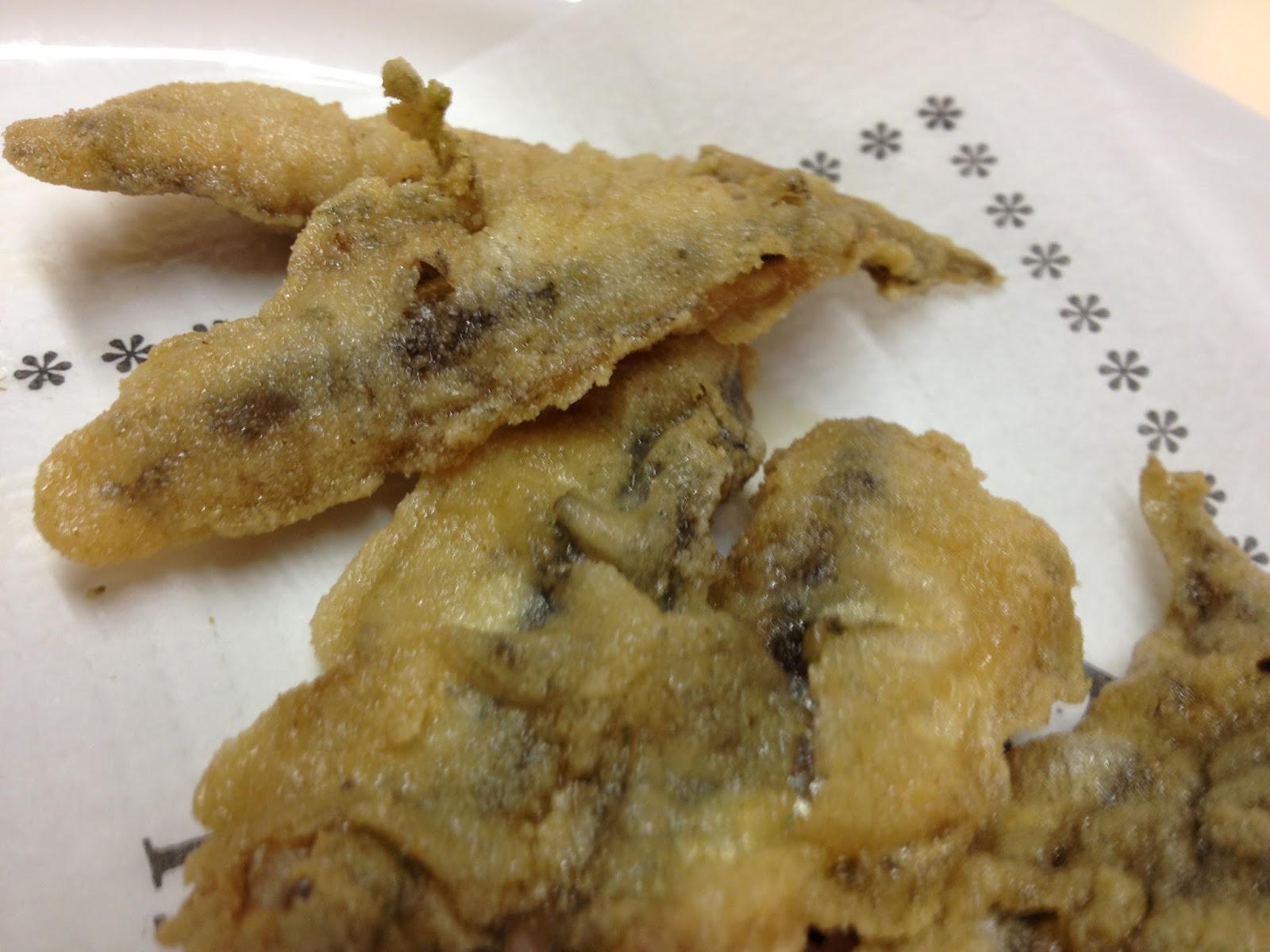
Yummy photo, kinda disappointing papas. The hot factor was dialed way down, although the potatoes themselves were fresh and superbly cooked and the mayonnaise contained a good amount of garlic. Oh, well. Then we went for some fried anchovies. Can't miss with this.


Considering that the default here is oil-cured, not salt-cured, anchovies, these were heavenly. And those of you who don't like anchovies because of rancid, fishy things on your pizza, hold off until you can at least try European ones. My only complaint was that I could have honked down the entire serving. Finally, I decided I still hadn't had enough seafood, so I asked for a plate of baby cuttlefish, which are called seiches here in France; I forget what they're called in Catalan.


These were expertly cooked: too little time on the griddle and they're slimy, too much and they turn into pencil erasers. These still had the ink sacs in them, apparently (see squirt in picture), and the combination of fish and char, plus the garlic-infused olive oil delicately draped over them, made these guys a joy. I could have done with more, but it was getting late and I had a long (but picturesque: there are two very enjoyable Gaudí buildings on the way) walk ahead of me. I was meeting a couple of Americans, recent transplants to the city, the next day for lunch, so I vowed to continue my search.

I had heard much about the big market and how picturesque it was, not to mention the amazing tapas joints in it, so it wasn't much problem to convince these folks to go there for lunch. Of course, I picked the wrong market, the Mercat de Santa Caterina, which is new and much smaller than La Boqueria, which is the one everyone goes to. Which was actually fine: there's a restaurant there with nice tables outdoors and a good list of tapas. We got an order of life-giving padrón chiles, of course...


...and having eaten one before shooting this may have revived my secret Blur-O-Vision® technique. At any rate, we got some more calamars...


...and of course some papas bravas...


...which were pretty good (but look at that mingy serving of chile oil!). Oh, and the calamars were perfection, again cooked perfectly, and flavorful on their own, enhanced by the olive oil. In the market we noted a lot more olive oil than I see locally, with no doubt a wide range of uses for the varying kinds. The folks I was with weren't hip to salt cod, so I explained how it more or less helped the Hanseatic traders invent capitalism, as they bought it in Norway and sold it in Spain and Portugal, and then we had some with some kind of sauce that seemed to be sun-dried tomatoes and olives and, um, other stuff. I didn't get much, because my companions went at it lustily -- and I don't blame them. The photo I took came out entirely white, which is weird. Ah, well, next time.

There was also a serving of this enigmatic bread, which has tomato and garlic rubbed on it, supposedly, but I wasn't tasting any. My teeth are currently in horrid shape, so eating something like that is a bit of a challenge as it is. I hope to have a report once that's taken care of.


My companions had errands to run, and I, too, had some stuff I wanted to do, so we headed into the old town and were wandering when I heard my name being called. It was my friend Jeff, with whom I'd spent the past couple of days, out for a walk and some sightseeing. I told him we'd hit the wrong market, and he offered to show us to the right one, La Boqueria. To do this, we had to hit Las Ramblas, the legendary street everyone talks about so fondly. I found it a mess: thousands of tourists jostling each other and taking pictures of each other, souvenir shops crammed with tack, and all manner of street life doing its thing. On subsequent visits, since some of the stuff I want to see is around here, I'm going to figure out ways to avoid as much of it as possible. I'd spent the past two days far from this sort of crap, and it was kind of unpleasant seeing it so suddenly.

However, there's no way to get to La Boqueria without going on it (well, there probably is, but Jeff didn't know it), and I have to say, it lives up to the hype, a grand covered market which must (I didn't have much time to explore) have been loaded with astonishing stuff, from the small sample I saw. The hams alone were epic, the seafood departments loaded with everything you'd want, including, of course, anchovies.


There was also this place, which, dammit, I should have asked about an ingredient I have never been able to find, smoked paprika. It looks like they might know something about peppers.


And speaking of peppers, just about every vegetable stand had padróns, and I might have picked some up, except there's actually a place here in Montpellier that sells them. But this is what they look like raw:


Like jalapenos, except...not.

Jeff had places to go, and so did I: I was worried about doing my pre-departure shopping and making my train. After this journey's start, I really didn't want to make any more mistakes, so I exited reluctantly and made my way back up to Plaça Catalunya on the Ramblas. Once there, I went into the Corta Inglés department store basement, and, after a bit of disorientation, eluded the "gourmet" department and went right into the main supermercado and got two packages of corn tortillas (yes!), a can of what I thought were clams (cockles, not exactly the same thing, but maybe doable), and various pork products, including a package of ham shavings from fancy ham that, scrambled with eggs and poured over sauteed potato cubes and some sauteed red onion, made one of the best breakfasts I have had in a long time this morning.

So after that, I dropped a gift for a friend in Austin at the front desk of Jeff's hotel, jumped into the subway, got to my hotel, stuffed my purchases into my bag, turned around and hit the subway again and made it to Sants station with 20 minutes to spare.

The train ride back was definitely enhanced by the sunset, which came after we'd cleared the highest of the Pyrennees and had crossed the border into France, hugging the side of the Mediterranean and then passing a series of lagoons and bays. I'm still fantasizing exploring French Catalonia, as well as Girona, with its old Jewish quarter whose history intersects with Montpellier's, and, of course, returning to Barcelona with an eye towards possibly relocating, yet again, but just maybe in a place where I'd feel a little more at home.

But this emptied my bank account, so I've got to get on some of these writing projects pronto and bulk it back up. No more travel for the moment, but this sure felt good. Thanks to all who helped.


Saturday, September 15, 2012

Barcelona, Day 2: Seeing God, Etc.

Okay, I lied. This is two days later, and I'm back in The Slum, where it's bit easier to write this stuff. No temptation to go exploring or seek out padrón peppers.

I had one thing I just had to do first, before any of the other stuff Barcelona offers: I had to go see Jesus.  Not just any Jesus, though: one from my distant past. In the waning months of 1966, I'd worked in the Christmas card stockroom of the Metropolitan Museum in New York, and of course that was near the stockroom for the bookstore, which in those days sold mostly books and postcards, believe it or not. I was pretty fixated on medieval art back then, and my girlfriend's father encouraged that. He himself had a large collection of art books, mostly from that era and a few personal favorites like Ingres, and when I'd find something I liked he'd tell me where I could go read about it. At any rate, whether because I saw it in his library or because I saw it at the Met, I bought a very expensive ($35 at least) book that may have been called Romanesque Art of Catalonia because I liked the pictures. I had a little idea of what Romanesque meant, although I'd only seen the term applied to architecture, and I had no idea where Catalonia was, except that it was somewhere in Spain. I loved this book and kept it near so I could look at the art during various, um, excursions of the sort I was taking frequently back then.

So imagine my surprise when, reading Robert Hughes' book about Barcelona, I came upon an old friend, a fresco of Christ in majesty, which had been on the cover of this book, and learned that it, along with lots of other stuff, had been removed from the tiny churches in which it had been painted to prevent any further deterioration of the images. It was carefully taken off the wall and moved to the Museu Nacional d'art de Catalunya. Which was in Barcelona. I asked Jeff, and he told me to take the metro to the Espanya stop and "it's just up the hill."

Boy, was it ever.


There are outdoor escalators to get you most of the way up the hill from where those columns are, but the last bit has to be hiked on foot, since the museum is in a building erected for the 1929 World's Fair and saved from destruction at the last moment. The view is spectacular, and cut out of this picture is Sagrada Familia, the still-under-construction cathedral, which is a bit to the right. When I first got to the museum, a black cloud of smoke was erupting a little to the left of the cathedral, and although I wasn't sure of the exact coordinates, I hoped it wasn't my hotel. (It wasn't.)

The museum visit got off to a great start, as I approached the desk to pay my admission and the nice old lady selling tickets said "Excuse me for asking, sir, but are you a senior?" Takes one to know one,  I thought, and said yes. Seniors get in free. After that, it was just a hop and a skip to the sign pointing to the Romanesque collection. With typical Catalan modesty, the museum says its Romanesque collection is unparallelled in the entire world. Without having seen all of them, I'm inclined to agree.

There are two things I like about this period. One is the fact that nobody had yet learned how to do faces "right," which lends a certain comic-book flavor to portraits that I think has a lot of charm. Witness Thaddeus and Jacob here.


The other is that painters were being asked to render stuff from the Bible that the priest commissioning them likely didn't really understand himself. Thus, there's a certain species of angel whose description must have been pretty baffling, and these painters solved the problem by showing them with a bunch of wings covered with eyeballs.


These frescoes, as I've said, came from little country churches, no doubt funded by the local lord, and attended by the various illiterate locals who listened to a priest who basically knew the New Testament, or at least its greatest hits, explain the basics of Christianity as it was in those days: live a good life, pray to a saint to try to clear your troubles away, take communion each Sunday, and give some of your produce to the church as an offering. At the top of the list was Jesus, who'd died to help you get into heaven.

I love the "tah-dah!" posture of the angels here!

It didn't take long to get to the museum's most famous fresco, the one which had been on the book cover, taken from the apse of St. Climent de Taüll. The faces here are both comic-booky and expressive, and the colors and composition are outstanding for this era.

You thought I was kidding about seeing god? Well, whose hand is that up there, huh? 

After that there was a different kind of primitiveness, as some capitals from columns and other sculpture was displayed.


I have no idea why all these people look so nervous, except for the last one, which appears to be Adam, Eve, the tree and the serpent (serpent to left, Adam center, apparently with glowing genitals, which may explain his facial expression, and Eve far right: she, at least, got a leaf).

The further I went, the better it got, with lots of pieces I hadn't seen before, like this amazing fragment of a Deposition (a sculpture group showing Christ being taken off the cross).


The crazy thing was how modern some of this old stuff looked.


Ah, but I hadn't seen anything yet. As I staggered out, I realized I could do with some lunch and some time sitting down, so I found the cafeteria and ordered a tasteless wedge of alleged pizza which was redeemed by a granita of fresh lime juice: a slushy, as it were, which lowered my body temperature just fine, thanks. Then I got up and tackled the next part of the joint: the Gothic hall.

Again, I'd always considered Gothic to be an architectural term, and, as with Romanesque, it once was, but the MNAC draws a line around 1200, with art coming after that tending towards their definition of Gothic. And there's no doubting that the ideas of what you could do with depicting the human figure was changing. Take the decorations of the coffin of a knight, Sancho Sanchez Carillo, whose departure from the world not only seems to have upset a lot of people, but caused an artist to invent Art Nouveau about 600 years early:


It would seem that a lot of people, the women in particular, are very unhappy that Sancho is no longer among them. They're tearing their hair out, crying...but it's an amazing leap forward for the faces. The elongated gowns and colors are just icing on the cake, but very tasty icing. I stared at this for a while because I've never seen anything like it, and would be willing to be there isn't anything like it.

Not long after this, a bunch of local boys went to Italy and saw Giotto's stuff and came back all inspired. The ecclesiastical art in Catalonia changed markedly, but not all at once.


I don't know what's more remarkable here, the psychedelic sky, the big cat trying to get into the grave, or the fact that the living saint is able to hold the dead saint out there with no support for his feet.

Realism began creeping in, and the stories became more complex. Realism made it possible for a lovely picture of St. Stephen debating with the Jews to truly get its point across: a couple of the Jews are debating, one has his hands over his ears, but my favorites are the ones sitting on the floor with a Hebrew book open, their expressions clearly saying "Aw crap! He's right! It's right here!" With Jews playing a prominent role in Catalonia at this point, St. Stephen was a popular saint.

But the many, many retables and altarpieces, painted wooden scenes that went behind the altar in the churches, suddenly moved Jesus into the background, and, my mind already blown just by the visual aspect of this, I had another revelation about the changing role of the church in daily life. In the pre-1200 days, the parish priests would see a bishop now and again, and that was about as far up the ladder as it went. Nobody was making trouble, and Rome was probably only vaguely aware that these churches existed. As communications and travel became easier, though, the church was becoming richer as the number of communicants grew and the bureaucracy in Rome grew even more. Various saints were promoted as worthy of worship because of the political aspects of their life stories, and the paintings in Catalonia started emphasizing, in comic-book-style panels ("Bible manga," as a Japanese woman I was showing a cathedral to once exclaimed, looking at the stained-glass windows with their stories on them), the miracles of the saint, and the gory martyrdom ("Look what this saint went through for you!"), if any. The Spanish Catholic church really emphasized blood and gore, and the message to the average church-goer changed from an emphasis on Jesus to an emphasis on saints with powerful patrons in Rome who needed money to promote their causes -- the church militant in the case of the Archangel Michael, or conversion of the Jews in the case of St. Stephen, for instance. The Crusades were underway, draining the coffers of the Papacy, which itself was in crisis, with one set of Popes hanging out in Avignon, another in Rome, allegiances to various power structures in Italy and France causing friction and outright warfare. The naïveté of the art -- and, to a large extent, its charm for me -- was a victim of all of this.

I kind of hurried through the end of the Gothic section having had my mind blown by realizing this, and my visual cortext having been overloaded well before some second-rate Dutch stuff floated into the mix. I had to go back to the hotel and process this stuff. And by then, it was time for the art opening I had come to write about, and dinner.

Some final observations -- and more food! -- in the next post.

Thursday, September 13, 2012

Barcelona, Part 1: Getting There is Half the Trick

I'd been looking forward to it for a year: I was going to deliver a short talk about the art of Daniel Johnston, and I'd get paid, at least transportation and hotel in Barcelona. When the funding fell through, the idea of doing this stayed with me, and to tell the truth, I was definitely feeling the need to get out of town -- which I haven't done since getting back from the States at the beginnig of April. So I bought an inexpensive round-trip ticket, found an (excellent, as it happens) inexpensive hotel, and alerted the troops that I was coming anyway.

Inauspicous start: I set the iPhone alarm for 6:09 and went to bed. Slept pretty well. Eyes opened the next morning, and thought, hmmm, what time is it? 7:12.  The train left at 7:31. (As I later discovered, the 6:09 was PM.) I'd already done some packing, but boy, you should have seen me pack now. I don't live far from the station, but far enough that my hopping onto the last car as the doors closed was the closest shave I've had in travelling in some time, sort of the opposite of the day I went to the Austin airport, checked my bags to Berlin, and then had the lady say to me, "Oh, but wait. This ticket is for tomorrow!" But I settled, sweating a little, into my seat, and ten minutes later, we were in Sète, our first stop. Then there was an announcement: there had been an accident personal down the line and we were stopped for an indefinite period. In case you don't know how that phrase translates, let me just say that if you decide to kill yourself because you think everyone hates you, don't jump in front of a train. More people than you've ever known in your life will hate you, and with good reason.

Since we got into Barcelona 90 minutes late, and I still had to find my way to the hotel, and my friend Jeff, whom I was meeting, had given up and gone elsewhere, and since I hadn't eaten anything yet because I'd had to leave home without any money and it was 3pm, the very first thing to do was to get something to eat. The hotel recommended a place down the street, Taberna del Cura, which gave off the distinct odor of tourist trap, but which I was too weak to resist. Yes, tapas were available mid-day, so I ordered a plate of padrón peppers, which look like jalapenos and have the interesting habit of sometimes being hot, sometimes not, but always having that deep green flavor good chiles have underneath their heat. Seared on a griddle, dipped in olive oil and rolled in a tiny bit of fleur de sel, they rock.


That got followed by a selection of pork products and some "famous rosemary bread" that was like an elongated crouton and had no taste whatever that I could discern. That's okay; it made a nice palate cleanser for the other stuff:


That ham on the bottom was amazing; I'm going to find some to bring back with me, which won't be difficult because seemingly every fourth store here is a pork store. There's also some chorizo peeking out therre, and some lomo, which is another pork product you can either get cured or cooked. Up above that is some sausage, and some slices of fairly tateless cheese. The little plate of olives didn't really make the shot -- I was concerned more with pig here -- nor did you see the tomato-and-garlic-smeared roll (again, not much taste) or the little bowl of potato chips, which I didn't go near. A nice beer rounded things off and before I knew it, it was 4 o'clock and I hadn't seen a thing.

Back at the hotel, I checked and was astonished to see that, except for a decent pen, I hadn't forgotten anything, so remedial shopping, for once, wasn't necessary. Jeff was busy, and we were getting together with friends of his for dinner at 10 (they do things late here), but he suggested I check out a couple Gaudí houses and his Güell Park, both near my hotel. Sounded good. Although I'd read Robert Hughes' masterful book on Barcelona and was thinking that maybe Gaudí and I weren't going to get along, since they either burned down or urban redeveloped a lot of the place, at least his stuff was intact, or as intact as the kleptomaniacal Japanese tourists allowed it to be. Turns out that the Casa Vicens is right behind my hotel, so that was what I hit first.

I was kinda disappointed.


Didn't look much better from further back, either.


I dunno. Disharmonious elements all competing for your attention, and then some kind of birthday cake there on the corner. Maybe the park would be better.

It was quite a hike. I thought I'd missed it (Barcelona's not particularly tourist-pedestrian-friendly when it comes to marking attractions like Montpellier is), but no, it was even further up the hill than I'd thought. I hiked and hiked and found one of the fancy mansions squatted by anti-fascist youth, who were opposed to everything imaginable, especially tourists, whom a large graffiti announced they would kill. Even so, I doubt it had anything to do with this:


Exactly what's going on here is hard to tell, but there's a hospital complex with some private homes on its property that's also protesting the potential cutting of roads through their territory. If anyone can explain point three here, that might be a way into the issue.

Anyway, I screwed up getting to the park efficiently, and wound up having to backtrack along the wall. No, I didn't get a good shot of the two famous entrance buildings. There were too many people there. But here's the wall.


Seriously, the place was overloaded with people.


One of the downsides of affordable digital photography is the rise of the Yes, Your Fat Wife Certainly Improves This Masterpiece school of picture-taking. I like to look at the object when I look at the photo. Most people don't, I guess.

Anyway, I got a couple of the iconic animals...


...knocked off a shot of the smoggy skyline in late afternoon from the hill...


...and beat a retreat down the hill and approximately towards a route which I believed would take me to my hotel. Which, I'm happy to report for the GPS I've carried in my head since childhood, it did, but not before sending me through a very interesting-looking neighborhood, Gracia, which used to be an independent village and showed signs of intelligent life.


I wandered past interesting-looking bars, bakeries, bookstores, boutiques of various sorts, and realized I was seeing something I'd missed: a beatnik neighborhood. Oh, my terminology is out of date, but I also had the revelation that one of the things that's making me unhappy in France is the utter lack of beatniks: when something like 75% of your college students want civil service jobs, you do not produce beatniks. More seriously, you don't produce artists and musicians and the kind of creative people that can give you a healthy socieity. I may have hated Germany and the largest part of the art it produced, but at least it was producing art.


Anyway, musing on this, I came to what looks like (but may not be) an old church with a nice square out in front of it, a couple of cafes, yet another lovely little urban space which this town seems to do well. I was thirsty and considered getting a drink, but, unsure of where I was, soldiered on, only to be popped, ten minutes later, onto the main street that runs by the street where my hotel is. Back in my room, I took my shoes off and laid back.

Jeff is here to promote an art show, and I'm writing that up for the Austin Post, so I'm not going to write about it here, except to say that I believed Jeff when he said it was a 25-minute walk to his hotel, which it would have been if I'd had a clue where I was going after I got to the Plaça Catalunya. The walk there, though, was spectacular, and I may do it again tonight, now that I know where I'm headed. Two major Gaudí buildings, both of which are on a considerably higher level than the one behind me, a dizzying array of stores, indicating some serious wealth in this city, and an urban space that's wide-open and intelligently designed (as opposed to evolved: both styles work, but in different ways). We met a bunch of people connected to the show and went to dinner. As to the Catalan restaurant where we dined, I wasn't impressed: a plate of grilled eggplant, red pepper, and onion was nice enough, but the grilled meat platter was dry and tasteless, even the slab of lomo. A shame.

Ah, well. But after the meal, we headed into Gracia and went to a pretty happening bar. I'm now intrigued, and after learning today that I could get an apartment half again as big as the one I'm living in for about the same money ("It's expensive here!" the woman said), Barcelona may be on the short list of places to live next. As may be Montpeller, of course. Or Des Moines.

Okay, probably not Des Moines. Tomorrow, I talk about meeting Jesus and God and I can't remember who else today and, yes, take more pictures.

Friday, September 7, 2012

The Window Up Above

It really has been far too long since I've posted here, but I have the same old excuse: the book  proposal I thought I'd have out of here in June has dragged on and on and, although I'm about to move on to another part of it, it won't be finished any time soon. This isn't the sort of thing that demands frequent appeals to the Muse and transfigurative blasts of inspiration, although there are times I wish it did. No, this involves dull, hard work, assembling pieces and putting them together just so, and then finding more pieces to assemble. Books cover the tiny work area I have here in The Slum, and other documents come and go. Odd Web pages lurk in tabs on my browser until I realize I don't need them any more and then click them away.

Personal life? Not so much, even considering how little I had before. I sit at the desk and e-mails come and go. Not long ago, a friend in Texas, a dozen years younger than myself, died while at the dentist's. Last week, a friend here tried to commit suicide. These things, I figure, are better left unshared in the details because there's nothing edifying in them, just sad. One pleasant thing was seeing E and J again after a summer that left us all prostrate and uninspired, and we celebrated our first car trip by duplicating part of it, going to the Tomato Festival in Clapiers, a suburb to the northwest of town. Eric the Tomatologue was there, as usual (he'd done an earlier one this summer in the square by St. Anne's church here in town), but he didn't have any tomatoes for sale, for some reason, just a bunch of peppers. No problem: I picked up a kilo and a half from a woman I recognized from the Tuesday market and made an astoundingly delicious gazpacho out of it, some of which still exists in the refrigerator. And there was a fresh-tomato pizza last night which could have been better if I'd used more acid fruits than I chose. Ah, well.

No, mostly, this is my day:


A window. It's across the courtyard my windows mostly look out on. But there are stories there, too.

As I noted in one of my very first posts here, there's a 19th century former hôtel particulier, or large private house, across from me. As I noted recently, there have been some changes. A couple has moved in on the ground floor, which has been unoccupied for ages and ages, and have been renovating the huge apartment there, as well as putting out a bunch of potted trees to sort of mark off their territory from the violin-makers' area. Upstairs, a couple with a daughter have taken over the former Alliance Francaise, and heavens knows where that's gone. There is, however, one window to the right of that large space, and that's what I look out on.

When I first moved here, there was almost nothing going on there. Then a rather melancholy-looking young woman moved in, and I'd see her from time to time, opening or shutting the shutters. After a while, she acquired a boyfriend, a wiry, Spanish-looking guy with an out-of-control explosion of curly hair that verged on being an Afro. He looked like a nice guy. Maybe he was: after a while of his being around, they vanished. The next regular visitor to the apartment was a guy who looked like a really unpleasant minor French bureaucrat, very pleased with himself. He brought women there, and, in a reversal of how these things usually go, the sex noises coming from the window were all his: "Ouiiiii, ouiiiii, ouiiiiiii, OUIIIIIIII!!" He sounded like the little piggy, going oui oui oui all the way home, actually. But that wasn't the worst thing about his sexual encounters: he liked to do it to music, a mix-tape of the Gypsy Kings and Queen which he played loudly. I felt sorry for his women, except that the fact that they were with him already signaled they had serious problems with taste.

Then, for the longest time, there was nobody. At one point, Mme Merde's young son was pitching a fit, which, in his case, usually also involves pitching some toys, and he threw a couple of metal cars out the window at amazing speed. One of them went through the upper right-hand window, which finally got patched up with what looks like paper. And then, this summer, there was somebody. First, two Algerian-looking women opened the shutters and the window to let some air in, and after a while I could see them cleaning the place. After that, several young women in their 20s appeared. And, the following Sunday, disappeared. Then the Algerians were back, and then more young women, speaking Spanish, and hanging their underwear in the open window, since they'd washed it in the sink. And then, on Sunday, they, too, disappeared and the Algerian ladies were back. Finally, I got it: either the melancholy young woman or the sex maniac had the lease on the place and was renting it out as a vacation apartment.

This was confirmed by the next batch in there, the oddest ones yet. I actually caught them moving in, six young gay men and one young woman, who turned out to be from the rental agency, because I didn't see them until the day they (finally) left. These guys seemed intent on disproving every stereotype that gay men get saddled with: that they have taste in clothing, that they have taste in music, that they're sensitive... But there was something else going on, I realized one evening when the one black guy (who had a goatee bleached white) was moving something across the floor. It was one of those stands they use in hospitals to hold sacs of fluid which are administered intravenously. I thought I was seeing things, but there's a no-smoking rule in the apartment, and one by one, the boys would appear, shirtless (you could hardly blame them: it was during our heat-wave and it was in the 90s), on the windowsill to indulge, and one day I noticed one had a brown elastic surgical bandage wrapped around him, which clearly showed the outline of a tube leading to his stomach. They'd sleep late, go to the beach (they, too, washed their stuff in the sink, and beach towels and bathing suits hung on the windowsill), then, about 10pm, go off to the bars, returning at about two or three in the morning, apparently deaf, because although their talking to each other was never quiet (and the room does echo), it was louder in the middle of the night. The heat made it much harder to get back to sleep after they finally settled down.

And then, on a Sunday, after an all-night party, they went, the Algerian ladies were back, and the next day a guy and a young woman who might have been his daughter and might not showed up, saw me typing, shot me looks of total disgust, turned the lamp on, and never showed up again. The lamp was on for three days and the Algerian ladies showed up again. Next up were a huge, disheveled woman and her daughter, a carbon copy 30 years younger than her, who talked to each other in a language I couldn't identify. And now there are two middle-aged French couples who stare at me from time to time. One of the guys actually smiled. And one of them went berserk last night when some drunks were making a hell of a racket somewhere and yelled at them to shut up. The courtyard is actually the negative space defined by a bunch of different buildings on four different streets, and although I, too, was awakened by these clods, I couldn't tell exactly where they were. And what is it about French guys that makes them sing -- or attempt to sing -- when they get plastered? There are two bars on my street (but The Slum has, as one of its few selling points, the fact that it doesn't face that street) which specialize in binge-drinking students, and every night a song -- sometimes "Happy Birthday," but just as often not -- gets bellowed into the night air at maximum volume. It's worse on Fridays and Saturdays, of course, and, if the presence of medical students trying to sell candy pills and the number of broken eggs on the ground yesterday is anything to go by, the centuries-old traditions of the start of the school year are upon us.

Of course, that also means that the winemakers are harvesting the grapes (tiny crop this year, which could mean good wine, but higher prices), the tomatoes are getting harvested, too, and soon the markets will have different stuff in them, just like always. Fall lasts a long time here, and it's always a nice time to wander around the countryside. But I don't mean to rush things: I'll happily enjoy a few more weeks of summer now that the heat's broken.

And I won't just be doing it here: Wednesday I head off to Barcelona for a couple of days to cover an art show for the Austin Post, and I'll also be blogging my art and food adventures in the city and seeing if Gaudí really does rub me the wrong way, as Robert Hughes' book Barcelona makes me think might happen. No matter: there are some frescoes I've been waiting to see since 1967 in a museum there, and some grocery shopping to do. And yes, I'll have my camera along. So the pace will pick up some, promise.

And then it'll be back to this:


Sunday, August 19, 2012

Little Town, Big Wines

It's always nice to get visitors in mid-summer, and when my old friends from Berlin, Ben and Yuhang, said they were on the way, I was glad to hear it. They'd been at my going-away dinner at Wok Show, the Chinese restaurant Yuhang had discovered and encouraged to serve real Chinese food instead of "Asia cuisine," and they're both wacky and full of fun. Yuhang is pregnant, so no wine tasting for her, but Ben's brother Micah was visiting from Chicago, and was along on this trip, and they had a rented car, so I was hoping they could stay another day and I could give them my Languedoc's Greatest Hits tour.

And I admit it: I also had an ulterior motive. The rosé wine I'd had at the Estivales a couple of weeks ago, Domaine d'Archimbaud's Les IV Pierre, had made a real impression on me and after haunting all the usual places looking for it, I realized I'd have to go to where it was made to find some more, and if I did this trip just right, we could hit St. Saturnin, where it's made.

So the first day I did a credible job doing the walking tour and showing them the history of Montpellier, and finding an okay place to have dinner. They were staying over behind the train station, literally with the tracks across the street, in one of the funkiest apartaments I've ever seen here, with a friend of Micah's who promotes hip-hop shows at the Rock Store, a friendly young guy named Clément who likes Americans to call him Clem. We hooked up with him and his friends after dinner at the Beehive, the wonderful English pub over near St. Roch church, which was a reminder of the only disappointment of the day: missing the annual St. Roch celebration, which happened sometime on Thursday afternoon. Good old St. Roch: a saint's day on August 16, which is always in the running for the very hottest day of the year.

At the end of the evening, the contingent decided that a tour the next day was in order (ending up at the Estivales in the evening), so we met and took off about 11:30. It was later than I usually like to leave for this tour, but once we got to Sommières, I saw it had the great advantage of our getting lunch there rather than at the pizzeria I usually use at the second stop, St. Martin de Londres. The Moroccan joint we went to, chosen as much for the amount of shade it offered as anything, was perfectly wonderful, although they were out of a lot of menu items. It was burning hot, so we did a quick turn around Sommières, jumped in the car, and found the road to Pic St. Loup and l'Hortus -- and thence to St. Martin -- in no time.

That drive remains one of my favorites, and this time I paid attention to looking for a hallucination I had last November: I thought, just as l'Hortus becomes impossible to see, that I'd seen a multi-story building attached to it. I did: it's there. It comes and goes so quickly that I couldn't even approximate how old it was or what it could have been. So there's another project: there's a new visitor center at Pic St. Loup, which I'd like to see, and then I'd like to find out something about this odd building.

St. Martin de Londres was its usual quiet self, no tourists at all, and the 11th century church just as cool in the midday sun as always. After a visit and a ramble through the village as we headed back down the hill (Micah is on a mission to scratch every cat in the Languedoc, apparently, and the village cats had absolutely no objection to this), we headed off to the Pont de Diable visitor center to determine if it made sense to take the shuttle bus to St. Guilhelm le Désert. Given that the parking lot was almost totally full, the answer was a resounding no, even if the majority seemed to be people swimming in the Hérault River at the beach there. After a look at the explanatory exhibits in the visitors' center (pointing out the need for the bridge as a connection between St. Benedict's church in Aniane and St. Guilhelm's up the hill), and a quick trip to the bridge, we jumped back in the air-conditioned car and headed to St. Saturnin. A guy who overheard us while the troops were cooling down with ice cream in the visitor's center assured us it was ten minutes away by car. I'm real glad we didn't encounter him driving on the way over.

Photo by Ben Perry


St. Saturnin is remote. Looking at the road map, you'll see that, if you're heading north, after a while, both of the roads out of town just stop. The reason it's there is wine: lots of St. Saturnin wine in the supermarkets, all from the caves cooperatives, most of it pretty good (and definitely cheap) but no better. This article gets it about right: nothing special. It's the end of the road, except it's not, exactly.

Photo by Ben Perry
There's one main street, and in the building down there where the road turns, you'll find one of the two winemakers in town who don't use the caves cooperatives. (The other is the famed Virgile Joly, who was on his way to Montpellier to set up at the Estivales). Marie-Pierre and Jean-Pierre Cabanes bought the Domaine d'Archimbaud some time back, and in 2009 separated from the CC to make a transition to organic wines. The estate itself has supposedly been used for wine off and on since 1313, and today its 12 hectares grow syrah, grenache, mourvèdre, old-vine carignan, vigonier, and muscat. They're best known for their great big red, La Robe de Pourpre, aged 12 months, 50% syrah, 30% grenache, 10% mourvèdre and 10% carignan, deep, complex, the kind of thing, as I mentioned as we tasted it, that you want to get in the winter, when you've got a nice leg of venison roasting in the oven. "Or," Mme Cabanes suggested, "mousse au chocolat!" It costs a whopping €12.50, and I know a couple of places I can get it here in town. They also make a wine called L'Enfant Terrible, which is sold out for this year, so we didn't get any of that, and then there's Le Tradition, which is the same composition as the Robe de Pourpre, but just a bit less showy. There's a leathery nose to these two reds which seems to be a house trademark, and when the evenings cool down here, I'm going to investigate both of these at my leisure.

We started the testing with the other Les IV Pierre, a white, of all things (one thing Languedoc is not noted for is white wine), which had been awarded a gold medal in this year's Concours des Vins de la Vallée de l'Hérault. Who knows how those things are judged, but this vin de pays (80% vigonier, 10% white grenache, 10% muscat) has an eccentric composition but a wonderful smoothness, with the same mineral opening I noted in the rosé followed by stone-fruit, but mellowed by a floweriness that would make it go, as Mme Cabanes suggested, with fish or white-fleshed meat (poultry, rabbit). After all the time I've spent investigating the local wines, I'm surprised to say that I might well find myself spending €9.50 for a bottle of this some time down the line. And, of course, there was the rosé, the reason I'd come. Mme Cabanes informed me that there were two wine-shops near my house (ones I, of course, never think to go to) which stock all of their wines including this one, so that's good news. And €6.50 was a much easier price than the ten smackers they'd been obligated to charge at the Estivales.

After sticking our purchases in the car, we wandered through what remained to see of the village.

Photo by me
Just to the left of this shot is a small street which leads up an incline, ending at what appears to be a very old church, but one which is so oddly placed that it's almost impossible to figure out what it looks like, socked in on all sides by other buildings, except at its rear which is rounded like Romanesque churches are. There was a pile of wood by the church (which was closed) and a sturdy-looking Weber grill nearby, so I decided that whoever St. Saturnin was, he was into barbeque -- my kind of saint.

Also on this street is what appears to be a very lovely and affordable hotel, L'Hotel du Mimosa, and across the street a very nice-looking restaurant, Le Pressoir, which apparently has a 130-bottle wine list. I can't think of a better place to be based for a couple of days' driving around some of the region's most beautiful countryside.

It's straight ahead! Photo by me

I put those fantasies on ice, though, as we returned to the car, drove back to Montpellier, and inserted ourselves in the chaos of the Estivales, which, I'm afraid, really is too crowded after a given point. I love the opportunity to taste small wineries' products (we nabbed a couple, an amazing Terrasses de Larzac red called La Tête dans les Étoiles and a very nice rosé from a Pic St. Loup producer called Château de Lascours, both of which are currently being researched) but the fight to get to where you can buy some food -- or, later, to get within pouring distance of a tasting-glass of wine -- and the incessant terrible music (anyone who wants to flatten the tires of Las Vegas Wedding's van is okay with me) takes away the fun. The best procedure would seem to be to arrive early -- the event opens at 6:30 -- get your tastings (and, if you want to eat early, a few things for dinner) and then go somewhere else for your evening meal. In fact, if I hadn't been so exhausted by the whole day, I would have recorded the ambient noise from my apartment and posted it here so you could see what I sometimes have to put up with.

Ben, Yuhang and Micah and I said good-bye, and I trundled home. The next morning, I got up to go to the market rather late, and arrived closer to noon than my usual 11am. Imagine my surprise to be greeted by Yuhang. Their 8am departure hadn't quite worked out, so I helped them shop for road food (peaches, small heirloom tomatoes, melons, some of Mimi's good saucisson sec) and we said good-bye a second time. Thanks to the Perry Three for the wonderful ride. I really did need to get out of the house, and what a way to do it!

Now...who's next?

Photo by Ben Perry


Site Meter