Showing posts with label Pavillon Populaire. Show all posts

Monday, April 18, 2016

Europe, Spring 2016, Part Four: Montpellier: You Can/Can't Go Home Again

Ahhh, Montpellier!


There was little enough reason to stick around Narbonne, when I knew that the road I'd parked on eventually turned into the road that'd drive me straight to my next destination, Montpellier, the city where I'd lived for five years before having to return to the States. I'd booked four days in a hotel there, planning to use it as a base of operations as I went out into the countryside visiting wineries and seeing more of the landscapes I'd loved.

I left Narbonne early enough on Monday that I realized I could drop down to Sète on the way and grab some fish for lunch. Once again, it was a grey day, and windy. At this time of year, I remembered, the sun could warm you if you stood in it directly, but it wasn't making an appearance, and as I drove into Sète, I saw big waves in the Mediterranean crashing against the seawall: there was a storm out there somewhere, and it was a big one. After parking under the canal, I came up and walked around the main drag, then a couple of other streets, working up a hunger and noting that almost nothing had changed. I had in mind a tielle for lunch, a local specialty best described as a pie with octopus cooked in a spicy tomato sauce as filling, but the best place in town, the place that, in fact, was credited with inventing the tielle, was closed for the season. I settled for one of the canal-side restaurants -- one of the few that was open -- and had a fish soup with croutons (not so hot) and a rouille sètoise, which, the last time I'd had it, was cuttlefish under a blanket of hot, saffron-scented mayonnaise on a bed of rice, and this time was cuttlefish in a spicy tomato-based sauce with a dish of spaghetti on the side. It was far better than the soup, but the place wasn't exactly doing a lot of business on a Monday out of season.

It was too cold to do any more wandering, or to go up the hill the town is built on, so I got in the car and headed towards Montpellier. I'd arranged this trip so that I'd wake up at the hotel on Tuesday, walk downstairs, and go to the Tuesday market, which stretches out across the street. It wasn't the best season for the market, but I could tell just what time it was by visiting it, I'd spent so much time in the past buying my food there. Meanwhile, there was Monday to kill by strolling around the center of town, seeing what had changed and what hadn't. The hotel itself was much improved from when I used to stay there on my visits from Berlin: no more rickety furniture and lumpy bed, no tiny shower booth leaking all over the place. It was too cold to take breakfast in the hotel's wonderful garden, but it would be possible later in the year.

A quick stroll confirmed a few things. First, despite the Virgin Megastore's demise, the covered market was still open, although I'd heard otherwise. Neither the Musée Fabre nor the Pavillon Populaire had shows up currently, which, in the latter case, was too bad. Not having to endure the surliness of the Fabre staff was fine with me. Wandering out onto the Comédie, there were no patrons at the outdoor cafés, and slipping down the side-street towards my old place revealed that the former jeans store was now a beer-bar with an actual good list of beers (must be the American exchange students). The biggest disappointment was when I came to my old house, and the Lebanese snack bar was still in operation, but redesigned, and with someone I didn't recognize manning it. Had my pal Hani disappeared? Apparently: he wasn't there when I passed a couple of days later, either. There was a new burger joint where there'd been a nail salon, and I recalled the words of a Facebook friend whom I don't actually know who'd preceded me by about a week: he said that food in Montpellier had changed to pandering to students, and that cheeseburgers were now a fixed thing, even on the menus of decent restaurants. There was no reason for France not to have great cheeseburgers: they have good beef, many different cheeses, and great bakers capable of crafting a bun, but when I lived there, there was only one place that did a decent burger, the Vert Anglais (which, I saw, was now called something else). Now, burgers are omnipresent, and, at least in France, they ain't for dinner. Still, I wasn't worried about getting a good meal.

The saddest change was the old hat store on the Rue de la Loge, which had been run by an old man with a great story: he was Jewish, but didn't know it, and when the Occupation came, concerned Montpellierians hustled him out of town, ran the store for him, and got him out of hiding when it was safe again. That's as much a story about French laïcité as anything. But it was shuttered (I'd considered buying a straw hat there) and the few hats in the window were dusty.

Back at the hotel, I took care of some other business, calling my Apple tech support guy, Etienne, to tell him I had my old iPad and an old iPhone he'd asked me to bring, along with some sort of memory card for an Apple Cinema Display he'd bought. He'd wandered into the English Corner Shop one day, and impressed Chuck and Judi with his abilities, although back then he was only a teenager, and now, at 21, he's at loose ends, buying and selling computer stuff, and kind of vaguely thinking about coming to America. He's also into cars, and wants either a Cadillac or a Ford Crown Victoria, of all things. But his automotive knowledge would come in handy.

There was no question of where to eat on Monday: I'd already checked, and the Chat Perché, my absolute favorite restaurant, was open on Mondays. The menu in the window looked unchanged, but inside, it was a different story. The people running the place looked different, and there on the menu was the dreaded cheeseburger and fries, where the seiches a la plancha once were. There were other things, though, and I started with a fresh green pea soup, cold, and went on with a roulade of chicken breast stuffed with Conté cheese. And, of course, I had a bottle of Mas de la Seranne Sous le Figuier with it. My favorite winery, clearly keeping up the quality, I noted, waiting for the food. The soup was good, but the chicken was dry, and the vegetable side-dishes, always a highlight there, were bland. Bland! Clearly the Chat had fallen on hard times. Very sad. I remembered so many meals with friends (including the young woman whose philosophical conversations I remembered in the first part of this travelogue), and my sister's surprised "Who puts mint in mashed potatoes?" when she had dinner with me there. The Chat did. But not any more, apparently.

Montpellier's Muslims have tacos instead of cheeseburgers. I have no idea if this is a common North African street food, if one of them is called "a tacos," or whether some Moroccan guy thinks this is a taco. 


Of course, for the Tuesday market, the heavens had opened up and it was pouring. There were stands set up, though, and I decided to see if the storm would pass, and about 11, it relented, and I made a quick tour of a much-diminished market. The egg guy was there, and, moreover, he remembered me. We had a genial chat, and I almost asked him for one of the rubber bands he uses to keep the egg cartons closed. I'd been using one, my last physical connection with my Tuesday-Saturday market ritual, to hold my bags of Anderson's coffee shut back in Austin. But I figured he'd never understand why I'd want one, so I didn't. It was obvious that a lot of folks had bailed on showing up, but the Italian guy with the fresh pasta and salumi was there, busy as usual, the quiet guy with the best vegetables (usually) in the market was there, of course (most of his trade is with restaurants), but not many others had ventured out. The herb, spice, and soap people were obviously not there, because you can't display dried herbs and soap in a downpour, and I'd promised to bring back some of their famous Marseille soap, but there was a little guy with some hiding under a canopy, so I got it from him. It was kind of slippery because it had gotten wet, but it'd do.

The rest of the day, I just left the car in the hotel's newly-leased underground parking spot and did some random stuff. I visited my friend Kirsty, a Scottish woman who seems to have defeated the various crises she was going through when I'd left, and she filled me in on the latest idiocies that the city was perpetrating (not that, when a major hunk of the city is torn up, it wasn't obvious that something was going on), surprised the hell out of the woman who used to cut my hair by dropping in for another trim (this, too, was something I'd hoped to do), and, later, met my friends E&J, who made plenty of appearances in this blog back in 2011, for a catch-up at an Armenian restaurant, of all things (well, J is vegetarian, after all). A good, relaxed day.

The next day, Etienne had asked if he could tag along while I visited some wineries. Despite a surname that means "wine jug," he declared that he didn't like wine, but was curious as to why people did. The weather had turned brilliant, and it was a good day. And Etienne's car-geekery came in handy, too: I'd scratched the paint getting into the parking spot in the hotel's lot, and although it wasn't dented or a very serious scrape, I know that these things can come back and sting you, so I'd asked him if there were someplace I could get a quote for a quick buff-and-paint job. I managed to scratch it again getting out of the space and then out of the garage -- this wasn't a big car, but damn, I'd forgotten about French parking spaces -- so our first visit was to a Peugeot dealership on the edge of town, near where we'd get on the motor route towards wine country. The only guy who'd talk to us there kept us waiting for about 20 minutes, did a superficial look at the car, and, no doubt smelling panicked rich tourist, said if we left the car now, he could have it ready by the end of Friday for €3000. Um, no. Thanks, but no. But this was a concern, and it was preying on me a bit: I'd declined CDW when I'd rented it, and although people with more experience than I said that it might not even matter, I was hoping not to have to deal with insurance.

But now, our job was to get to Aniane, and the first winery on my list. Well, there were actually only two, but I was keeping my options open. Mas de la Seranne has been my favorite Languedoc wine since I tasted my first bottle on an early visit to Montpellier, and some of my favorite wine experiences have involved it (and one of my least favorite, when I spent €13 I didn't have on a bottle of one of their higher-end wines, Clos des Immortels, for a birthday treat and...it was corked).  I'd always wanted to visit the winery, and now I had an excuse. I'd ordered a swell piece of luggage from a company that makes a collapsible suitcase that can contain cushioned holders for a dozen bottles of wine, which you can then check like normal luggage. (You declare 9 liters of wine for personal consumption at Customs, and the government charges you something like $1.35 a bottle). I'd bought one and had it delivered to a friend in Nîmes, whom I'd see later.

We got to the winery just as they'd reopened from lunch, did a tasting, and I discovered that they had a new high-end limited-production wine in the range, and upon tasting it, added it to the rosé and Clos des Immortels I already knew I wanted. Mme. Venture put up with us nicely, and let me take a photo in the room where the magic happens:

Well, some of the magic: the rest happens in the fields.
The next stop would be St-Saturnin, the traditional last stop on the little driving tour I'd give visitors, whisking them up and down the hills through medieval villages and UNESCO sites and, finally, stopping at the Domaine d'Archimbaud for a tasting with Mme. Cabanes, who was always gracious about it once she'd bullied me into trying her III Pierres white. I told her I didn't drink much white wine, but I'd loved her rosé at the Estivales, Monpellier's summer-long wine festival. Turned out the white was as good as the rosé, an astonishing feat for a region that isn't particularly regarded for white wine. This time she let me taste it again and made another sale, and so I made off with a white, a rosé, and her top bottle, Robe de Pourpre, a thick, intense red that calls out for a winter evening and a hunk of roast beast. To my surprise, Etienne declared that he'd never had a wine like that (well, I could believe that) and he loved it, so he got a bottle, too. As we drove away, he was making plans to serve it with a dish of magret, the breast of a duck that had been raised for foie gras.

It was a little early to head back, so I remembered that on the way in to St.-Saturnin, we'd passed Mas Conscience, which was not only back in the Terrasses du Larzac appelation like Mas de la Seranne, but, like them, had made an early transition to all-organic, certified and monitored. Their wines had been hard to get in Montpellier, but I remembered them as excellent, so we decided to check them out. Mme Ajorque was rather surprised to see tourists draw up, but arranged a tasting. Not only did I score two bottles, but I talked her out of a straw hat with AOC TERRASSES DE LARZAC on the band, decorations that had no doubt been part of the presentation at this year's Vinisud, the big biannual wine trade fair held in Montpellier. So now I really would look like a tourist returning from vacation on the plane! I also got a catalogue of their wines: starting this year they've imported a few pallets of wine to San Francisco and New York, and seemed open to talking to a Texas distributor. So next time I visit Austin Wine Merchant, I'll hand it off and see what happens.

It was a good day out in the country. The fields were yellow with wildflowers (ground cover, no doubt) with the occasional bright red poppy, and the vines had been grafted and were spindly green. Back in Montpellier, I parked in the outdoor lot near the hotel. No more scratches for me, and birdshit washes off. I dropped my haul off at the hotel, and fielded a text on my phone: "Headed in, traffic jam." It was from Gerry, the guy in Nîmes to whom I'd shipped my wine suitcase, who I was expecting to have dinner with the next night. It hardly mattered: I had no dinner plans tonight, and I was glad to see him. We had a fine chat over a nearly inedible dinner at Le Vieux Four, a restaurant I'd never really liked, but I was stupidly obsessed with having seiches a la plancha, a favorite that had disappeared from the Chat Perché's menu in favor of the cheeseburger, and I was also obsessed with eating someplace that didn't offer a cheeseburger on the menu, thereby narrowing choices greatly. The seiches -- encornets, actually; cuttlefish of a larger size -- could have been used to patch the tires on the Peugeot, and I struggled through two of them before giving up. Memo to self: never go on a restaurant search with low blood sugar due to having skipped lunch. I got back to the hotel, saw that Merle Haggard had died, and fired off a tribute on Facebook, then crashed.

The next day was my last in town, and I did...essentially nothing. Etienne checked in with two more shade-tree body shops he'd found who offered to do the job for €700 and €1100 (he'd taken pictures with his camera), and I decided that, with a $1300 hold on my credit card, I'd take my chances. I actually liked having nothing to do after all of the intense activity of the past week, and Friday would mark the last segment of the trip: drive to Perpignan, turn in the car, take a train to Girona, Spain. So Thursday, I wandered some, stopped in a restaurant Etienne had recommended for lunch (Les DouSoeurs, which had just opened when I left, and specializes in dishes from the Aveyron, in the north of Languedoc where there's no wine grown, but they make up for it with pork: the charcuterie-laced salad I had here was the best meal I had in Montpellier), wandered some more, found a small wine shop with a bottle of the Trois Lunes wine I'd had in Perpignan in the window -- the last bottle in the store, and the last of its vintage, the woman said -- and then wandered into a comics store and found that my favorite French comic artist, J.C. Denis, not only had a new book out, but one featuring his long-time character Luc Leroi, whom I thought he'd abandoned. I spent some time at the hotel packing, goofing off, and went back into town for a non-memorable meal.

There's no doubt in my mind that I'll return to Montpellier next time I'm in France because of the many friends I have there and the memories I also have, and because it's still the best place to base yourself for explorations of the surrounding countryside, and there are still places I want to see. And it was empowering to walk its streets now with no fear that my being broke was limiting me. I had spent a lot of time there frustrated, wanting to do things that I couldn't because my carefully-planned move was sabotaged by the capricious cancellation of a project I was working on with a music-biz sleazeball, and the subsequent $20,000 hole it left in my plans. Now I could walk into a good restaurant, drive a car into the hills, buy whatever I wanted (although I didn't want much). But knowing the town as I do, I no longer want to live there -- or, most likely, anywhere in France. The whole country still exerts a powerful pull on me, but, well, I don't know. At any rate, there's time to think before acting, and I have work to do.

And, I thought, turning out the light, there were still a few days to go, once again in unknown places.

Next: Spain And Out

Saturday, May 11, 2013

Merry Miettes of May (With Socialism and Rabbit Turds)

As I said in my last post, it's not like nothing's been happening around here, and besides the pretty much related stuff in the last post, there's been a bunch of miscellaneous miettes-like things piling up on the desk. So, because I hate clutter (short pause for audience laughter), let's clear some of it up.

* * * 

I haven't been over to the Pavillon Populaire recently because it's been one dreary academic photo show after the other. While it's commendable that the city sees the acquisition and exhibition of a municipal collection of art photography, as well as an ongoing number of curated shows during the year as part of its cultural mission, the selections tend to be pretty uninteresting and the rationale behind them full of artspeak. 

The current show, La Volonté de Bonheur (approximately, The Desire for Happiness), however, is something else. Subtitled "Photographic testimony of the Front Populaire, 1934-1938," it documents a tumultuous period in French history, during which some fairly amazing stuff happened. One thing was a huge workers' movement, as strikes turned into general strikes, and the right-wing government was brought down and a socialist one under Léon Blum was installed. As you might expect, the horrors of socialism were inflicted upon France immediately: in 1936 alone, women were given the right to vote, workers were given a 40-hour work-week, and for the first time, everyone got paid vacations. Quelle horreur, non?

It's amazing history, but not such great art, but once you walk through the show, you'll be okay with that. You'll see such familiar names as Robert Capa, Brassaï, André Kertész, and Henri Cartier-Bresson on the poster, but you'll barely notice their presence on the walls. You'll see a lot -- a lot -- of pictures of  cute kids with their fists raised, sometimes along with proud mère and père, sometimes just marching along by themselves in demonstrations or parades. You'll see workers on strike at automotive and machine shops dancing and eating lunch while they're on strike. You'll see lots and lots of pictures of gigantic demonstrations filling the streets of Paris (as with much of French history, you'll never guess that some of it actually did happen outside that city), and I gotta say, the picture used for the poster, by Fred Stein, of the guy perched on the rooftop giving the clenched-fist while a huge crowd below is milling around waiting for a parade is pretty dramatic. 


Stein, a German who relocated to Paris in 1933 and whose work is virtually unknown these days, is the discovery of the show, mainly because he got some good shots while embedded with the Front Populaire, as the huge coalition of all of the French Left was known in these years. There's a Capa that's identifiable as a Capa, but this is reportage, not art. The one exception is Cartier-Bresson's famed 1936 series of photos of French working-class families on their first vacations. There are a couple of vitrines in the show with magazines that are approximately "how-to" guides to vacationing, and a separate series by Pierre Jamet shows daily life at an "auberge de jeunesse," or teen summer camp, and you might want to check out the slideshows of his work here if you can figure out how to get in. 

This is the kind of show you want to go to on a rainy day, because there's lots of reading to do, and, if you're not up on French history, some of it will require catching up with later via some online resources. As Hitler grew in power, the Front Populaire went from being "like a convivial village fair," as one of the captions describes the general vibe, to the usual squabbling of the Left, with the Stalinists (surprise!) not helping a lot. By the end of 1937, it was over.

EDIT: According to this page -- and Marie, who commented below, women did not get the right to vote until 1944

La Volonté de bonheur: Témoinages photographiques du Front populaire 1934-1938, until June 9 at the Pavillon Populaire, Esplanade Charles de Gaulle, open Tue-Sun 10am-1pm, 2pm-6pm. Admission free. The show will also be at L'hotel Fontfreyde, Clermont-Ferrand, from Oct. 8-Jan 4. 

* * *


Je suis désolé, mais j'en doute


* * * 


Now that it's getting warmer, street life is picking up, and there are more beggars than before. As I was doing the laundry the other day, though, there was a young couple in the laundromat who looked familiar, talking in a language I didn't understand, but which sounded familiar. Aha! It came to me: Russian. Their familiarity was explained when a third person joined them, with his dirty clothes in a knapsack, and a cardboard sign which fell out as he was getting them ready for the machine: J'AI FAIM! AIDEZ-MOI! I just knew that the three or four people I saw with these identical signs had to be  connected, and I was right. That they were Russians didn't surprise me at all. They always have a small dog of some sort, too, because they know that that softens the hearts of the old ladies they depend on for their take. And just a few days ago, a new guy joined them. Of course, he had to have his own sign, and I guess they didn't have a spare dog at the moment, but they did manage to come up with a gimmick that was even better for attracting attention: his sign read J'AI FAIM! AIDEZ MOI! VIVE LA FANCE! It worked, but it was only temporary: I saw him the other day with a new sign and a dog. 

* * * 

Ever since I got here, there's been a "tropical" store on the rue de Faubourg du Courreau, which is what St. Guilhem turns into when it crosses the Boulevard de Jeu de Paume. I always wondered how they made money, since they were in a huge space and didn't have much stock, and then they expanded next door and started selling wigs. I just noticed today that they're gone, but people who need South American stuff, frozen African fish, and, on rare occasion, fresh corn tortillas (yes!) can still find them. A much smaller (and, for me, closer) store has opened. 


La Pangée keeps long hours and seems to have most of the good stuff from the old place. They're kind of hidden, but maybe word of mouth will keep them open. There are lots of things like sweet potatoes and yam and plantains and okra, and mysterious Central and South American things I don't recognize. As I keep saying, I have nothing whatever against French food, but I also like to encourage diversity. 

La Pangée, 12, rue de Balances, 34000 Montpellier. Open Mon-Sat 9:30am-8pm, Sun 10:30am-5pm. 

* * *

Finally, some news from the suburbs. I keep passing a parked car with one of those things you don't see the first few times you notice it: a sticker for a local baseball team. Yes, baseball. (I still remember my shock at having to have it pointed out that there were a bunch of Bulgarians playing baseball when I was there: apparently it's a very popular sport in that country.) 

But yes, they're the Clapiers Rabbits. I'm not sure what this is all about, but "clapier" is a word for a rabbit hutch, although the name of the town is derived from an Occitan word, according to the official Clapiers website. And, although I can't find the word I'm looking for, I was in Clapiers a couple of years ago with a couple of French women who noticed a sign on a local bakery and started giggling. It mentioned that among the specialties you could buy there (it was Sunday and it was closed, sorry to say), were Pétouls de Clapiers, the famous candy. The word which provoked the giggles, I was told was a slang word for rabbit turds. Which, assuming they're made from chocolate, might be good. Meanwhile, best of luck to the Clapiers Rabbits for the upcoming season. 

* * *

Gotta go. I swear, I had another item here, but Mme. Merde's been screaming into her cell phone out in the hall for the past half-hour and I've lost the ability to concentrate. More news as it happens!

Saturday, May 5, 2012

Obsessed With...Pittsburgh?

If you're a certain age, or you have an interest in journalism, the name W. Eugene Smith will ring a bell. At least one of his images will be stuck in your head: the kids walking into the woods on the last page of that pioneering coffee-table book, The Family of Man, maybe one of his iconic World War II photos, or the photograph of the mother bathing her daughter, severely deformed from radiation poisoning, which appeared in his exposé of Minimata Syndrome. He's one of those names which come up when people talk about the glory days of Life and other photojournalism magazines.

One of his famous assignments was to go photograph Albert Schweizer at his hospital in Lambaréné, in French West Africa for Life, and when they came out he flew into a rage and quit the magazine's staff. Hearing he was at loose ends, in 1955, a historian named Stefan Lorent, who was working with some people who were putting out a commemorative book about Pittsburgh for its bicentennial, invited him to document their city in photographs. To their pleased surprise, he accepted. He moved to town, and started shooting.

And shooting. And shooting. And printing. And shooting. And re-printing. And shooting some more. By the time he gave up, in 1958, he'd amassed over 17,000 photographs, too many to publish, too many to display. There was a tiny excerpt printed in a photo magazine, but Smith had clearly overachieved. To put it mildly.

Gilles Mora, the director of Montpellier's Pavillon Populaire, has selected 160 of these images for a small show at the Pavillon Populaire, entitled The Impossible Labyrinth, and it's drawing crowds. I've been twice, and I'm still trying to figure out a bunch of stuff.


Untitled


To attempt the portrait of a city would be impossible... The most one gets is the rumor of the city. -- W. Eugene Smith, in a note to himself, 1955.

The show is laid out thematically, for the most part, so that similar images are all in one place. The photos are in several stages of completion, and some of the images have Smith's notes in red grease pencil on them, with ideas for the next stage of printing the negative. So we have a wall of steelworkers and a steelworkers' strike, a wall of shots of houses and apartment buildings, a wall that deals with some sort of street festival, a room of images of kids playing, another with nothing but street signs, some interior and exterior shots of banks, all shot in Smith's trademarked black-and-white, with a finish that I can only describe as "greasy." You go through this exhibition and you feel like you've got some of the industrial grime from the city you've just spent time in on you, despite the fact that a relatively small proportion of the show is dedicated to the heavy industry one associates with Pittsburgh. 

It may be Mora's selection, but there's something haunting here, a palpable search for something that's not found, coming out of all of these photos. Which, I guess, is another way of saying there are very few great images here. There are attempts at them, some kind of sophomoric, like the patterns in the decorated pavement shot from high above, others more sophisticated, like the shot of the couple returning wedding presents or another couple playing shuffleboard with the woman laughing, her hand to her mouth, which seem to want to be great, but...aren't. 

There is no sense of what was going on with Smith personally during the three years he worked on this project here, and I began to speculate as a result. Smith really isn't known as a photojournalist whose work crossed the boundary into art. He isn't shown at galleries as much as, say, Dorothea Lange or Russell Lee. And yet I'm sure he felt, as anyone who views this show will, that he had art in him. Reportedly his inability to "finish" the Pittsburgh project, whose artifacts he just packed away, distressed him for the rest of his life. (He died in 1978). What's the obstacle here? 

Dream Street, the good one

Some of it is, I think, that in trying to please his employers, he went for the easy shot. There's a whole room of street signs: Rescue St., Breed St., Hope St., Loyal Way, and the corner of Ophelia and Hamlet. With the exception of Dream St., these are all represented as just what they are, no context, no representation of anything but the sign itself. Dream St., of course, is one of those pictures he must have come upon and said a silent prayer of thanks to the gods of photography. (He should also have added thanks to Raymond Loewy, who designed that Studebaker that's half-floating along there, too). It's far and away the best photo in the show, and loses nothing by being reproduced in gargantuan fashion at the entrance to the first room. 
The Wikipedia article on Smith makes reference to his "longterm consumption" of amphetamines and alcohol, which may have helped create the "impossible labyrinth" of the Pittsburgh project. Certainly there are pictures here which have their obsessive qualities: a long row of apartment buildings with their windows reflecting the sky, parking lots shot from far off. The repetition for the sake of repetition seems to be part of his style. And this might also be the key to the "what on earth did he see here?" reaction I got to some of the photos, as well as the "what is this all about" reaction to the street fair series. How on earth can you shoot a street fair and not include anything that gives you a clue as to its purpose? Or, rather, why would you do that?

Here is a photo essay which is primarily about the strength and quality of its execution, rather than the subject itself, which makes it unusual. -- Note by W. Eugene Smith, 1957


There's no telling what went wrong here, but the wreckage is at least a view of a place nobody would think to make great art out of with a camera. The mid-'50s, middle America, the innocence which still hung around the edges of American society, that's all here in abundance. And I'm trusting -- which, given previous shows at the Pav Pop, maybe I shouldn't -- that Mora's made a representative, unbiased selection here. At any rate, it's a disturbing and yet pleasant show, and I recommend at least one visit. 


And, speaking of impossible labyrinths, on the way out there's a room where you can look through books of Smith's photographs and read criticism of his work. There are two maps on the wall, one of the U.S. with a red push-pin stuck in Pittsburgh, the other a brand-new street map of the city which just blew my mind. No wonder Smith photographed street-signs: I've never seen a city with so many, mostly short, streets. It would be a nightmare to be a cab-driver there. 


William Eugene Smith: Pittsburgh, l'impossible labyrinthe (1955-1958), at the Pavillon Populaire, Esplanade Charles de Gaulle. On view until June 3. Open daily except Monday, 10am-1pm, 2pm-6pm. Admission free.

Thursday, December 8, 2011

Death For Christmas


In one of the odder choices by our local photography museum, the Pavillon Populaire, the show which has followed the rather sad Brassaï in America show is entitled Apocalypses: The Disappearance of Cities, from Dresden to Detroit (1944-2010). It's quite the change, fighting your way through the Christmas market to the Pav Pop, the forced cheer giving way to huge, stark images of utter destruction. (For the most part, but we'll get to that). 

The short wall essay that greets you after pushing your way through hanging vinyl strips on which Richard Peter's rather ham-handed picture of the ruins of Dresden's City Hall through a skeleton in a nearby museum has been printed makes the point that an actual enactment of the Bible's prophecy of the end of the world was made possible by what it calls "industrial warfare." The first room, hung with huge prints of bombed-out Cologne, makes the point eloquently. The show is chronological, and takes the visitor first through the ruins of World War II Germany, as seen by German photographers, who tended to have a more artistic sensibility than the American GIs whose color photos of bombed-out Nuremberg I've seen. In fact, having seen them made it far clearer to me why the photos here are more than documentary shots, in that time has been taken to compose them, and some care has been taken with the black-and-white printing. Thus, Herbert List's photos of the Munich Residenz, an old royal palace turned art museum which was stomped by Allied bombs, are about the damage to the artworks, and are not without a sense of humor, as the large nude Greek statue lying on its back, frozen there making an odd gesture for someone lying down, shows. 

Mostly, though, there's nothing to laugh at here. Richard Peter was a Dresdener who somehow escaped Bomber Harris' firestorm, and set about as soon as he safely could documenting the city's rebirth. In fact, his picture of the Neues Rathaus provides the only other light moment in the show for those who know German: the façade remains, as does a statue, but there's rubble all over the place while a sign declares "Wiederaufbau des Neues Rathaus" -- Reconstruction of the New City Hall. Peter not only shot the utter destruction of the Frauenkirche, which was only finished through a superhuman rebuilding program a couple of years ago, but he also got into the air-raid shelters, where all you Slaughterhouse 5 fans will recall people baked to death or died of anoxia due to the firestorm using up all the available oxygen. Whether Peter's close-ups of screaming corpses is appropriate to a show that deals mostly with the disappearance of the city itself is another matter, but they are horrifying. There is also the inevitable attempt to make Art out of something that already is by the single-named Chargesheimer, who does a good job of turning ruins into abstracts, and then prints the same picture solarized, which makes no sense at all. 

From Germany we move to Poland, which is more of the same: Warsaw also got totally stomped, and Leonard Sempolinski's artfully composed pictures of the Church of the Visitation have a hopeful note to them, empasizing as they do the artworks in the church that look over the bricks and stones lying on the ground. The most puzzling pictures in the whole show are a wall of photos of Warsaw by Maria Chrzaszczowska, which are the size of large postage stamps, hardly larger than the 35mm film they were shot on. 

No show on the destruction of cities is complete without its Hiroshima, and, after a few familiar pictures of the devastation, including the canonical one of the dome of the surgical hospital, we are in for the best series in the show: huge unframed prints by a young photographer, Hiromi Tsuchida, of objects from the Hiroshima Peace Museum: clothing, a lunchbox, a clump of hair, all with captions in French and English telling their stories, not all of which are tragic. 

Unfortunately, the Pav Pop had a lot more square meters to fill, and whether the curators decided there had been enough death and destruction or through the kind of logic only those with doctorates in art history can follow, we move to a section called Phantoms of Cities. 


One wall has this ghastly vision of Haixinsha, China, by Mü Chen, and an equally huge shot of Pyongyang by Namsik Baik. Both drew me in, particularly Baik's, which takes in the entire city and the mountains beyond, with the multicolored buildings, most of which are quite futuristic, the new snow, and the endless housing projects emanating a kind of glittery evil while the mountains, which have been there forever, just look on. Two more walls are dedicated to four gargantuan square photos of London, Paris, and New York by the annoying duo of Lucie et Simon, who have painstakingly erased all the humans from the photos but one in each shot. Cute, but so what? Everyone has Photoshop these days. And finally, there are a number of photographs of deserted buildings taken in Detroit in 2006-8 by Yves Marchand and Romain Maffre, which don't hold a candle to the ones by Camilo Jose Vergara, a Chilean-American whose work preceded theirs by a decade. He may have had the hometown advantage, having a wife from Detroit, although it seems to me there are a couple of Italians who've done good work there as well.

After the Brassaï show, too, the curators are to be congratulated for only including one obvious howler. Or, rather, one piece of misdirection. The German photos are mostly on the upper floor, but there are a couple before you go up, and, lonely on one wall, a photo by Lee Miller, "Non-Conformist Chapel, 1941," showing the doorway to a London building with bricks from a Blitz bombing spilling out its front door. The small print acknowledges that it's London, and it is. But you climb the stairs and get hit immediately with a blow-up of it stretching to the ceiling and the word ALLEMAGNE, Germany. I found this both confusing and amateurish: it's easy enough to miss the original downstairs, and it's also the only picture of London's war damage in the whole show. It's a weird slip-up, but it wouldn't be the Pav Pop, I guess, without at least one. 

The show runs through Feb 12, 2012.

Sunday, July 3, 2011

As Others See Us, Chapter 3


I thought that the end of the Year of the United States last December might be the end of the odd voyeuristic treatment of my homeland by French photographers, but something was going on in the background that I didn't know about: someone was going through the archives of the great Franco-Hungarian photographer Brassaï, and found 110 black and white and 60 color images which he'd shot in the U.S. in 1957 and which had never been shown in public. As digital restorers restored and Flammarion got ready to publish a book of these new photos, curator Agnès de Gouvion Saint-Cyr and Gilles Mora, the artistic director of Montpellier's Pavillon Populaire huddled to create an exhibition worthy of the historic find. It opened a couple of weeks ago, and, it being a sunny Sunday afternoon, I figured I'd wander over there to see what was what.

From what I can gather, Brassaï wasn't really much interested in America, although from time to time Harpers Bazaar or another fashion magazine would print his work, and in 1956, his old buddy from Paris, Henry Miller, got the Museum of Modern Art to show a series Brassaï had just shot of graffiti on the walls of Paris, which was a big hit. After a lifetime of declining to visit, Holiday magazine offered him $3000 for his impressions of America, suggesting he shoot in New York and that most French of American cities, New Orleans, so he gave in, and in 1957, took some cameras to New York and got to work.


And there you go: Brassaï in color! Not that he gave up black and white:


That's about as iconic a shot of Grand Central Station as you'll ever see, (even though the caption at the show says Penn Station).

And yet...

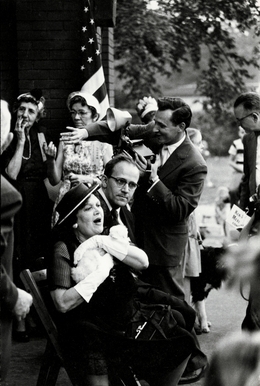
I don't mean to sound cynical, but there is every possibility that there's a good reason that it's taken forty-odd years after the old master's death to find these photos. And that reason is, the overwhelming majority of them just aren't very interesting. Very few images stuck with me after two go-rounds of the show. There are a lot of pictures of black people dressed up, some color shots from a Sunday in Brooklyn, where the subjects, teenagers, mostly, are on their way to or from church, but they have a snapshotty character to them that doesn't go anywhere. The subjects aren't interacting with the photographer, but the photographer doesn't seem to be interacting with the subjects, either. And it's not like Brassaï had never seen black people before. There is a big series from the Easter Parade on 5th Avenue, in black and white (see the picture at the top of the blog) which imparts the shocking news that women wear fancy hats on Easter. Even black women!


And people dress up, even little black girls. There are also some shots of Times Square at night, like this one:


Nice enough, but if someone told you this came from the oeuvre of one of the 20th century's great photographers, you might scratch your head. Only one of the New York pictures of people resonated with me, and that's because Brassaï knew it was an inside joke:


The New Orleans shots are even less distinguished. He apparently took a Mississippi River cruise, where he shot pictures of his fellow passengers and some nicely atmospheric black-and-whites of trees in the swamp. Then he went to Bourbon Street, where he went to a bar and heard an unknown-to-me Columbia Records artist named Earl Williams sing. Four pictures, a series, stand out of the New Orleans group, though. He shot a picture of a well-dressed young black woman talking to a friend, a chef at a restaurant, outside his place of work. As she left to walk up Iberville, Brassaï followed her, and she looked over her shoulder, once with suspicion, a second time with growing comprehension, and finally he posed her next to a lamp-post, smiling most winningly: hey, this French fashion photographer wants my picture!

I should also add that there is one photograph in here which is not from New York, as its caption says, and, if Wikipedia is right and he stopped shooting photos in 1961, not by Brassaï. It's a white wall with a sign over it saying "Boston Parks and Recreation: Graffiti. Each Man His Own Censor." Here's what gives it away: 1) Someone has lightly crossed out "Man" on the sign and written "person"; 2) Someone has stencilled the words NIXON BUGS ME; 3) Someone has done a crude drawing and written "I am free and gay," and it is clear (although it's not a pornographic or even sexual drawing) that the word "gay" doesn't mean "carefree"; 4) Someone has written, next to it, "right on."  The color is wrong, the composition is wrong, and I wonder how this early '70s artifact from someone else in another city snuck into this show. I know nobody at the Pav Pop's going to read this, let alone the people who are publishing the book, but as always you wish they'd run this past a homeboy first.

Anyway, as opposed to the dire, hyperintellectual, embarrassing work from last year's America celebration, this is worth your while for a half-hour some afternoon when you want some air-conditioning and want to see the lovely job someone's done printing and hanging these mostly minor pieces by a major artist.

(Brassaï en Amérique 1957, through October 30, Pavillon Populaire, Esplanade Charles de Gaulle, open Tue-Sun 11am-1pm, 2pm-7pm. Entrance free.)

Sunday, April 10, 2011

Les Miettes d'Avril

And so I return to France to find spring in full swing. I suspected as much: ornamental cherry trees had just bloomed when I left at the beginning of March, but now we have lovely warm days, full sun, and just a bit of a breeze to cool it off. The market finally has some interesting stuff, all of it green: one place had a sign noting that the leaves in the basket beneath it were not parsley, but, rather, young celery leaves. Interesting idea there. Lettuce is plentiful and cheap, as it never is when it really gets hot and all you want for dinner is a salad and half a baguette, and I just bought my first asparagus and strawberries of the season, have disposed of the former, and will get to work on the latter tomorrow at breakfast. Moreover, Eric the Tomatologist has posted pictures on his Facebook page showing the first buds in his plantation, so I look forward to his return to the market in mid-June.

* * *

And, with the return of spring one's thoughts return to...um...errr...

See, Montpellier has this very nice sex shop, very female-friendly, very relaxed, called Lilou Plaisir, which, it turns out, is owned by an American. I was out walking last Sunday, and went past it, as I often do, and here were two little girls, about four or five, avidly looking in the window, squealing at each other, as their father stood there pointing something out. Well, okay, I know the French have a reputation for liberality and that they tend to be fairly rational in matters of sex education, but, well, um...

Naturally, I wasn't going to eavesdrop, but I walked past it again on my way back from wherever I'd been going and looked in there to see what this awful man was telling his daughters and there were two rabbits. Yup, Easter bunnies. Which, as we all know, do have some connection to sex, although I couldn't tell if one was a boy bunny and the other a girl bunny. Given that the gestation time for rabbits is three to four weeks, though, and Easter's not until the last Sunday of April, we may yet find out.

* * *

One thing about Montpellier, we've got us some street art. Berlin was always good for this, but in Montpellier it has a different feeling, as with the Space Invaders guy who put up mosaic depictions of Space Invaders baddies here, mapping them onto a Space-Invaders-baddy-shaped grid over the map of Montpellier, thereby launching an international career. Most of the rest of what I've seen has been wheat-paste paper stuff, which decays rapidly even when jealous rivals don't tear it down before it can decay, and which always seems to appear when I'm least equipped to photograph it. But this took me by surprise:


I found this yesterday on my way home from the market, and I'd already seen a larger piece of the kid on a horse with a full war-bonnet on another wall. What was interesting, though, was that little rectangle just above the kid's head: a business card.

I wasn't totally surprised. During my stint at the English Corner Shop last year, a guy across the street was scrubbing out an old space and, eventually, moving a bunch of bicycles into it. Now, he's open. And how:


It looks better with the grate open, but it's Sunday today, and I wanted to shoot this. I can't think of a better way to advertise that you have a bike shop. And it's the same guy, who trades as al-sticking.com. You can buy a poster he made inside the bike shop until April 30, and it features another work of his that he stuck up on a parking garage above an indoor market, and is reflected in the wheels of this bike:


I should have shot the other wheel, where the picture's right-side up, but it's on the website, along with a bunch (but not all) of his other stuff. He's good, he brightens up the urban scene, and any street artist who leaves a business card is all right with me.

* * *

Another bit of art that's disappearing at the end of the month is the latest photo show at the Pavillon Populaire over on the Esplanade Charles de Gaulle. I'm beginning to think that the people who curate the shows there are way too academic for their own good. This one's called Aires de Jeux, Champs de Tensions, which translates as "playgrounds, fields of tension," I believe, and is subtitled "Figures of urban photography in Europe since 1970." I've never seen such forgettable work so well hung and lit. Well, maybe that's not true: I certainly saw a lot of forgettable photography when I lived in Berlin, but hey, I forgot it!

This show brings together 14 photographers who seem to be competing to see which one can make the most depressing, uninteresting, piece of black-and-white (although to be honest, a lot of it is in color). There are a lot of pictures of pre-1989 Eastern Europe, including a long, long, long series of badly-printed (intentionally) blue photographs called "At Dusk" by Boris Mikhaïlov that takes up much of the second floor of the exhibition. There, you can see people in a blasted landscape walking here and there, and, in a lot of cases, vomiting or collapsing. Fun. Other intentionally badly-printed work by Sergej Vutuc depicts skateboarders amid the scratches and blobs, and a huge mural by Octavian Trauttmansdorff, showing people in a shopping district. Trauttmansdorff develops his film in polluted water from a nearby river, allowing the chemicals to make his statement. There are also moving pictures, again competing to see which can be more annoying. Muntean-Rosenblum's "To Die For" slowly pans across a parking lot filled with figures who've frozen by their cars as a female voice intones a  horrible text in the second person dealing with, I dunno, Time or something. Four minutes of your life can be lost to this if you choose. The whole place rings with the grinding sound of two really stupid films by Christoph Rütimann, where the camera follows a track in imitation of a skateboarder, hence the titles bearing the word Handlauf, or "hand-journey." The only "name" in the show is Wolfgang Tillmans, with four photos from his "Subways in London" series, shot so close that it's nearly impossible to figure out what's what, resulting in both the kind of claustrophobia one feels in a packed tube train and the abstraction of a long journey on one. Still not his best work, though.

Anyway, there's absolutely no need to go into the Pavillon Populaire until after Easter, and even then, if this ludicrous hyperintellectual curation continues, you're probably better off outside in the sharp spring sunlight.

* * *

Off for a car-trip on Wednesday. Stay tuned for more photos, since we have absolutely no idea where we're going.
 
Site Meter