Showing posts with label St. Chinian. Show all posts

Wednesday, February 22, 2012

Outsidering At Vinisud '12 And Elsewhere

Two years ago, I was excitedly looking forward to Vinisud, the Mediterranean wine trade show which happens every two years here, and which, the "Mediterranean" notwithstanding, is largely a showplace for Languedoc, Provence and Rhône Valley wine. Unfortunately, in the weeks leading up to Vinisud '10, sinus polyps caused me to lose my sense of smell and taste, as documented elsewhere on this blog. So this year, with the faculties working much better (I still don't think I'm 100% healed, but this will do), I was really looking forward to it. Not only is it a great opportunity to see all the local wineries under one roof without having to drive hither and yon (and then miss them), but this year, the Outsiders were doing a tasting -- one that was as out of the ordinary as it could be. And, with the weather warming up, it was sort of a harbinger of spring, even though, as I keep having to remind myself, it's still February here.

So bright and early Monday, I headed down to the Mercure Central hotel in the deserted section behind the old city hall, and joined a bunch of other folks waiting for the shuttle out to the Parc des Expositions. I'd gotten an invitation from someone through Les Vins de Charlotte, the new little wine shop near me which I wrote about earlier, and a friend from New York who was in town got me a second one, which I handed off to E, so he could continue his education on local wines -- and red wine in general. We agreed to meet at 2, and a third party, Michael, a young guy who distributes wine in Germany, was going to join us, thanks to his knowing a couple of my friends in Berlin. A merry time was in the offing.

Meanwhile, though, I figured I should wander around and get the lay of the land, which isn't easy: the Parc des Expositions, like most trade-fair facilities, is made up of several freestanding halls, linked together by pathways, and each containing a theme: Provence, for instance, takes up all of hall 10, while hall 5, right next to it, is the Spain/Italy/Portugal ghetto, along with "other countries." That connects to Hall 1, Hall 6, and Hall 11. Halls 2 through 4 don't seem to exist. So you can see how this gets confusing, especially once you've begun tasting. I held off on that until our crew assembled in the early afternoon and still spent most of my time trying to figure out how to get from one place to another. Square mats on the floor used their corners to point in the general direction of the other halls, but after being walked on for most of a day, they became askew and, thus, generally unrealiable.

I was trying to get to the AOC Languedoc halls, 7, 8, and 9, so that I could chase down some wines that interested me and find some old favorites to see how they've fared. Somehow, I always managed to get back to Hall 6, which was dominated by Corsica's huge banner hanging in the air with its scary slogan:


That gets filed under "Please use a native speaker when making these sorts of decisions," although I have to admit, it's the same in French. Maybe in Corsican dialect it sounds less threatening.

One thing I'd kept hearing, especially from Jean-Michel at Les Vins de Charlotte, is that in the past couple of years, Pic St. Loup has been discovered as a major source of fine wines, and it's driven the price up. Certainly, the display at Vinisud bears this out:


It was hard to photograph this: there was a door inbetween, leading to the enclosed area where a couple dozen winemakers offered their wares and in the center, a chef gave three hour-long demonstration-lectures on "Fusion Food and the Wines of Pic St. Loup." Yup, sounds like Pic St. Loup has arrived, all right. Meanwhile, I like the silhouettes of the Pic and its faithful limestone companion l'Hortus on the enclosure.

At 2, we assembled at O'Vineyards' stand, as planned, and Joe O'Connell gave us a generous tour of his wines. He's an American, with a French-Vietnamese wife, and a son, Ryan, who is a dynamo for both proselytizing for Languedoc Wines (he has a blog, Love That Languedoc Wine, which I started reading early on to educate myself about this region) and for using social media and the Internet to promote your winery. For all his contagious enthusiasm, though, very few have taken his advice, at least given the overall numbers. Meanwhile, the reason he proselytizes like this continues to exist: nearly all small winemakers skate on the edge of poverty, no matter that some of their wines sell for (relatively) big money. Maximizing the potential, you have to do several things simultaneously. The O'Connells manage it with Joe making the wine, his wife Liz running a B&B on the property, and Ryan making his own wines, giving tours, and doing the cyber-wine thing. (It's actually not that simple, because everyone does everything, but the point is that there's a lot more you have to do to keep your winery's head above water, and the old joke about how to make a million dollars farming -- start out with five million -- applies).

One thing O'Vineyards is good at is branding, with everything featuring that O', and everything with a characteristic sturdiness which then finishes in a firm blaze of flavor. Their efforts have been rewarded by the Hotel de la Cité, Carcassonne's noted luxury hotel, putting their Proprietor's Reserve on the menu. It's a remarkable, complex but friendly wine -- and it's not cheap. Still, they've made it to the point where now Ryan has been able to buy some outside grapes to fashion his new wine:


This has to sit a while, but as a wine for a non-special occasion, as something to drink with some down-home cooking, it's going to be excellent.

There's a problem, though, and it is one which hangs over all of the halls at the Parc d'Exposition: you can't get O'Vineyards wine anywhere in Montpellier. I remember a couple of years ago, Ryan filled the car with bottles and came down here, hitting store after store, and being told, yeah, good wine, but it's from too far away. How far? You can drive the 150 km to Carcassonne in an hour and a half, or so says Google. And while it's true that the geology of this region is pretty tumultuous and that terroir changes every mile or so, these micro-distinctions don't do anyone any favors. I'm all in favor of supporting our local winegrowers, of course, but it sure would be nice if a few wine shops in the bigger towns here would take the risk of stocking a little broader selection from this huge Languedoc-Roussillon area.

We thanked Joe for his superb tour and E and I pushed on to a couple of winemakers I wanted him to check out. Or, rather, that he'd already checked out. Regular readers will remember that it was E's birthday last year that wound up in our getting in the car and driving to St. Chinian, having been inspired by the bottle of Les Eminades we'd enjoyed that evening. It turned out that, of course, Les Eminades had a stand in the St. Chinian area of Vinisud, and since we hadn't met the young couple who run it last year, it was easy enough to do that now. Patricia and Luc Bettoni turned out to be both enthusiastic and extremely knowledgeable, as well as in possession of some very old plants -- their Carignan vines are 110 years old, the Grenache between 30 and 60 years old, and the Syrah and Cinsault 40. That explained part of the great complexity they achieve with their wines, and another part, Patricia explained as she guided us through their four reds, has to do with sunshine management.


While we were tasting, all hell broke loose as a large number of people in robes carrying signs started parading through the hall. I only managed to get a couple of blurry shots, including this one with an embarrassed woman looking to empty her spittoon only to be blocked by the parade:


I'm still not sure exactly what was going on here, but it appears that these are members of organizations dedicated to the winemaking efforts of various Languedoc AOCs, chevaliers devoted to celebrating the area's food and wine.

Our next stop was my old favorite, Mas de la Serrane, whose wines I've enjoyed for years, thanks to their distinctive complexity, wide variety, and comparative affordability. I was already very familiar with all but the highest-end wine they make, Antonin & Louis, which I'd had but not particularly enjoyed. "It's broken; it just doesn't work," a wine expert told me a few years back, but I'm happy to report that whatever it was that was the problem seems to have been fixed.

"I get it," said E, as we hightailed it to the Outsiders' tasting, "it's like a family. All the wines have something in common, something which unites them, but they're all different." Exactly, and we'd just been afforded three excellent demonstrations of that fact.

The Outsiders tasting was definitely going to be something different. Ryan had been talking it up for weeks on Facebook, and so had the indefatigable Louise Hurren, publicist for a number of Languedoc wineries and another proselytizer for the area's top wines. In the short speech he gave before we got going, Ryan gave a hilarious presentation of word-clouds used by the tasters in the Wine Spectator's notes for its top-rated wines -- all of which were bland but enthusiastic. He then crunched some comments on his own wines into machine-generated reviews and machine-generated words. The point was simple: there are more ways of communicating ideas about wine than the standard, and exhausted, vocabulary of today's wine journalism allows. To this end, they had assembled 24 pictures -- a bunch of kittens, a Swiss Army knife, a bunch of ice-cream cones, a Lego guy, a firebomber, an ancient Citroën truck -- and asked us to taste the wines and, instead of making a comment, match each one with a picture, or a couple of pictures. Michael, the German guy, had joined us, and we were sitting next to each other. I was curious about what he'd do, as a professional, against me, who's only not been allergic to wine for 20 years and missed over a year's education to taste failure. We got pours of a Domaine de Cébène 2009 Felgaria from Faugères. We tasted. We spit. We tasted some more. We scribbled numbers in the tasting book. We compared notes.

We had picked the exact same picture: the multicolored ice cream cones. "Okay," said Michael, "this is interesting." What was also interesting is how utterly different from the mainstream virtually all of these wines were. Not just Jonathan Hesford's odd "mistake" MO2 wine, which was sort of orange and got matched to an odd face-shot which was half female, half male, but things like Château d'Anglès' Grand Vin Red (can't get more ordinary than a name like that), which got matched to the Swiss Army knife, Château de Combebelle AOC St. Chinian Rouge (old books), and my favorite, Domaine Jones' Fitou Rouge 2010 (four Renaissance portraits).

Everything was on the same high level, and I was approaching taste-bud fatigue. Also, no matter how much you spit, alcohol does get into your bloodstream through your tongue and mouth lining, so now that it was 5pm, I was about tasted out. Yesterday, I begged off because I had my other blog to write, and briefly considered going in today when I realized that I still had enough residual sensory information to process that it probably wouldn't increase any of it very much. But I'm very happy that it worked out that way: too much tasting beats not being able to taste hands down.

* * * 

There was a larger issue, too, which began coalescing as I sat at home after Vinisud and thought about all that had happened. The Outsider issue stuck in my mind: as the webiste says, the members of the group come from all over -- the UK, New Zealand, Sweden, the U.S., other parts of France -- and predominantly not from winemaking backgrounds. They came down here and got to work, and many of them discovered that they were "outsiders" in another way: the French can be cold and clannish, particularly, it appears, when a sacred part of their culture is being threatened by "outsiders." Not, it should be emphasized, the other small winemakers: lots of these people belong to organizations which purchase farm equipment in common and share it out, and lots of them exchange tips (and bottles) with their winemaking neighbors. No, it's others who seem they'd rather you weren't there.

And I felt relieved hearing these stories, because after three years here, I've felt the same thing. It's different from the experience I had when I first moved to Germany: the Germans, many of them, were friendly towards Americans for obvious reasons. But not in France. My solution has been simple: ignore it. I know it's not all French people who feel this way, so I'm not offended. And I know another thing: the day E and J and I went to Ambrussum, we were walking along and J said "You know, of all the places I've lived, I've never felt so much at home as I do here." Which is a pretty odd statement for someone living under these conditions -- and yet I knew exactly what she meant, even if it's supremely difficult to articulate it myself.

I like it here, and I'm going to stay if I can. I'll be an outsider the whole time and I don't care. There's enough of this place for us all to share and enjoy our own pleasures, and, I bet, enough friendly French people, hard as they are to find, to clue us in to some of the nuances. All of this takes on a greater meaning now that I'm readying my annual trip to the States. I'll be leaving Sunday to visit a friend in Paris, then flying to New York on Monday. I'll also hit Texas, California and, well, the end of the trip hasn't been figured out yet. The next few posts will be from the trip, and I'm happy to have the break.

But I'm really looking forward to coming back here in April. As an outsider. Go figure.

Friday, October 21, 2011

St. Chinian and the Middle of Nowhere

As good ideas around here so often do, this one started with a bottle of wine. Specifically, the one we got at the restaurant last week for E's birthday. He'd noted over the meal that he felt like taking another drive, and I was fine with that and said I'd look at the map and see what ideas came to me. He wanted to go to the Cirque de Navacelles, a drive which I don't think I want to do again too soon, because those twisting roads can cause havoc with my stomach when I'm not doing the driving. Also, I'd already been there. Hunkering down with a map over the weekend, I had another idea. I'd looked at the website for the wine we'd had, Les Eminades, and noticed that the winery was in Cébazan, and that was on a good road on the way to St. Chinian. I only knew St. Chinian as a wine appellation, but I also knew it had to be a town as well. Why not go check out some of this huge wine-producing area and see what it looked like, since we were already familiar with Pic St. Loup, the Terrasses de Larzac, and St. Saturnin? Anyway, beyond St. Chinian, the road split, and we could head back via a different route, which also included the villages of Roquebrun and Olarges, which Gerry had recommended from his cycling adventures. E was all for it, so we decided to get an earlier start than we usually do and head out at 12:30.

An hour later, we'd passed Béziers, gotten off on the Béziers West exit, and started off into the hills. Grapes were everywhere, which made sense: the 19th century saw the explosion of the Languedoc wine business, as a direct Béziers-to-Paris train made it possible to send gigantic quantities of not-so-hot, strong red wine to the capital in 24 hours, making wine cheaper than ever before up there. Farmers and négotiants made out like bandits until the whole thing collapsed in 1907 with the army out quelling riots in Narbonne, Béziers, and finally a huge demonstration right here in Montpellier. These towns showed evidence of this in their architecture, and had we gone off the main route, I bet we would have seen more ostentation and possibly decaying old chateaux from the boom-times. Instead, we saw some new ones, and some old ones that had been nicely fixed up. As the day progressed, it became obvious that tour buses were no strangers to this road.

We landed in Cébazan at 1:30, puzzled. E had hit Google Maps for a route to the winery -- his plan was to "buy a six-pack" of the wine we'd had at the restaurant -- and there we were, already in town, the "rue des Vins" noted on the download having failed to appear. We parked in what looked like the parking lot of the Cave Cooperative so we could ask them where it was, but it turned out to be the old CC, the new one being next door, and all shiny with steel and glass. And locks: it would be lunch for another half hour. We jumped back in the car and backtracked, finally deciding that it would be off the road leading south to Cruzy. Then we landed in Cruzy, with none of the well-marked winemakers along the way having been the ones we were looking for. We turned around and went back to the main road. I suggested that we take a turn just before downtown Cébazan to investigate the Abbey of Fontcaude, which was listed as being 11th century, but E didn't take to that, so I suggested that we just drive on to St. Chinian and find a good wine-store which could well have it.

Just out of Cébazan, it became apparent that we'd reached the top of a hill and were about to get hit with a view. And that's just what happened. We pulled over next to a monument to some Resistance fighters who'd been killed there and I hiked back up the hill a few feet to grab a shot of the valley we were about to enter.


There was also a huge sign in French, German, and English which clearly lays out the main growing areas in the vicinity and the soil types of each and how that affects the resultant product. Nothing about the history of the area at all. But who needs history when you have wine?

Of course, we didn't have wine yet, so we wound our way down into the valley, noting that there were big signs for wine-stores along the way. Yup, those tourists again. And boy, was I glad it was out of season. So all of a sudden, we found ourselves in St. Chinian, and parked in a park shaded by plane trees. It was hard to figure what to do next, but I just thought we should hike a little ways up the road we'd just come in on and look at what appeared to be a good wine store. Finding the wine we were looking for among the bottles in the window was a nice piece of luck.

It wasn't a good wine store. It was a remarkable one, the Espace Vin St. Chinian. As you can see on this page of their website, they've got 250 square meters offering heaven only knows how many wines, the vast majority of which are St. Chinian (that's them against the far wall, taking a right turn at the back wall) but with a very well-thought-out selection of other fine Languedoc wines, and the obligatory small selection of €100+ wines from Burgundy and Bordeaux. The woman who greeted us knew her stuff, and when E picked up two bottles of the wine we hadn't found over the mountain, and I grabbed two bottles of Mas de la Serrane's Clos des Immortelles, I asked her to suggest a third wine for the rest of the "six pack" (actually a "case" in France is six bottles), and she suggested a third wine, a Pétale Pourpre from the Domaine Pin des Marguerites in nearby Berlou which had the schist, red sandstone, terroir to contrast with the limestone terroir of the Les Eminades. Sold. We got outside, laid the precious cargo in the trunk of the car, and noticed how early it was: "It's so close!" E said with evident surprise. But it is: just because the landscape's so different from where we live doesn't mean it's another planet.

We walked around St. Chinian, but it's really nothing much to look at. There was a weird sculpture or something above a door


but the only building of note was city hall, which has a very well-stocked tourist info center worth checking out on it's right-hand side as you face it.


But with a glance at the map, it appeared Roquebrun and Olargues were both easy enough to get to, so we took off towards the former, going through acre after acre of vineyards bearing names we'd just seen in the wine shop, some of which I recognized from previous encounters at the table. In fact, we missed the main turnoff to Roquebrun, and took a back route that went up and down a mountain, and when we were too high for grapes to grow, it was worth remarking on. But soon enough we pulled into Roquebrun, one of those villages that hangs on a mountain.


And which actually looks like this.


What is most notable about the place is that it's also got rocks that look like buildings. This seems to be a feature of the local mountains, many of which sprout similar formations.


About half-way up to the tower, which we didn't even attempt to get near (not to mention the admission-only garden up there), there's a church, which was nice, but locked. (The garden is all about the local micro-climate, which doesn't cool off much in winter, so a xeriscape exhibition of plants thrives there for those who want to climb up the hill. For those who don't, there's the local wine, which is apparently fantastic, part of the St. Chinian appellation.)


When we got up there, we decided to head back down the hill. There was a nice view, and someone was burning off some vines by the side of the Orb River.


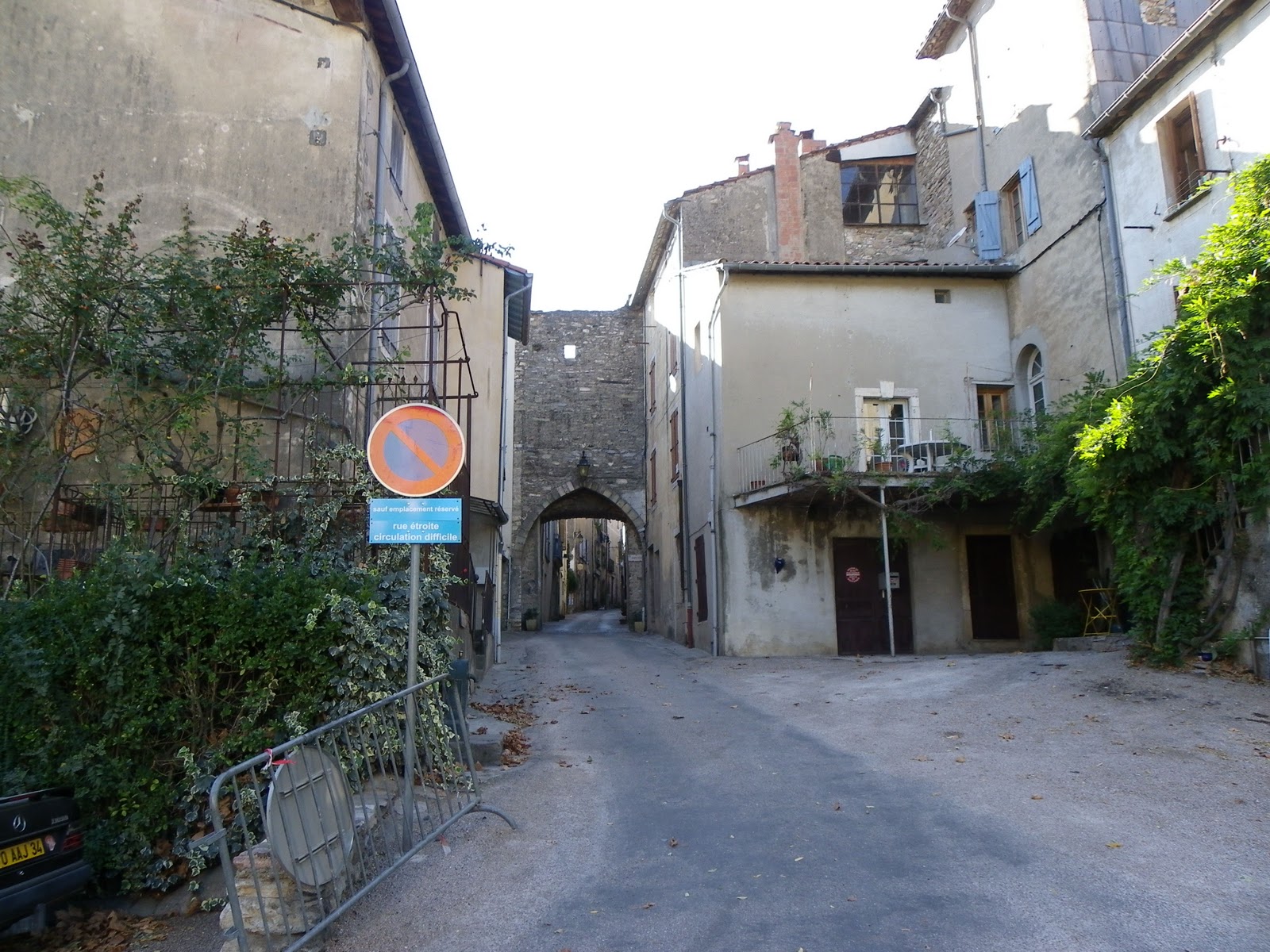
It was no problem getting to Olargues, either: it was just up the road. It was a fortified city, and much earlier we'd passed a sign on the road informing us we were in Cathar country. Roquebrun didn't have the signs of a fortified village, nor did the church appear that way. Olargues, though, might have been, but I'm not sure. The entrance to the old town is guarded by a double gate in the wall (the construction sign is modern; you'd think I'd learn how to use the damn zoom on the camera, wouldn't you?), through which a stout piece of wood could be slammed to deter invaders.


The big attraction here, too, is a tower, but a different sort than the one in Roquebrun. You reach it via an enclosed staircase which sends you up through the middle of the old village


and then you hike a bit up the hill and are confronted with this:


Which consists of this ruined bell-tower


sitting in the middle of a bunch of rubble which extends over a lot of the hilltop, which has breathtaking views of the Espinouse Mountains.


This whole area is referred to as le castrum, with castrum being a Latin word for a fortification. Nothing I've been able to find points to a Cathar connection, but I'm still not sure what the whole thing is about and the museum half-way up the covered stairway was closed, so I'll either have to go back or find a reference that makes some sense about the place. Anyway, that gated thing in the first picture is locked tight, and looking through the gate just heightens the mystery of what it is. It looks like a chapel, but has a legend on it I couldn't quite make out which seems to say it's a tomb.


That's what it looks like through the gate, anyway.

It was getting late, and we were a ways from home, so we headed back to the car and prepared to leave. Didn't happen. E has a peculiar habit of keeping the car key loose, and putting it on the seat before he sits down to drive. Which isn't a problem unless the key hits the upholstery and bounces by chance into the space between the seat and the stick shift assembly. He's a fully-qualified engineer with a doctorate and everything, and between the two of us it took us 30 minutes of pulling the driver's seat back and forth and sticking hands in where we couldn't see what we were doing and finally I spied part of the key emerging from underneath the track the seat slides on and managed to retrieve it.

The drive home started off beautiful, with all the mountains stretching into the distance, but we missed a time-saving turnoff in Bédarieux, the first of a series of seriously ugly towns we came upon, and thus climbed over a bunch of hills to Lunel and finally Lodève before we chould head down to the freeway back to Montpellier. The odometer showed we'd gone 260 km during the trip, which is a bit much, but right up until the end, when that stretch of nasty industrial towns started, it was gorgeous the whole way.

The moral? There's nothing wrong with drinking and driving, provided you do one one day, and the other the other day. The label on a bottle of wine had provided us with a fine adventure.

Oh, and the kicker: the lady at the wine shop in St. Chinian told us how to get to the Eminades winery. That road leading to the old abbey? You turn up there and there's a sign near the graveyard. Oops!

OLARGUES UPDATE: E wasn't happy with our lack of information about Olargues, and did some research the next day. It turns out that most of the original settlement was on the hilltop and it was a fortifed village whose main group of structures dated back to Romanesque times, but that in the 16th Century, Louis XIII was becoming concerned with the amount of power the individual nobles had, so he ordered all the communities like the castrum of Olargues to be razed. Even that didn't stop them, so after the Duke of Montmorency, governor of the Languedoc, proved to be too much of a pain, he was beheaded and, eventually, all the governors had to live at court in Versailles and not among the people they governed.

The other thing he researched was something I'd forgotten (probably because I didn't take a picture of it), which was there was a bright red railroad bridge running across the road into town which, a sign informed us, had been built by Gustave Eiffel. It's now part of a hiking trail, as nearly as I can figure out, but it dates from 1889. There's also another bridge which I think we would have driven into town on if we hadn't come from another direction, yet another Pont du Diable, from the 11th century or thereabouts, whose connection to Satan I can't seem to find.
 
Site Meter