Showing posts with label Daytrips. Show all posts

Wednesday, October 28, 2015

A Visit With Dracula: 1997

For about eight years, I had an enviable freelance position as a roving cultural correspondent for the Wall Street Journal Europe, with a territory encompassing Germany, Scandinavia, Switzerland, Eastern Europe, and, occasionally, other places the other correspondents didn't want to go or where stories they had no interest or knowledge in were. I wrote a lot about art, some about music, and got to visit a load of interesting places and people. I'm thinking of doing another Kindle book with some of my greatest hits from this period of my life, but seeing as it's Halloween and this CD just showed up in my living room for some reason, I figured it's time to tell the tale of my brief encounter with Dracula.

Yup, that's him

* * *


        Dracula lives!
And, this being 1997, he lives in the suburbs, drives a car, has a cellular phone, and frets over the exorbitant cost of heating Castle Dracula in the wintertime. Some things haven’t changed, though: this year hundreds of people have left Castle Dracula minus some of their blood.
Yes, there really is a Dracula, and yes, he really has a castle. Not the sort of forbidding stone pile of filmdom, but a stately country home built in the middle of the last century by Rudolf Mosse, a Jewish publishing magnate who lost it to the Nazis in 1934. The house was commandeered after the War by the East Germans, who used it as housing for some of the tenants of the collective farm they built on the grounds. Dracula bought it for a token fee from the Treuhand, the organization in charge of converting East German state property after the unification of Germany, and now he’s stuck with it.
But...Dracula?
As readers of Bram Stoker’s classic novel, published 100 years ago in Dublin, have discovered if they’ve researched its background, there really was a historic Count Dracula, Vlad Tepes, or Vlad the Impaler, a gruesome Wallachian nobleman in Romania who used to enjoy punishing disobedient subjects and “unchaste women” by impaling them on sharpened logs, often dining amidst the hapless victims as they died. Tepes was the son of Vlad Dracul, Vlad the Dragon, and “Dracula” means “son of the dragon.” In the 350 years since his reign, the family grew in stature in Romania, eventually becoming the Kretzulesco family, whose status was upgraded to princes and princesses, and whose grande dame, Katharin, escaped the Communists and settled in Kansas City, where she was awarded the Congressional Medal of Freedom by Ronald Reagan for her tireless anticommunist activities and work to free her native land from the Russian yoke, and died in 1994.
The story takes its current turn in 1977, when a Kretzulesco heiress walked into an antique store on Berlin’s fashionable Pestalozzistrasse, trying to sell some of the family silver. The store’s owner noticed the crest and inquired about it. The woman told him a tale of woe: the Kretzulesco line was about to become extinct, having produced nothing but women in its current generation, and they were too old for child-bearing. This was a worry, because the family was responsible for the maintenance of two palaces in Bucharest, nine churches, and eleven monasteries scattered throughout Romania. Unfortunately, the Orthodox Church only recognized men as having the power to make decisions, and if the property was to remain in the hands of the family, the Kretzulescos would have to adopt a male heir. Thus, after consultation with the youngest daughter, Princess Caradja Krezulesco, the antique dealer became Ottomar Rodolphe Vlad Dracula, Prince Kretzulesco.
It was, if not quite a deal with the devil, not quite an ideal situation, either. At first, there wasn’t much Prince Dracula could do about things. The Ceauçescu regime didn’t mess with the Church, so those properties were safe, and the state maintained the two palaces in Bucharest, which were regarded as national treasures, and housed the Goethe Institut and a musical-instrument museum. But with the changes in Eastern Europe eight years ago, he seized the opportunity to buy the Mosse property in Schenkendorf, a village a few miles from Königs Wusterhausen, a town on Berlin’s southeast edge. He set about renovating the house and grounds, only to start running into problems.
“I want to paint these walls,” he told a recent group of visitors, “but the historic preservation people want me to conduct a color analysis to discover the original wall-color that will cost me 70,000 Marks ($39,600)! It’s been painted so many times, who can tell?” That, and the fact that it costs 200 Marks ($113) a day to heat the antiquated building, is just the tip of the costly iceberg.
In order to make money, the Prince has moved his antique business into Castle Dracula, and has opened a lovely beer-garden and snack bar, complete with an outdoor grill and a stage area for outdoor musical events. Even there, he’s run into problems: this year, he tried to have a fireworks display and was informed that it would interfere with nesting storks in the area. He lost his deposit with the fireworks folks, only to discover that, due to a late spring, the storks stayed in Africa longer than they normally would.
The property has potential: off in a wooded copse near the main house, Mosse erected a tower with a commanding view of the countryside, atop which he would take breakfast. This still has bomb damage, and the pond next to it is filled with muck and beer-cans, but there are plans to renovate both next year. The collective farm Prince Dracula plans to turn into a complex with a hotel, shops, and a restaurant as soon as a stubborn 87-year-old woman who lives there is persuaded to go elsewhere or passes away. But all of this will take money, and so far, Castle Dracula has been a financial black hole.
The most successful undertaking at Castle Dracula, though, has been, unsurprisingly enough, a blood drive for the German Red Cross. “They were completely unprepared for the response,” the Prince glowers. “Twelve thousand people showed up, but they only managed to have the resources to get donations from 870 of them.” In addition to the five Marks ($2.82) donors got from the Red Cross, they also got a CD of “Dracula’s Song” from the Prince. “I pressed up 10,000 of them, and there are 500,000 more of them waiting to go,” he says. “If only I could get a connection with the American Red Cross, I’d be willing to tour the U.S. promoting their blood-drive, but...” He shrugs his shoulders.
But noblesse oblige and all that. Still, another crisis looms for the 56-year-old Dracula. “It is of course essential that Ottomar produce a male heir,” his 38-year-old girlfriend Bärbel explains as she gets ready for a bartending shift. “We are planning to marry next year, but I feel a tremendous pressure, and this makes me feel terrible.” Meanwhile, the publicity machine grinds on, with a web-site (long vanished as of 2015), plans for more concerts next year, and, of course, another blood drive. And, just maybe, Son of Dracula.
(To reach Castle Dracula, take the S-Bahn or regional rail from Berlin to Königs Wusterhausen. From there, it is a short taxi ride to Schenkdorf, where the Castle is easily found.)

* * *

As much as the story above paints him as a gloomy guy, Dracula was hardly publicity-shy, and mine was certainly not the first story about him -- as a friend of mine who freelanced for them noted, People magazine had run a story about him not long before mine. But there was some truth to his worries; even today, Schenkdorf isn't exactly a tourist destination. 

I remember the visit as pleasant, with a friend's sister translating for me, and in the end, I managed to talk him out of a beer mug from Castle Dracula's beer garden. He'd never even thought of selling them as souvenirs. 


And in the process of researching this post, I found a Wikipedia entry on him, which noted that he'd opened a winery, but had died ten years after I'd talked to him of a brain tumor. He didn't even live long enough to see the birth of his son, Otti, in December, 2007. By then, the Kretzulescos had given up on the castle, and had moved out. But Dracula lives on. 


Thursday, April 9, 2015

California Eatin'

I took off a long weekend from book-writing last Thursday to fly to San Francisco to attend a party celebrating the 30th anniversary of the Well, the online community I've been a member of since early 2001, making me something of a n00b. The party wasn't four days long, but I wanted to see some old friends while I was out there, and, well, eat a bunch of stuff I can't get here in Austin.

The event stirred up a bunch of feelings and ideas about community that feed directly into my post last year about my ambivalence about returning to America, and I'll address them sooner or later, because I keep seeing things that disturb me in this country besides the headlines about rogue cops and Republicans. But first, let's eat.

* * *

I started out the trip in a bad mood. The booking I'd made on Virgin America was apparently for the 1st, and I'm quite sure that's not what I'd paid for, since I knew I had to teach a class that evening. It only cost me $350 to rectify this "mistake," which I couldn't prove I hadn't made, bringing the cost of the flight almost up to the cost of a flight to London, since I opted for one of the legroom rows, not wishing to repeat my little adventure with pulmonary embolism. Once on board, the flight attendants failed to tell me that food was free, and in order to catch the 8am flight, I'd skipped all breakfast, which caught up to me later. 

On landing, it was easy enough to catch BART almost to the front door of my hotel, although BART, for some reason, has ticket vending machines that won't take a bill larger than $10. Although I'd notified the hotel of an early arrival, the front desk snarled at me when I tried to register, even hinting that they might be oversold. Not a promising beginning, but I checked my bag and walked down Market Street to the Ferry Building, about which I'd read a great deal since it had been turned into a "farmer's market." The quotes indicate that there are only a few farm-to-market stands (offering, true, some very nice looking stuff), but that most of the space is filled with lifestyle accessories more or less oriented towards food, and some restaurants. Starving and disoriented by not having had any coffee yet, I searched for something light I could eat and for some coffee: I had a 2pm lunch scheduled, and it was already after 11am. Acme Bread sold me a delicious sourdough cheese spiral and practically next door was Blue Bottle Coffee, where I purchased a café au lait. I'd heard great things about the coffee (including how expensive it was), and found it just adequate. After colliding with a woman staring into her phone and losing a bit of it, I made it out onto the deck, where the only seat I could find blocked the view of the East Bay with some kind of dredging equipment. Still: a nice place to sip the coffee which hadn't flown out of the cup and work on the pastry -- my teeth still aren't up to most bread, dammit, because Acme is easily the finest bread in San Francisco. 

After walking back to the hotel and being reminded that check-in was 3pm, but that my room was indeed ready, although I was very early, snarl snarl, I checked into the room and headed to the lunch appointment, for which I was slightly late. It was worth it because it was at the legendary Zuni Café, a San Francisco landmark most famous for its roast chicken (one-hour prep time) and hamburger, but also featuring other nice comestables. Trouble was, I wasn't too hungry, as the poorly-chewed pastry was taking up a lot of room. There were nine or ten of us, all Well people except for a friend of one guy who happened to be in town from...Austin. One of our party ordered oysters and champagne, half of which I availed myself of (I do like oysters, but I was still too zonked to want alcohol), and I ordered a salad (arugula and hazelnuts, if memory serves) and a soup (black bean soup, but not like I'd expected). Conversation, as it is on the Well every day and as it is when we meet face-to-face, was lively and wide-ranging. Eventually, we paid the bill and dispersed until the party at Rickshaw Stop that evening. The party was largely a blur for me: the crowd was large enough that I missed a couple of people I knew, I neglected to eat any of the snacks, and two beers just about laid me on my ass, although I did spend several hours sipping them. I did have a good time, though, and crawled back to my hotel at 10:30 to sleep the sleep of the dead. 

I felt much better when I awoke the next day, and then less better when I managed to buy two muffins, a coffee, and a bottle of orange juice for $22 at a nearby trendy supermarket. Lunch would be with my former next-door neighbor, Susie, in what I was hoping would become a tradition: dim sum in the Chinatown of Clement Street. My friend George, who moved to the Bay Area from Austin just as I moved from France to Austin, had recommended a place called Good Luck Dim Sum, and I wished we'd had some. Some good luck, that is: we had the dim sum, and most of it was awful: thick, gummy wrappers around all-but-tasteless fillings. One, which was spinach and minced shrimp, was wonderful, and George later said that none of what we'd had was anything he'd tried. Bad luck. But a fun time catching up and walking the blocks of Chinese Clement. 

Dinner would be solo, and I was thinking of walking down to the Ferry Building to see what the Slanted Door was like, since I've been cooking out of owner Charles Phan's Vietnamese Home Cooking book since returning to Austin and have liked what I've made. But it was Friday night, and I was afraid of going all the way down there and getting turned away, so when someone brought up the fact that Tadich Grill wasn't far away, I became awash in nostalgia for the many tons of sand dabs I'd put away there in the '70s, and headed out there. Tadich was also perfect because, in the food-obsessed society that San Francisco has become, it's way déclassé even though it's superb. Everyone's been there, the menu never changes, isn't it just a tourist trap? Well, no. And when I got there, I decided on crab louie, which is essentially crab, chopped lettuce, and louie dressing, which is sort of like 1000 Island dressing. Crab was in season, sand dabs could wait for next time. I was also kind of full from lunch. Perfecto. Got a seat immediately, waiter was excellent, food was great, there was a hunk of bread served with it that was classically San Francisco sourdough sour, and I was a happy guy. Tomorrow I'd rent a car and the second half of the adventure would happen. 

* * *

A snapshot of Berkeley. Note: it's colder than it looks.
Saturday morning, I checked out of the hotel, only getting snarled at twice, and walked a few blocks to Turk Street to pick up my reserved car. This sent me through the heart of the Tenderloin, a neighborhood calculated to depress the sunniest individual. That old joke says that they picked up America, tilted it to the west, and all the fruits and nuts slid over to California. The Tenderloin is chapter two of that joke: and then they all got old. A lot of the people in the streets were victims of Ronald Reagan's decision to empty out mental hospitals while he was governor. They were shuttled into derelict hotels, and now they still live there, drinking, doing drugs, or just high on their own craziness. 

So in my new Dodge Charger, a car that operates without a key (ain't technology grand?), I headed to Berkeley, to the cottage behind the house of Amy, a Well person who'd offered it for the weekend. It was my first crossing of the new Bay Bridge, which looks suspiciously like the bridge in Milau, north of where I lived in France. Berkeley hadn't changed much, but I wasn't going to spend much time there, since most of the weekend would be spent with George and his girfriend Robin, with a couple of specific goals in mind. The first was to find some salt-cured anchovies. I've been buying them from Amazon for $13.99 plus $10 shipping, and it was the shipping I was planning to avoid. But there was a snag: it was Easter weekend, and apparently there's something traditional that Bay Area Italians make that involves salt-cured anchovies, because Robin called around and called around and finally located a can or two at Genova Deli in north Oakland's Temescal district. This place is legendary, and I'd never been there in all the years I lived in California, plus they make authentic deli sandwiches on fresh sourdough rolls. It was totally satisfying, I have to say. Plus, anchovies. Okay, the cans were $21.95, so I saved two bucks. But I'm set for a year: keep 'em in the fridge in a plastic bag and dig the fish out of the can when you need them and you'll have a new taste sensation; these are not your neighborhood pizzeria's anchovies, not by a long shot. 

Score! 
So what to do next? There are huge stretches of the Bay Area I haven't seen, including Vallejo, where George and Robin live (not that it's all that worth seeing from all accounts), and north of there are some wonderful wetlands and the town of Napa, which I don't remember visiting, probably due to my extreme wine allergy when I lived out there. (Check your allergies every seven years, folks: sometimes they go away. But that's another story). 

Napa has turned into a gahongous foodie/yuppie destination, in part because of the decision to build a covered market on the formerly bad side of the river, the Oxbow district. There's not much in the Oxbow market per se, just more food-as-lifestyle accessories, non-essentials like a rainbow worth of flavored olive oils, a place selling about 15,000 kinds of bitters, some restaurants, and a fancy butcher shop with dry-cured steaks (something I'm going to try some day). Next door, though, is a building with a baker and another high-end butcher called Fatted Calf that makes its own charcuterie, and we mooched around there for a while. I longed to spend a couple hundred dollars and take a bunch of stuff home with me, but that was impractical from a number of viewpoints, and I note that the website says they also have an outlet in San Francisco, so I might sneak some back sometime. After Oxbow, we went to the other side of the river, where I became gradually horrified by the spectacle while simultaneously becoming thirstier and thirstier from the wonderful sample of prosciutto the guy at Fatted Calf had handed us. Eventually we landed at a gelateria which had Italian sodas, and George got a lemon soda and Robin and I had chinotto, which I'd always wanted to try. A very distinctly adult soft drink, bitter but with a fruit note in the taste, you can find it in Italian delis and probably high-end groceries. 

It was growing dark, and time to head back to Berkeley, although on our way out of town we took time to look at the reconstruction underway from a recent earthquake. There was a great sunset, which I couldn't stop on the freeway to photograph, and after hitting the cottage to drop off my anchovies, we decided to go to an Indian restaurant George had heard about and I'd seen for many, many year, Ajanta. This place is a Berkeley institution, and, like Tadich, it's not as full as it should be, and for the very same reasons. What I liked about it was that it listed not only the ingredients, but also the region where the dish originated. I had chicken mulligatawny, a descriptor I'd only seen referring to the Raj soup, but this was a well-developed curry. The prices here were reasonable, the service impeccable, and yeah, I know, everyone's already been there. You should still go. 

(George's photos of our jaunt are here, by the way.)

The next day I met my friend Elissa, who lives in San Jose, for lunch in Oakland Chinatown, almost certainly the best Chinatown in the Bay Area: not as touristy as the one near North Beach in San Francisco, bigger than Clement Street, it's clearly serving a Chinese-Vietnamese population, as well as other minorities. George had handed me a menu for a place called Spices!3, but I wasn't sure it was a good idea for lunch, more for a group for dinner. Some of the items on the menu also put me off: what's "stinky tofu"? Do I really want to order "Gangsta" Casserole "Murder Style"? On purpose? We decided to wander and see if anything else presented itself, and it did: Classic Guilin Rice Noodles. As you can see from the website, there are two chili sauces that can be mixed in with the noodles, which are very much like rice-based spaghetti. You get them with various meats, mix everything together, and then, towards the end of the meal, mix in a white, milky liquid that comes with the order, or else eat it on the side. I couldn't figure this stuff out, since it seemed to have no discernable taste, but the drier of the two hot sauces wasn't insanely hot and had other stuff -- nuts, maybe? -- in it that really set off the meat-noodle combo. Guilin province is apparently on the border of Szechuan province, and their noodles are apparently legendary. Based on one experience, I'd say so. After that, we stopped briefly at an Afro-Caribbean shop I'd seen while we were looking for parking, far more Afro than Caribbean, but the did have authentic Jamaican curry powder, so now I can try to make beef patties at home. 

That evening, I'd promised to buy dinner for George and Robin at Tommaso's, a restaurant with which I have a long-standing love affair -- and they with me: I helped save the restaurant from closing during the darkest part of their history (to be fair, Francis Ford Coppola, a man I despise, was also instrumental in this) by reviewing it in a magazine. For many years, the review was framed just inside the door, but there have been hundreds since. I was anticipating the food, and possibly a reunion with one or another member of the Crotti family, but...it was Easter. Tommaso's was closed. Ah, well, I had other fond memories: Henry Chung's original Hunan restaurant, another place that magazine had discovered and that became a favorite, with lines out the door. Closed. So, it appeared, were other, tertiary choices. We wound up at the Michaelangelo Cafe, which was perfectly nice (not to mention open), but not what I was dreaming of. It was the stuff I'd found inadequate in San Francisco when I moved there 45 years ago, a New York boy not happy with the far more delicate, northern Italian take on southern Italian food. I now understand it, and I know the ingredients were fresh and tasty here, but it wasn't what I'd hoped for. 

All in all, I had a nice trip, and might well head back there, particularly if summer in Austin makes me crazy: it's never warm in the summer in San Francisco, after all. And I will get to Tommaso's, dammit. 

Sunday, March 29, 2015

Texas Dance Halls, Part Two

The last bitter, rainy, windy day passed. The sun came out more frequently. This would probably be a problem later on, but for the moment it looked good. What better way to celebrate than with the second half of Steve Dean's dance hall tour, this time of the eastern end of the trip?

This part of Texas is one I haven't spent much time in, although I have been to Schulenberg in the company of the present Count Studeman von der Schulenberg (better known to his friends as Fred) and would often break the journey back home from Louisiana at the now-vanished Bon Ton in La Grange for their superlative fried chicken.

This was also the part of Texas that Steve has documented in his only (so far) book, Historic Dance Halls of East Central Texas, available in Austin at your favorite independent book store (or that link). Just reading that book made me want to jump in the car and head out there, but I was more than happy to be a passenger with a bunch of other people, like last time, and just ride along.

As we did last time, we headed out from the Midway Food Park, where Steve books the entertainment, and headed east out of Austin. We had a full van this time, 13 of us, all history buffs or Texana fans, apparently, although the couple next to me were dance fans and seemed to have a project of dancing in as many Texas dance halls and honky-tonks as they could, and at the outset were already plotting to see if they'd be home in time to see the Bellamy Brothers in the evening. Our driver was Erik McCowan, who's still working on his documentary about dance halls, which should be a doozie once it's finished. Steve usefully defined the difference as being "A dance hall you go to to dance with your wife, but a honky-tonk you go to to dance with someone else's wife," as concise and useful a definition as I've heard. During the day, as we went from one dance hall to another, he'd also point out legendary honky-tonks, most of which were no longer operating, but emanated history and good-natured sleaze.

The main difference between what we'd see today, as opposed to what we saw last time, was that Czech-Tex was added to the mix. The Hill Country is pretty solidly populated with the descendants of German immigrants, and although when the immigration boom happened, there was only a subtle difference between German and Czech (go look up the Sudetenland, if you want), there being no Czechoslovakia at the time, these settlers, mostly from Moravia, part of the Austro-Hungarian Empire, were different in that they were solidly Catholic (the Germans were Protestant and Catholic, depending on whether they were from the north or the south), and their foodways were subtly different.

Our first stop was Kovar, a fly-speck so small that nobody has ever included it in a census, a Czech-Moravian settlement with an active SPJST (Slavonic Benevolent Society of the State of Texas) chapter at one time. There's still not much in the way of Kovar, but the SPJST Hall, is still there, and in pretty good shape. When we arrived, it was preparing for someone's Golden Anniversary party, and truth to tell, it wasn't much.


It doesn't even have the SPJST seal on it, but at least it's still in use.

Our next stop was an early lunch in Smithville, which connoisseurs of barbeque will realize meant a stop at Zimmerhansel's. This relatively unsung barbeque joint is one of the best in the state, and if it were in Austin, would give healthy competition to Franklin's for crowds. But the servers are quick and efficient, and if you order right, you can get a very memorable meal.

The good stuff is hiding under those onions

Unfortunately, I ordered wrong. Or part-wrong. The sides were utterly undistinguished, including the beans, but the brisket (I asked for half fatty and half lean) was astounding. The sausage, much raved-about in the online reviews, was the coarse-ground, underseasoned type found in a lot of barbeque joints in this area, and was only mildly improved by dipping it in the vinegary sauce. What was good, although I was afraid my teeth wouldn't be able to handle it, was the pork ribs, which a fellow-diner shared with me and was the cliched falling-off-the-bone excellent. So next time -- and there will be a next time -- I'll order small quantities of meat (mixed brisket, ribs) with one side. I've known about this place forever, thanks to my pal George Carver, but never made it out; Smithville never seemed that attractive to me. Silly me.

Erik exits, happy.

Where the action is: Zimmerhanzel's' pit, powered by post oak.
Next stop was Plum, Texas, pop. 95, host of the annual Plum Sausage Festival in June. Steve swears by Plum's sausage, but it's only available at the festival. Hmmm.

Plum in full bloom.
It sure didn't hurt that the recent rains have encouraged a fine bloom of seasonal wildflowers, which will continue (barring a freeze, which in a state loaded with climate deniers, Nature might yet impose just to show them), and this display was very patriotic, consisting of bluebonnets, some little white flower, and bright red Indian paintbrush. I also spooked a cluster of small frogs while taking this shot; they were hanging out in a culvert with water in it and leaping into darkness when they sensed my presence.

Plum's hall, again, wasn't very spectacular, but the surroundings were so nice I wasn't about to complain. Unlike the rest of the halls on this tour, the original settlers here came from Tennessee, and so were presumably Anglo Protestants, but the place soon was full of Moravians, who built the hall next to Sts. Peter and Paul church.

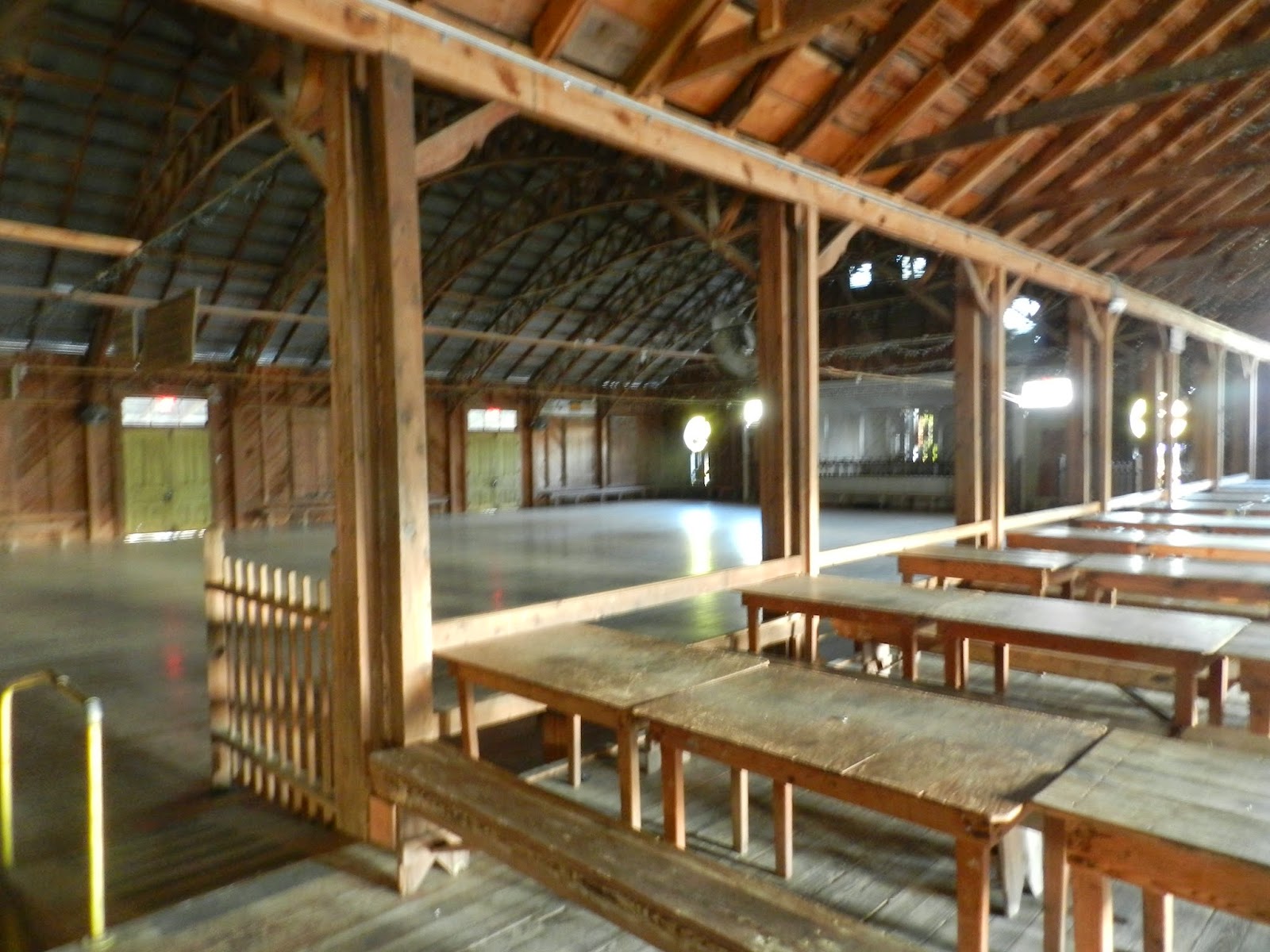
From here, we went to LaGrange, whose large fairground just out of town sits on a magnificent bluff above the Colorado River, totally invisible from any fairground attractions. It also has the spanking new Texas Czech Heritage Center, an archive of historical papers and photos which is expanding to a museum village just behind it with various buildings of interest to Texas Czech history in the process of restoration. The Pavillion is used in several events on the grounds, although as a relatively recent hall (1927) I didn't find it too interesting.


It is, however, big.


After leaving LaGrange, it was down another back road to another break, this time at the Rohan Meadery in Nechanitz. I'm not a big fan of mead, and after one small taste of what promised to be one of their varieties not infused with sweet fruit syrup (although a pure honey mead was, inexplicably, not available), I noted a nose of decay and a bunch of cloudy flavors and walked out to await the rest of the party on the porch. There was a huge white dog who'd greeted us, some guinea fowl making noise off by an outbuilding, and a bunch of chickens, some with elaborate leg feathers. There was a much smaller one who was chased away from the water dish by a very aggressive black chicken, and after a while I managed to coax it onto my lap.

What I saw.

What I imagine the chicken saw. 
And, refreshed by their mead-tasting, my fellow voyagers filed out and we were on our way to Cat Spring, where the Landwirtschaftliche Verein (Agricultural Society) erected a round (actually octagonal) dance hall in the 19th century. Thanks to an unusual community cohesiveness, this society is still in existence, with over 200 members, and was setting up for an event when we showed up. It's been dramatically renovated without harming the exterior, and you can dance in air-conditioned splendor when they have music.


The Germans, being German, had rules, though:

Translated from the Deutsch-Tex: The wearing of hats, spurs, smoking and chewing are forbidden in this hall. 
Cat Spring was an important German community, the first German settlement a lot of immigrants encountered after getting off the boat at Indianola or Galveston and heading towards the Hill Country, so it prospered by selling them supplies and provisions.

The history (click to enlarge, of course)
Germans just seem to naturally form associations, and so down the road apiece we pulled into Millheim, where the local Harmonie Verein built a hall in 1874, and built a new one in 1938.


The two chairs in the picture had just held two voluble and entertaining gentlemen who filled us in on the history and were eager to invite us to the Father's Day bash, where two tons of meat (including mutton) are cooked in an odd concrete trench and served to members and visitors.

The trench, minus glowing coals, brisket, pork, and mutton.

The history
Among the things the two guys yakked about with us was how pathetic the folks down the road at Peters were, especially after we told them that was our next stop. Oh, Peters could hardly draw flies at their Mother's Day barbecue! Those poor people! Well, we'd see about that, but I'd already begun considering coming back to Millheim for Father's Day, and Erik and I made a tentative plan at the end of the day.

Peters turned out to be another octagonal hall, surrounded by large trees -- and the stumps of others, since a violent wind-storm in 2001 severed a bunch of large boughs, one of which went through the roof --  and it dated from the end of the 19th century, built by a Schussverein, or shooting club, like the one in Grapetown we'd seen on the Hill Country tour. The Verein no longer exists, but the association now administers the hall, which is popular for Mexican 15th birthday celebrations and weddings. And that Mother's Day barbecue.


The local paper was supposed to be there to meet us, but instead they asked the folks from the Verein to do the honors, and at one point we all sat on the lip of the stage and grinned for a photo. The things people will do for the media!

Schneider Hall, though, our next stop, was a raging success story, mostly due to Amber Burris, a descendent of the four Schneider brothers on whose land it sits. In 2009, her younger sister Adrienne decided she wanted a deluxe wedding reception and they started clearing out the old hall, which had not only been a venue for dances, but also a meeting place for the local Farmers League. In 1941, it was shut down and used to store cotton, and then hay, so the girls had their work cut out for them. But after the wedding, Amber went into high gear, engaging social media, the site's proximity to Houston, and a clever feeling for marketing Texana into a publicity campaign that assures that the place is booked up nearly every week into the beginning of the summer and starting up again in the fall. Current pride of place goes to the new building containing the bathrooms, which are the equal of some I've seen in fine restaurants.

Deceptively funky: Schneider Hall
Amber admitted to being a garage-sale addict, and two corners of the hall bear her out with a wonderfully improvised lighting system:


Mason jars, Ball jars, and tea lights: this whole array may have cost two dollars.

Our last stop was Schulenburg, where Steve had assisted in the renovation, opening, and managing of Sengelmann Hall, a two-story dancehall that's attempting to be a tourist magnet in a town whose motto, last time I was there, was "Halfway to Everywhere!" Presumably someone snapped to the hidden meaning of this phrase, because it's changed. I was looking forward to getting there, not only to see how it had changed since my last visit, but because their annual Sausage Fest was underway. We cleverly managed to miss it, though, and it was even hard to snap a photo of the hall because the sun was making a blazing exit from the sky.

Kinda hard to miss. 
A bunch of vintage tractors (and one vintage car) were parked across the street, but the cookers had long packed up, won their prizes, and hauled their sausage home. Something of a street party was happening in the block the sun was zapping, but I didn't bother to go check it out because, like a number of our other passengers, I was bone-tired by now: one of the problems with Steve's enthusiasm is to assume it on the part of everyone, and since this turned into a 12-hour tour, it was too long by several hours. Also, having Erik making his film stretched out our time at places where there were people to meet us, because he wanted to interview them. I stayed around for some of these interviews because I found them interesting (as I assume the film will be) but not everyone else did. And I believe the couple headed to the Bellamy Brothers must have missed the first set.

* * *

Although the Hill Country tour was more scenic (East Texas is pretty flat), both tours had me thinking similar thoughts, but talking to the folks at Millheim and Peters really put one issue in stark relief. These places were largely built by communities, and sectors of those communities who identified themselves by reference to national origin, activity, or occupation. Since travel between towns was done by horse, and 20 miles was an average day's horse ride, that's where towns were, but starting in the 1920s, the car shortened those distances (although the state of Texas took a while improving the roads). Nonetheless, the community feeling remained, often bolstered by a statewide association of associations (the SPJST being the most obvious) or simply common interest (now it was easier for the singing groups to visit and compete with each other). 

World War II put the German communities through a lot of stress, although their loyalty to America was hard to question, and indeed Texans rarely equated a German-American neighbor with Hitler, even if he did speak Deutsch-Tex. But when men came back from the war, they'd seen a lot of the outside world, even if they hadn't shipped overseas, and mass media began to break down the kind of solidarity these people had felt for each other. The next generations saw this solidarity erode even further, especially as the young people left for good-paying jobs in the oil fields and the cities -- far better-paying than a family farm could offer. Even those who stayed saw no reason to engage with their forebears' culture, and the current generation seems to have no interest in it at all. This may well change as they grow older, but as they grow older, so will the majority of the current members of the Vereins who maintain these halls. The men we talked to at Millheim and Peters admitted it was hard to interest the younger generation in paying the nominal fee to belong, and at Millheim, they said that the only time younger folk showed up was when the night crew for the barbeque (they start the fire about 10pm for an 11am start to the food), and when the cooking was over, they disappeared. (Another thing to note is outside interference: the health authorities raided the sausage-making at Plum one year, although there had been no complaints and certainly no illness or deaths from eating sausage made in the traditional way, and the association had to comply with the rules). 

Community is one of America's vanishing resources, at least partially because it's in the interest of the forces attempting to take control of the country to keep its people atomized and stupid, by cutting back education, putting them at each others' throats on political and racial issues, and numbing them with cretinous entertainment, particularly on television. So far they're doing a magnificent job, but I can't help but feel that by entering into the world that the activities generated by the structures we visited yesterday represent, a key towards a contemporary definition of healthy community -- even temporary community -- people might see an alternative. To me, this alternative is vital, essential for putting American society back on track before the oligarchs and plutocrats have it totally at their mercy. That's why getting married at one of these places is a more optimistic thing to me than just the cliche of two people setting off on the journey of life, blah blah blah. The people who attend the reception get a glimpse of what community can do. A drop in the bucket, perhaps, but with enough buckets, you can start putting out a fire. 

Sunday, May 11, 2014

Tanz(hallen) Im Mai

Yesterday I had the opportunity to do something I'd been wanting to do for a long time, although I hadn't really been aware how much I'd wanted to do it. I've known Steve Dean for a long time, ever since he and his mother were running the Aus-Tex Lounge, one of innumerable clubs that I used to stop into on my rounds as the music guy for the Austin American-Statesman 35 years ago. Thanks to Facebook, I've discovered his fascination with old Texas dancehalls and their preservation, and when I was teaching my history of Austin music course through UT (and I'll be doing it again in August), I had him and a friend of his come in to talk about the 1950s country dance hall scene (and the formidable Harold McMillan to discuss Austin's East Side blues scene, but that's another blog-post).  I was astounded by how much he'd learned, and discovered that he had a book coming out, the first of several volumes that'll cover the entire state.

So when he announced he was doing a tour of central Texas dancehalls on May 10, I got on board. Originally there were going to be something like 15 people, but the larger block of participants had to change to another date, so I was told to be at the Midway Food Park at 9:30 am.  And I would have been, if Google Maps hadn't decided it was just over a cliff about six miles from where it actually is. I burned up a lot of gas finding it,  but just as I gave up and was on my way back home, I realized I'd driven past it almost an hour ago, and found my way in. Fortunately, problems at the vehicle rental company delayed things, and I drove up to find Steve and his friend Sherry (who was going to drive) helping a pair of documentary filmmakers pack their gear into a Ford Explorer. At about 10:15, we hit the road.

First stop was Hye, population maybe 105, owned by two entrepreneurial brothers who have decided to turn what there is of it into a roadside attraction. It's mostly a footnote of American postal history, in that Lyndon Johnson, who grew up nearby, is said to have mailed a letter there when he was four years old, no doubt asking someone to vote for him for something. There was a chili cookoff setting up when we got there and the air smelled great.

Steve hustles to get into the Hye Market. Must've been the bacon bread
Inside the market was a cornicopia of food and drink all laid out for tasting -- and sale, of course. I took a pass on the craft beers, locally-distilled whiskey, wine, and vodka, but checked out the salsa, spaghetti sauce, and barbeque sauce, all sopped up with the excellent breads (overpriced at $6.75 a loaf) on sale there.

What we were there for, though, was this:

Hye Dancehall, fallen on hard times
As there would be at most of the halls we subsequently visited, there was someone to let us in and reminisce about childhood nights spent falling asleep to the music from the stage. There are plans to rescue this hall and turn it back into a venue for music in about two years. Hye's on a well-travelled patch of highway, so unlike so many of the stories Steve tells, this one has a shot of success.

Our next hall was in beautiful downtown Albert, where a renovated hall awaited us next door to a tiny beer-joint.

Albert Hall. There will be no Beatles jokes, please

Albert Hall, interior
The whole town was sold to an Austin businessman ten years ago, and he put it up for sale on eBay, only to get a winning bid from an Italian who never paid up. Like most halls, this one has live music on a regular basis, usually once a month. The Albert Ice House next door is a popular hangout for locals and passers-by, but I remain suspicious of the food trailer parked next to it, which offers french fries with goat cheese. Although, come to think of it, goats do feature on some of the farms we passed.

Next up was a place I'd as soon have missed, but the film crew obviously needed it. Luckenbach, Texas, really does exist, and Waylon Jennings' hit song put it on the map shortly after I visited it in September, 1976 and interviewed Hondo Crouch, its alleged only inhabitant and front-man for its legend. I don't remember where we sat and had our chat, but he did his charming thing, there was nobody else around except for a friend of mine who'd driven down to Texas from Alaska when she'd heard I was doing a story on Texas and would be seeing Willie Nelson in the process, and who burst into tears the next morning at the La Reyna Bakery on S. 1st in Austin as I was reading the paper: apparently not long after we'd left Hondo had succumbed to a massive heart attack and died, and his obituary was on the page facing her.

Today, it's the Central Texas tourist trap to end all tourist traps (if only!),  although for some reason there were only a couple of hundred people there yesterday.

Luckenbach Hall from a distance. To the right, parked motorcycles, tourists, food trailer not featuring goat cheese. 

Interior. Rosie Flores had played the night before
Somehow we temporarily lost our documentarians there, so it took us nearly forever to get out of Luckenbach. If you're planning on visiting the Hill Country, I hope you can take some hints from this post to find other places to visit.

Steve was a little concerned at this point because we'd told the folks in Grapetown that we were going to be there at 3, and it was that time when we pulled out of Luckenbach. Despite there only being 76 people in Grapetown these days, the reason for the dancehall is still active:

Shootin' at stuff since 1887
This whole part of Texas is rich in Texas-German history, since a bunch of settlers started arriving from Germany in the 1840s and only increased with the failure of the 1848 revolution, when many families wanted to escape mandatory conversion to the Evangelical (Lutheran) Church, the Prussian state religion, and the military conscription that went with it. All manner of religious nonconformists flocked to Texas and, being Germans, immediately started building breweries, making sausage, and forming singing and gymnastic and shooting Vereins, or non-profit organizations. Each year, the Grapetown Eintracht Schuetzen Verein (United Shooting Club) held a massive fund-raiser/dance/shooting championship/barbeque that lasted an entire weekend, and built a dancehall to go with it, which was used for weddings and other celebrations during the summer. It's still in pretty good shape, but so is the Verein.

Steve gets the story from a Verein vet

Grapetown School

Grapetown's other building
Bikers love the Hill Country, so just down the road from Grapetown a guy from Austin who had the brilliant idea of opening a Hooters clone called Bikinis decided to build a Bikinis in a town which he bought and renamed Bikinis, building a dancehall there. To the credit of the motorcycle enthusiasts of the world, they rarely seem inclined to stop for a beverage there, and the locals don't seem to be in mourning over this. Recently, his Bikinis location in San Antonio burned to the ground. If, for some reason, you want to experience Bikinis, Texas, I suggest you do so very soon.

Steve's been booking shows in Twin Sisters Dance Hall. so that was our next stop after a very late lunch or early dinner at a place called Hillbillyz, which featured wooden doors leading to the kitchen and prep area made out of a 1941 or 1948 Oldsmobile woody, some rather provocative taxidermy involving two coyotes, some relaxed bikers, and some okay barbeque. Twin Sisters is named after a pair of extinct volcanoes visible from the highway as you approach, and its dance hall is amazing.

Twin Sisters Hall
The inside is capacious, and Steve managed to talk a couple of the guys standing around to get out a couple of ladders and put down the curtain in front of the stage for the first time in ages.

Wanna buy a Hudson? A Kaiser? Go to your eternal rest in a Packard hearse?
This is the first curtain like this I've seen outside of a museum in decades. Each of those boxes or circles advertises a local business, who helped pay for the painting and manufacture of the curtain (made out of duck cloth in Mexia, Texas in this case). From the phone numbers and goods listed for sale, this would appear to date back...well, several years. Early '50s, to judge from the automobiles listed. The board above the stage lists some somewhat newer merchants, but it, too, has some age on it. The place needs some work, but it's getting it, and the folks who run it are as nice as can be.

Steve had deccided on a magnificent finale, so we drove to Anhalt Hall, which is officially in Spring Branch, and is a mammoth facility overseen by the Germania Farmers Verein. Apparently there was once an actual Anhalt, Texas, and this building, on the edge of the Verein's property, may be what's left of it:


The building is huge, and has been added onto many times since the first structure was built (for a whopping $344) in 1879. Steve had a key, but most of the lights weren't accessible, so we poked around in the dark. The main hall is, as you'd expect, cavernous.


The bar area was also huge (as is to be expected: the Farmers Verein lobbied heavily against Prohibition, as did much of German-Czech central Texas)

I'll have a Grand Prize, please

and the kitchen was finally outgrown a decade ago and housed in another building entirely. The stage (on which Asleep at the Wheel performs at a yearly benefit for Texas Dancehall Preservation) has a fence in front of it, and the fact that old-timers continue to dance there (also obvious from the performers for the Maifest currently up on the hall's website) is seen on this sign.


But if you look above that sign (there's another banning t-shirts and bluejeans, among other clothing), you'll see a truly remarkable sight: curved beams made from timber left to soak in the river and gently coaxed into the arches that still support the roof today.

The sun was setting as we began the journey home, but my head was buzzing with Texas history and amazing scenery (which I didn't photograph because we were in the car when it was surrounding us). It was, as Steve noted earlier in the day, a perfect time to be in the Hill Country, with relatively low temperatures, moderate breezes ventilating dance halls, beer joints, and biker barbeques alike, and the last cycle of the wildflower season, with firewheels (a daisy-strawflower-like plant), poppies, thistles, and especially prickly pear cacti in riotous bloom. It was just icing on the cake that, as I left Midway, I discovered a way to get home in about ten minutes. To hell with Google Maps.

Friday, August 2, 2013

Vacation (Not Much Of A)

The day started, as they sometimes do, with a (strawberry-flavored) East German condom and a bottle of vinegar. They were waiting for me next to the bathroom sink as a reminder. I was up at 5am, so I kind of needed reminders. And, since I'd be gone for the better part of three days, it was a perfect opportunity. Ahead of me, I knew, was a glimpse of God, and, unknown to me, remaining eggs and a gigantic bikini.

But first things first. It's good to know engineers. Over the past few days, I'd cleared the spigots in my house -- the kitchen one and the shower-head -- of the lime that accumulates in our hard water. The one that had eluded me was the bathroom sink, whose spigot is raised just enough that getting a glass full of vinegar up to it was impossible. An engineer friend had suggested filling a condom with vinegar and slipping it on -- a perfect fit. The first time I'd done this I'd returned to find a white sediment in the bottom of the condom, the lime in the screen dissolved. But now, the water was going everywhere again (including onto my pants, which was embarrassing) and, since it takes a while and I use the bathroom sink a lot, this was the perfect time to do it.

Although, to be honest, 5:30am isn't otherwise perfect. Still, I had a 7:28 train to catch to Barcelona. To be honest, I didn't want to do this. A couple of friends from Texas had been going on a blitzkrieg European trip, and were going to Barcelona and then Avignon. Their travel agent had told them that a stop in Montpellier, located smack in the middle of the line between those two places, was impossible. So, although I really couldn't afford it, I booked a trip. Boy, is it hard to find a hotel room in Barcelona at the height of the tourist season! But I did.

Then they cancelled. Something had happened at home, tell you about it later, they said. So I was stuck with a non-refundable (first-class senior special) rail ticket and a non-refundable (expensive) hotel room. Damned if I do, damned if I don't. I withdrew all the money I had in the bank, €80, and hit the road.

Montpellier has totally revamped its railroad station in little over a month, since the last time I was there.  Not only was it 7 in the morning, but I had to find my way around anew. But I managed, found the train, found the seat, and I was off. I know exactly three people in Barcelona, and two of them hadn't replied to e-mails. The third was a woman who's just bought an apartment and is going to get rid of the huge one she's in right now. I've been fantasizing renting it when she leaves, although that's a ways off. That's okay: so is the money to arrange the move. She, at least, was around, albeit for only a short while. But she could see me on Tuesday.

And she did. I got to the hotel, and there she was. Her name is Rachel, and she does stand-up comedy and other theatrical work in Spanish. Also a blog that's very entertaining. She's been there a while, knows people, and is well-integrated into the place. I, not having had breakfast, was ravenous, and we repaired across the street to a place I'd heard about, Ciutat Comtal, a choice of which she approved. Their menu is weird: the English menu is, as she noted a lot now are, the product of Google Translate. How else was I to make sense of a place I passed the next morning which was offering "bacon, eggs, remaining eggs" as a single offering on its English menu in the street?

We didn't get anything spectacular. Padrone peppers, green asparagus (I'd OD'd on this during this past spring, so she got it all), anchovies (which came with one of those great green Spanish olives the size of my thumb knuckle), a steak sandwich thing that didn't really do much for me, in part due to the poor condition of my teeth.

Refreshed, we walked to her apartment so I could see it. It's over twice the size of this one, has a wonderful kitchen, a luxurious bathroom and a smaller, less luxurious one, a huge balcony, numerous rooms, and, being on the top floor, no Mme Merde upstairs. The building has only one flat per floor, which is somewhat typical of the neighborhood, the Eixample, that it's in. On the downside, being on the top floor makes it hot, and cross-ventilation by opening the windows in the front rooms isn't possible because it's on a huge main street with 24-hour traffic. But it's central. Boy, is it central. We took a walk after looking at the place and she pointed me to some wonderful places and generally oriented me to the surroundings before heading off for a doctor's appointment.


One thing Rachel hipped me to was the amazing amount of what she called "modernism" and I called Art Nouveau that just hangs around Barcelona. Her neighborhood is well off the beaten track for tourists, but there's a lot to see for architecture aficionados, including a "Modernism Museum" that's on my list for next time.


Not the entry to Rachel's building, but a random place on the walk back to the hotel.


Soon enough, it was dinner time and there was no question where I was going. Money was definitely an issue, but a place Rachel had pointed out had a €19 menu. She had also raved about it considerably. I found out why.

El Nou de Granados (because it's at Enric Granados 9) is one of those places that has grand ambitions. It also has Google Translate. To make up for that, it has a genius chef and wonderful service. And great food. Here's what I mean. Earlier, I had spotted a weird tapa at Ciutat Comtal that I'd never seen before, which seemed to be fried eggs on top of a mound of fries with something red. Suspecting that that's what was being offered here, I ordered it: ous estrellats. Here's what I got:


The finely-shredded potatoes were on top of the eggs, but the red stuff was missing. Instead, that brown thing hanging out there turned out to be an intensely-flavored mushroom, a number of which formed the bed for this dish. I wondered if they applied this sort of re-thinking to their tapas menu, which I'd forgotten to look at. No matter: there were two more courses.

Now, in Berlin, there's a thing called Eisbein: pig's trotter, usually boiled. It's about 90% fat, which is why it's weird to pay so little for such a huge hunk of pig, but once you cut into it, you find that there's only a little meat there. So what these folks have done is to take a pig's trotter and fashion it into what the menu calls a terrina, ie, they've pasted bits of it together and put it in a meat-loaf pan and baked it. Then they've reduced the hell out of the juices and added a pinch of this and that and put some over the meat. It was incredible.


Again, the base was mushrooms, this time the local delights called girgolas, which I noted last fall when returning from California. By this point I was kind of levitating.

Now, I generally don't eat dessert. I'm just not a big sugar fan, and too often desserts are sugar bombs -- which is what a lot of people want out of them. But this came with the menu, and I actually saw something that intrigued me: lemon sorbet with...gin-and-tonic jelly. Okay, bring it on.


The matchsticked lemon peel was the perfect foil to the not-quite-sweet sorbet and the absolutely perfect gin and tonic jelly. Although I later discovered that the g&t might have been courtesy of Nigella Lawson, I still think the combo was genius. And the bill for all of this, including two beers -- I was going for broke, literally, here -- was a whopping €24.00. (There's a 15% surcharge for outdoor dining). It was one of the best meals I've had all year, seriously, and there's no way I'll go back to Barcelona and not go to this place.

I got back to the hotel and discovered my Internet connection had run out. It was the "free" one offered by Swisscom, the Swiss national telecom, which I chose because I couldn't afford €20 for 24 hours of unlimited use and, when I had been able to afford it, it was no faster than dialup -- when it worked at all. This way, I had all the inconvenience with none of the charge, and a huge 100mb up, 100mb down allowance to play with. Which had lasted six hours.

Thus, I was happy that Rachel had pointed out a Starbucks a couple of blocks from my hotel, where, for the €6 a muffin and a huge cup of coffee cost me, I had 45 minutes of actual speedy use and was able to transact a bit of business. It was on this walk that I noted the "remaining eggs" as well as this, which may be of use to some of you:


How the word bikini got to mean grilled-cheese sandwich I cannot say. It became the name of a bathing suit because Bikini Atoll was a nuclear test site in the '50s, and a bathing suit like that was like seeing an atomic bomb at the beach. But there you are.

After breakfast I went onto the roof to scope out the pool. The hotel is really tall, and the roof is a great place to integrate your geographical knowledge of Barcelona. It was also, with this many tourists in town, as close as I wanted to get to the Sagrada Familia.


No idea what the building in the foreground is. From the roof you can also see the harbor, a place I have yet to look at (or, needless to say, eat at).

I totally did not see that cruise ship there when I took the picture! I was trying to get the container ship in there and was looking at that.
It's also a place to stare at some of the fantastic architecture in the neighborhood.


But it was getting warmer, and I had a plan for at least part of the day: to head to the Museu Nacional d'Art de Catalunya and finish the look at their collection that I hadn't done on my previous visit. I also wanted to see the Miró Foundation, but finances were tight and I knew that I could get into MNAC as a senior citizen (which, I later discovered, I'm not, yet). I could try Miró later in the afternoon.

As if. MNAC is huge. Last time I'd had sensory overload in the middle of the Gothic/Renaissance galleries, which was actually okay, because I'd managed to see the stuff I'd been seeing reproductions of for my whole life -- and more. But I'd also photographed a lot of it and made a slideshow of that folder my computer wallpaper, so now I was familiar with a lot of it. Still, I shot a lot more for future reference.

Late Medieval/early Renaissance goat-crossing highway sign. 


As Robert Hughes had warned me, there's a distinct fall-off after the Baroque era, especially towards the end of the 19th and beginning of the 20th centuries when it seemed like the purpose of a lot of the art was to get the artists' girlfriends to take off their clothes. Nothing wrong with that, of course, but it doesn't necessarily make for great art. More amusing is the idiosyncratic painter who daubed a bunch of happy drunks in a local wine-cellar where artists and writers and such used to gather.


Leaving the MNAC is easier than getting there: there are escalators about 3/4 of the way up the mountain, but those last 200 or so steps have to be done by foot, which means that this is probably the least-accessible museum on earth. (There are, however, wheelchair lifts, so there must be another way in). As I left, I realized that the afternoon had progressed nicely, and found my way back to the hotel, where I took a siesta and turned my computer back on. There was an e-mail that a kind reader of this blog had spontaneously donated $50, so, if PayPal was quick enough, I might yet have a tiny bit left for shopping the next day; it was silly to come all this way and not have enough for chicken broth, that elixir and useful item that's not available here in France, but is, in a commendably well-made product, in Spain.

At the hotel, I napped and mooched around, waiting for dinner. I wasn't quite sure what I'd do, frankly. And what I wound up doing wasn't very smart. For years, I've noticed this; the blood sugar gets low and I do, well, just anything. And what I did was go back to another fine restaurant I'd discovered that, as my memory told me, was not that expensive: Matamala. I remembered, too, that they'd had tapas, which would be less expensive than the regular meals. Which, considering what happened next, was a dumb decision.

I ordered salt-cod croquettes,


which were delicious little bombs of fishy goodness, and anchovies,


which turned out to be two filets -- ie, one fish -- with a blob of balsamic, a halved cherry tomato and two of the smallest olives I've ever seen in Spain (tasty, though), all for €4.50, and something called torrada amb escalivada, three slices of bread with, from left to right, sliced cooked mild (too mild: I couldn't actually taste them) onions crossed with another anchovy fillet, superb tuna and roasted peppers, and tasty grilled, mashed eggplant crossed with another blob of balsamic.


Yum. I was ready for dinner. Except...that was dinner. "Don't you want to order more?" the waiter asked. Well, yeah, I did. But if I were going to have breakfast the next morning before heading to the train, and if the PayPal money didn't arrive in my bank account, I couldn't.

Although I maintain that they owe me at least one more anchovy, and that €24.30 was a bit rich (there was a beer: you can't have tapas without some kind of alcohol nearby), I still like Matamala. They seemed like a different restaurant in tourist season, though, with a guy out front urging you in like all the other restaurants in that area. Their no-nonsense organic, locally-sourced, Slow Food approach is great. I'll be back, but not in high season.

The next morning I woke up, quickly started the computer, went to the bank website and hooray! The money had arrived. I could withdraw €50 and have lunch and shop and have money when I got home, which was good because there was zero food in the house. Just as I logged off the bank website, the cheapo Swisscom connection was cut. Whew. Off to Starbucks, then back to check out of the hotel. The train wasn't until 4:30, so I had several hours to kill. First, I started checking out the neighborhood again. Rachel had pointed out a place that, she said, had the best ham in Spain. That's a mighty big statement; Spanish ham is like nothing else. If you've ever had really good Smithfield ham from an artisinal producer in the American South, you're getting close. I went in to see what the vacuum-packed slices were going for and the guy carved me a slice from one leg. "This is from the South, very intensely-flavored," he said. It was mind-blowing. "This one is from the North, and is quite a bit lighter." He was right, but it had other virtues, a nuttiness that was present, but more subdued, in the first sliver. He handed me a brochure, and I made a note to come back when I had some money. I also noted they have a Japanese website: the Japanese tourists who come to Barcelona may be annoying, but they're also fabulously wealthy. I can imagine that it costs a bit to ship a €514.50 ham to Japan.

I wandered and looked, and tried to stay away from the tourists, but dammit, the taste of that ham stayed with me and it was time to go back to Ciutat Comtal for a second breakfast. I'd order that eggs-and-fries mess. Which, there, turned out to be called huevos estrellados. The red stuff? Flakes of Iberian ham, fried until crisp and scattered over the dish. Only €5.95, too.


And, lingering at that table, watching the tourists go by, I realized it was time to end this non-vacation. My friends had told me that I needed to get away from The Slum, and they were right. I wanted air conditioning, silent nights, a dip in the pool, and there they were. I wanted good food, and I got that. But every single moment I was there I worried about money, wished I had my €420 back, wondered when a bill I'd submitted was going to get paid. Vacations should be longer and more stress-free. But there was nothing else to do, so I did it. I'm glad I did, although now it appears my phone's going to be turned off sometime soon. Maybe not. At the moment there's nothing I can do, so, as I'm fond of saying, I live like the alcoholics, a day at a time.

Oh, and the condom? Cleared that spray problem up just fine, although this time the residue was green and there was very little vinegar left. No idea what that's about. But it's nice to have a working sink again.


Site Meter