Showing posts with label Local History. Show all posts

Sunday, May 11, 2014

Tanz(hallen) Im Mai

Yesterday I had the opportunity to do something I'd been wanting to do for a long time, although I hadn't really been aware how much I'd wanted to do it. I've known Steve Dean for a long time, ever since he and his mother were running the Aus-Tex Lounge, one of innumerable clubs that I used to stop into on my rounds as the music guy for the Austin American-Statesman 35 years ago. Thanks to Facebook, I've discovered his fascination with old Texas dancehalls and their preservation, and when I was teaching my history of Austin music course through UT (and I'll be doing it again in August), I had him and a friend of his come in to talk about the 1950s country dance hall scene (and the formidable Harold McMillan to discuss Austin's East Side blues scene, but that's another blog-post).  I was astounded by how much he'd learned, and discovered that he had a book coming out, the first of several volumes that'll cover the entire state.

So when he announced he was doing a tour of central Texas dancehalls on May 10, I got on board. Originally there were going to be something like 15 people, but the larger block of participants had to change to another date, so I was told to be at the Midway Food Park at 9:30 am.  And I would have been, if Google Maps hadn't decided it was just over a cliff about six miles from where it actually is. I burned up a lot of gas finding it,  but just as I gave up and was on my way back home, I realized I'd driven past it almost an hour ago, and found my way in. Fortunately, problems at the vehicle rental company delayed things, and I drove up to find Steve and his friend Sherry (who was going to drive) helping a pair of documentary filmmakers pack their gear into a Ford Explorer. At about 10:15, we hit the road.

First stop was Hye, population maybe 105, owned by two entrepreneurial brothers who have decided to turn what there is of it into a roadside attraction. It's mostly a footnote of American postal history, in that Lyndon Johnson, who grew up nearby, is said to have mailed a letter there when he was four years old, no doubt asking someone to vote for him for something. There was a chili cookoff setting up when we got there and the air smelled great.

Steve hustles to get into the Hye Market. Must've been the bacon bread
Inside the market was a cornicopia of food and drink all laid out for tasting -- and sale, of course. I took a pass on the craft beers, locally-distilled whiskey, wine, and vodka, but checked out the salsa, spaghetti sauce, and barbeque sauce, all sopped up with the excellent breads (overpriced at $6.75 a loaf) on sale there.

What we were there for, though, was this:

Hye Dancehall, fallen on hard times
As there would be at most of the halls we subsequently visited, there was someone to let us in and reminisce about childhood nights spent falling asleep to the music from the stage. There are plans to rescue this hall and turn it back into a venue for music in about two years. Hye's on a well-travelled patch of highway, so unlike so many of the stories Steve tells, this one has a shot of success.

Our next hall was in beautiful downtown Albert, where a renovated hall awaited us next door to a tiny beer-joint.

Albert Hall. There will be no Beatles jokes, please

Albert Hall, interior
The whole town was sold to an Austin businessman ten years ago, and he put it up for sale on eBay, only to get a winning bid from an Italian who never paid up. Like most halls, this one has live music on a regular basis, usually once a month. The Albert Ice House next door is a popular hangout for locals and passers-by, but I remain suspicious of the food trailer parked next to it, which offers french fries with goat cheese. Although, come to think of it, goats do feature on some of the farms we passed.

Next up was a place I'd as soon have missed, but the film crew obviously needed it. Luckenbach, Texas, really does exist, and Waylon Jennings' hit song put it on the map shortly after I visited it in September, 1976 and interviewed Hondo Crouch, its alleged only inhabitant and front-man for its legend. I don't remember where we sat and had our chat, but he did his charming thing, there was nobody else around except for a friend of mine who'd driven down to Texas from Alaska when she'd heard I was doing a story on Texas and would be seeing Willie Nelson in the process, and who burst into tears the next morning at the La Reyna Bakery on S. 1st in Austin as I was reading the paper: apparently not long after we'd left Hondo had succumbed to a massive heart attack and died, and his obituary was on the page facing her.

Today, it's the Central Texas tourist trap to end all tourist traps (if only!),  although for some reason there were only a couple of hundred people there yesterday.

Luckenbach Hall from a distance. To the right, parked motorcycles, tourists, food trailer not featuring goat cheese. 

Interior. Rosie Flores had played the night before
Somehow we temporarily lost our documentarians there, so it took us nearly forever to get out of Luckenbach. If you're planning on visiting the Hill Country, I hope you can take some hints from this post to find other places to visit.

Steve was a little concerned at this point because we'd told the folks in Grapetown that we were going to be there at 3, and it was that time when we pulled out of Luckenbach. Despite there only being 76 people in Grapetown these days, the reason for the dancehall is still active:

Shootin' at stuff since 1887
This whole part of Texas is rich in Texas-German history, since a bunch of settlers started arriving from Germany in the 1840s and only increased with the failure of the 1848 revolution, when many families wanted to escape mandatory conversion to the Evangelical (Lutheran) Church, the Prussian state religion, and the military conscription that went with it. All manner of religious nonconformists flocked to Texas and, being Germans, immediately started building breweries, making sausage, and forming singing and gymnastic and shooting Vereins, or non-profit organizations. Each year, the Grapetown Eintracht Schuetzen Verein (United Shooting Club) held a massive fund-raiser/dance/shooting championship/barbeque that lasted an entire weekend, and built a dancehall to go with it, which was used for weddings and other celebrations during the summer. It's still in pretty good shape, but so is the Verein.

Steve gets the story from a Verein vet

Grapetown School

Grapetown's other building
Bikers love the Hill Country, so just down the road from Grapetown a guy from Austin who had the brilliant idea of opening a Hooters clone called Bikinis decided to build a Bikinis in a town which he bought and renamed Bikinis, building a dancehall there. To the credit of the motorcycle enthusiasts of the world, they rarely seem inclined to stop for a beverage there, and the locals don't seem to be in mourning over this. Recently, his Bikinis location in San Antonio burned to the ground. If, for some reason, you want to experience Bikinis, Texas, I suggest you do so very soon.

Steve's been booking shows in Twin Sisters Dance Hall. so that was our next stop after a very late lunch or early dinner at a place called Hillbillyz, which featured wooden doors leading to the kitchen and prep area made out of a 1941 or 1948 Oldsmobile woody, some rather provocative taxidermy involving two coyotes, some relaxed bikers, and some okay barbeque. Twin Sisters is named after a pair of extinct volcanoes visible from the highway as you approach, and its dance hall is amazing.

Twin Sisters Hall
The inside is capacious, and Steve managed to talk a couple of the guys standing around to get out a couple of ladders and put down the curtain in front of the stage for the first time in ages.

Wanna buy a Hudson? A Kaiser? Go to your eternal rest in a Packard hearse?
This is the first curtain like this I've seen outside of a museum in decades. Each of those boxes or circles advertises a local business, who helped pay for the painting and manufacture of the curtain (made out of duck cloth in Mexia, Texas in this case). From the phone numbers and goods listed for sale, this would appear to date back...well, several years. Early '50s, to judge from the automobiles listed. The board above the stage lists some somewhat newer merchants, but it, too, has some age on it. The place needs some work, but it's getting it, and the folks who run it are as nice as can be.

Steve had deccided on a magnificent finale, so we drove to Anhalt Hall, which is officially in Spring Branch, and is a mammoth facility overseen by the Germania Farmers Verein. Apparently there was once an actual Anhalt, Texas, and this building, on the edge of the Verein's property, may be what's left of it:


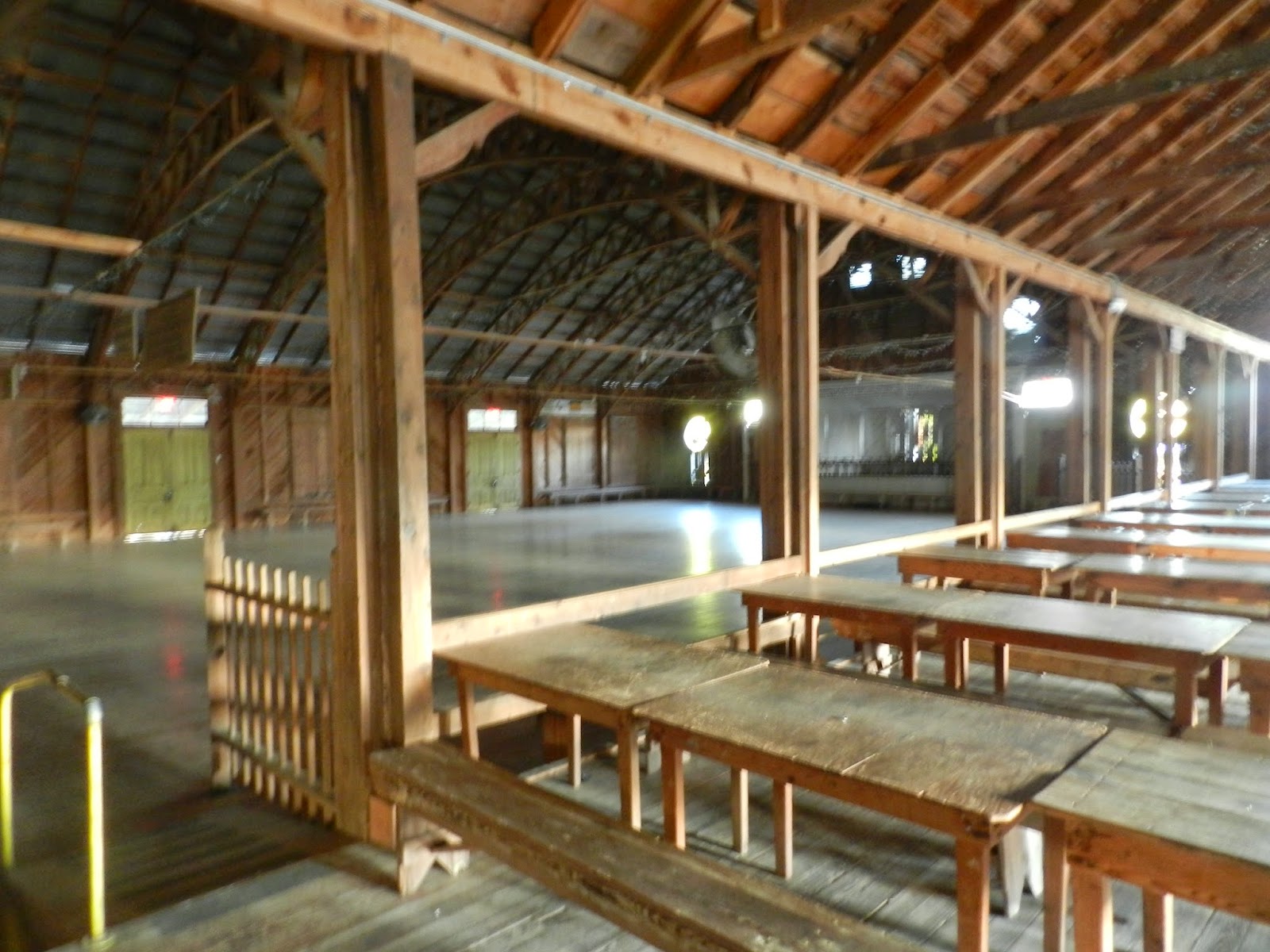
The building is huge, and has been added onto many times since the first structure was built (for a whopping $344) in 1879. Steve had a key, but most of the lights weren't accessible, so we poked around in the dark. The main hall is, as you'd expect, cavernous.


The bar area was also huge (as is to be expected: the Farmers Verein lobbied heavily against Prohibition, as did much of German-Czech central Texas)

I'll have a Grand Prize, please

and the kitchen was finally outgrown a decade ago and housed in another building entirely. The stage (on which Asleep at the Wheel performs at a yearly benefit for Texas Dancehall Preservation) has a fence in front of it, and the fact that old-timers continue to dance there (also obvious from the performers for the Maifest currently up on the hall's website) is seen on this sign.


But if you look above that sign (there's another banning t-shirts and bluejeans, among other clothing), you'll see a truly remarkable sight: curved beams made from timber left to soak in the river and gently coaxed into the arches that still support the roof today.

The sun was setting as we began the journey home, but my head was buzzing with Texas history and amazing scenery (which I didn't photograph because we were in the car when it was surrounding us). It was, as Steve noted earlier in the day, a perfect time to be in the Hill Country, with relatively low temperatures, moderate breezes ventilating dance halls, beer joints, and biker barbeques alike, and the last cycle of the wildflower season, with firewheels (a daisy-strawflower-like plant), poppies, thistles, and especially prickly pear cacti in riotous bloom. It was just icing on the cake that, as I left Midway, I discovered a way to get home in about ten minutes. To hell with Google Maps.

Friday, December 13, 2013

Opening King Tut's Tomb

I've spent most of the past couple of weeks hauling a couple of boxes of books in from the garage each day, going through them, discarding the ones most eaten by rodents and insects (not nearly as many as you might think, but some), then going through the ones I clearly don't want but kept out of inertia, and looking up their ISBN numbers to see if they're special in any way. If so, they get listed on my Amazon store.  I'm selling about one book a day, and had to de-list some because of interest from a rare book dealer.

But oh, that gets tiresome. There are these other boxes, boxes with, well, stuff. I do accumulate stuff. Stuff tends to be the documentation of memories. Which is a good thing: I didn't remember getting a large poster for the Residents' album Third Reich and Roll with a letter from them on the back. I do remember going to a San Francisco art party with my pal Hudson in the mid-'70s and us wandering around looking for someone interesting, and Hudson spying four guys standing together and saying "Those guys are the Residents," only to have all four say in unison "No we're not!" So I've seen them without their eyeballs. I bet that poster would bring something on eBay. If I could only figure out how to use eBay, that is.

But like I said, this is documentation of memory. For instance, I think I was on assignment, probably for Creem, at Willie Nelson's horror-filled 4th of July extravaganza at College Station in 1974 when Charlyn Zlotnik caught me and some other low-lifes backstage.

L to R: Himself, Joe Nick Patoski, unknown, Patrick Carr


Now, I have some memories of this three-day error in judgement left. It was terribly hot, and Jim Franklin, the artist-in-residence at Armadillo World Headquarters, had distributed salt tablets to one and all, most likely keeping us from dying. If you could get into the Lone Star Beer bus, Jerry Retzloff would give you a beer. That was all the nutrition available until some brave students drove an old station wagon through the fence, opened its tailgate, and started selling barbeque brisket sandwiches for a buck apiece. Words cannot convey how good they were, and, their tuition for the next two years in hand, they zoomed off as quickly as they'd come. Just as the thing got started, a catalytic converter on a car set the field of grass in which it was parked on fire, and people watched helplessly as a dozen or two cars were turned into art. (One, I think, belonged to the poor bastard who was performing at the time). I have no idea where I slept, but on the last night it vanished (probably along with the record company person who was paying for it), and I wound up with the Mother Earth Band, most notably Toad Andrews and family, on the floor of a Holiday Inn. The record company person who'd driven me there having vanished, I was very, very grateful to hear a voice asking if anyone needed a ride back to Austin, and that's how I met the late, great Joe Gracey.

But wait, there are other pictures here. Dozens of me cooking gumbo, as if that were some kind of remarkable event. Hell, now that I'm back in Texas I'll probably do that again relatively soon: I'm out of the land of eight okra pods for €7.00 now. There are pictures of bands snapped during performance, but who are they? More than that, there are scads of posters, lots from a band I was going to produce called No Sisters, who really were four brothers (and one drummer), and who almost got signed to A&M right after I moved to Texas. (They went for D-Day instead, because their wealthy manager was absorbing the expenses). At some point I'm going to have to sort through these posters, because I'm certain some of them are worth money, and I have multiple copies of some of them, too. Ah, but here's another photo of me in my back yard in Sausalito taken by my long-vanished friend and colleague AJ Bernstein.

Gentleman on the verge of a nervous breakdown. A year later I was in Texas. Probably saved my life. 
But there were other artifacts that were less disturbing.

Ashtray, candle
The way I used to cope with Texas summers when I worked at the newspaper was to save my money, and put in for my two weeks' vacation sometime in August, when I could be sure that I'd reached the limit of my endurance and very little would be happening to write about. I would fly to London and then make my way to Aylesbury, Buckinghamshire, where I would be retrieved by a gent named Pete Frame, who would then convey me to his thatched-roofed former pub in the tiny village of North Marston, which didn't have a post office, store, or much of anything except sheep and cows.

And a pub. The Bell, it was called (like about 60% of the pubs in England). Mel the Bell was the landlord, and I was a novelty: no American had actually stayed more than a day in North Marston, and since I had Pete's imprimatur, and bought my rounds as a decent pub-drinker should, I was accepted. What I was drinking, at any rate, was ABC Bitter, a lovely drink with lunch and after dinner, and just the thing to dissipate any lingering tension from working for The Man. I met a lot of fine folk there, including Rob Gurney, Pete's running buddy, and a budding mariner at the time. He's a full-fledged captain now, and has places in Aruba and Belgium, but has held on to the family farm. Pete lives in Dingwall, in remote Scotland, and pretends he loves it. He was down visiting the captain recently and tells me that ABC Bitter is no longer made, that in fact that whole brewery complex in Burton-on-Trent has been eaten alive by The Man and the Aylesbury Duckling is no longer seen on glasses or ashtrays. Which is a shame, because I have a pint glass and it's chipped. That, too, was in storage.

The candle is a very wry piece of post-modern commentary, although it just looks like a bust of Lenin made out of mud. Waxy mud. But I had one of those once-in-a-lifetime moments in 1990, when I drove from Berlin to Prague what seemed like moments after the Velvet Revolution. At the time, the word was that it had been a bloodless revolution except for one student who'd been shot dead. Immediately a wall with a huge John Lennon graffito on it became a place of pilgrimage and hundreds of candles burned there in his memory. Now, it appears that some people knew the truth, because if Wikipedia is to be believed, this guy, Martin Smid, was fictional. In the spirit of punk -- or something -- a bunch of entrepreneurial students cleaned away the candle wax, melted it down, and, with some molds they'd found, cast candles of Marx, Lenin, and so on, and then sold them on the sidewalk. I bought one because although I didn't know all the story, the involution of the idea of recycling memorial candles into an ironic icon of the now-defeated enemy sold for profit appealed to me. And yes, that was an amazing trip.

But before I get sucked into that, what about this (sorry about the framing)?

The real action's on the back.
This is a souvenir of a story that never happened. A friend of mine was on the comedy beat at the paper, and invited me to go see this new guy, Bill Hicks, at one of the local clubs. He wasn't local: he was from Houston, where, he insisted, a wild comedy scene was happening. Being unemployed and freelancing, I sold Mother Jones magazine on the story, and thus it was that I found myself in Houston doing a story on the Texas Outlaw Comics which would culminate in an appearance at Rockefeller's. A day or so into hanging out with these guys made me realize that there was no way a magazine as politcally uptight as Mother Jones would even go near this material, but I stuck with it until the show, which was magnificent -- I particularly remember Bill Hicks' piece on Jesus returning and walking into a church and seeing, first thing, a crucifix -- and at the end of my stay in Houston, I was presented with the above artwork, signed by all the Outlaw Comics including Bill. I wish I could tell whose signature was whose.

Then there are other souvenirs of I know not what: the odd duo of a wind-up sushi chef who chops at a fish (which wriggles its way out of range of his knife) while reading what is presumably a how-to-cut-sushi book and an enamel advertisement for Casanova Cigaretten, showing a scarf-wearing Boston terrier smoking a cigarette and blowing a smoke ring. I must've gotten the latter at a flea market before moving to Germany, but the other is anyone's guess.


And then there are memories that go back much, much further.


Tammany? Los Angeles 1911? I swear I wasn't there. 

When I was in college, my friend Terry, even then a great photographer, became obsessed with the dying city of Springfield, Ohio, near where we were going to school. One of the great things about the poor side of town, where he went photo-hunting, was the antique shops, which were loaded with the most miscellaneous things. I've always loved advertising ephemera, and there was tons around. Buttons, too, matched my fashion sense as a kind of East Coast hippie. ("NO SALOON!") People collected cigarette cards, which came with every package of some kinds of cigarettes, and then didn't know what to do with them. I also found a copy of what is probably the first country music record, but no other recorded treasures (turns out they were still for sale in a strange old record store I only went to once). Anyway, Terry got some great pictures over the years. I got some of the odder corners of my own personal King Tut's tomb. I just hope there isn't a curse on this one.

Thursday, December 13, 2012

"Starting Now, You Have Lost The Right To Stand."

Sorry for those with delicate sensibilities, but this story starts on the toilet.

Two weeks ago this past Sunday, I was seated on mine, and ready to get up. I stood, hit the button in the center of the tank, bent down to get my pants, and...almost passed out from lack of breath. I was hyperventilating like I'd just run for my life and my heart was pounding. It had come out of nowhere, but there I was, huffing and puffing. It passed soon enough, but I'll admit it scared me a little.

But only a little: my family has zero history of heart disease, and every time I've had a checkup that particular area has passed the test: a little enlarged due to hypertension, but otherwise strong. The aged alcoholic doctor I went to when I first moved here always told me I could have "one, two, manny women" and offered to write me a prescription for little blue pills. (I told him to write the prescription for the women first and we'd see if I needed the pills. He didn't get it.)

Anyway, in the ensuing week, this came and went. It was always a bit of a chore climbing the stairs to this third-floor (second, as Europeans measure it) apartment, but there were times when I'd have to stop and catch my breath while walking to the store. Still, I made it to the market and back on Tuesday without incident, and I did it again on Saturday, adding on a short walking tour of the town for some friends from Texas who stopped in. Once, though, I had to stop and regroup during the tour. Mid-week, I'd gone to E and J's for a simple dinner of lentils and sausage so that E (who's Swiss-German) and I could complain that the French just Don't Get sausage (J's a vegetarian, and so had no opinion). Sunday, though, was really bad. Just sitting up in bed meant a pause for breath, and I took it real, real slow. Tomorrow, I told myself, I'll call the doctor and make an appointment. I was almost out of blood pressure pills anyway, so it made sense.

Monday was pretty bad, too, so when I called I asked for a same-day appointment and the doctor told me she could see me at 5:15. So in I went, via the cash machine so I could pay her. A ten-minute trip took a half-hour as I poked up the hill, pausing every now and again to catch my breath. I still got to the appointment on time, and she was only 15 minutes late seeing me. The blood pressure was okay, she listened to my heart, and then started asking questions. "You must go to La Peyronie to the Urgences," she said. I had no idea where this was, nor did she have a clue how to get there on the tram, but we finally figured out that it had its own tram stop on Line 1, the one that stops by my house (although it took a phone call: I'm amazed at how many people here drive places). "Do I have time to stop at my apartment and..." "NOW!" she said.

So I shuffled down the hill and discovered there wasn't a bill-changer on the ticket machine. I walked over to the bakery on my corner and asked the gal at the counter if she could change a five. "Into what?" she asked. I told her I'd settle for two twos and a one. Ticket bought, I got on the tram at full rush hour and headed off to La Peyronie.

Whose emergency entrance was not visible from the tram-stop, I discovered. I painfully crept towards the main entrance, stood in line with a bunch of other people, and was re-directed to the right place by a fast-speaking woman. Fortunately, an African aide outside repeated the directions more slowly, and I shuffled on. I talked to someone at admissions, and was whisked onto a gurney. Not long afterwards, I wsa wheeled into a room where I was checked with a stethoscope for any immediate danger and then left lying there. It was 6:30.

Soon, a couple of young guys appeared, their whites bearing a sewn-on badge that said "Étudiant." It was quickly determined that I spoke French if I were spoken to slowly enough for me to understand what was being said, and some questions ensued: I told them my symptoms, answered family questions  (no history of heart problems, no diabetes), and, mostly, waited. One of the students was an olive-skinned guy with tightly-curled hair who spoke excellent English. "Yeah, I'm getting good at it because when I graduate and get my MD, I'm gonna go to the States and get rich because there aren't any taxes." Lying there in the heart of socialized medicine, quite certain I'd be well taken care of, I bit my tongue. I wanted to tell him this was like moving to France because the women were prettier, a real "yeah, but.." moment, but said nothing. (My sister, who's a medical professional, laughed when I told her this: "He probably doesn't now that he's going to have to go through his residency all over again if he does this!" He also proudly told me he was a Libertarian and I told him that was okay; he'd grow out of it).  He produced a huge Samsung smart-phone from his pocket. "You want to contact anyone?" Ah! E and J could get the word out. I gave him their name -- couldn't remember the e-mails -- and he searched. "Not in the white pages," he said. Hmmm. "What about Facebook? You have an account?" Another excellent idea. But...couldn't remember my password. It began to dawn on me how dependent I was on my computer being able to remember all this stuff. "Okay, I gotta go." And he did, to be replaced by an actual doctor (they wear red plastic badges) who seemed angry.

Actually, he seemed German, with red-blonde hair and a flushed complexion and very brusque manners. He set up at a computer in the room and asked some more questions as a couple of other students appeared to observe. I believe some blood was taken. He jumped up and left the room. Eventually he came back. He asked some more questions, which I answered as well as I could. One was whether I'd taken a long airplane flight recently, and I remembered my trip to San Francisco at the end of October, and being wedged into a window seat, unable to escape due to a couple of immobilized gigantic Russians who blocked my way to the aisle for nine hours. Finally, he asked me my weight. I didn't know. Really, I didn't: I don't have a scale at home, and I've always figured that as long as I didn't resemble a zeppelin or my weight wasn't causing me health problems, and as long as I was eating moderate portions of good food, I was okay. I'd slimmed down a lot since I'd moved here, and I figured that was good. "You don't know your weight?" he asked, incredulous. Well, no, I... He jumped out of the chair and left the room, saying something on his way out.

One of the medical students knew I hadn't heard or understood it. "Starting now," he said, in English, "you have lost the right to stand." I started to scoot up on my elbows and he put his fingers on my chest, firmly pushing me down. "Non," he said.

*  *  *

The rest of the night was a blur of medical technology: a set of x-rays, a scan in a futuristic-looking machine with an attendant who was full of jokes and jovial about his horrible English, which he insisted on speaking, blood being drawn and whisked off to labs, and a glucose drip being attached to my left arm. Finally, I was wheeled onto an elevator and taken to a room. It was 3:15. "I bet you're happy to finally be able to get some sleep," the nurse said as I rolled from the gurney into the bed, my arm still attached to the drip. I was, but it eluded me for a while. Finally, it came. 

The next morning, I was raised slightly into a sitting position, and breakfast was served, along with a heapin' helpin' of pills. I was given a cup of coffee, a couple of biscottes (rusks), a pad of something that looked like butter but couldn't have been, and a little serving of a jam-like substance. Looking at the pills, I asked if there were some juice to help me wash them down. The servers were surprised, but went to check the cart. "We only have apple juice, is that okay?" Sure, I said, not really liking apple juice that much, but realizing that I hadn't actually had anything to eat in several days: I'd cooked dinner on Sunday, but it smelled and tasted awful (another reason I felt impelled to call the doctor), and, for the first time in a long time, I threw it all out, thinking of my diminishing cash reserve. There'd been a bowl of cereal on Monday morning, but that was it. I was ravenous, but would have to do with biscottes. And the apple juice was great. It was also the last I'd see. 

Not much happened. I was alone in the room, which was nice. Since I couldn't get up, I had to pee into a pistolet, which looked like a turtle with a trumpet for a head. I dozed. There was lunch: a boudin noir, which was something I'd never had before, and couldn't really figure out because it was, shall we say, not of the highest quality. Alongside was some cauliflower in bechamel sauce -- utterly tasteless -- and mashed potatoes. 

But I didn't get to finish it. At one point, a trio of women swept into the room with a computer station. One was wearing the red doctor's badge, tall, elegant, exuding a centeredness and a calm that was palpable. One of the most beautiful women I've ever seen, although way above my pay-grade. She was followed by two younger women, a round redhead and a thin, bird-like woman who'd examined me earlier, all business and just a bit tense. The tall doctor sat on a table bolted to the wall across from the foot of my bed, and, like in a Renaissance painting -- the lighting was right for this, too -- the redhead arranged herself facing the doctor on one side, the bird-woman on the other. "Aha," I said. "The Judgement." They laughed. "Right," said the doctor. "Tell me about the patient." Bird-woman rattled off the presenting symptoms, the treatment, and at one point said "The patient, Mr. Ward EDMUND," (that's how names are presented in France) "is an agreeable American writer and radio journalist" (I swear I'd never mentioned this to anyone, and wondered if she'd Googled me) "and speaks reasonably good French." The doctor thanked her and it was the redhead's turn. "The patient, according to his x-rays and scans, has a pulmonary embolism, which is being treated with medication." She then turned to me and asked me if I knew what this was. I told her I thought so, but she brought a piece of paper over to the bed and started drawing. 


(You'll have to click this, and even then it might not make sense). "You have your heart, the right side and the left side. Your embolisms are blood clots which are sitting in your lungs, making the transfer of blood and oxygen difficult. We are dissolving them with medications." 

I thanked her and she resumed her position next to the doctor, who was the next to speak. "In order to observe your progress, we're going to want to keep you here for about a week." "A week? But..." "I'm sorry, but it's necessary." Crap. And me without any way to contact anyone. "Is there someone here we can contact for you?" Again, I brought out E and J, and again, she searched the Internet for them and came up dry. This was bad. I had come directly from the doctor's office and now realized that not only had I not packed a little bag with necessaries in it, but my glasses were on my computer keyboard and even if I'd had something to read, I couldn't have done so. And a week like this? What was I going to do? "We'll be moving you this afternoon to another building," she went on. "I'm sorry we couldn't find your friends." And with that, she stood, and the three of them departed. 

Sure enough, later that day I got a visit from two guys who wheeled me into an elevator and outside into an ambulance, my first. "We're taking you to St. Eloi," they said, and right away I felt better. 

* * * 

I first encountered St. Eloi at the Petit Palais in Avignon, back when my friend Suzy was researching her book about girls and horses. Like all of her friends, I was constantly on the lookout for horse-related stuff to pass on to her, so as I wandered around this small museum attached to the much more famous World Heritage Site-cum-concert venue, I was arrested by a small painting of a guy holding a horse's leg in his hand, with the horse standing in the background stoically bleeding and waiting for it to be reattached. When I got back home, I searched for a copy of the painting to send her, but without luck. (You can at least read about this miracle on his Wikipedia page, but without the bleeding horse with its bland expression, you're missing a lot). So when we stopped at St. Eloi hospital, I figured a place named for a guy who could chop off a horse's leg and then reattach it probably knew a thing or two about fixing bodies. (I didn't, however, realize he was the patron saint of goldsmiths and metalworkers). 

Once again, I found myself alone in a double room. 

Home


My glucose drip was replaced by a machine that held a huge hypodermic that was verrrrry slooooowly injecting me with anti-coagulant. It weighed a lot, given its size, and it had to go everywhere with me. It was a pain in the ass and a pain in the arm. Wednesday afternoon, I got a roommate, or "neighbor (voisin)," as the French put it, a big guy about my age with a salt-and-pepper moustache whose nocturnal noises reminded me that this was the pulmonary ward. The next day, they took him off for a while and he came back and started packing. "They took it all out of me. It was disgusting! Agggh! But it's good now," was what he had to say about it. 

I fell into bad sleep habits. With nothing whatever to do, I think I discovered the basic principles of meditation, a state that wasn't sleep but where I wasn't really "there," either. It had its points, I have to say. Awakened from one of these states by a nurse or somebody entering the room, I realized I'd formed a systematic plan for what to do in case anyone did contact me somehow. I grabbed the piece of paper on which the redhead had sketched my heart and lungs and began to write. Another time, I found myself having made some connections in a thing I'd started just before heading off to the doctor's office on Monday. And I rehearsed some of the stuff I'd write here. But mostly, it'd be dozing and staring at the wall. 

The patient is bored.


On Thursday, a social worker came to see if she could help, carrying a pile of papers which dramatically illustrated the word "caseload." I carefully wrote out a short message to be e-mailed to people -- a friend in Berlin, my agent, my producer at Fresh Air, a couple of people on the Well -- who could start spreading the message that I was alive and well. I drew her a map of where E and J live and she recognized it immediately -- "Oh, I live just around the corner!" -- and said if she had time she'd stop by there. Friday morning, the phone rang, which was weird since I hadn't subscribed to the phone service. It was a guy in Paris who was the friend of someone on the Well, calling to see what was up. I outlined the situation and he said he'd relay the info, and if I was still in the hospital on Tuesday, he'd hop a train down to see what was what. I thanked him and sat astounded at how information gets out these days. 

I was getting out, too. Seeing how bored I was, one of the porters, the guys who help clean the rooms and hump beds and so on, said "Why are you just sitting there? You should get up and walk around." "I'm allowed to do that?" I asked. "Sure! It's good for you!" Well, hell, let's go! I had to put on my shoes over my compression bandages, but I strode around in a circle, doing the circuit of the not-all-that-big ward a couple of dozen times. (I'd been disconnected from the slow-injector several days earlier, although the faucet-like thing it had been attached to was still with me). Most of the residents I saw were quite elderly, and one shocking thing I saw was an old woman sitting up in bed, a table in front of her on which rested a bottle of some kind of liquor and a bottle of mineral water and two glasses, from which she sipped alternately, her eyes fixed straight ahead, probably on the television. 

I probably shouldn't have been shocked. Shortly after the guy who'd had the disgusting stuff removed moved out, M. Lopez moved in. A short, balding guy in his early 50s with a doughy body, he was in for the second or third time. From what I heard of his intake interview, he'd had problems that had resulted in the loss of a significant amount of vision in one eye and was on all kinds of medication. He spoke a little English which he was happy to try out on me, and let me know that his sister was headed to Chicago, or Madison, because her son was graduating from high school there. He was bored, too, and really wound up. Every hour or so, he'd put on some clothing under and over his gown and slip out for a cigarette. His panic when he couldn't remember where he'd packed them was impressive. Now, if I'd had a blood-vessel go out of business, partially blinding me, I think the cigarettes would be the first thing to go. And if I'd just be re-hospitalized for phlebitis, that also would have been a signal. 

Lopez' nighttime noises made the other guy's fade into insignificance. On his first night, he let out a long, high note that made me wonder if we'd hear any more of the Haydn trumpet concerto, but the action moved to his nose and throat, which also made impressive noises. He also sometimes called out, and although it was hard to understand most of it, there were cries of "ne touche pas!" and "arrête!" ("Don't touch! Stop!") in there. When the nurses came in the morning to take temperatures, the first few days he'd wake up confused and frightened and it would take him a minute to figure out where he was. 

Things took a turn for the worse for me on Friday, when his sister showed up and paid for a television subscription for him. But not, I should add, headphones. Soon it would be the weekend, and football. 

But then, on the flip-side, at one point someone came in and told me that I'd be going home on Monday. Then someone else told me that I'd have tests on Monday and go home on Tuesday. Seeing as how there wasn't much stimulation, just going anywhere was fun, and one day I was taken to a dark corner of the ground floor (I was one up), where a skinny, harried young woman had a machine with a screen and a bunch of controls, and wielded what looked like a Lady Schick razor, on which she kept spreading goo. This was electrolytic jelly, and she prodded my legs up and down. The right one passed, but she found a small clot in the left one. "It's just a little one," she said. "Ah, so no big thing," I replied. "No, it's only the size of the one you just had in your lungs," she shot back. "We'll get it with the drugs, don't worry." 

On Saturday, a miracle occurred. There was a knock on the door in the early evening -- I'd just finished dinner -- and there stood J. They'd gotten worried, called the central hospital number, and I'd been found in seconds. E, however, had been willing to do the research, but was creeped out by hospitals, so he stayed at home. I dove for the list of stuff to do, and J took notes. At last, tomorrow I'd have glasses and my iPad, so I'd have reading material! And so it came to pass on Sunday morning. I was overjoyed, both by the human contact (E had come for the second visit and was surprised at how nice the place was) and by the fact that long after they left, I had the New Yorker, and Wired, and William Shirer's Berlin Diaries, which I'd been in the middle of, not to mention a few versions of Angry Birds and the never-ending cribbage game. And on Sunday, Marie de Montpellier paid a visit with her cell-phone, which has unlimited calling to anywhere, and we called a guy on the Well whose number she had and I gave him the news. 

The iPad and the word getting out helped a lot, because definitive word came down: I was being tested on Tuesday and, if everything was okay, released on Wednesday. My news was better than Lopez'; he was being transferred to a cardiac ward soon, which terrified him. He made some phone calls. He cried a little. He kept smoking. His sister returned, and saw a copy of the New York Review of Books on the table. "Ah," she said, "you read English!" Lopez gave her a wry look and said "He's American, you know." There was an awful lot of football on Sunday (seven hours non-stop), some on Monday, and more on Tuesday (two matches). When it was over, Lopez couldn't bear to turn off the television. I learned to roll over and try to sleep, but along the way, I got to admire the striking skills of Zlatan Ibrahimovic, who plays for Paris St. Germain, and has some arcane ability to teleport into just the right location to receive the ball and kick it into the net. I'm no sports fan, but the cat's uncanny. 

* * * 

Which sort of leads to the last part of this long post. The teamwork displayed by everyone at St. Eloi was awesome. On one end of the scale was the elite doctors 'n' ducklings parade, a doctor followed by a string of medical students. All very polite, all very reserved. The trio I observed before I moved was exceptional by their camaraderie; for the most part, there's a strict hierarchy. But on the other end are the day-to-day folks. Medical students are one thing; nursing students quite another. We had some excellent ones, the best of whom was Super Marie, a skinny dyamo of about 30 who entered a room with the force of a controlled nuclear explosion. With Super Marie, stuff got done. Got a question? You'll get an answer. Need something? You'll get it or find out why you can't have it. Somebody forgot something? They'll be running into the room very shortly, embarrassed. I've been stuck with more needles in the past week than in the past 20 years combined, and anyone who was under Super Marie's supervision did it with the minimum pain and as quickly as possible. There were also the crews who served the food, changed the beds, cleaned the bathrooms, and so on. Here, the star was Island Girl, whom I'm pretty sure was North African, but with her brown skin, long black hair, and rounded figure, reminded me of one of Paul Gaugin's Polynesian maidens. She also spoke pretty good English, which sort of embarrassed her because none of her peers came close. (There was an African gal who I named Miss Miami because when she found out I'd lived in Texas, she said "Yeah! Texas! Dallas! Miami!") 

Oh, and the food. It ranged from wretched to edible, most often leaning toward the former. It didn't help that utensils seemed to be distributed sort of randomly, although only Lopez managed to be served a meal -- three times -- without any at all, which caused him to surge out into the hall yelling for the servers. Maybe I can save a thousand words with a picture of my last meal there: 


Not all visible, but the printed menu describes what's there. Most often, there was a vegetable soup made from unknown and unstated vegetables. Here there were cucumber slices in watery yogurt. The pork was gristly, the peas and carrots canned but not as bad as you'd think. There was a choucroute garni one day that was pretty good and one day Island Girl came in with dinner and announced "It's a fish with a West Indian sauce. You're going to like it!" and she was right. "Sauce Rougail," says the menu slip, and I'm going to look it up, because my guess is that a non-hospital version could well be worth the time, and I want to eat more fish these days, for some reason. Worst dish, besides steamed potatoes with no seasoning, which also came with that fish dinner, was a puree of some sort, made from unidentifiable vegetables with a decidedly nasty taste. And lots of it. Gack. 

* * * 

A last round ot tests halfway across the small city that is the University of Montpellier Medical School (the oldest in Europe, and a testament to the amity between the Jewish financiers, the North African Muslim sailors, and the French Christian merchants who ran the spice trade here and provided money, scientists, and property in which to build the institution over 1000 years ago) and I was good to go. I was provided with instructions for outpatient care (which includes shooting myself up in the belly twice a day with anticoagulants, which has proven to me that I'm braver than I thought, although Super Marie's example that it could be done fairly painlessly helped), the news that my next appointment at St. Eloi would be at the end of February to check that all was cool before I attempted to fly to Austin (although I'll probably do this in two phases as it is, because I'll probably need to stop in New York), and after that meal pictured above, I sat and waited three hours for my papers to be ready. Stepping out into the cold air in my thin jacket holding a bag with all my stuff in it, I couldn't wait to get back here to The Slum and see what I'd missed.  A lot, as it turned out. And not so much. 

* * * 

What Happened: Frequent International Fliers Please Read. On my way back from California, unlike when I flew Barcelona-Atlanta and waited a couple of hours before flying to San Francisco, I got a direct flight SFO to Paris, nine hours. At the ticket counter, I was told that as a gift from my frequent flyer program, I'd been "upgraded" to a window seat. I've avoided window seats practically forever, because the curvature of the aircraft means less headroom, and there are usually two people between you and the aisle. As I said above, this time, the two were an immense couple, Russians, flying SFO to St. Petersburg, and they necked a handful of pills before takeoff and passed out. I managed to get to the bathroom once, but that was it, and they spread out as they slept, cramping me into the wall. Somehow, I managed to get to sleep, but woke with a pain in my right leg. Sore muscle, I told myself, and although it took longer than usual for the pain to go away, it did go away. 

This was no twisted muscle. I'd developed phlebitis, deep vein thrombosis, a very common malady related to immobility and pressure. The above-mentioned Suzy e-mailed me this morning to say she knew of two other people, personally, to whom this has happened. I've flown internationally for years, not frequently, but pretty often, and never had anything like this happen before. It's not a factor of age, apparently, but of immobility. It's also not heart disease: the chances of this recurring are, well, the chances of it occurring in the first place. But it's nothing to play around with: that clot could have gone to my brain or my heart. It's just that, as I understand it, it usually goes to the lungs first. 

* * * 

Thanks to all, especially those who designed the French health care system. I haven't gotten my bill yet, but I'm thinking it'll be around €3000 or less. As my sister confirmed on the phone yesterday, I'd be into five figures by now if I were in the States. It's too bad my native land doesn't recognize health care as a basic human right. Here's hoping that changes sooner than later. 


Thursday, December 29, 2011

Religion, Wine and Smoke

I've still got second-hand smoke in the back of my nose, a smell I can just barely detect after 24 hours. Or maybe it's just the memory. But there's a lot of burning out there, which doubtless has something to do with the way the air is hazy even though the sun is shining brightly. And there's a good reason for this, as I found out yesterday.

E was rarin' to go on another drive, but I nixed Romans this time, even though he's found another good-looking oppidum. I wanted to move ahead in time and start unsnarling the church history here -- which is to say the Roman Catholic history -- so that I could start to make sense of the Catholic heretics and the Protestants, both of whom were big in these parts. The logical place to start was Maguelone.

If you look at a map, you won't find it; you'll find Villeneuve lès Maguelone instead. But just below that, you'll see a round landform in the Mediterranean with a skinny road going to it and the name Maguelone. It's just that nobody lives there. Not now, at least. But for a few centuries, it ran this whole part of France.

The only story I could find starts in the 700s, when the Crusader Charles Martel arrived and wiped out the town that was on this island, which was apparently called Maguelone, and was a "Saracen" (ie, probably North African Muslim) town. Before that, there had probably been a Christian church there. At any rate, Martel reported that the island was clear, and somewhere in the bowels of the Vatican, it was decided that the Diocese should switch from Narbonne (where Christianity had been introduced to the resident Romans by a guy who'd walked around with his severed head in his hands) to a new cathedral, dedicated to Saints Peter and Paul, on this island. It went up in the 11th century, and it was where the church was run, along with all its other businesses, which eventually included Montpellier University, until 1563.

"I always wondered about that place!" E said, as we blasted off out of town. It sure wasn't far, although the road there is, basically, one lane, with sand dunes on one side and the Étang de l'Arnel, a small bay, through which the Sète-Rhône Canal goes. As you walk from the parking lot to the church (which is free to visit), you get a good sense of where you are.


It's a pretty extensive vineyard, and, apparently, it's where the cathedral's graveyard was.

Off in the distance, not visible above, are some of the permanent residents.


The flamingoes were everywhere yesterday, busily finding shrimp so they could get pinker.

The cathedral itself is both impressive and disappointing. I rented an audio guide, in hopes that I'd get some insight into the story of what went on there, but, while not quite a bust, it wasn't as helpful as it might be. The British bird who was chirping the narration had an annoying habit of mispronouncing everything, rendering façade as f'SAYD, and, most annoyingly, the adjective used to describe the buildings that weren't the cathedral, episcopal, as eppiSCOPPal. That's just gotta be wrong. Hell, she even misprounounced Montpellier.

But one bit of useful information came out of all of this: this building had been trashed during the Wars of Religion and the Revolution, and then, as a Treasure of France, had been sold by the revolutionaries to a guy with some money. in the early 19th century, a guy named Frédéric Fabrège bought it and began restoring it. Since the original entryway had been nuked by rampaging peasants, he bought bits and pieces of other Romanesque churches and framed the door with St Paul


and St. Peter


and then a lintel with a horrible inscription about how, as you enter, you should weep for all of the sins you've committed and bathe in your tears and I forget what else, and, on top of that, a pretty standard-issue Christ In Glory surrounded by the four evangelists. This particular Jesus has an odd look on his face, as if he's sat on a whoopie cushion.


Inside, unsurprisingly enough, the place is huge.


Upstairs is a dormitory where the monks who kept the place up lived, while the Bishop and his people had their own residences nearby. As with all these churches, people with power got buried near the altar, with some pretty impressive tombs.


The front of the church was once guarded by two defensive towers, only one of which is still standing. The stones of the other, as was the case with a lot of churches around here after the Revolution, were donated to help build the canal.


Today, most of the island which isn't vineyards is a huge park which was put together in the 1890s, and everything is gradually being restored, thanks to the fact that the property is now in the hands of a foundation with some money. It's a huge tourist attraction, particularly in the summer, and is close enough to Montpellier that we saw some folks who'd ridden down on the VeloMagg bikes you can rent from the city.

What happened to the cathedral of Maguelone? Well, as I said, the diocese controlled a lot of stuff in the area, and as Montpellier grew -- there was almost nothing here when the cathedral went up -- the people who'd normally spend most of their time at the cathedral were spending time in town. Eventually, with the University booming and the city growing like mad, and becoming a commercial center and an important center for politics, it just didn't make sense to sit out on an island in the middle of the Mediterranean and try to run things. There was probably a skeleton staff left when the peasants started going nuts and trashing the place. As to why they did this, we had to go to another huge church for the answer.

* * * 

On the way out of Maguelone, we stopped for a minute to look at the beach. Rounded stones gave testimony to rough waves out there, and from what I could see from the tiny ones rolling in, there appeared to be a hell of an undertow. 

We got back to the mainland and headed towards Sète, from where we'd head to Villeveyrac, our next destination. White smoke was everywhere: wine-growers were trimming last year's growth off of their vines so that next year's would eventually start up and bear the next crop of grapes. Somehow we got lost and missed Sète entirely, but as E noted as we rolled along, it hardly mattered: we were headed in the right direction and the scenery was soothing, the garrigue and its stubby bushes and small trees rolling on in every direction. 

"Now, it's really great you wanted to see this, because I've wondered about this place, too. I've driven by it but never stopped," E said as we went into the bus parking lot across the street from the Abbaye de Valmagne. I'd been curious about this place since before I moved here. In Berlin, Galleries Lafayette, the huge French department store, had opened its only non-French branch, and although the prices were punishing, I sometimes went there to shop for stuff I couldn't get anywhere else, and it had a nice selection of wines, of course. I'd look at the Languedoc section, and I realized I could afford the lower-end bottles, some of which were Abbaye de Valmagne. I'd gotten a story in my head that the Revolution had left the Cistercian monks there alone because the wine was so good, and that somehow their vines had escaped the phylloxera plague. 

Both parts of that turned out to be false. 

The abbey was founded by the Viscount of Béziers, and started out as a Benedictine community, but soon became a Cistercian one. Cistercians are noted for their hard work, excellent farming skills, and innovation with machinery. Nestled in prime wine country, in the grès de Montpellier terroir, with abundant game and farmland given to it by local landowners, it was one fat monastery. Its inhabitants might have been monks, but they lived well. 


You can imagine how the local peasants felt about that, especially considering a lot of them were "protestants," which, depending on when you find the term used, meant either Cathar (Albigensian Heresy) or actual Calvinists. To be Roman Catholic was to play along with the French king and the folks in Rome, and was roughly equivalent to being a Republican in America today, while you could say that the "protestants" were the 99%. At any rate, the bishop of the abbey became a Huguenot protestant in 1575 and organized a riot that destroyed all the stained glass and a lot of the other decoration. He was quickly hustled out and a declining number of monks started rebuilding. And I do mean declining: from around 300 in the abbey's heyday, there were only five left when the next bunch of raging peasants happened along with the Revolution. We're lucky that some of the highest-up decorations up front didn't get erased, because they're weird and charming. 


Once again, cash-strapped revolutionaries looked for a rich person to buy a national treasure, and found one in a guy named Granier-Joyeuse, who immediately recognized the value of an empty church stripped of all its art and decoration and installed the furnishings it has today. 


It's hard to explain just how weird it is to someone who, like me, has been in dozens of old churches of greater or lesser importance to see gigantic wine-barrels lining the sanctuary of a Gothic cathedral. 

Other evidence of the virulence of the reaction against the church is piled against the walls of a couple of the rooms off the cloister next door. 


They not only smashed the sculptures, but they sanded down the Bible stories and other narrative features on them. That said, the cloister itself is a very nice space, and is probably even nicer in summertime. 


Admission to the place is pretty steep: €7.50, but it gets you a dégustation, a wine-tasting, and that's worth it, since these folks make very nice rosés and some decent reds that need to be laid down a while. There are also some lesser wines (check the website) that are ready for drinking right now. 

They were burning the trimmings as we walked up to the place and they were still doing it as we left. I was lucky to get a shot of the abbey without smoke, and the smell is probably still in my jacket as well as, as I said, in the back of my nose. I know that in America, people like to grill over vine trimmings, and it's just a shame there isn't more outdoor cooking around here, because I can tell it'd be a great addition to just about anything cooked over it. 

As the sun was setting, we headed back to Montpellier, reflecting that if you were pressed for time, it'd be easy enough to drive out here and back in an hour or so. But E got a wild hair and decided he wanted to look at a wind farm that was up on a rise between the abbey and the road back home, so we drove up a dirt road to the summit -- or near enough -- and checked it out. 


It was cold, but it wasn't raining, at least. That's going to come to an end, I -- and countless farmers -- hope, so that the crops can get some water and, when the springtime starts to return in March, the cycle can start again. 

Thursday, December 15, 2011

Roman Around

It's been a while, so I was happy to find an e-mail from E in my in-box the other day asking if I'd be interested in going to Ambrussum with him and J. J's had dental surgery, and hasn't been in much of a mood to go out, but her interest in Greco-Roman times around here finally got her out to look at the oppidum over in Murviel-lès-Montpellier the other day, and that coincided with E's interest in the Via Domitia, the Roman road which connected Nîmes with Cadiz starting around 120 BC. Wikipedia lists 11 oppida in France, but I'd always heard that Ambrussum was the good one. Boy, was it ever.

It didn't take long to get there. "Gee, this is hardly a trip," J said as she got out of the car. We'd headed down the A9 to Lunel, taken the exit, and followed the signs to the parking lot. (Hint: if you go, drive slowly once you're off the A9, because the signs come quickly and aren't obvious). The place was deserted, despite the fact, which E had discovered, that it was free until the end of the year. It was warmish, sunny, and a fine day to see what was going on here.

Oppida were rest stations for travellers, stationed about every 15 km along the Via Domitia. You could get a change of horses, a bath, blacksmith and wheelwright services, a meal, and a room. If you were a postal courier, you could pick up the mail for delivery down the line. Up the hill, there was a settlement with protective walls and shops where you could buy supplies. My guess is that Ambrussum was a pretty cushy place to be stationed. On the other hand, it was abandoned around 100 AD, possibly because of flooding from the river.

Of course, like all places that had to be dug out of the ground, it doesn't photograph all that well. Here, for instance, is the inn, and if you look hard, you can make out, over there on the left, the four guest rooms.


Just past this, a path heads uphill, and as you approach the gates of the settlement (or, rather, where they stood) it gets paved:


(Shoes included for scale. Yeah, right.)

Once up the hill, you're in the oppidum's community, and according to the archaeologists who are still working there, there are entryways to where shops and other services once stood. If the reconstructions are accurate, the houses up here were pretty nice, with the living quarters ringing a shaded courtyard.


The hilltop has ramparts facing away from the Via Domitia towards the Gallic settlements. The Gauls were at peace with the Romans during the time the oppidum at Ambrussum was occupied, but hey, they were French, so the Romans figured they had to keep an eye on them anyway.


And it's true that you're high enough up here: there's a real panorama visible from this part of the settlement, with a nice view of Pic St. Loup and other mountains, and one of the signs said that 180º from this view, you could sometimes see the snowcapped Mt. Ventoux over in Provence, but not yesterday. That's okay; the Languedoc mountainscape was real nice.


I think that's l'Hortus on the left close in, but I wonder what that sharp peak right-center is. Notice also that the A9 is right there, following the ancient route of the Via Domitia. Those Roman engineers knew the best way to get places, and there's no reason to change it now.

Down the hill lies the Vidourle River, with the famous Roman bridge providing access to the site from the Via Domitia. It started being knocked down by the locals in the 14th century, and the river has finished most of the job. If you wonder why, look at the size of that log hanging off the thing: that arrived just recently, and possibly with some force.


This Roman bridge is perhaps more famous than the other ones in the area because before the second arch fell apart in the 19th century, Courbet painted it.


Which puts Ambrussum on another Languedoc tourist route, the Courbet Trail.

As I said, this was free, but normal admission is only €4, and well worth it. There's a museum where you start your trip (and buy your ticket) and it's loaded with information both on the site in Roman times and its excavation and preservation, largely at the hand of the 19th century's platoon of gentleman archaeologists, many of them medical doctors who liked to go digging on weekends. In the museum, you learn that this site was occupied since Neolithic times, and even had some Greeks messing around it -- there's a shard of Attic pottery that was found on the grounds.

And J was, as she admitted, wrong: although it only took about 20 minutes to drive here from central Montpellier, the hike around the hill and the riverbank took a couple of hours. On a warm winter day with plenty of sunshine it was pretty easy going, but I'd say that if you're going in the summertime, you should bring some water along (and take it out: they're pretty militant about not littering this site, and I'm totally in agreement), because that hilltop's going to be nice and hot.

E's already talking about going to another oppidum down by Béziers, and that sounds good to me. And while this nice weather's not going to hold forever, there'll be enough of it to take advantage of it when it appears. Stay tuned.

(Oppidum d'Ambrussum, open daily except Monday, February-December, 2pm-5:30pm October-March, 2pm-5:30 Tues-Sat, 10am-12:30pm and 2:30-5:30 April-December, 9am-12pm and 3pm-7pm July and August.)
 
Site Meter