Friday, June 8, 2012

Peas Be With You

Oh, don't worry: I thought for a long while before posting that as the title. So many bad puns, so little time. But actually, it's the "so little time" that impelled me to post this today. Around here, fresh green pea season is almost over, and, although some people don't get it, this is one of my favorite vegetables and I'm always looking for new things to do with the short season when perfect peas are in the market. Thing is, frozen peas are almost as good, and a lot of the recipes I see mandate using them instead. But the gap between "almost" and "fresh" is just big enough that I celebrate pea season.

So this year, I did some paglio e fiena ("hay and straw," where you're supposed to use equal portions of red and green pasta to support a cream sauce with shallots and peas and ham and Parmesan) and a superb mattar paneer (peas with pan-fried Indian cheese), and...I still had some left over. So when I stumbled on this recipe, I told myself a) it couldn't be that good and b) it was so simple and cheap I still had to try it. Well, one out of two isn't bad, so the third time I made it I grabbed the camera, knowing that it's still pea season in parts of the U.S., and if it's not you can use frozen. Not as good, I don't think, but I may well try this later in the year.

Anyway, here's what you need to make it.


Clockwise from the peas, we have the peas (well-thawed and with as much water as possible removed if you're using frozen), some parsley, pepper, olive oil, tuna in olive oil, and butter. The potatoes in the bowl to the rear aren't part of this.

You start by heating some olive oil, and then melting an equal amount of butter in it.


Then you add your peas.


Lower the heat and cover, so they partially sauté, partially steam. This will take a couple of minutes, no more. If in doubt, eat one to judge the texture.

Next, add the tuna. Break it up if you need to.


You should, by the way, have your pasta water boiling right about now. You should use a broad, flat pasta, like fettuccine or what I used, tagilatelle.

Anyway, when the sauce is cooked and the tuna's warm, throw in another couple of tablespoons of butter, some parsley and a little pepper...


...stir it around, add your pasta and stir it again, and there you are. I told you it was simple! It had just never occurred to me that this is a kind of deconstruction of that bane of my childhood, tuna-noodle casserole, stripped down to the good parts.

Oh, and no cheese: there's tuna in there, remember.


And if the evening's warm enough, a nice rosé goes real well with this. A Languedoc, of course!

Monday, June 4, 2012

History On My Doorstep

A couple of months ago, a guy came into the (now-departed) English Corner Shop and announced he was leaving town. He'd been a regular customer, and was saying good-bye. "Yeah, they've covered up the dig and now the tram-line's going in." As it developed, he was an urban archaeologist from England who'd been part of the team excavating by the Babotte before the tram dug the area up. "We found a lot of information about where the roads had previously been," he told me, "and some information about what went on in the neighborhood there, such as what kinds of trades had been practiced and so on. No sexy artifacts, I'm afraid, but the town's learned a lot about its history, which is what they pay us for."

At that point, I remembered that there was a "parc archéologique" on the other side of town from the Corner Shop, and, although I'd walked through it a few times, I'd never stopped to figure out just what had been excavated, although I knew that the tram-station excavations for the Corum stop in 1999 had unearthed it all. So today, realizing that I was missing the historical journeys with E and J while E's leg healed (he was getting muscle cramps which made it difficult to drive), there was a hunk of local history just down the street that I could easily take a look at.

Actually, there was a lot of stuff. The most important to the history of the town itself was the Porte du Pila St. Gely, built between the 14th and 15th centuries, which was one of the most important gates to what was then a walled city.


This is a reconstruction, but you can see the wooden drawbridge. The roads from Nimes converged nearby, and this was the checkpoint you had to pass to get into the city. The gate itself had two paths, one for wide vehicles like carts, the other for pedestrians, which you can sort of see here.


I was actually trying to get the foundation there, but that's the wide track over across from the narrow track, where I was shooting from.

Here it is from the other side, once you're in.


That's the Corum, the opera-house/convention center in the background.

And, once you were in, you could rest at the Hospital of the Holy Spirit, established by Gui de Montpellier in the 12th century.


Gui (1168-1208) was probably the brother of the local ruler, Guilhem VIII (1156-1202), whose palace stood near where the Palais de Justice is now, over by the Peyroux. Gui, for his part, wasn't ever going to be the big cheese, so, as younger brothers did in those days, he became a monk and founded the Order of the Holy Spirit, and went to Rome to lobby for its recognition by the Vatican. He succeeded, and this hospital was an important stop on the pilgrimage to Compostella in Spain. Like all the hospitals along that route, it had a medical function, of course, but was also a place of rest, and the brothers of the Holy Spirit presumably could take care of spiritual matters for you. It was one of several in town, but the only one which has a bit of it surviving: above shows the rough outline of its chapel, another thing the tram excavations uncovered.

Outside the city walls was where the dangerous stuff took place. Montpellier was famous for its pottery for a long time, and in fact there's an exhibition dealing with that at both the Musée Fabre and the museum down at Lattera at the moment, for those who are interested -- and you can now get to the latter by tram. Excavation for the tram came up with the foundations of four pottery kilns, and they're right at the foot of the stairs leading from the Esplanade.


That's three of 'em; not sure where the other one is. On display behind filthy windows on the handicapped elevator's shaft are some pieces of local pottery. They didn't photograph too well, but this one's an excellent example:


Across the tracks is something I'd looked at forever without realizing that it was more than a neat illusion. Here it is from the Esplanade.


And from across the street.


It's a piece by an artist named Betka Siruckova called "The Carnival of the Animals," and as such is a nice play on words: it stands at the entrance to the Beaux Arts neighborhood, so called because it's where the École des Beaux Arts is. But it wasn't always called that: this was the slaughterhouse district, and Siruckova's paying homage to the various kinds of animals slaughtered there as well as punning on the word "carnival," which comes from the Latin carne vale, "farewell to meat," which is what the carnivals of the days before Lent are all about. At any rate, it must have been a good place for the slaughterhouses, because the stream called the Verdanson passes in front of this building, and it was easy enough to build sewers in the middle of the street and let the offal and blood drain into it.

There's surprisingly little history here organized as well as this particular little spot, and a lot of it needs interpretation that the locals aren't providing. Just the other day, a reader made a wonderful comment on an old post I totally blew (read the comments and you'll see what I mean, although I do want to thank Olivier for his diplomacy!) which alerted me to the fact that the medical school here was largely run by Protestants, something I'm going to have to chase down now.

Not that I don't want to get out in the countryside and clamber around looking for Romans and ruined monasteries and all, but sometimes this stuff really is right in your back yard.

Saturday, May 26, 2012

Confessions of a Clam Smuggler

If you're a friend of mine in the U.S. and have come to visit in the nearly 20 years I've been living in Europe, you've heard the request when you tell me you're coming. There are just some groceries you can't get here, and, although things have improved, I still make requests. Cornmeal, for instance. It's not that there isn't corn in Europe, but it's just the wrong grind. We have a very fine one which Turks (and, I think, others) use to make a gruel, and a coarser one which is sold as polenta. The one I want for cornbread falls right in the middle. So a bag of cornmeal, preferably Lamb's, is welcome. When strawberries are in season, as they are now, I used to ask for some Grape Nuts, but these days I have a good supply rescued from the English Corner Shop's closing. Their price, too, was a big change from that shop in Amsterdam where all the homesick American, British, and German expats go, where I used to buy Grape Nuts for a whopping €7 a box. Another old favorite, Zip-Loc bags, has also fallen off the list, since whoever owns it has licensed that technology to several European companies, and I can now buy them at the corner supermarket.

But that leaves an old favorite: canned clams. As far back as I can remember I've loved spaghetti and clam sauce. I used to buy cans of Progresso white clam sauce as soon as I started cooking for myself. Eventually, though, I realized that it was stupid to pay that much for something I could likely make better myself, and when the first edition of Marcella Hazan's Classic Italian Cooking (which you can buy from the Amazon gadget over on the right, along with many other great cookbooks, of which I get a tiny percentage of the purchase price) came my way, I found what I was looking for. She noted in the introduction to the recipe that it had two things that you never find in Italian fish recipes, butter and Parmesan, but the recipe would suffer without them. I whipped some up. It rocked. I had other pasta-and-clam recipes, including one that I found in the New York Times where the sauce and the pasta were finished up by encasing them in foil and baking them, which I sure wish I had today, but this one quickly became my favorite.

Then something odd happened. Hazan combined the two volumes of Classic Italian Cooking into one volume, called Essentials of Classic Italian Cooking, and...the recipe vanished. Another one took its place, and it wasn't nearly as good. Fortunately, I had the old one memorized by then, and it remains my go-to recipe today. When, that is, I can get clams. Which I can't.

But, but, you say, you live practically on the Mediterranean! And yes, I can get those little clams, which are sweet and delicious and I know the old trick of scattering them around a pan and covering it until they open and there's a broth there and scooping them out and preserving the broth and making the clam sauce that way. And I've eaten in Italian restaurants where the "sauce" is a heaping handful of those clams in the shell mixed in with the pasta, which has to be one of the most annoying things it's possible to eat, because you have to fish around for the clams and stick the shells somewhere and meanwhile everything else is getting cold. But surely, you say, there are clams available in a jar or something. And yes, or at least there were in Berlin, where the Italian grocery store had them. They cost about €6 a jar, and there was almost no broth. They were commendably salty, but expensive. And I haven't seen them at all here in France.

Thus, I ask visitors to bring them. I loaded three cans into my luggage in Brooklyn in early April. They are, alas, gone now. And I say alas because of a sad fact about spaghetti with clam sauce in my life: it's become the ultimate broke-not-poor food. When the food starts running out and the check is far away, or, worse, there is no check on the horizon, there's almost always a can of clams stuck away. The first can of this last batch went when there was still plenty of food around, but I hadn't had this dish in so long I wasn't going to wait. It was good. The other two, though, succumbed to the usual protocol, the last one about a week ago as things got really touch and go. And now there are none. Surely one of you has heard the siren song of the Languedoc and is planning to drop by this summer...

But for those of you in the U.S. (or anywhere else you have access to this to-me exotic foodstuff), you probably wonder about Marcella's Forbidden Clam Sauce recipe. Fine: as part of our ongoing Broke-Not-Poor Cuisine series, I present it to you now.

* * *

Here's what you need to gather together to make this: 


There's parsley, white wine (sauvignon blanc), olive oil, shallots, red chile peppers (optional, but more photogenic for our purposes here) and one can of clams. Not shown is the Parmesan, which is still in the fridge, or the garlic, for some reason. 

The first thing you do is chop the shallots and saute them in olive oil. Yes, you can (and I have) use yellow onions, although they're not as good. You cannot (I discovered one day) use red onions and have this taste very good. (I ate it anyhow, of course, because it was what was for dinner). 


When they've gotten transparent, add the garlic and stir it around the oil briefly. Then you add some wine. How much? Enough to float the bits of sauteed stuff off the bottom of the pan; maybe a bit more. At this point, you also add the chile peppers and a couple of tablespoons of chopped parsley. 


Don't turn down the heat. Let this come to a slow boil and boil it for a few minutes, until the wine's reduced by at least half. Then add the juice from the can of clams. 


Let this boil, too. The wine and the clam tastes are blending, as you'll smell. You should start your spaghetti (actually, linguini by preference and tradition) at this point so it'll be ready when the sauce is. After it all boils down, it's nice and concentrated. Then add the clams and let them heat up.


Now, take it off the heat, and take a hunk of butter and a whisk and whisk it in to emulsify the sauce. 


And you can figure out the drill from here: drain your cooked pasta, and mix it with the sauce and some Parmesan, top with more Parmesan, and dig in. 


Dang, that's making me hungry just looking at it. Fortunately, I have a little food in the house now, thanks to a small check, and so I'll be photographing another recipe tonight. Tomorrow will feature the weirdest thing I got from the English Corner Shop's demise: a turkey, which I'll be sharing with E, since his wife J, who's vegetarian, is out of town. And that should leave me with some leftovers to make turkey enchiladas with. 

Oh, yeah, that's another thing I smuggle from the States and request from visitors from Texas: corn tortillas. But that's another thing entirely. 

And, better-nourished than I've been for a week, I'll bang away at yet another book proposal. I'll beat this broke-not-poor thing yet!

Thursday, May 17, 2012

Massive May Miettes

Ah, the surprises just keep on coming: I woke up this morning and realized that it's Ascension Day, the holiday that, in almost 20 years of living in Europe, always catches me by surprise. Maybe it's because after Easter in the States, we figure that, with Jesus dead at Easter, we're finished until Christmas. Or maybe it's because they don't celebrate Lincoln's Birthday over here. The other thing is, in the States, obsessed as we are with work, we round off the holidays, so that the day off always falls on a Monday. Here, if a holiday falls on a Tuesday or a Thursday, the Monday or Friday affected by it is called a pont, a bridge. It essentially means a four-day weekend.

We had one a couple of weeks ago, and since this time I knew in advance it was coming, I was ready with the camera and headed off to the extensive war memorial which lies behind the Pavillon Populaire.


These complex floral offerings are laid with much pomp every year on May 8, V-E Day. It's an indication of how distracted I am these days that I actually wondered for a minute why I'd never been aware of this holiday before moving to France. Oh, wait. Maybe because I was living in...Germany?

And shortly before this, someone went through the city to the plaques honoring resistance fighters who'd lived in a building or, in some cases, been shot dead on the spot, and hung bouquets from them. A visitor noted that in these days of European unity, the plaques in Paris have been rewritten to say "shot by the enemy," but I noticed that's not the case here: "les allemands" take a lot of blame, both for killing people in the streets, and for deporting them to camps and killing them there. There's a memorial with ashes from the camps right next to the war memorial, too.


But after this comes Ascension Day, and what that essentially means is that summer has started, even though it's not all that warm yet and nobody's taking vacations for a while. But the first affordable cherries were in the market on Tuesday, melons will be right behind them, and one hears that the grape vines have got delicate shoots on them which, if the wind doesn't snap them off, will soon be strong enough to support clusters of fruit.

*  *  *

Speaking of which, I've been meaning to mention a couple of wine atrocities I've seen reently. There's a local company that's putting out a rosé-grapefruit juice blend, which they're selling at one of the serious wine shops here in town, and that's intriguing, although not intriguing enough to spend money on. But a friend on Facebook recently posted a photo of a can of wine (not that that's necessarily bad for your run-of-the-mill wine) whose label proclaimed it "genuine French wine -- with melon flavor!" Even that's not the worst idea I've seen this year. That has to go to Chocovine, which I discovered in a HEB in Texas. Described as "Rich Dutch chocolate and fine red wine," it looks like a chocolate version of the barium milkshake you drink for X-rays and probably tastes almost as good. Theoretically, I can see the wine and chocolate thing. But not in the same bottle. 

*  *  *

I was walking on the Esplanade the other day when I realized I was hearing an unfamiliar sound. Turning around, I noticed that the fountains were working. They get turned off in the winter, of course, to keep the pipes from freezing and breaking, but recently, we've had a pretty serious drought, and the city passed a rule that no fountains that don't recirculate their water are allowed to operate until the drought is over. We had some rain not long ago -- and a lot more is forecast for this weekend -- so maybe they loosened up. There didn't seem to be the usual exuberant display, though, so I guess the drought's not over. That is, however, one of the things I like about living here: there are tons of fountains here, the most famous of which is the Three Graces out on the Comédie, but there are lots more tucked away here and there around town. That, apparently, is what the great fake Pont du Gard aqueduct, the Arceaux, and the big temple-like water-tower in the Peyroux park are for: to bring water and distribute it to the fountains around town. But what most interested me was discovering that I'd only noticed the lack of the sound when I unexpectedly heard it again. 

* * * 

Generally, I ignore the art that gets shown at the church in Ste. Anne. It's a real nice space, but the committee which decides what gets shown there usually chooses one of the many state-supported artists of the region and splashes big stuff by them around the former sanctuary. It's maybe not as bad as what I've seen in Sète at the CRAC, but it's produced by artists at a lower level than show there. But I'd been seeing a poster for the current show around town, which I'd noticed because of its stunning ugliness. 


The Eye and the Heart, the poster announces, is an exhibition of "curiosities and masterpeices from the collections of Montpellierians," and since I was looking for something to blog about after the W. Eugene Smith show at the Pav Pop, I figured it'd be good for ten minutes and a laugh. I was wrong. 

We've apparently got some serious art collectors here. Constrained either by money or availablility, the more adventurous ones have gone into some really unexpected places. For security reasons, I guess, the collectors aren't identified, although there are hints. For the first time, access to the space is tightly controlled: you have to take a little plastic chip when you come in the door and surrender it on your way out. I have no idea how this makes the artworks more secure, but you don't say no to the heavies who are hanging all around this show. Grab a booklet, too: you'll need it to decode the jammed rooms. 

The first works you're likely to see aren't very impressive: a wall of distinctly second-rate works entitled "Modernity," by artists like Kees van Dongen, Francis Picabia, Jean Arp, and Wifredo Lam, apparently all from the same collection. Then a couple of large works against one wall that are more like magazine illustrations, and a text piece by the impenetrable Sophie Calle, a breakup letter sent by e-mail, written in English by the unidentified sender, and annotated with framed footnotes in French by the artist, who is shown in a photograph above the texts, impeccably dressed, reading a single sheet of paper in some elegant surrounding. Annoying. 

But the next thing I happened on cheered me up a lot, disgusting as it was. A pair of paintings by the Congolese painter Chéri Samba, which I can only describe as highly politicized surrealism with a healthy touch of traditional African sign-painting technique. His "Amoureux Chatie" ("Chastized Lovers") is a disturbing scene with a bunch of things happening at once. In one corner, a naked woman is ripping the clothes off of another woman and commenting that at last she's found her rival. The main part is a man with his pants pulled down, being grabbed by the hair by a young woman, held by a young man, while an older man takes a hand-drill to his bleeding rectum. There are cartoon-like balloons coming from everybody in English, French, and Lingala, and in another corner, a well-dressed man comments that what's happening is horrible and if he were a soldier he'd arrest them all, but, unfortunately, he's only the artist. The other painting is more obvious: a grotesquely fat Zairian guy is being examined by a white doctor and commenting that it's the duty of anybody in the country who becomes wealthy to also become very fat. 

These two paintings flank a doorway which leads to a small room in which we see the library of Doctor P., which is decorated with an amazing and impeccably-displayed mixture of ancient and modern art, much of it Peruvian, although there are also pieces by Robert Crumb and Enki Bilal and a wonderful Dutch artist, Pat Andrea, whose creepy "new subjectivity" paintings I'd never run across before, but will now keep an eye open for. (There's a large painting of his in the same room, but not part of the good doctor's collection). Then, outside the room, there are more Congolese paintings, this time by Moke, an artist who lived in a large market in Kinshasa, and set his realistic and surrealistic paintings there. Being simpler and less dependent on text than Chéri Samba's work, these are even weirder and more exciting. The large "Marché des Oignons" has enough enigmatic story in it to keep you busy staring at it for some time, and the bizarre inhabitants of "La Ninja sur la Route" sticking their tongues out at each other must mean something or other, but I wasn't able to figure it out. These are some of the most exciting paintings I've seen in some time, and I'm rather amazed that the several exhibitions of contemporary African painting I saw in Berlin didn't have either of these artists in them -- and even more amazed to find out that Chéri Samba's dealer was a gallery I used to walk past daily in that city! 

Next up is a really bizarre room, "The Cabinet of François." Here, 100 works (if you count the two wooden African statues flanking the door) by all manner of people are crammed onto the walls -- at least where the sink and toilet aren't. Only two people at a time are allowed in here, and I never got all the way in. In part, I didn't want to, both because of the huge confusion of all the stuff on the walls and the fact that, on the other side of the rope, a rather fat man, not in a security uniform, was sitting in a chair, just staring. Was this François? Did I want to go into his bathroom while he was there? He wasn't talking to anyone, nor did he seem to be inviting conversation. The stuff on the walls includes a piece of American folk art by one Roy Finster, who seems to be connected somehow to the late Rev. Howard Finster, and there's other folk art from Africa and Mexico, along with French comics and fine artists. Overwhelming and disturbing, with that guy sitting there. 

There's lots more, too. The center of the sanctuary is given over to some very large African pieces, most from one community in the Ivory Coast, but also one huge mask/hat from the Dogon people of Mali. There are several skateboards with pinups on them by one Madelaine Berkhemer, and a small collection of photos, including a large nude study by J. M. Engström which is oddly riveting, although the trick (and it's a good one) is that only the woman's face is in focus. 

L'oeil et la Coeur is the best group show I've seen since I've lived down here, and it's good for a couple of hours. I left wondering if the Musée Fabre would ever put together a collection of contemporary central African art from Collector B. and Collector D.'s collection and other French collectors' holdings. But they're not that daring, I don't think, so I'll have to go back to this one before it leaves on June 11. Just remember to hand in your chip at the exit: these security guys look even meaner than the guards at the Fabre -- and that's saying something. 

L'oeil et le Coeur, Carré Sainte-Anne, 2, rue Philippy, 34000 Montpellier. Open every day except Monday, 11am-1pm and 2pm-7pm. Entrance free. 

Tuesday, May 8, 2012

Obit

This was the scene at the English Corner Shop about 3pm last Saturday.


As that woman in the second photo was about to find out, the store was closed. She would get everything she'd selected for free, because Chuck and Judi Fowler wanted to pack up and go home.

They'd put almost two years into running this business. In what must have been one of the retail miracles of all time, the Corner Shop became profitable after only three months. That's a miracle because neither Chuck nor Judi knew the first thing about what they were doing. They'd never owned a retail business before, but, more importantly, they didn't have a clue what most of the stuff they were selling was. It was British groceries. The Fowlers are Americans.

The corner on the rue Four des Flammes had stayed empty for two years when the Fowlers found it. Previously, it had been occupied by an underwear store aimed at gay men like the guys who ran it. Montpellier must have more underwear shops, and more lingerie shops, per capita than anywhere else on earth. It was hardly surprising that this particular one had gone out of business. I try to do a random walk through town most days, simply because the city center's so small and because it feels good to get out of the house and walk up and down the hills every day, so when the Fowlers' little sign went up announcing the new business, I made sure to fall by every couple of days to see what was going on.

It took a while, but eventually shelves went up, refrigerators and freezers were moved in, and, in October, 2010, the shop opened for business. I went in because they were selling one of my favorite treats: Grape Nuts, which I think are the perfect foil for the local strawberries. Not that it was strawberry season, but if they had them, who knew what else they'd have?

Then, one of the periodic disasters struck me and I lost my telephone service. I asked Judi, who'd advertised free wi-fi until she learned about the French law that if you offer wi-fi you have to keep records of the patrons' use of it, if I could use their wi-fi a few hours a day. She was very happy to have me there: not only were customers scarce, but Chuck had to go into the hospital for observation, and he'd be in for a while. She didn't like being alone in the store, so I was happy to hang out there.

One reason there were so few customers was that word hadn't gotten out yet. Before moving to Montpellier, Chuck and Judi, both engineers, had worked at a tech incubator over near Cannes, only to watch it fall apart. They'd been patronizing an English grocery store near Antibes, and, while casting around for something to do next, noticed how well she was doing. They told her they'd like to do something similar, only not in her back yard, and she pointed out that Montpellier was a central location for an area that had thousands of British people, mostly retirees, in it. It was a natural.

To stock the shop, though, they went to the Internet, crowd-sourcing the items to put on the shelves since they themselves didn't know what any of it was. There were two drawbacks to this. The first was that someone's mad enthusiasm for an item didn't mean that anyone else would want it, nor, indeed, that they themselves would come it to buy it. The second drawback was that their core customers, the retired Brits, were neither heavy nor savvy Internet users, so it took them some time to discover that the place was there. When they did, they often acted like kids in a candy shop (and candy was one thing the Fowlers learned to stock in abundance, because the French have a thing for English candy).

Pretty soon, they were getting the hang of it. Oh, sure, there were blunders. The Great Mincemeat Glut of 2010, where Chuck ordered a truly mindbending quantity and variety of mincemeat for pies and sold not very much of it (to put it mildly), came and went. They discovered that the French, so very protective of their own goods, thought the Brits made vastly better marmalade than they did, so a nice selection of that went in. They ordered a bunch of flour on someone's recommendation. That turned out not to be a great idea, but when the sell-by date came, I got all the 00 flour to make pizza with. French kids discovered Dr. Pepper. (Note to Texans: they still make soft drinks with cane sugar over here. No having to search for Mexican Cokes or Dublin Dr. Pepper!) Someone talked them into stocking wine, which was a real coals-to-Newcastle move.

But the Marmite flew off the shelves ("People really eat that?" asked Judi, amazed), and so did the Vegemite ("What's the difference?" she asked me, as if I'd allow another molecule of the stuff to pass my lips). Vegetarians were delighted in the Quorn and Linda McCartney offerings (although if you're going to be a vegetarian, eating fake meat seems to me like you haven't thought it out very well), and came in to fill baskets with the stuff. Frozen British sausages and that hyper-salty pork that passes for bacon over there did very well. So, for some reason, did frozen sliced white and whole-wheat bread, although the pan-European company Harry has identical products available in all the supermarkets here. Despite the dire warnings from the doomsayers and the mountain of unsold mincemeat, the Corner Shop started making a profit. They started getting offers for the business.

It became a regular stop on my walks around town, although so much of the stuff for sale was processed or loaded down with sugar that I didn't buy much (Grape Nuts and bite-sized Shredded Wheat were exceptions, but they were expensive), leading Chuck to call me a "food snob." It was still fun to talk to the Fowlers, to meet the folks who came in, the ones who, like me, hung out from time to time, to learn about the town (and pass on my own knowledge as I gained it) from the daily events there. Once, I was showing some folks around and walked in there minutes after Chuck had been robbed by a gang of Roma. He hadn't realized this sort of thing happened. I followed the politics of the local English bar scene without having to hang out in them and spend money. I got to know the routines, like the guy who'd come over from the bar across the street to buy candy. He was an alcoholic, dry for years, who tested his resolve by continuing to hang out at his old place with his old crowd. And he was a sucker for English candy.


But the Fowlers ran afoul of another delightful local custom. Unsure if they'd succeed, they took a 23-month lease on the property. Around the beginning of this year, they realized they should renew: even if they didn't keep the business, they could sell it to one of several people who'd expressed interest. But there was a catch. Rental law in France is very hard on the landlord (which means it's good for renters like me). After two years, you're in. It gets very hard to evict a sitting tenant. So as that 23rd month approached, the Fowlers went to the landlady. And she said sure, they could have the lease. For €20,000.

And guess what? They refused. I was there when Chuck got the call from Judi saying that's what had happened. "Well, that's it. We're gone," he said. And, a month later, they were. The day after the call came, they marked down everything 50%, sold a bunch of stock to a new enterprise called Loulou Internationale on the rue Marioge over by the Arceaux, and sold the freezers and refrigerators to a woman who's opening a store in Clérmont-Hérault in June. As soon as they can sell their house on the outskirts of town, get rid of some of their furntiture, sell their cars and all, they're moving to Panama. Or at least that was the fantasy last I'd heard.

Two exhausted Fowlers

* * *

I'm sad to see them go. A few months after I moved here, Lawrence McGuire opened his quirky bookshop, The Globe, over behind the main post office, and after a year or so, it went out of business. In the meanwhile the Corner Shop had opened. These were places I could drop into, meet people and chat with them, hear gossip and learn stuff. I'm not sure what closed the Globe, but I am sure what closed the Corner Shop: greed and mistrust of foreigners, both of which are rampant here. Why would any landlady in her right mind not want a business which had been profitable for 18 months in a location that wasn't particularly central or visible from the main tourist routes? And what made her so sure the Fowlers could just reach into their pockets and hand over 20 grand, even if they were making a profit? And, of course, if they'd sold the business, the new owners would have to renegotiate the lease. 

And this has played into some of my thinking about my own situation here. I've now been here 3 1/2 years. I know almost nobody, don't hang out much, and have no network. I keep comparing this to my situation in Germany and telling myself it's different: there, I had a network when I moved, friends my ex-girlfriend had introduced me to. I acquired other networks, which had Germans and non-Germans in them, and they helped me understand the place I was. And it was easy to move around: my first apartment was a tiny box, and over the course of the next couple of years, I moved several times and eventually found a nice place. When I had to leave that after 11 years, I found another nice place. 

Here, it hasn't been as easy. Information about basic daily life has been hard to come by. It took me months to discover that I could pay my telephone and electric bills at the post office, and that was after asking at offices of the electric company and the phone company and being told it was impossible. I've discovered that I might not be able to get another apartment. Well, I could, but it would take my having to 

  • put down a year's rent in escrow
  • pay three month's more rent as "security"
  • give the real estate agent a month's rent as a kind of legal bribe
and even then, it'd be hard to find someone to agree to that, given that I'm above the retirement age in France, don't have a pension, am self-employed, and, oh, yes: I'm American. The Germans seem happy to see Americans, most of them. The French not so much.

On the one hand, I really love this place. It's been hard because finances have been hard ever since I got here: I rented an apartment that proved to be much smaller than the lying landlord told me it was (but on the other hand, I have a good lease), and two months after I got here, the project I was going to finance the first few months with, ghostwriting a guy's memoirs, collapsed when he burned me for $20,000 and then turned around and declared bankruptcy. I haven't been able to sell a book idea since then (although I've come close), and magazines no longer exist, so it's been hard establishing a firm foundation, living on a hand-to-mouth, broke-but-not-poor basis. 

On the other hand, the weather here, the natural resources (which includes the food and the scenery), the whole vibe of the place, keeps me from the utter despair that was an almost constant companion in Berlin. Part of my recent marathon trip to the States was seeing if there were a place back there I'd like to live, and the short answer was that although Petaluma came close, the answer was no. Come August 2013, I'll have been in Europe for twenty years. 

The closing of the English Corner Shop just stirred up these thoughts, especially as I enter another period of counting the pennies. That won't last forever, I hope, but it's still hard to make long-term plans at the moment. And, as I was walking along thinking these thoughts, with sort of an imaginary black cloud over my head, I came upon a wall with graffiti on it. I stopped, stared, and gaped. I'd seen it before, in Berlin. In German. I came back and took a picture of it, but someone had defaced it and written over it, and when I looked at the photo it didn't reproduce so well. 

The sentence, however, read "Étrangers, ne nous laissez pas avec tous les FRANÇAIS!!!" 

Foreigners: don't leave us here with all these FRENCH!!! (The assholes had crossed out the last word and replaced it with "Arabs.")

Okay. 

So now I'll leave you with a little picture of defiance while I put on my shoes and take another walk and try to figure all of this out. 


Saturday, May 5, 2012

Obsessed With...Pittsburgh?

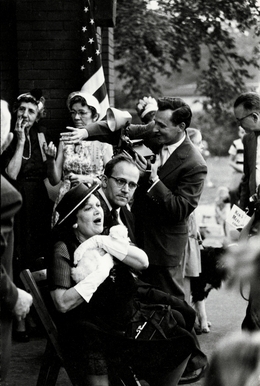
If you're a certain age, or you have an interest in journalism, the name W. Eugene Smith will ring a bell. At least one of his images will be stuck in your head: the kids walking into the woods on the last page of that pioneering coffee-table book, The Family of Man, maybe one of his iconic World War II photos, or the photograph of the mother bathing her daughter, severely deformed from radiation poisoning, which appeared in his exposé of Minimata Syndrome. He's one of those names which come up when people talk about the glory days of Life and other photojournalism magazines.

One of his famous assignments was to go photograph Albert Schweizer at his hospital in Lambaréné, in French West Africa for Life, and when they came out he flew into a rage and quit the magazine's staff. Hearing he was at loose ends, in 1955, a historian named Stefan Lorent, who was working with some people who were putting out a commemorative book about Pittsburgh for its bicentennial, invited him to document their city in photographs. To their pleased surprise, he accepted. He moved to town, and started shooting.

And shooting. And shooting. And printing. And shooting. And re-printing. And shooting some more. By the time he gave up, in 1958, he'd amassed over 17,000 photographs, too many to publish, too many to display. There was a tiny excerpt printed in a photo magazine, but Smith had clearly overachieved. To put it mildly.

Gilles Mora, the director of Montpellier's Pavillon Populaire, has selected 160 of these images for a small show at the Pavillon Populaire, entitled The Impossible Labyrinth, and it's drawing crowds. I've been twice, and I'm still trying to figure out a bunch of stuff.


Untitled


To attempt the portrait of a city would be impossible... The most one gets is the rumor of the city. -- W. Eugene Smith, in a note to himself, 1955.

The show is laid out thematically, for the most part, so that similar images are all in one place. The photos are in several stages of completion, and some of the images have Smith's notes in red grease pencil on them, with ideas for the next stage of printing the negative. So we have a wall of steelworkers and a steelworkers' strike, a wall of shots of houses and apartment buildings, a wall that deals with some sort of street festival, a room of images of kids playing, another with nothing but street signs, some interior and exterior shots of banks, all shot in Smith's trademarked black-and-white, with a finish that I can only describe as "greasy." You go through this exhibition and you feel like you've got some of the industrial grime from the city you've just spent time in on you, despite the fact that a relatively small proportion of the show is dedicated to the heavy industry one associates with Pittsburgh. 

It may be Mora's selection, but there's something haunting here, a palpable search for something that's not found, coming out of all of these photos. Which, I guess, is another way of saying there are very few great images here. There are attempts at them, some kind of sophomoric, like the patterns in the decorated pavement shot from high above, others more sophisticated, like the shot of the couple returning wedding presents or another couple playing shuffleboard with the woman laughing, her hand to her mouth, which seem to want to be great, but...aren't. 

There is no sense of what was going on with Smith personally during the three years he worked on this project here, and I began to speculate as a result. Smith really isn't known as a photojournalist whose work crossed the boundary into art. He isn't shown at galleries as much as, say, Dorothea Lange or Russell Lee. And yet I'm sure he felt, as anyone who views this show will, that he had art in him. Reportedly his inability to "finish" the Pittsburgh project, whose artifacts he just packed away, distressed him for the rest of his life. (He died in 1978). What's the obstacle here? 

Dream Street, the good one

Some of it is, I think, that in trying to please his employers, he went for the easy shot. There's a whole room of street signs: Rescue St., Breed St., Hope St., Loyal Way, and the corner of Ophelia and Hamlet. With the exception of Dream St., these are all represented as just what they are, no context, no representation of anything but the sign itself. Dream St., of course, is one of those pictures he must have come upon and said a silent prayer of thanks to the gods of photography. (He should also have added thanks to Raymond Loewy, who designed that Studebaker that's half-floating along there, too). It's far and away the best photo in the show, and loses nothing by being reproduced in gargantuan fashion at the entrance to the first room. 
The Wikipedia article on Smith makes reference to his "longterm consumption" of amphetamines and alcohol, which may have helped create the "impossible labyrinth" of the Pittsburgh project. Certainly there are pictures here which have their obsessive qualities: a long row of apartment buildings with their windows reflecting the sky, parking lots shot from far off. The repetition for the sake of repetition seems to be part of his style. And this might also be the key to the "what on earth did he see here?" reaction I got to some of the photos, as well as the "what is this all about" reaction to the street fair series. How on earth can you shoot a street fair and not include anything that gives you a clue as to its purpose? Or, rather, why would you do that?

Here is a photo essay which is primarily about the strength and quality of its execution, rather than the subject itself, which makes it unusual. -- Note by W. Eugene Smith, 1957


There's no telling what went wrong here, but the wreckage is at least a view of a place nobody would think to make great art out of with a camera. The mid-'50s, middle America, the innocence which still hung around the edges of American society, that's all here in abundance. And I'm trusting -- which, given previous shows at the Pav Pop, maybe I shouldn't -- that Mora's made a representative, unbiased selection here. At any rate, it's a disturbing and yet pleasant show, and I recommend at least one visit. 


And, speaking of impossible labyrinths, on the way out there's a room where you can look through books of Smith's photographs and read criticism of his work. There are two maps on the wall, one of the U.S. with a red push-pin stuck in Pittsburgh, the other a brand-new street map of the city which just blew my mind. No wonder Smith photographed street-signs: I've never seen a city with so many, mostly short, streets. It would be a nightmare to be a cab-driver there. 


William Eugene Smith: Pittsburgh, l'impossible labyrinthe (1955-1958), at the Pavillon Populaire, Esplanade Charles de Gaulle. On view until June 3. Open daily except Monday, 10am-1pm, 2pm-6pm. Admission free.

Sunday, April 29, 2012

Pizza, The Broke-Not-Poor Staple

It's inevitable: if you're raised within a certain radius of Manhattan, you're going to eat great pizza at a very young age. And if you're someone who likes to cook, you're going to spend countless hours trying to recreate that experience at home.

And you'll fail. You'll fail for a bunch of different reasons: unless you're Francis Ford Coppola, you're not going to have a professional pizza oven in your home kitchen, and temperatures upwards of 700º F, which are necessary to get the dough to rise and the toppings to cook in the amount of time that locks in that flavor, are not going to be possible. You'll fail because you won't be able to get the right kind of char on your crust. You'll fail because some ingredients only come in huge cans available to pizza-shop operators.

But that doesn't mean you shouldn't try. Because you can come close, and you can make a very satisfying simulacrum. And the more you do it, the closer you'll get. And yes, you'll get back to New York and have some pizza and get little insights that will improve your next pizza. And yes, I'm going to tell you how I do it.

I didn't get enough pizza when I was in New York in March, mostly, I suspect, because the really good pizza places, like all the other really good ethnic restaurants, have fled Manhattan and gone to places where the rents are kinder to the bottom line. There's a reason that the only good bagels I found were in Brooklyn, after all. But I picked up a good insight one cold, rainy night on 9th Avenue in the 30s somewhere. The pizza itself wasn't very good (note: this isn't the place behind Port Authority Bus Terminal, which was the only other pizza I had in New York, and which was considerably better), but the guy there was kneading the dough in a metal bowl. I tried that last night, and it worked amazingly. Another little trick in the repertoire!

There are also a couple of specialized pieces of equipment you'll need here, but nothing that'll break the bank. First, you need a pizza stone. These are easily found in the U.S. and cheap, but really all you need is unglazed terra-cotta tiles, which are available everywhere. Some "gourmet" company was selling a glazed pizza stone for something like €30 around here last year, which amazed me. I can't imagine it worked. The other thing you need is a peel. This is a device on which you build and top the pizza, then use it to shove it into the oven. Restaurant-supply stores have them, they're not expensive, and they last forever.

Okay, on to the recipe. I apologize in advance for the photos. Not that they're so awful, but because there are some crucial steps here which take both hands, and which I couldn't photograph.

My dough recipe is based on one from the woman who literally wrote the book on pizza, Evelyne Sloman, who also operates a restaurant in Albany, California, called Nizza la Bella, where I've never eaten, but which features her pizzas and an 800-degree oven. You take three cups of flour and a teaspoon of salt and mix them together in a metal bowl. All-purpose flour works, but if you can get what's known as 00 flour, which some Italian groceries have, you'll get a much better crust. You also take a teaspoon of granulated yeast and put it in one cup of hot (but not too hot) water, and wait for it to fizz. Then you mix them together. Start mixing with a wooden spoon, and keep some extra flour and water handy. Depending on the weather, you may find that you need to add more water before all the flour is scooped up. Then, you start with your hands, accumulating it into a single mass. Then you knead, pushing the dough into the bottom of the bowl. You can also, of course, knead on a countertop, or, if you have such a thing, in a food processor with a dough hook. Eventually, the dough will smooth out. It may stick, in which case add some flour. It definitely shouldn't feel dry, and you can wet your hands to add just a touch of water while you're kneading. But eventually, you'll get this:


This isn't quite there yet. When it is, it'll be a bit smoother on the surface, and when you hit it with your open hand, as Evelyne says, "it'll be like smacking a baby's bottom."

And when you've got it right, put it on the counter, wash out the bowl and dry it well, and put some vegetable oil in there, then return the dough and roll it around to cover it in oil thoroughly, cover it with a plastic bag (or plastic wrap, I guess) and let it sit for an hour in a warm place.


Meanwhile, put your stone in the oven and heat it at maximum heat, which for me is around 500º.


(If you look closely, you'll see that my stone broke some time ago and is now in three pieces. Fortunately, they fit together perfectly).

Now it's time to get your sauce going. Last night, I had some leftover pizzaiola sauce, my basic red sauce I've made for 40 years, which I'll demonstrate here some day. It's not as liquid as an ideal pizza sauce would be, so what I usually do is sautee some garlic in olive oil, then add a cup of tomato puree out of a box, some salt, and generous amounts of dried basil and dried oregano, in about a 1-to-2 ratio, more oregano than basil. Cook this carefully over low heat for around 45 minutes, stirring it frequently and making sure it doesn't scorch. It should be about the same consistency as ketchup. If you can do this earlier and let it sit some, it just gets better. Just make sure it's ready by the time you have to assemble the pizza.

And, while I was waiting, I prepared my other topping, slicing some mushrooms


and then sauteeing them in some olive oil, and a little salt to make the juices come out. Nice and brown!


Set these aside. After an hour, check your dough. It's risen. Probably not a great deal, but there's more there than there was. Okay, now, as gently as you can, make two balls out of it, pat one into a disc, and put it in a zip-loc bag and into the freezer: this recipe makes two pizzas, but since each one takes 20 minutes to cook, it doesn't exactly make dinner for two unless you can make the logistics work, which I can't. Anyway, the next step is to take the dough you will be using and cover it with the plastic and put it into the refrigerator for at least 15 minutes. Get out your peel


and sprinkle it with cornmeal. If you live somewhere where good old American cornmeal is like gold, you can, as I do, use semolina, which is cheap and used in Arab recipes.


Now the part I wish I could have photographed. After the dough is cold, take it from the fridge, flatten it into a disc, and shape your pizza shell. There are a bunch of different ways to do this, but this is a little 12" (approximately) shell, so I've found this to be the easiest way:

Grab the disc by the edge and turn it quickly with your hands. Gravity will start stretching it, and you want to keep the center from breaking, but you'll notice that you're getting a ridge around the outside of your disc, which you should squeeze to send more dough into the center. It's probably still pretty small, so at this point, drape it over your two hands and open them slowly, or push them apart. This will stretch the dough, but maintain the ridge. Try like hell not to tear the inside bit: keep it just thick enough that this doesn't happen. Yeah, it takes practice. Yeah, you can repair holes, but they usually leak. With luck, you'll lay down, precisely over the area with the cornmeal or polenta on it, your shell:


Pretty good! Now, lay anything that could burn (in this case, the mushrooms, but also anchovies -- which I meant to add here, but forgot -- or thin slices of salame or cooked Italian sausage) as your first layer.


Next add your sauce, spooning it into the center and spreading it with the bottom of your spoon (you've seen guys in pizza joints do this hundreds of times, it should be easy).


And finally, your cheese (Italian mozzarella here, of course)


and then, open the oven, slide the peel on top of the stone, and with a quick jerk, snap the pizza off of the peel and onto the stone. Not overloading the pizza is a real skill, and it's important to learn it: too much stuff and it can make the bottom soggy, or at least make the stuff fall in your lap as you're trying to eat it!


Much depends on your oven, but please, don't take this out too soon. Uncooked pizza dough can cause nasty reactions a couple of hours after you eat it as the still-living yeast hit your digestive juices. This one maybe got just a tad too brown


but not too badly. It maybe was in there two minutes too long.

You're not through yet. There are two more steps. First, I always put the pizza on the plate, then transfer it to a wooden board, and sweep the cornmeal/semolina off the plate. It's like sand, and you want to get rid of it. Then there's the post-oven dressing. At this point, you'd add fresh basil leaves if you had them (too early here), parmesan cheese (don't cook with parmesan: it'll burn), and a drizzle of fruity olive oil (a must).


And that's it.

One more specialized piece of equipment you'll need at this point: a pizza wheel to cut it into wedges. It's worth investing in a good one: I've had them come off their axles and fly across the room when confronted with a hard crust, and the crust you get with this recipe is usually too hard to cut with a steak knife.

There are a lot of variations you can ring on this, especially when fresh tomato season comes in, which it will in a couple of months, bringing with it eggplants, which also work well on a pizza. But the surprise comes when you figure out how much this costs you. A basic pizza like this costs under €2, and all it takes to make it is time: it's about 2 1/2 hours end to end. And that's €2 in retail cost of the ingredients. Now do you see why there are so many pizza places? At a decent local pizzeria, this'd cost me over ten euros, at least. It's true, it takes a while to learn how to make something as well as I made this (and don't let its ugliness put you off: it tasted just great), but when you can feed yourself a satisfying meal like this for so little (there was also a salad), it makes being broke just a bit easier.
 
Site Meter