Showing posts with label Food. Show all posts

Saturday, June 30, 2018

This Is The Stuff, A Tale of Two Restaurants

Every now and then, it becomes necessary to head over to Louisiana and visit my old pal Mr. LeJeune for some of his superb meat products, most notably garlic sausage and tasso. In the 40 or so years I've been making this trip, a lot has changed. There are, for instance, more and better places to stay. There's been a resurgence of pride in the local culture. And these two things have resulted in a lot more tourism. Which is a good thing (for the locals making money off of it) and a bad thing. Which we'll get to in a minute.

Now, last week it became essential for me to get out of town before I lost my mind. You know, mostly the same thing that's been oppressing all of us Americans, but also the fact that I just wanted to be somewhere else, even for a short time. I had a short visit to San Francisco in January that was pretty unsatisfactory for the most part (some day I'll realize that that place and I just don't get along, plan the trip so as to get what I wanted done, see who I wanted to see, and leave before my blood pressure gets too much of a workout), but nothing since then. With little money, but my flexible work schedule (I'd just finished the next-to-last chapter of The History of Rock & Roll, Vol. 2) it boiled down to a quick drive to Lafayette, overnight in a hotel, visit Mr. Le Jeune the next morning, and come back here.

It's a long trip, but my friend K said she'd like to join me, to keep me from nodding off or becoming too tired along the way. The only downside is that, as in San Francisco, my sense of taste and smell is still intermittent. I'm probably going to have to go see the only doctor who's actually treated me for it successfully, and he's in France. (American doctors, motivated by greed, want to do an operation that works briefly, then shuts off the sense for the rest of your life. I don't want that, thanks. And a flight to France would be way cheaper than the operation, as would be the price of the medications.) These days, though, it's been clearing up in the mornings most days, so that was a plus.

The drive out was hellish, mostly due to a stretch east of Houston, where we sat while three lanes folded into two somewhere around Bay City. We got in to Lafayette about 5 and checked in to a place I'd stayed at before, the Hilton, a giant high-rise and probably the tallest building in town. The last time was in the late '80s, when it was the only decent hotel in town, and I spent most of a day fighting food poisoning I'd gotten at Mulate's, which had once been a decent place to eat before they started courting the still-rare tour-bus crowd.

The hotel's now a Doubletree By Hilton with modernized decor, and it was filled with pre-teen baseball players and their parents, but that didn't matter: I passed out for a half-hour nap as soon as the bed was within striking range. I woke, refreshed, and then the next decision was where to eat. Weirdly, in the middle of a place famous for its food, there weren't many choices. I didn't want to drive too far from Lafayette, like to Breaux Bridge, and crawfish season has been over for a while, so it was a problem. Both of us were dressed fairly casually, which left out Café Vermillionville, which was getting kind of long in the tooth anyway. What remained wasn't very inspiring to say the least: there was a chain called the Blue Dog Café, an annoying reminder of the late George Rodrigue, who made an empire out of a cutsey cur (he was an okay painter before the dog took over his life, but not nearly as good as Francis Pavy). The only remaining choice seemed to be something called the Bon Temps Grill, which Tripadvisor rated #1 in the city and which happened to be real near the hotel. So the Bon Temps it was.

Now, from a cursory glance at the website, I knew this wasn't going to be traditional Cajun food, but food -- described as "swamp edge cuisine" -- that took from Cajun traditions and worked with them. Fine with me. My taste buds had shut down, but that was nothing new. The place was hopping when we got there, so it was evidently popular, and the waitress was top-notch. The only warning of what was to come was a basket of cold, dry garlic bread slapped onto the table first thing. K wasn't very hungry, so she ordered the seafood stuffed mushrooms as a main and a side-salad. I saw remoulade shrimp, which is a traditional dish, albeit from New Orleans, and since I'd only made it myself years ago (and, I should add, made it well), I ordered that, along with a stuffed pork chop, something I'd discovered at the long-gone Stop & Shop supermarket in Lake Charles ages ago. The butcher there was a genius, and his boudin, beef tasso smoked on mahogany, and stuffed pork chops were sublime.

Well, the food came quickly, my shrimp and her mushrooms, followed too quickly by the salads, which caused the waitress to come apologize for that lapse. I assured her that it wasn't as if they'd get cold. My shrimp seemed to taste okay, though, although I could only barely discern the taste, but K was irate: here were these mushroom caps with, well, basically a lump of bread on them, surrounded by supposed tasso-and-pepper gravy that was indistinguishable from the stuff you get on a chicken-fried steak. I soon found out, too, that the shrimp were done like guacamole in a bad Mexican joint: piled on a mountain of shredded lettuce. Then came my pork chop. It was a pork chop. It was thick. Instead of being sliced lengthwise and filled with stuffing, there was a hole a little bigger than a quarter with a tiny plug of stuffing wedged into it. The pork chop was pretty good, but hey, I grill pork chops at home all the time. Annoyingly, they also provided a knife to cut it with that was like a cutlass.

It was while I was sawing away at the chop that K noticed something. "This music is fake," she said. "I don't recognize any of it." What she meant was that the Muzak, which was blues, wasn't the original recordings. And she was right: just then some song I did recognize played, and it was...off. The whole thing left me puzzled. We paid our bill and left, full but unsatisfied.

The next morning the idea was to get to Eunice to see LeJeune before noon and head back, but as usual that's not the way it happened. But there was another restaurant I'd seen on my last trip over that interested me and from what I could tell, it was breakfast and lunch only. The name, though, worried me a bit: T-Coon's. I remember being shocked 35 years earlier by discovering a guy named T-Neg in the Cecilia, Louisiana phone book (slightly smaller than a monthly issue of Reader's Digest). But then I remembered the word "coonass" referring to Cajuns. A lot of them don't like it; some claim it's derived from a regional French word, conasse, meaning a stupid woman, or silly bitch, according to my French dictionary. But the front of the restaurant shows a coon stirring a black pot. And anyway, a decent breakfast is the hardest thing to find in these parts, so we went. Again, the place was packed. Unlike the night before, though, my nose was playing nice, and the smell was excellent. So was the Mellow Gold coffee, a coffee/chicory blend, light on the chicory, that's the house java.

K still wasn't hungry, but she ordered a sausage-and-biscuit combo. The waitress asked her if she wanted pork sausage or a link and I urged the link: that's what we were here for. I was intrigued by the courtbouillon omelet. To me, courbouillon was always (in Cajun cooking: it's a whole different thing in French) a fish stew with a roux-based tomato sauce served over rice. The waitress said it was mixed seafood with a sauce in an omelet. Okay, I'll take it, with a biscuit and grits, which I wasn't going to eat much of. While we waited, I picked up a box of seasoning from the table. It was T-Coon's The Stuff. Okay, I'd seen and used Tony Chachere's Creole Seasoning for years, and on one of my recent visits I'd stopped at the Slap Ya Mama! store in Ville Platte on a Cajun friend's recommendation and bought a box of their seasoning, which was a bit better.

The breakfast came, and I noticed a nice touch: both biscuits were wrapped in some paper: old timey! But...where was the butter? K surfaced out of hers long enough to say "It doesn't need any." I took a bite. She was right. And, in the spirit of scientific inquiry, I very lightly dusted the grits with The Stuff. Quite different from the others. But enough carbs: this omelet was sending my nose a message that my mouth needed to investigate. The courtbouillon turned out to be much thicker than I was used to, but the mixture of catfish, crawish, and shrimp, not to mention the seasoning, was exquisite.

As we were enjoying the meal, a guy with a T-Coon's shirt that said David on it came over to ask how we were doing. Then he asked where we were from  and K said "Austin." "Well," said David "I'll try to keep from makin' any librul jokes." A chorus of grunts came from behind me, and a couple of ominous chuckles. (I later saw that it was a quartet of gentlemen in camo, either Army or National Guard). I told him that his coutbouillon was different than what I'd encountered before and he was off, talking with passion about how he was about to raise his prices 12 ½ percent because he refused to stint on quality. "That's a quarter pound of crawish goes into each omelet. I have those links made by a friend over in Abbeville to my own recipe. The catfish comes from over in Mississippi and it's fresh, not frozen." It was a nice little conversation.

"I'm gonna change your life," he told me. "I'ma give her a box of The Stuff, and when she starts adding it to your food, well, look out: things are gonna get a lot better for both of you." And he told the waitress to make sure she gave K a box of it.

There it is: The Stuff
By avoiding politics and other minefields, I was rather liking David, because without mentioning tradition, he was still passionate about it. (You can see more of this passion on the front page of his website). As I waited in the car for K to finish smoking -- she only takes a few puffs, but puff she must, and she does it outside, not in the car -- I saw the list of daily lunch specials painted on the front of the restaurant: smothered rabbit, short-rib fricassée, smothered chicken and okra, and that courtbouillon on Fridays. But it was getting on, and we still had to vacate the hotel and get to Eunice.

We did, and now I have 20 lbs of sausage and tasso in the fridge waiting to be packed into freezer bags and frozen, except what I'll use to make red beans and rice (without rice) for dinner tonight. But before I press "publish" on this, I've been thinking about Cajun culture, tradition, and Americans.

My takeaway is this: As I've long realized, Americans are so alienated from their own country by this point that they usually don't know where they are. Oh, sure, they can check their phones and use Google Maps, but that's not where they are. The thousands of people who've moved to Austin since I last lived here, they don't know where they are, either. They've bought into the marketing slogan of keeping Austin weird, mouthed the slogan about the live music capital of America, but they don't know how it got that way in the first place, nor why it actually isn't either of these things any more.

And Americans who go to Cajun country don't know where they are, either. They come to Lafayette and stay there, possibly because they're attending a Ragin' Cajuns football game or doing oil business (not much of that left), or whatever. Few of them have even a superficial knowledge of where they are: the imagery in their heads are of alligators, crawfish, Blue Dogs, and swamps dripping with Spanish moss. There are accordions and fiddles involved somehow, probably to play blues, because the often-subtle distinctions between Cajun and Creole music is of no interest. They probably think Dr. John, Mac Rebbenack, is a Cajun. They don't understand the distinction between New Orleans and Lafayette, let alone New Orleans and Grand Mouton, Eunice, or Ville Platte. And ultimately, this is sad, especially if they spend more time there than we did this time. So they go to the Bon Ton and get their buttons pushed, no matter that it's a mediocre joint just a bit above a fast-casual restaurant. They hear piped-in blues, no matter that that's not the local indigenous music (hey, shaddup, Eddie Shuler), no matter that it's 21st century remakes by the Muzak Corporation or that ilk. They go away happy.

In no way will they want to engage with David Billeaud and T-Coon's, unless they happen in by mistake, in which case they'll be wary and a bit conservative about what they order and then be surprised that it's as good as it is. They're not going to get his cultural conservatism (not to mention his background music, which is mostly zydeco: I recognized two versions of "Hip et Tai-yo," both, I think, by Clifton Chenier), or understand why he'd rather raise his prices than compromise his quality. And if they got to talking politics, well, who knows?

Mr. LeJeune up in Eunice is just as culturally conservative as Billeaud is. He even makes ponce, a rarity which is sausage meat stuffed into a pig's stomach and smoked. I bought one last time I was there but couldn't find anyone to eat it with me. It was, unsurprisingly, excellent. I have no idea what his politics are, and after 35 years, I don't give a damn. Some things are above that, and these men have that figured out. They're members of their community, they practice their faith (which is Catholic: another ominous thing is the incursion of evangelical fundamentalism in Cajun culture, which could erase it before you know it), they interact with their neighbors, like the soldiers and the table of teachers who were finishing up when we walked in. And when I interact with them and their kind, I know where I am, know I'm a visitor who's treated with respect because I treat them with respect, as I would if they were visiting me. This is what's increasingly being lost in this country, as we tribalize and march towards one-party rule and fascism. It's an emergency, like so many other things happening at the moment, and an emergency that's so small it risks getting lost. I feel it because I don't feel at home in Austin, and haven't since returning almost five years ago, so it's a personal emergency for me.

Anyway, that's my takeaway. That and a box of The Stuff.


Wednesday, November 8, 2017

Rye Bread and Ghosts

Yes, I'm well aware that it's been six months since I've posted here, but it's been pretty crazy. I'm trying to get this second (and final) volume of The History of Rock & Roll done -- it's due in July of next year -- while negotiating Life Itself (as Austinites know, we lost a dear friend earlier this year, and I spent some time with her during her last days in San Antonio) and the trials of squeezing out the last drops of a book advance that I predicted would run out in November. And I was right.

But I had a shining light to follow: in March, at SXSW, I was asked by a friend from Finland if I'd like to do a keynote at their Musiikki & Media conference in early October. I've never been to Finland, and I was assured that Tampere, the city where the event was was "sort of Finland's Austin" (only, one presumes, without edible Mexican food), and, furthermore, that I could get a round trip from Helsinki to Berlin cheap on Air Berlin, so I could add on a cheap trip to my past to the whole experience. Which is pretty much what happened. So here's the story, with pictures.

* * *

The route the Finns sent me on started with that damn non-stop flight to Heathrow, one of the two non-stops to Europe from here (the other being to Frankfurt). Heathrow is a vision of Hell at any time, not to mention after a 9-hour flight on a plane with rather limited legroom, and of course no matter where you're going, you have to change terminals, so you have to go through security again, where the ill-tempered British security minions yell at you and hurry you along. This time I was so hassled by them that I thought I'd lost my house keys until an accident at my hotel in Tampere revealed that I'd tossed it into my computer bag along with my loose change as someone was yelling HURRY HURRY HURRY at me. Whew. 

But first I was headed to Helsinki, where by a fortuitious error I'd booked two days in a hotel to recover before heading to Tampere. Paid for them, too. And I'd accidentally picked a very nice hotel: Radisson Blu Plaza, which is in part the former corporate headquarters of an old company whose product I couldn't quite figure out, but featured stained glass windows and heroic decorations. 

Workers, the lifeblood of any company
Another error -- not nearly as fortuitous -- was not knowing that Finland is two whole time zones away from Central European Time, which is what I'm used to in Spain or Germany. To say I was particularly gazorbled when I pulled into the hotel at 6pm is no understatement. I also had a problem: I'd no-refund paid for those two days, but the conference wanted me in Tampere the next day. Fortunately, my train wasn't until later, so this gave me time to be a little more liberal with my checkout time -- and meet Pekka Lainen, something of a superstar on Finnish public radio, who'd be interviewing me for the keynote. We hashed over what we'd be talking about over lunch (I passed on the chile con carne tacos and ordered fish -- Arctic char, to be exact) and as he said good-bye, the rain stopped for the first time since I'd arrived and I grabbed my camera and walked to a square Pekka had mentioned over by the University. It's overlooked by a huge white church, which, since the sun was out, gleamed beautifully. 


This is Constitution Square, and since I had a train to catch, I didn't explore much, but I did notice across the street the oldest building in Helsinki. 


As you may be able to see if you click the picture, it dates from 1785. That's right: the entire nation of Finland is celebrating its 100th birthday this year. It used to be Russia. And thereby hangs a tale, which we'll get to in a minute. 

I got back to the hotel, packed, and caught my train. It takes about 90 minutes to get to Tampere from Helsinki, and it rained intermittently the whole way. Before it got too dark, I looked at the countryside and the occasional town. The architecture is quite different from western Europe, and one feature I thought rather silly: metal ladders on the roofs which led to the ground. It occurred to me that these were fire escapes, and they'd get hot if the house was on fire. Really dumb, until I had a flash: they weren't fire escapes. They were snow escapes. Yes, they get a bit of snow in Finland in the winter, as you may have heard. 

The hotel where the conference was held was also the hotel where I was put up, a huge tower, the largest or second-largest structure in Tampere (it was hard to tell; the explanatory text was in Finnish, a language with no cognates in English, but fortunately every public bathroom I used had a little man or woman cutout, because if it had just been the word I'd have been out of luck). Naturally I went the wrong way, and, being still very gazorbled, took a cab when I walked across town to the other hotel the chain maintains in Tampere. There was a mandatory welcome party, I grabbed a meal in the hotel restaurant and eventually crashed.

Tampere from the 13th Floor (Yes, there were Elevators)


Jet-lag got me up early, so I checked my mail and Facebook and...uh-oh: Pekka was planning on catching a train in Helsinki at the time our interview was scheduled to start! Fortunately that got straightened out and he arrived on time. It was a great interview, and went way over our time limit. The discussions continued in the hotel restaurant, and by the time it was all over, it was mid-afternoon. This was a good thing: my return to Helsinki wasn't for another day. I had 24 hours to see what was in Tampere. I mentioned this on Facebook, and a Finnish woman I know suggested the Lenin Museum. The Lenin Museum?

But there it was on the map, so off I went. A relic of the Russians was nearby.


Now, if I remembered the map right...

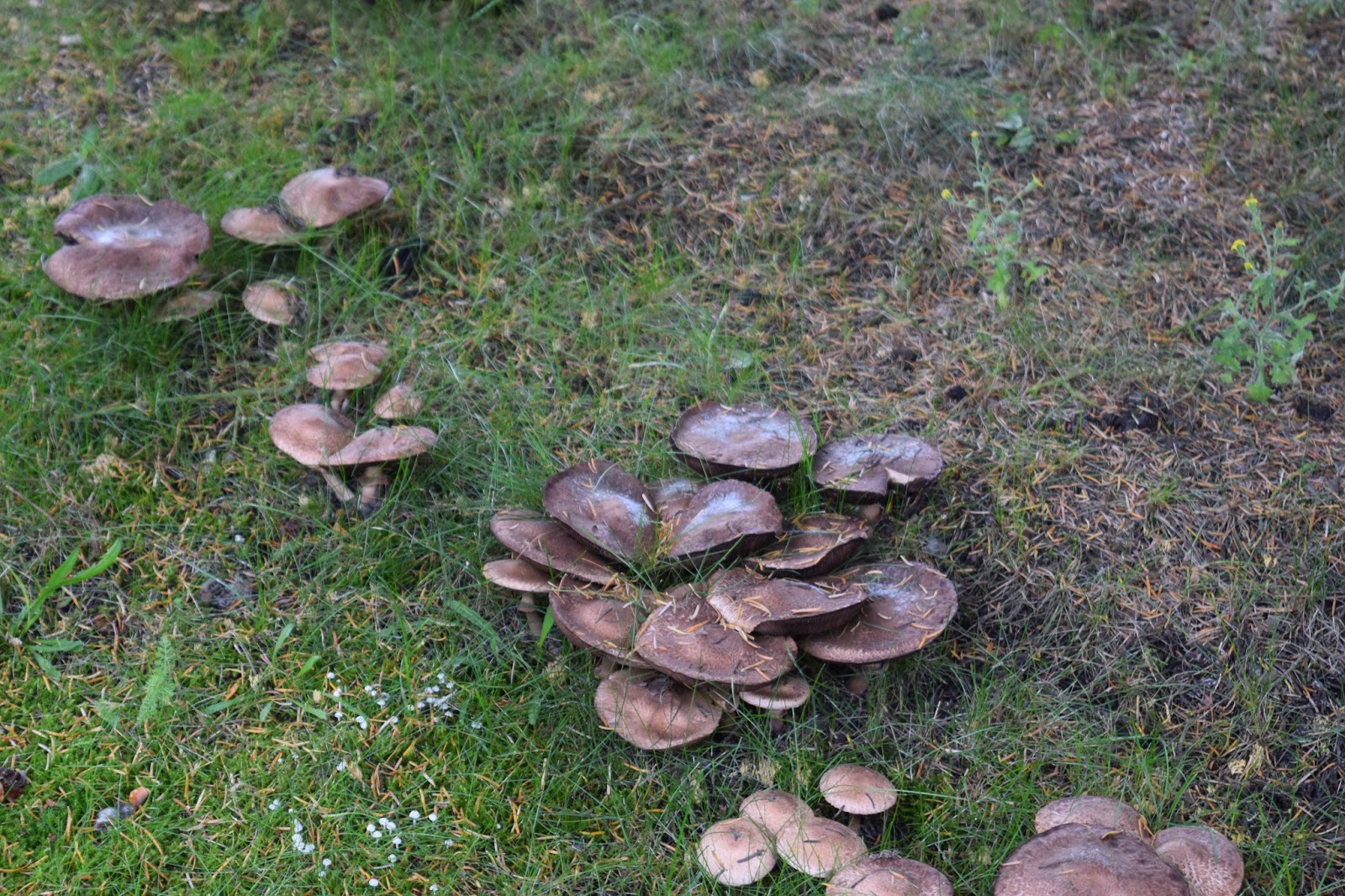
I didn't. I took a wrong turn and kept walking. There was a park. I remembered a park from the map, so I kept walking. There were mushrooms. Big mushrooms.

You can't tell from the photo, but this guy was close to two feet tall.

Each lobe was the size of my hand.

And these were like mini-pizzas

Eventually, I came upon a sewage treatment plant, which was way wrong. Had a nice view, though.


But none of this was supposed to be there. I turned around, and for the first time I remembered that my phone was in my pocket, so I dialled up Google Maps. I had a 37-minute walk ahead of me. The day was overcast, wet from the previous day's rains. I was still jet-lagged. I walked and walked and after about 20 minutes of slogging through industrial wasteland and alongside a freeway, I arrived just down the hill from the Russian church at a place where I should have turned right instead of left. The phone said I still had 18 minutes to go. I don't know if it was a combination of jet-lag and diabetes or what, but I was exhausted and starving. I lurched onto a traffic island and felt myself losing my balance as oncoming traffic sped inches away from me. I threw out an arm and embraced a traffic sign. When the light changed, I trudged in the right direction and sure enough: there was a park. I had to sit down, but soon enough felt good enough to soldier on. An arm of the park I'd sat in divided a street on the right, and I walked where the phone told me to. And there was the Lenin Museum, confusingly enough in the administrative building of the state theater. And, a quick look at the map told me, the market hall was just a few minutes away, so, knowing that I needed to eat, I headed in that direction, and found it. Right inside there was a lunch counter, and the woman behind it spoke simple English. I ordered what she said was chicken in a cheese sauce with mashed potatoes. It wasn't like any chicken in cheese sauce I'd imagined, but it was very good, and not just because I was hungry. The rest of the food hall, I discovered, was mostly lunch counters, but then, I doubt there were many crops in early October.

Okay, time for Lenin. The building was fairly opulent, and I eventually learned that it had been the union hall for all the industrial unions in Tampere, where Finland's heavy industries created factory equipment and locomotives. I'd even passed an ancient locomotive in the industrial section I'd wandered through. In the early 20th century, Tampere's workers were unionized and were very interested in the communism/socialism brewing elsewhere in Russia, so when a couple of Bolshevik thugs knocked over a bank in Estonia (another Russian province), they realized they were too hot for Petersburg, where most of the rest of the Bolsheviks were and fled to the small provincial city of Tampere, where the union guy welcomed them at the opulent union hall, all polished wood and marble. One of the thugs was a Georgian named Josep Dzhugashvili, who seemed hot to get the revolution going, so the Finns sent word to Germany, where Lenin was hanging out, and he got on the famous sealed train to Tampere. The unionists introduced him to the bank robbers and he soon decided it was time to go back to Petersburg and get this Party started. When he arrived, he was greeted in an office at the union hall, which is now the Lenin Museum. There's actually not much in it, the major artifact being Lenin's cane (although it's not even his cane, but an exact replica traded to Tampere's mayor, who brought the original to Moscow on a friendship tour some years ago), and there's this corny bit:

Red marks the spot!
I'm pretty sure you can't read what's on the red spot on the floor, but it says that this is the exact spot where Lenin and Stalin first met. The corny bit of Lenin in the sidecar ("Have your picture taken on the motorcycle!") and the life-size Stalin figure (my friend JJ Gordon, during his acting career, performed a one-man play called I Am Joseph Stalin, about one of the doubles Stalin used, and I have to say that I never met Stalin -- thank heavens -- but this thing's the spitting image of JJ) give you something of the flavor of the place. Cool gift-shop, though, if you don't have enough Commie crap.

The reason this is Finland's 100th birthday is because once the Bolsheviks took over the Russian government, they thanked Finland by giving it its independence. Of course, they also changed their mind, which resulted in yet another 1917 revolution, and that's given as the reason Finnish, inscrutable as it is, is the national language. (Actually, Swedish is the second official language, which means German-speakers can sort of make out some signs).

The next day, I returned to Helsinki, and spent the night, flying off to Berlin for a short visit, my first to the place I'd lived for 15 years for eight years. I understood it had changed. Uh, yeah.

* * *

Dude, where's my apartment?
It's really hard to take a picture of what's not there, but since Berlin has always been a city of vanished places, I got kind of good at it there. This one takes some explanation, though, because it's not a very good picture of something that's not there. Okay, my old apartment was impossible to find unless you knew the secret. The yellowish building in the center of the picture was Borsigstr. 2. Next door on the right was 1, and next door on the left was 4. I was in 3, which, for reasons known only to the city of Berlin, referred to the building behind 2. Somehow, my landlord sold off the driveway you'd walk down to get to it, the tiny vacant lot on the side of the driveway, and part of the parking lot behind the building to developers, who put up the grey building, which is now allegedly a four-star hotel. I need not remind anyone who visited me at this place that my apartment was barely even a one-star one. The note on the grey door, which was never open during the 11 years I lived here, says that access to 3 was through the hotel garage. 

That was only the first shock. Although I could probably have found cheaper and better accommodation, for nostalgia's sake I chose the hotel on the corner (to the left and all the way up the block), Honigmond. Honigmond started as a bar during Communist days, the Borsigeck. It was the favored watering hole for the students at the theological seminary in the church two doors up from my place, and back then, the church and divinity students were secret centers of dissidence, as was the theater. Borsigeck was also a favorite of another bunch of malcontents, actors. The code word for meetings was "playing chess at Borsigeck." After the regime change, a bunch of Borsigeck folks bought the bar and renovated it in turn-of-the-century elegance, and made the kitchen into one that produced excellent German food, with a weekly menu that also had Italian touches. I first ate there with my editor at the English-language magazine whose offices were not too far away, Checkpoint. It had just reopened, and we thought that, as far off the track as it was, it was doomed. Hardly. It was a neighborhood joint, our secret. Once they acquired the whole building and turned it into a hotel, I wondered what the breakfast was like, but I never found out. Eventually, they bought two more buildings to add to the hotel. It made me happy; I ate and drank there a lot, and when I started my communication company, Berlin Information Group, we'd commandeer the back room on Tuesday nights, which were very slow, and have our meetings there until someone talked a developer into giving us free office space a couple of blocks away.  So you see why I picked the hotel. 

But Honigmond the restaurant died earlier this year. The space has far fewer tables, and it is now Neumond. And on Neumond's dinner menu, amidst all the gussied up dishes, is that signifier of Euro-hipsterdom gone bad: a fancy cheeseburger. I had breakfast there my first day (very generic) and went elsewhere from then on. (Yes, I'll get to food in a minute here). 

But beyond all this there was an onslaught of change to absorb. My friend Nikki picked me up at the airport and after I checked in, we went for a walk just to check it out. Torstr., on whose corner I almost lived (it's a major street, so it was good to have a couple of buildings muffling the noise), had been a collection of this and that, a couple of bakeries, kebab stands, a television repair place...that sort of miscellanea. There were a couple of restaurants, especially late in the game, with an excellent if terminally trendy Chinese place, the super-snotty Bandol (I was denied entrance once because I was wearing jeans, which was so out of place in that neighborhood that I just laughed at them), and an excellent Italian place. Now, it's wall-to-wall restaurants, of which the only one I recognized was Bandol. Some of them, I was told, were quite good. Many appeared to be hipster-yupster in appeal: a great number of people with money from elsewhere in Germany have arrived, and it's unlikely I could even manage to aford an apartment on a side-street. By the time we made the grand circle, I was dizzy. Nikki drove off and I went uptairs to think. 

The next day I kept walking, this time below Torstr. in the so-called Scheunenviertel, which had been filled with emigrants between the wars and featured the Neue Synagogue, a prominent Reform congregation that was accidentally bombed by the British in World War II. When I lived there, it was where the edgy galleries were, a couple of odd bars, and our magazine offices, and, later, the studios of JazzRadio, where I did three shows a week for about 8 years. I took a lot of shitty photographs. But not all of them were bad. 

The Empty Apartment
For some reason, I'd never gotten a good shot of this memorial to the deportation of the neighborhood Jews. Or maybe this is better than the ones I took because the greenery's had eight more years to grow in. I could have framed it better, though. 

I think the reason the photos were so bad, though, was because I wasn't looking at what was there, which is, well, kind of important. I was looking at what I remembered, and that made accurate documentation imposible. Okay, and the early-morning light was off; I never got up this early when I lived there. But it's also that there were ghosts. Things I expected to see that weren't there. The hotel was quite close to the apartment of my short-lived ex-girlfriend, Lady Drunkula. She may still be there if she isn't dead, which she might well be; it'd only be a question of whether someone murdered her, she had an accident while drunk, or she drank herself to death. I'd walk past places and memories came back to me despite myself. I found I didn't much enjoy this. 

To be honest, though, I returned without much of a plan, many of the people I wanted to see were out of town or busy, and I realized that the next visit would have to be planned a bit differently. And there should be one, but maybe not too soon. 

One thing that went off brilliantly was that the same day I went below Torstr. I also went to the Bode Museum to look at their room of Tilman Riemenschneider sculptures. The Nordrhenisch school of wood-carvers appeal to me greatly, and I've seen plenty of their work over the years, but Riemenschneider is a cut above. The Bode doesn't even have a lot of them, I discovered. I'd remembered a lot more when I was rushing through the Bode for the first (and until now only) time I'd gone there, writing it up for one of the many guidebooks I'd worked for, and since everything in Berlin is always under construction, there was a room with at least one of his pieces that was blocked off. But the room that had ones was fascinating. I'm not even a sculpture guy, but these knocked me out. 

Venetian dude

Another Venetian dude

No idea dude
And then there was Riemenschneider. The masterpiece was the four Evangelists. 

All together


And, of course, the band of angels.


Most of the rest of the museum is later stuff that doesn't appeal to me, much of which isn't first-rate (that'd be off by Potsdamer Platz in the Gemäldegalerie), and I went and overdosed myself by buying a ticket good for all the museums so I could see what they'd done to the Neues Museum, which had a hole you could (and some did) drive a truck through due to wartime bombing. It's now been patched up, rebuilt, and houses Greek and Egyptian things, including that bust of Tutankhamen's wife (and sister) Nefertiti. Bet you thought that was in the Metropolitan, eh? In the basement was a nice show about the beginnings of civilization in China and Egypt, their similarities and differences as demonstrated by objects. As is the custom in Germany, though, the museum was grossly overheated, I was getting tired, and so I went back to the hotel after an increasingly more cursory glance at this exhibit. 

My proposed last-night mass meetup wound up being Nikki, two of her boys, Uwe, her ex, who is also the father of one of the kids, and my friends John and Aimee, at a bar Uwe was running (and has since left) called Kegelbahn. It was pretty low-key, especially since John and Aimee had to leave early, but at one point we were all at the table nursing our beers and I said "You know, this place has ruined me. I just can't get used to the States." And...well, I can't. It's not just our grotesque, evil President, or the utter alienation of the new, bloated Austin. It's a way of living that overlays the entire country I've seen since I've been back. I just don't like it. If it were mere culture-shock, it would have worn off. And it hasn't. I'm not sure what I'll do, exactly, but I can't budge for another couple of years, while I write this next book and promote it when it comes out. I didn't really have any choice in returning: there were things here I needed to use for the book. But once I don't have that choice...

* * *

A FEW CULINARY NOTES:

Finland is probably not high on your list of countries for destination dining, but should you have to do there, you shouldn't regret it. One thing I noticed immediately was that the bread there is extraordinary. This is because it's mostly rye; wheat doesn't grow too well, so it's not as much used in the national cuisine. At breakfast in the hotel, I got that immediately, including a crispbread covered with seeds that I brought back with me. The cheeses were good, too. 

I had dinner at some fine places. My friend Karen in Berlin suggested Seahorse, in Helsinki, whose business card advertises "Finnish food and culture since 1934," which would be better for someone who, unlike me, does not have a deep, visceral distaste for beets, root vegetables being another of the mainstays of local agriculture. I had some herring, some of which had a camphor flavor (not bad, but weird), and then a "Scandinavian hash" of ham and potatoes that wasn't too memorable. Cheap and friendly joint, though. Another place I enjoyed quite a bit was Kuu, which means "month" in Finnish (it's the suffix of the names of all the months, the waitress explained). The salmon cured in aqavit with a crayfish sauce was super, and the reindeer stew (had to have it once!) was very well done, letting the distinctive flavor of the meat play off the berry-studded wine reduction brilliantly. A mixture of locals and Japanese tourists, superb service, highly recommended. My third dinner was at Bryggeri, which, as you can tell from its (Swedish) name is a brewpub, but one with extraordinary food, matched with the in-house beers. I had a bit of a cold so I remember I started with their cheese and charcuterie plate, but my taste buds faded before the main course so I don't remember what I had. And the receipt is in Finnish. Recommended, though. Bryggeri is also near the harbor, which is where you'll find the market hall, which has far more food than restaurants (including a pancake place with the motto, in English, "A pancake a day keeps the sadness away," which tells you everything you need to know about Seasonal Affect Disorder in Finland), where I got a nice snack of a slice of superb smoked salmon which I munched as I walked around. 

In Tampere, I ate twice at the hotel restaurant (not particularly recommended, although there was nothing wrong with it) and once at Tiiliholvi, a place which also seems to have a branch in Helsinki. This was very nice, although I was the only person in the place when I went. A soup of root vegetables was a fine Finnish start, and the "duck two ways" turned out to be breast meat and liver, each with its own sauce. They brag that they have the best wine cellar in town, and if the glass of Les Douves Latour Carnet (I was intimidated by the "Latour" part, but it was affordable) was anything to go by, they're right. It was not only a perfect accompaniment, but a profound wine -- and, as I discovered on my return, a $20 bottle if you can find it. 

In Berlin, after the Honigmond disappointment, I went down the street to a place that had opened when I was living there. I hadn't liked it, thinking it pretentious but not cooking to meet its pretentions, so I never went back. But this time, it appeared that the spirit of the old Honigmond had just picked up and walked a block. True, Alpenstück has white tablecloths, but the Radeberger beer is just as good, and the bread, well, that's different. The reason is that they've expanded across the street, clearing out a hairdresser and a bar (Smily :-) der Friseur and Cheer's -- a copy-editor's nightmare in 3-D) to put in a bakery-cafe, whose first-rate breads and pastries would have been a real boon to the 'hood back when I was living there. 

Quite the adventure, and now I'm back in the USA, where hamburgers (and cheeseburgers) sizzle on an open grill night and day. But I know I'll be back to Berlin. And who knows, maybe Finland. 

Thursday, May 18, 2017

Thanks, Henry!

Monday morning, I got up, ate breakfast, and started the coffee, after which I headed into my office to see what disasters had befallen the world since last night. I also checked the e-mail and, as usual, one of the mails was my daily news digest from the New York Times. And there, in the obits, was the headline:

Henry Chung, Who Helped Bring Hunan’s Flavors to America, Dies at 98


I looked at the coffee cup I'd grabbed. 

One side

The other side
After I got over the shock of the coincidence, I had one of those "I had no idea he was still alive" moments, but I knew the Hunan Restaurant still existed because I'd attempted to go there with a couple of friends a year or so back. It being Easter weekend, it was closed. My friends were a bit skeptical: they'd heard it wasn't as good as it had been. But that just made me want to go more: in the novelty-obsessed world of San Francisco (and elsewhere) foodie-ism, there's always a rush to find the newest, the latest, and the most authentic. The Hunan fulfilled only one of those slots in the 21st century. 

I read the obit with interest. I'd known Henry, but not known a lot about him. Of course, it was impossible to go to the restaurant without knowing Henry: he was as friendly and garrulous a man as ever walked the earth, and it was clear that the restaurant was a mission. I know, because I was an early convert. 

When the Hunan first opened, I was working at City, a magazine where a bunch of ex-Rolling Stoners were working, which was, I surmise from looking at the map, on Pacific just off of Columbus in the bit of San Francisco where Chinatown blends into North Beach. Of course, Broadway is the official boundary, but even back then it was getting blurrier, and the stretch of Kearny between Portsmouth Square and where Columbus crossed it was a bunch of nondescript businesses, as well as a couple of bars and restaurants nobody in their right mind would enter at any time of day. In other words, rent was cheap, just the thing for an ambitious Chinese restaurant startup. I think the only reason Michael Goodwin stopped in there was because it was a new place, not as obviously trashy as its neighbors. Michael was from New York, and he was Jewish, so the soul-food element may have figured in. Or maybe he was just on his way to a deli and passed the exhaust fan. 

In any event, he came into the office, raving. "Hey, check this out!" He had one of those classic cardboard takeout containers with the wire handle. And, when he opened it, an amazing odor came from within. "What is it?" "Smoked ham and vegetables from this new Chinese place." "Wow, where is it?" "That's the best part; it's just around the corner!" And so it was. 

I don't want to pretend that City's patronage at lunch established the Hunan as a hip place to eat, but I do think that the money we spent there was part of what made Henry able to make the rent at first. But only at first: Within a year, it became the first restaurant I'd ever seen that had a line in the street. It didn't hold many people: there were a number of tables ingeniously squidged into the irregular space and a much coveted counter where you could watch Henry and his family prepare the dishes. What you couldn't do was find out what some of the stuff he was using was. Michael innocently asked him one time what kind of wood he used to smoke his ham (and duck) and Henry threw back his head and laughed. "I'm not gonna tell you that!" he said. (Probably this was because he was doing it himself, illegally, if the tale he tells in his cookbook -- that he steamed American bacon or used Canadian bacon -- is to be credited: I know what those things taste like, and, well, no. And, of course, there was the duck.)

My friends and I were frequent enough visitors that he stopped warning us "That's hot" or "Lotta garlic in that one." We'd just say "GOOD" and he'd chuckle and get to work. I can't even remember all of the stuff I enjoyed there over the years. Scallion pancakes, for one. Wow, they were a revelation, although they're common enough these days. Dungeness crab, in season, treated far less politely than the garlic-butter-and-parsley treatment it got at Fisherman's Wharf, and spectacular for what Henry'd done to it. We had a protocol for dining there: if the line hadn't reached Washington by the time we arrived, we'd stand. Two people around the corner and it was too late. Four years after he opened, he'd acquired another property on Sansome, a cavernous place where there was never a problem getting a seat, which is not to say it was often very empty. Same good food, just a long line of woks to prepare it in. 

Shortly after opening the new joint, Henry, with the help of Tony Hiss, a journalist who specialized in China, put out a cookbook. 

My copy
I went down there right away and bought one. 

He got the tall part right
But, with California at my feet and Chinese markets just across the bridge from where I lived, I never made anything out of it. Why should I? Henry and his team did it better than I ever could. In fact, I never attempted any Chinese cooking when I lived in California. Again, why should I?

The reason came to me about a year later, when I packed up everything I owned (including Henry's cookbook) and moved to Austin, a true Chinese food desert. (It pretty much still is.) I may have tried my hand at Chinese, but I never really got it. I did, however, return to San Francisco in 1980 on a visit and I must've eaten at the Hunan, because I got the coffee cup. Somewhere in its peregrinations, it got chipped, as you can see, but the damage wasn't enough to toss it. Anyway, it brought back good memories. 

Another thing I may have picked up on that trip -- or a subsequent one -- was a jar of Henry's Hunanese chile paste. I still wasn't cooking Chinese food because Austin had only one store, on Airport Boulevard, that stocked the necessities and because none of the Chinese cookbooks I had seemed do-able. But I brought it back as a memory aid or something. At any rate, it was in my possession when the Austin Chronicle, to which I was contributing a food column as Petaluma Pete, ran an issue on picnics. I was asked to come up with a couple of recipes and wound up making one of the most inspired mistakes of my career when I made a potato salad out of The Vegetarian Epicure book and accidentally started one recipe and finished it with the recipe on the facing page, all made better by my using green New Mexican chiles. Boy, that was good! And, inspired, I then invented Chinese cole slaw, by taking Henry's "rich salad dressing" recipe and dumping it into the slaw mixture. Wow. 

I finally learned Chinese cooking in Berlin, driven by necessity and using a five-euro Ikea wok. They're not bad learners, although you burn through them soon enough. Eventually I acquired a spun-steel wok like you're supposed to use and got good with the help of cookbooks by Fuchsia Dunlop and the folks at the Big Bowl, a chain I've never even seen, but whose book wound up in my hands. Poor Henry, relegated to the never-used category. 

Nowadays, I almost never eat Chinese food at home: my diabetes flares up with rice and rice products  in a way it doesn't with wheat, although I don't eat much of that, either. Most East and Southeast Asian cuisines also use a lot of sugar. I tend to save my breaking of the diet with Chinese food for the incredible Cuisine Szechuan in Montreal. But Henry's passing sent me to the bookshelf for his book, and I see that a lot of the recipes in it don't call for sugar at all. Hmmm...

And I realize now that Henry Chung is one of my heroes. He was almost 60 that day he signed my cookbook, and he lived to be 98, making people happy and building a little empire of Henry's Hunans with his sons. Hell, he was in his late 50s before he even got started! If that's not something to aspire to I don't know what is. So I raise a glass (but, forgive me, not of one of those awful Chinese spirits) to Henry, and thank him for his life. And for you, I'll tell you how to make Chinese cole slaw:

Henry's Rich Hot & Sour Dressing 

2 Tablespoons sesame seed paste (or crunchy peanut butter)
2 Tablespoons soy sauce
4 Tablespoons vinegar (I'd use rice vinegar here)
1 Tablespoon hot red pepper oil
1 teaspoon hot red pepper powder (you could also use Hunanese chile paste if you can find it to    substitute for these two ingredients)
½ teaspoon black pepper
1 teaspoon sugar (optional)
1 Tablespoon sesame oil
2 Tablespoons vegetable oil
1 Tablespoon finely minced fresh ginger
1 Tablespoon finely minced garlic
1 Tablespoon finely minced scallions
1 Tablespoon white wine (the book was written before Shao Shing became widely available, and I'd suggest that instead)
1 teaspoon hot mustard (optional)
½ teaspoon salt
1-2 cups chicken broth

Combine. Dump over slaw vegetables and let it sit a couple of hours, then mix before serving. 


Thursday, October 20, 2016

Tarragona: End Of The Trip, Sorta

The couple seated across from me on the train from Valencia had a couple of English-language local papers for the Costa del Something on the table. There are enclaves of coastal Spain that cater to retired Brits and are called Costa Brava, Costa Blanca, and the like, although the names probably preceded the expats. There are the same kind of sea-facing boring apartment blocks that de Gaulle built on the Languedoc coast, and they're largely peopled by right-wing British folks. I even recognized the papers: they were just like one published in France, whose name I forget, which deals exclusively with problems British people face in an environment where they don't speak the language, don't talk to the locals, don't understand the customs, rarely eat the food, and still feel privilege. They're there for the sunshine (which, admittedly, is a scarce commodity where they're from), inexpensive high-proof wine, and, in Spain, untaxed cigarettes, not necessarily in that order. They don't much like the locals (who return the favor), and they positively despise Americans, as I was reminded when the train stopped to let on some passengers and a guy and a woman, obvious tourists making their way through Europe, came into our car. They were both stocky, and I noticed the woman, in particular, because she was East Asian and had impressive muscles, hardly a delicate lotus blossom of a stereotype. They hoisted their bulging backpacks up onto the luggage rack, and my neighbor remarked to his wife "He didn't even offer to help her with her pack. You know why that is?" She said no. "Because he's American," he hissed. He picked up the paper and showed her an article headlined "The perils of Brexit," and said "I'm tired of seeing rubbish like this. They never talk about the good bits." Which, as I understand it, will make it more difficult for him to live in Spain.

The train was a slow one, taking two hours along the Mediterranean coast to my last unknown stop, Tarragona. It sounded interesting: Roman settlement, big seaport, Visigothic Christian presence, and, for the gastronome, home of the fabled romesco sauce, which is made out of olive oil, crushed almonds, and a particular dried red chile that isn't hot: recreating it in the US involved chile ancho. I'd had it once in Barcelona with a mixed-vegetable tapa, and again in Valencia with that mixed vegetable plate, but it's most often served with seafood, so I was ready for that.

But how much of the town would I get to see? For the first time in my visit, the clouds were dark, and the Mediterranean was choppy, its water varying from slate-colored to black ink. The sere, brown countryside I'd been seeing had made me forget about rain, except for its absence. But this didn't look good for a pedestrian visit to a city. It held off until I reached my hotel, charmingly located above the city's bus terminal. It seemed to have been airlifted in from Czechoslovakia in 1979: sort of modern, with much polished wood and stone, a totally indifferent front-desk staff verging on mildly hostile, and a room that was just a smidgen smaller than would have been comfortable. I checked my watch: it was almost 4:30, so I'd better figure out what was where. But by the time I got to the lobby, it was raining. Still, I intuited that this wouldn't last long, and I was right: a half-hour later it stopped and the clouds looked a bit friendlier. Off I went.

I knew that the traffic circle just outside the hotel was the beginning of a rambla, one of those delightful Spanish streets divided by a strip of park where people walk, and that the rambla ended at the Mediterranean Balcony which looked from a height onto the sea. Turning left from there would take me to the Roman Circus, the remains of a giant chariot-racing arena. There wasn't much to see from the balcony, since the clouds were lurking offshore, and the harbor was full of container ships waiting their turn, so I was off to the Circus.

The moody Med, shot the next day from the Archeological Museum
At the Circus, the guy sold me a combination ticket good for several other attractions -- and good the next day, which was good because everything was going to close at 7. He also warned me that, the next day being Sunday, everything would close at 3 in the afternoon. Thus, I figured, I'd have to do all my inside activities early, and walk the streets afterwards.

The Circus didn't particularly thrill me: it's only partially excavated, since most of it lies under enough dirt to support the buildings of the nearby neighborhood, and, as I've said, I'm not thrilled by Roman art or architecture. Next to it is a Roman tower, to which the Spaniards added a story in the 14th century for the king to stay in when he was in town. Pretty dull. The Archeological Museum would have to wait for Sunday, so I just wandered aimlessly. Pretty soon I found myself at the Cathedral, and a quick look at its sign confirmed what I figured: closed to visitors on Sunday. Better take a peek.

Swarming with tourists on Sunday, of course. But again, no steeple.
It's not the grandest cathedral on the outise, although all those saints are pretty charming, each one holding a scroll with his name on it.

Hi! My name is St. ______!
I hustled inside, and was awed. Not so much by the architecture or the art in the chapels, but because an organist was playing early Baroque Spanish organ music, which is some of my favorite music in the world: I used to own about 15 LPs of it, and have quite a bit in digital form. The organ itself was set up especially for this music, too. Off to one side, there was a glass door leading to the Diocesian Museum, a magnificent collection of Spanish Romanesque art that the bishop's people had saved from crumbling churches in the state of Tarragona. I rushed through it, wishing I didn't want to be back in the main sanctuary listening to the organist. Then there was the cloister, again, gorgeous. I whizzed around it. Back inside. But the Cathedral was going to close in about 15 minutes, so I reluctantly decided to leave. Fortunately for me, I got lost trying to find the exit. There was, as there always is, a gift shop that I found, with exactly zero recordings of this organ. Crazy. I finally found the exit and pushed the door and walked out, the spell broken. I will very likely return -- Tarragona's only an hour's train ride away from Barcelona, after all -- but I'll make sure to do it during the damn organist's lunch break!

I wandered down the steps in front of the Cathedral (dedicated to St. Tecla, the town's patron, and surely one of the more obscure saints out there) and found myself in a square into which gigantes were gathering. I'd seen these outsize figures before, this spring in Girona, but not in this quantity.


I have no idea what was going on, because they are supposed to show up (as are the famous castells, the human towers for which the city is renowned) for the festival of St. Tecla in mid-September. In any event, they were gone by that night.

I made it back to the hotel after some wandering, and finding a big square lined with restaurants that would be a good place to find dinner. And, later, I ascended the hill again and chose a restaurant that had fish with romesco sauce. At last! The waiter didn't speak any English, but we communicated and I placed my order. He came out again with the menu. No romesco. Grrr: I ordered langoustines in garlic sauce and then hake with what the menu called "burned garlic." I'd been notably garlic-deficient on this trip, so it was time to make up for that. It was just okay, and instead of a wonderful Spanish draft beer, they had Amstel. The Dutch are gradually taking their revenge for the years the Spanish colonized them (yes, they did: how do you think the Prado got all those Bosches?), I guess.

It was damp and chilly the next day, so I headed to the Archeological Museum first thing. To my disappointment (but not surprise) it was 100% Roman, but at least it was dry.

The plaza outside the Archeological Museum. Notice umbrellas.
One thing I liked in it was a few mosaics that had been found in town, including this wonderful depiction of the fishes of the Mediterranean:

The menu for a Roman seafood restaurant? No, it was originally on the floor, and the Romans didn't have restaurants.
A lot of the museum is given over to Roman inscriptions, which I think is one of the most boring of the subsets of Roman archaeology, since they're mostly gravestones or celebrations of military victories. I read a little Latin, but the Romans didn't put spaces between their words and, worse, often left some vowels out. But there was a temporary exhibit about a remarkable structure some ways out of town, Centcelles. It has Roman mosaics, Arab baths, and Christian features, and was in ruins until a German team started digging in the '50s. They're still at it, and the wild thing is, despite all the artifacts and art that's been uncovered, nobody knows what it was. A rich farmer's house that the Arabs added the baths to? They're crowd-sourcing guesses, and you have until January 8th to add yours at the museum.

The Archeological Museum wasn't included in the ticket I'd bought at the Circus (although its ticket also gets you into other sites it administers, I found out too late and with no time). I wandered around, and discovered the only bit of Jewish presence I saw in Tarragona (although apparently an arch near the Archeological Museum was the gateway to its judería). It was an inscription on a stone supported by two Roman tombstones around the corner from the Cathedral.


Thanks to a couple of medieval Jews I keep on retainer for just such emergencies, I found that this reads "This is the gravestone of Rabbi Chaim bar Yitzchak," and a date nobody can make out.

It was lunch time, and it was sprinkling again, so I went into one of the few places that was open for lunch. I just wanted a couple of tapas and a beer, and the waiter urged calamari with onions on me, so I also ordered some blood sausage with "chopped eggs." The calamari were standard fried calamari (but good: I suspect any restaurant in Spain that produces calamari with the texture of pencil erasers doesn't last a week) with a few crisp-fried onions on top. The blood sausage sat atop a bed of fried, cubed potatoes with some padron peppers. I asked the waiter if "huevos" was a local term for "patatas," and all he said was "my mistake." Since the potatoes a) weren't very good, and were probably frozen, another cardinal sin in this country and b) bad for my diabetes, I concentrated on the sausage (excellent, and redolent of cumin) and the padrons. Now, you know that the Spanish say that every sixth padron is hot? I'd had several dishes of them on this trip, with zero heat, which is disappointing because the sport is part of the deal. These? Every one made me fear I'd leak earwax, they were so hot. Dang.

Padrons, but harmless Madrid padrons
The rain let up again, I wandered, and came upon the city walls box office, which was on my Circus ticket, so I went in and absorbed far more than I wanted to know about the Roman walls and how they were added to by the Spanish in the 18th century. I wandered some more, and decided I'd had it with Tarragona. As with the Reina Sofia in Madrid, I wasn't in the mood. Despite my being perfectly aware of the fact that I couldn't do anything in Austin until I got back on Tuesday, and that I had a nice day ahead of me in Barcelona, something in my mind was tugging my attention away from what was in front of my nose. I walked down the hill, then back up later for a really bad meal in a Basque restaurant on the square, one of the few open on Sunday, then back down to the hotel. The staff refused to help me get a ticket off of my Spain Pass ("Why don't you buy one out of a machine like everybody else?"), so I woke up the next day and did just that. Bonus: the train stopped at the Paseig de Gracia station a couple of blocks from my hotel. Non-bonus: the hotel gave me the first sub-standard room I've ever had there.

I proclaimed the vacation OVER.

Wednesday, October 19, 2016

Valencia: Catastrophe In Paradise

The coating of hucksterism that comes with tourism is annoying, albeit in my case, in a selfish way. I'd have preferred to stroll the streets of Toledo making discoveries on my own and with Naomi as a guide to the unseeable, but that's simply not possible. It is possible, of course, that less-concentrated doses of what I was seeing could be found in the countryside, in villages and smaller cities. But the purpose of this trip was just to dip my toe into Spain and see what I might want to see again. In Toledo, I'd missed many of the churches, the Alcazár, and more. In Madrid, I obviously need to visit the Prado again, filtering out the stuff I'm not interested in, and return to the Reina Sofia when I'm more in the mood for the artistic revolution of the early 20th century.

So I was good and ready to re-enter Toledo's magnificent train station and head into the wild unknown. Not, of course, totally unknown: I'd been in the province of Valencia before, in January, 2011, to do an interview at a rock festival in Castellón, and, since it was my first trip to Spain, I stayed an extra day to wander around, which I certainly did. In some ways, Castellón was kind of rinky-dink, a small provincial city, and in other ways it was fascinating. I bet myself that the provincial capital, Valencia, would be better, so I added it to this trip because, I saw, it also had a bunch of the history I was trying to figure out.

It took a while to get there, changing in Madrid and being welcomed by the turtles, then getting on another train which started out in that dull, flat, brown terrain but, as we approached the Mediterranean, sprouted some lovely mountains, rivers, and lakes. Then came the industrial outskirts of a city and bang, we were in Valencia. I liked what I saw from the cab as we sped to the hotel, and I definitely liked the hotel.

What's not to like?
The Hotel Caro was to be my splurge on this trip, and boy did I make the right choice. You want archeology? We got archeology: the building was the former residence of one Marquis de Caro, and in gutting it to put the hotel in, they found all kinds of stuff. Eating breakfast in the restaurant, there were weathered stones on either side of the passage into another room. Most of the relics are captioned, and this just happened to be the gate in the wall of the Arab city. In my hotel. (Breakfast was excellent, and not even the party of 10 screaming Dutch tourists could ruin it. It had all the usual breads and cold cuts and cheeses one gets in Spain with some unusual stuff, of which my favorite was a two-inch pickle sliced in half and filled with that excellent Spanish tuna, a dish that became problematic when it was time to eat it: the pickle was hard, and the tuna squished out when any pressure was applied to the pickle. Tasted good, though. But sloppy.)

And by "the Arab city," I'm invoking Valencia's history. It was settled when the Romans found it, I guess by Iberio-Celts. The Romans made quick work of them and established a trading outpost, Balancia, with Jews helping manage the trade. The city was destroyed in 75 BC by Pompey during the Roman Civil War, and the city, remote as it was from the eastern Mediterranean, where the action was, remained empty (or mostly so) until somewhere between 5 BC and 5 AD, when Visigoths stumbled upon it: a mostly-built port right on the Mediterranean! Cool! They had a huge party, and at the end of it threw all the leftovers and crockery down a dry well, for which archaeologists thank them. Next came the Moors, who stayed for centuries, although El Cid's army recaptured it between 1094 and 1101, only to be driven out again. In 1238, Christian Spaniards conquered it, and have held on to it ever since.

It was mid-afternoon when I arrived, so I went for a walk to see where I was. The hotel was tucked away on a quiet back street, but it was easy enough to find (one great thing about Roman-built cities: the roads are built to a grid, and it's pretty easy to find your way around, at least if you have New York in your head), so I felt free to ramble. And I did, camera in hand.

No idea. A block from the hotel. 

The Cathedral has an octagonal spire. Thanks, Arabs!

Serrano gate and towers

The Basilica at the end of a street
Like Barcelona, Valencia is home to some of the coolest street art in the world. This guy is omnipresent.

"In the kingdom of the blind," which I didn't know was a quote from Erasmus (and maybe isn't: don't believe everything you read in the street!).

The bullet holes in the Quart towers made me nostalgic for my old neighborhood in Berlin when I first got there, before they erased the evidence of the battle. These were inflicted in, I believe, 1833, when the French wanted in. 
Here he is again, a particularly nice one. I shot many more.

And am I right that this is a Banksy?
As I reached the end of my walk, I suddenly realized that I'd circumnavigated the old town, and was just a block or two from my hotel. I was also bushed: it was still summer here (as it was in the rest of Spain, actually), so I retreated to the hotel room after getting dinner suggestions from the always-helpful front desk. I was told there was a tapas joint just down the street, and I got a couple of other suggestions, which I researched as I relaxed.

Still tired as dinnertime approached, I walked to the tapas place, although I actually wanted a full meal. But I forgot that there are tapas places and tapas places. I ordered the "three queens" (marinated white anchovies, regular anchovies, and sardines: incredible), a plate of grilled vegetables with romesco sauce (the waitress warned me it was very big, and it was) and one of their tostas, a big slice of grilled bread with a topping; in this case three local sausages. To go with it, I noticed some local beers, one of which, XIII Hombres, called itself an "American IPA." Not only was it, but it was absolutely amazing. I had another.

The next day I arose lazily, took my time showering, and turned on my iPad to see what the e-mail had brought. And what it had brought was very bad news, indeed: I had asked a nearby friend to check the house every now and then because although I'd held my mail, UPS and FedEx don't do holds, so there was a possibility of a package on the front step. The friend had been called away by a death in his family and was in Buffalo, and he'd delegated the porch watch to another guy. This guy had shown up and seen water pouring out from under the front door, photographed it, and sent it to Buffalo, where it got forwarded to me in Valencia. I immediately sent it to my landlord, who went over to see what was happening, and what was happening was horrible: the toilet near my office had blown a gasket, and was shooting water out at a quick pace. It had flooded the entire house to a depth of 1 ½ inches, and caused ceilings to fall in and floorboards to warp. Anything that was on the floor, which included CD boxes and the entire inventory I'd had for sale at my Amazon store, was soaked. The closet opposite the toilet contained all my t-shirts, meaning what I had with me was all that I knew were wearable.

As I thought about it, I realized that there was nothing I could do. I didn't have renters insurance because I'd been almost dead broke when I'd moved back to the US, and then I'd just never thought of it. The damage was most likely done in the first couple of hours, as the paper fibers soaked up the flood. Even if I'd been in Austin, I might have been elsewhere when it happened. It was done. I didn't know just how badly, but it was done. I had another night paid for in my hotel, a couple more in Tarragona, and a last one in Barcelona, so I might as well finish the trip. Dealing with it would have to wait until I got back. I made a note to find a hotel in Austin, and then did what any rational human being would do when such a spiritual crisis hit: after breakfast, I went back to the room and prepared to go to church.

The dome of the Mercado Central
Valencia's Mercado Central, the central market, is one of the largest in Spain. Unlike the ones in France it doesn't open in the early morning and shut at 2; it opens at 9 and stays open until the early evening.  There are over 1000 vendors, most of whom seemed to be out in full force on the day I went. And there was an amazing variety of stuff.

Pimentón is what we call paprika, and the Spanish take it very seriously as an important ingredient in their cooking. The heat levels aren't particularly scary, but the deftness with which a good cook adds it to a dish is. 

Does anyone know how you're supposed to eat these little crablets I saw all over Spain (but not on menus)?

Live eels, swimming vigorously. 

I hear those red shrimp are incredible. I'll find out how incredible next time. 

Tiny eggplants of some sort. No idea what to do with them. 

Beans and more beans
Believe it or not, this is a pretty mediocre selection of olives and pickles for Spain, and the only reason I shot this is they were so compactly displayed. 
Fresh cheeses. You have to know what basket-imprint means what variety of cheese: they mature in wicker baskets that leave the impression of their weave on each piece. 

I bought some ham and lomo (cured pork loin) and a bunch of spicy chorizo (a cold-cut, not like the Mexican kind we get in Texas) from a nice lady at the Francés stand, and some equally sealed-in-plastic olives from a stand called Oiled & Salt (it's legal to bring the meats in if they're sealed), and headed back to the hotel to drop them off.

Believe it or not, after that long trek through the Mercado, I wasn't hungry: I'd indulged myself at breakfast on purpose. And, just a block from the hotel was a promising-looking archeological museum, so I headed over there. It turned out to be a continuation of the stuff found under my hotel: mostly Roman remains, a whole lot of the feast pottery from the Visigoths, and the remains of a small Visigothic chapel, which is thought to be where the city's first saint (whose name I didn't write down) was martyred. L'Almoina, as this center's called, is a modern building built over a 20-year dig, illuminated by a glass ceiling looking down on it all from the plaza outside. It's got ruins of the crossorads of the two main streets of the Roman city, the Arab fort, and various tombs. It's also got technical problems, making many of the explanatory videos either distorted or just plain not working, and when I was there there was a crew of filmmakers blocking access to a lot of stuff and shooing the few visitors away.

One thing I'd loved in Castellón, unexpectedly, was the art museum's entire floor of Valencian ceramics. This art came to this part of the world with the Arabs, and I fell in love with the primitive designs. I wanted to see if I could score a piece -- reproductions are still being made in the traditional designs -- so I also wanted to see what the Museum of Ceramics had to offer. This is in one of the most over-the-top houses I've ever seen, evidence that in the 18th and 19th centuries, the Spanish nobility had waaaay too much money.

It was kind of hard to shoot, but you get the idea

The interior is ghastly, too, and the museum personnel distinctly unfriendly, a novelty for Spain. But, over in one room, they had some of the plates I'd admired:


 The other major piece of folk art there is a Spanish tiled kitchen.


But there was nothing for sale, either there or in the surrounding neighborhood, that I could see. I was somewhat less enthusiastic about buying a piece, too, when I reflected that I didn't know where I'd be living and I didn't really want to lug it around with me back in Austin.

So I decided to check out the municipal art museum, and realized when I crossed the river that I was actually slightly hungry, so after a nice dish of fried calamari and a beer in the adjoining restaurant, I went into the museum itself and saw some wild medieval altarpieces and even wilder baroque ones and some more ecclesiastical art (Spanish depictions of Christ tend to center on the Easter story, with him getting whipped, crucified, pierced by the lance, wearing the crown of thorns, and being taken off the cross, and he bleeds like an overripe tomato: the blood gushes in torrents), a couple of nice Goyas, and a lot of people in uniforms staring at me. I was touristed out: hotel time again.

Dinner, later, was at the same tapas bar with the same huge portions and a couple of beers from the XIII Hombres brewery that were a bit gentler. I remember a tremendous gazpacho, a seafood salad, and...something else. (The tapas bar, incidentally, is called Bar Almudin after the street it's on, and the huge Arab building across the narrow street, al-Mudin, and Bar Almudin has been there since 1932). I realized that there was some anxiety humming in the background, and tried to sort it out. Some of it was the usual "the vacation is ending" stuff, and there was also the certainty that I had no idea what was going to happen next, once I got back. I'd taxied to the railroad station in the afternoon and had my ticket for tomorrow's trip. I'd go to Tarragona, but I really wanted to stay in Valencia. I had a feeling I hadn't even scratched the surface and that there was much yet to discover and enjoy. But the vacation was, in fact, ending, and I was being propelled into the future, like it or not.

15th century tiles in my room in the Caro

 
Site Meter