Showing posts with label Personal History. Show all posts

Saturday, June 30, 2018

This Is The Stuff, A Tale of Two Restaurants

Every now and then, it becomes necessary to head over to Louisiana and visit my old pal Mr. LeJeune for some of his superb meat products, most notably garlic sausage and tasso. In the 40 or so years I've been making this trip, a lot has changed. There are, for instance, more and better places to stay. There's been a resurgence of pride in the local culture. And these two things have resulted in a lot more tourism. Which is a good thing (for the locals making money off of it) and a bad thing. Which we'll get to in a minute.

Now, last week it became essential for me to get out of town before I lost my mind. You know, mostly the same thing that's been oppressing all of us Americans, but also the fact that I just wanted to be somewhere else, even for a short time. I had a short visit to San Francisco in January that was pretty unsatisfactory for the most part (some day I'll realize that that place and I just don't get along, plan the trip so as to get what I wanted done, see who I wanted to see, and leave before my blood pressure gets too much of a workout), but nothing since then. With little money, but my flexible work schedule (I'd just finished the next-to-last chapter of The History of Rock & Roll, Vol. 2) it boiled down to a quick drive to Lafayette, overnight in a hotel, visit Mr. Le Jeune the next morning, and come back here.

It's a long trip, but my friend K said she'd like to join me, to keep me from nodding off or becoming too tired along the way. The only downside is that, as in San Francisco, my sense of taste and smell is still intermittent. I'm probably going to have to go see the only doctor who's actually treated me for it successfully, and he's in France. (American doctors, motivated by greed, want to do an operation that works briefly, then shuts off the sense for the rest of your life. I don't want that, thanks. And a flight to France would be way cheaper than the operation, as would be the price of the medications.) These days, though, it's been clearing up in the mornings most days, so that was a plus.

The drive out was hellish, mostly due to a stretch east of Houston, where we sat while three lanes folded into two somewhere around Bay City. We got in to Lafayette about 5 and checked in to a place I'd stayed at before, the Hilton, a giant high-rise and probably the tallest building in town. The last time was in the late '80s, when it was the only decent hotel in town, and I spent most of a day fighting food poisoning I'd gotten at Mulate's, which had once been a decent place to eat before they started courting the still-rare tour-bus crowd.

The hotel's now a Doubletree By Hilton with modernized decor, and it was filled with pre-teen baseball players and their parents, but that didn't matter: I passed out for a half-hour nap as soon as the bed was within striking range. I woke, refreshed, and then the next decision was where to eat. Weirdly, in the middle of a place famous for its food, there weren't many choices. I didn't want to drive too far from Lafayette, like to Breaux Bridge, and crawfish season has been over for a while, so it was a problem. Both of us were dressed fairly casually, which left out Café Vermillionville, which was getting kind of long in the tooth anyway. What remained wasn't very inspiring to say the least: there was a chain called the Blue Dog Café, an annoying reminder of the late George Rodrigue, who made an empire out of a cutsey cur (he was an okay painter before the dog took over his life, but not nearly as good as Francis Pavy). The only remaining choice seemed to be something called the Bon Temps Grill, which Tripadvisor rated #1 in the city and which happened to be real near the hotel. So the Bon Temps it was.

Now, from a cursory glance at the website, I knew this wasn't going to be traditional Cajun food, but food -- described as "swamp edge cuisine" -- that took from Cajun traditions and worked with them. Fine with me. My taste buds had shut down, but that was nothing new. The place was hopping when we got there, so it was evidently popular, and the waitress was top-notch. The only warning of what was to come was a basket of cold, dry garlic bread slapped onto the table first thing. K wasn't very hungry, so she ordered the seafood stuffed mushrooms as a main and a side-salad. I saw remoulade shrimp, which is a traditional dish, albeit from New Orleans, and since I'd only made it myself years ago (and, I should add, made it well), I ordered that, along with a stuffed pork chop, something I'd discovered at the long-gone Stop & Shop supermarket in Lake Charles ages ago. The butcher there was a genius, and his boudin, beef tasso smoked on mahogany, and stuffed pork chops were sublime.

Well, the food came quickly, my shrimp and her mushrooms, followed too quickly by the salads, which caused the waitress to come apologize for that lapse. I assured her that it wasn't as if they'd get cold. My shrimp seemed to taste okay, though, although I could only barely discern the taste, but K was irate: here were these mushroom caps with, well, basically a lump of bread on them, surrounded by supposed tasso-and-pepper gravy that was indistinguishable from the stuff you get on a chicken-fried steak. I soon found out, too, that the shrimp were done like guacamole in a bad Mexican joint: piled on a mountain of shredded lettuce. Then came my pork chop. It was a pork chop. It was thick. Instead of being sliced lengthwise and filled with stuffing, there was a hole a little bigger than a quarter with a tiny plug of stuffing wedged into it. The pork chop was pretty good, but hey, I grill pork chops at home all the time. Annoyingly, they also provided a knife to cut it with that was like a cutlass.

It was while I was sawing away at the chop that K noticed something. "This music is fake," she said. "I don't recognize any of it." What she meant was that the Muzak, which was blues, wasn't the original recordings. And she was right: just then some song I did recognize played, and it was...off. The whole thing left me puzzled. We paid our bill and left, full but unsatisfied.

The next morning the idea was to get to Eunice to see LeJeune before noon and head back, but as usual that's not the way it happened. But there was another restaurant I'd seen on my last trip over that interested me and from what I could tell, it was breakfast and lunch only. The name, though, worried me a bit: T-Coon's. I remember being shocked 35 years earlier by discovering a guy named T-Neg in the Cecilia, Louisiana phone book (slightly smaller than a monthly issue of Reader's Digest). But then I remembered the word "coonass" referring to Cajuns. A lot of them don't like it; some claim it's derived from a regional French word, conasse, meaning a stupid woman, or silly bitch, according to my French dictionary. But the front of the restaurant shows a coon stirring a black pot. And anyway, a decent breakfast is the hardest thing to find in these parts, so we went. Again, the place was packed. Unlike the night before, though, my nose was playing nice, and the smell was excellent. So was the Mellow Gold coffee, a coffee/chicory blend, light on the chicory, that's the house java.

K still wasn't hungry, but she ordered a sausage-and-biscuit combo. The waitress asked her if she wanted pork sausage or a link and I urged the link: that's what we were here for. I was intrigued by the courtbouillon omelet. To me, courbouillon was always (in Cajun cooking: it's a whole different thing in French) a fish stew with a roux-based tomato sauce served over rice. The waitress said it was mixed seafood with a sauce in an omelet. Okay, I'll take it, with a biscuit and grits, which I wasn't going to eat much of. While we waited, I picked up a box of seasoning from the table. It was T-Coon's The Stuff. Okay, I'd seen and used Tony Chachere's Creole Seasoning for years, and on one of my recent visits I'd stopped at the Slap Ya Mama! store in Ville Platte on a Cajun friend's recommendation and bought a box of their seasoning, which was a bit better.

The breakfast came, and I noticed a nice touch: both biscuits were wrapped in some paper: old timey! But...where was the butter? K surfaced out of hers long enough to say "It doesn't need any." I took a bite. She was right. And, in the spirit of scientific inquiry, I very lightly dusted the grits with The Stuff. Quite different from the others. But enough carbs: this omelet was sending my nose a message that my mouth needed to investigate. The courtbouillon turned out to be much thicker than I was used to, but the mixture of catfish, crawish, and shrimp, not to mention the seasoning, was exquisite.

As we were enjoying the meal, a guy with a T-Coon's shirt that said David on it came over to ask how we were doing. Then he asked where we were from  and K said "Austin." "Well," said David "I'll try to keep from makin' any librul jokes." A chorus of grunts came from behind me, and a couple of ominous chuckles. (I later saw that it was a quartet of gentlemen in camo, either Army or National Guard). I told him that his coutbouillon was different than what I'd encountered before and he was off, talking with passion about how he was about to raise his prices 12 ½ percent because he refused to stint on quality. "That's a quarter pound of crawish goes into each omelet. I have those links made by a friend over in Abbeville to my own recipe. The catfish comes from over in Mississippi and it's fresh, not frozen." It was a nice little conversation.

"I'm gonna change your life," he told me. "I'ma give her a box of The Stuff, and when she starts adding it to your food, well, look out: things are gonna get a lot better for both of you." And he told the waitress to make sure she gave K a box of it.

There it is: The Stuff
By avoiding politics and other minefields, I was rather liking David, because without mentioning tradition, he was still passionate about it. (You can see more of this passion on the front page of his website). As I waited in the car for K to finish smoking -- she only takes a few puffs, but puff she must, and she does it outside, not in the car -- I saw the list of daily lunch specials painted on the front of the restaurant: smothered rabbit, short-rib fricassée, smothered chicken and okra, and that courtbouillon on Fridays. But it was getting on, and we still had to vacate the hotel and get to Eunice.

We did, and now I have 20 lbs of sausage and tasso in the fridge waiting to be packed into freezer bags and frozen, except what I'll use to make red beans and rice (without rice) for dinner tonight. But before I press "publish" on this, I've been thinking about Cajun culture, tradition, and Americans.

My takeaway is this: As I've long realized, Americans are so alienated from their own country by this point that they usually don't know where they are. Oh, sure, they can check their phones and use Google Maps, but that's not where they are. The thousands of people who've moved to Austin since I last lived here, they don't know where they are, either. They've bought into the marketing slogan of keeping Austin weird, mouthed the slogan about the live music capital of America, but they don't know how it got that way in the first place, nor why it actually isn't either of these things any more.

And Americans who go to Cajun country don't know where they are, either. They come to Lafayette and stay there, possibly because they're attending a Ragin' Cajuns football game or doing oil business (not much of that left), or whatever. Few of them have even a superficial knowledge of where they are: the imagery in their heads are of alligators, crawfish, Blue Dogs, and swamps dripping with Spanish moss. There are accordions and fiddles involved somehow, probably to play blues, because the often-subtle distinctions between Cajun and Creole music is of no interest. They probably think Dr. John, Mac Rebbenack, is a Cajun. They don't understand the distinction between New Orleans and Lafayette, let alone New Orleans and Grand Mouton, Eunice, or Ville Platte. And ultimately, this is sad, especially if they spend more time there than we did this time. So they go to the Bon Ton and get their buttons pushed, no matter that it's a mediocre joint just a bit above a fast-casual restaurant. They hear piped-in blues, no matter that that's not the local indigenous music (hey, shaddup, Eddie Shuler), no matter that it's 21st century remakes by the Muzak Corporation or that ilk. They go away happy.

In no way will they want to engage with David Billeaud and T-Coon's, unless they happen in by mistake, in which case they'll be wary and a bit conservative about what they order and then be surprised that it's as good as it is. They're not going to get his cultural conservatism (not to mention his background music, which is mostly zydeco: I recognized two versions of "Hip et Tai-yo," both, I think, by Clifton Chenier), or understand why he'd rather raise his prices than compromise his quality. And if they got to talking politics, well, who knows?

Mr. LeJeune up in Eunice is just as culturally conservative as Billeaud is. He even makes ponce, a rarity which is sausage meat stuffed into a pig's stomach and smoked. I bought one last time I was there but couldn't find anyone to eat it with me. It was, unsurprisingly, excellent. I have no idea what his politics are, and after 35 years, I don't give a damn. Some things are above that, and these men have that figured out. They're members of their community, they practice their faith (which is Catholic: another ominous thing is the incursion of evangelical fundamentalism in Cajun culture, which could erase it before you know it), they interact with their neighbors, like the soldiers and the table of teachers who were finishing up when we walked in. And when I interact with them and their kind, I know where I am, know I'm a visitor who's treated with respect because I treat them with respect, as I would if they were visiting me. This is what's increasingly being lost in this country, as we tribalize and march towards one-party rule and fascism. It's an emergency, like so many other things happening at the moment, and an emergency that's so small it risks getting lost. I feel it because I don't feel at home in Austin, and haven't since returning almost five years ago, so it's a personal emergency for me.

Anyway, that's my takeaway. That and a box of The Stuff.


Thursday, May 18, 2017

Thanks, Henry!

Monday morning, I got up, ate breakfast, and started the coffee, after which I headed into my office to see what disasters had befallen the world since last night. I also checked the e-mail and, as usual, one of the mails was my daily news digest from the New York Times. And there, in the obits, was the headline:

Henry Chung, Who Helped Bring Hunan’s Flavors to America, Dies at 98


I looked at the coffee cup I'd grabbed. 

One side

The other side
After I got over the shock of the coincidence, I had one of those "I had no idea he was still alive" moments, but I knew the Hunan Restaurant still existed because I'd attempted to go there with a couple of friends a year or so back. It being Easter weekend, it was closed. My friends were a bit skeptical: they'd heard it wasn't as good as it had been. But that just made me want to go more: in the novelty-obsessed world of San Francisco (and elsewhere) foodie-ism, there's always a rush to find the newest, the latest, and the most authentic. The Hunan fulfilled only one of those slots in the 21st century. 

I read the obit with interest. I'd known Henry, but not known a lot about him. Of course, it was impossible to go to the restaurant without knowing Henry: he was as friendly and garrulous a man as ever walked the earth, and it was clear that the restaurant was a mission. I know, because I was an early convert. 

When the Hunan first opened, I was working at City, a magazine where a bunch of ex-Rolling Stoners were working, which was, I surmise from looking at the map, on Pacific just off of Columbus in the bit of San Francisco where Chinatown blends into North Beach. Of course, Broadway is the official boundary, but even back then it was getting blurrier, and the stretch of Kearny between Portsmouth Square and where Columbus crossed it was a bunch of nondescript businesses, as well as a couple of bars and restaurants nobody in their right mind would enter at any time of day. In other words, rent was cheap, just the thing for an ambitious Chinese restaurant startup. I think the only reason Michael Goodwin stopped in there was because it was a new place, not as obviously trashy as its neighbors. Michael was from New York, and he was Jewish, so the soul-food element may have figured in. Or maybe he was just on his way to a deli and passed the exhaust fan. 

In any event, he came into the office, raving. "Hey, check this out!" He had one of those classic cardboard takeout containers with the wire handle. And, when he opened it, an amazing odor came from within. "What is it?" "Smoked ham and vegetables from this new Chinese place." "Wow, where is it?" "That's the best part; it's just around the corner!" And so it was. 

I don't want to pretend that City's patronage at lunch established the Hunan as a hip place to eat, but I do think that the money we spent there was part of what made Henry able to make the rent at first. But only at first: Within a year, it became the first restaurant I'd ever seen that had a line in the street. It didn't hold many people: there were a number of tables ingeniously squidged into the irregular space and a much coveted counter where you could watch Henry and his family prepare the dishes. What you couldn't do was find out what some of the stuff he was using was. Michael innocently asked him one time what kind of wood he used to smoke his ham (and duck) and Henry threw back his head and laughed. "I'm not gonna tell you that!" he said. (Probably this was because he was doing it himself, illegally, if the tale he tells in his cookbook -- that he steamed American bacon or used Canadian bacon -- is to be credited: I know what those things taste like, and, well, no. And, of course, there was the duck.)

My friends and I were frequent enough visitors that he stopped warning us "That's hot" or "Lotta garlic in that one." We'd just say "GOOD" and he'd chuckle and get to work. I can't even remember all of the stuff I enjoyed there over the years. Scallion pancakes, for one. Wow, they were a revelation, although they're common enough these days. Dungeness crab, in season, treated far less politely than the garlic-butter-and-parsley treatment it got at Fisherman's Wharf, and spectacular for what Henry'd done to it. We had a protocol for dining there: if the line hadn't reached Washington by the time we arrived, we'd stand. Two people around the corner and it was too late. Four years after he opened, he'd acquired another property on Sansome, a cavernous place where there was never a problem getting a seat, which is not to say it was often very empty. Same good food, just a long line of woks to prepare it in. 

Shortly after opening the new joint, Henry, with the help of Tony Hiss, a journalist who specialized in China, put out a cookbook. 

My copy
I went down there right away and bought one. 

He got the tall part right
But, with California at my feet and Chinese markets just across the bridge from where I lived, I never made anything out of it. Why should I? Henry and his team did it better than I ever could. In fact, I never attempted any Chinese cooking when I lived in California. Again, why should I?

The reason came to me about a year later, when I packed up everything I owned (including Henry's cookbook) and moved to Austin, a true Chinese food desert. (It pretty much still is.) I may have tried my hand at Chinese, but I never really got it. I did, however, return to San Francisco in 1980 on a visit and I must've eaten at the Hunan, because I got the coffee cup. Somewhere in its peregrinations, it got chipped, as you can see, but the damage wasn't enough to toss it. Anyway, it brought back good memories. 

Another thing I may have picked up on that trip -- or a subsequent one -- was a jar of Henry's Hunanese chile paste. I still wasn't cooking Chinese food because Austin had only one store, on Airport Boulevard, that stocked the necessities and because none of the Chinese cookbooks I had seemed do-able. But I brought it back as a memory aid or something. At any rate, it was in my possession when the Austin Chronicle, to which I was contributing a food column as Petaluma Pete, ran an issue on picnics. I was asked to come up with a couple of recipes and wound up making one of the most inspired mistakes of my career when I made a potato salad out of The Vegetarian Epicure book and accidentally started one recipe and finished it with the recipe on the facing page, all made better by my using green New Mexican chiles. Boy, that was good! And, inspired, I then invented Chinese cole slaw, by taking Henry's "rich salad dressing" recipe and dumping it into the slaw mixture. Wow. 

I finally learned Chinese cooking in Berlin, driven by necessity and using a five-euro Ikea wok. They're not bad learners, although you burn through them soon enough. Eventually I acquired a spun-steel wok like you're supposed to use and got good with the help of cookbooks by Fuchsia Dunlop and the folks at the Big Bowl, a chain I've never even seen, but whose book wound up in my hands. Poor Henry, relegated to the never-used category. 

Nowadays, I almost never eat Chinese food at home: my diabetes flares up with rice and rice products  in a way it doesn't with wheat, although I don't eat much of that, either. Most East and Southeast Asian cuisines also use a lot of sugar. I tend to save my breaking of the diet with Chinese food for the incredible Cuisine Szechuan in Montreal. But Henry's passing sent me to the bookshelf for his book, and I see that a lot of the recipes in it don't call for sugar at all. Hmmm...

And I realize now that Henry Chung is one of my heroes. He was almost 60 that day he signed my cookbook, and he lived to be 98, making people happy and building a little empire of Henry's Hunans with his sons. Hell, he was in his late 50s before he even got started! If that's not something to aspire to I don't know what is. So I raise a glass (but, forgive me, not of one of those awful Chinese spirits) to Henry, and thank him for his life. And for you, I'll tell you how to make Chinese cole slaw:

Henry's Rich Hot & Sour Dressing 

2 Tablespoons sesame seed paste (or crunchy peanut butter)
2 Tablespoons soy sauce
4 Tablespoons vinegar (I'd use rice vinegar here)
1 Tablespoon hot red pepper oil
1 teaspoon hot red pepper powder (you could also use Hunanese chile paste if you can find it to    substitute for these two ingredients)
½ teaspoon black pepper
1 teaspoon sugar (optional)
1 Tablespoon sesame oil
2 Tablespoons vegetable oil
1 Tablespoon finely minced fresh ginger
1 Tablespoon finely minced garlic
1 Tablespoon finely minced scallions
1 Tablespoon white wine (the book was written before Shao Shing became widely available, and I'd suggest that instead)
1 teaspoon hot mustard (optional)
½ teaspoon salt
1-2 cups chicken broth

Combine. Dump over slaw vegetables and let it sit a couple of hours, then mix before serving. 


Sunday, May 14, 2017

When I'm 68 1/2

I don't get asked to do this sort of thing much anymore, which is fine with me, since for the most part I'd rather write about other things or work on my book, but someone was kind enough to send me the 50th anniversary edition of Sgt Pepper last week, and I decided to play it last night. Herewith, some thoughts. 

* * *

The weird thing is not that Sgt Pepper is fifty years old, it occurred to me this morning as I lay abed looking for a good reason to get up at the ungodly hour of 7:30. It's that I was only 18 ½ when it came out, and that I found it inevitable when it happened. I'd already gone to San Francisco, where the good folks at 1836 Pine, the people who'd started the Family Dog, took me in for a few days while I roamed around the fragile, doomed attempt at Utopia they were building. One night they'd left a tab of acid on the dining room table for me, because they trusted I could handle it, but I didn't take it. Not yet, I thought. That had been February, and I was supposed to bring back a report for Aspen, the magazine in a box. I'd dutifully interviewed Alan Cohen, one of the proprietors of Haight Street's Psychedelic Shop and one of the editors of the Oracle newspaper, who was articulate enough, while at the same time (although this bit didn't make it into the excerpt they ran) gently suggesting that the thing to do wasn't, as Scott McKenzie suggested in his about-to-become-a-hit "San Francisco (Flowers In Your Hair)", to come there, but to make it happen in your own home town. That advice certainly resonated with me, and when, a month or so later, I returned to college, I found, unsurprisingly, that a lot of my friends there were of the same mind. That's when I took the acid. 

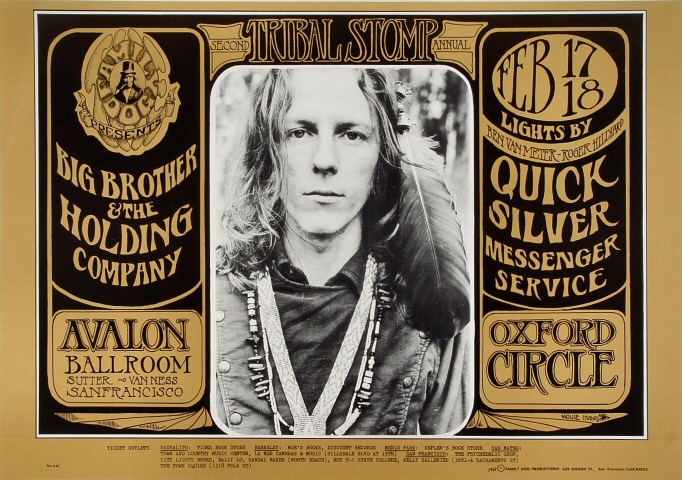
I'd caught as much music as I could in my few days in California, most notably the "Second Annual Tribal Stomp" on either February 17th or 18th, headlined by Big Brother and the Holding Company, which I recorded on a remarkable new tape format called the cassette, a recording that was in high enough fidelity that it awaits a friend's attention and, presumably, the permission of the Joplin estate, to be publicly issued. 

I wuz dere!
I also got to see Country Joe & The Fish at the Old Cheese Factory (aka Finnish Hall) in Berkeley, another show at the Avalon with Lee Michaels and (visiting from L.A.) the Peanut Butter Conspiracy, and, just around the corner from the Pine Street house, the Light Sound Dimension and the Orkestra, a psychedelic "multi-media" event (ie, a light show and some horrible music courtesy of future Manson murderer Bobby Beausoleil) that I remember walking out on.  

This kind of thing appealed to me more than the Beatles, although they'd caught my attention with Rubber Soul and even more with Revolver, but, in a way I didn't yet understand, things were different in England, no matter that George Harrison visited Haight Street a little after I did, after soaking up the Monterey Pop Festival. I liked music that jumped off a cliff, hoping for the best, because I knew it could be very good indeed when it took flight. Like most Americans, I didn't get pop music, which, as they were about to make perfectly clear, was the milieu the Beatles (and not the Rolling Stones, whom I preferred, of course) inhabited.

Still, there was no denying the power of this thing when it appeared a couple of months after I returned to school in March.  Everybody bought a copy, myself included, and it just as it was reported happened throughout the Haight-Ashbury, it poured out of dorm windows, open to the newly-hatched spring. Everybody was listening to it, all the time. I was. I don't even remember where I got my copy, but it was presumably in the campus bookstore like everyone else. (Not necessarily: I was also known to catch rides to Dayton, where a sort of hip record division of one of the big department stores stocked things like Kinks singles, which I couldn't live without). 

Of course, due to its ubiquity, Sgt Pepper became one of the first models of a problem all pop potentially has: being enjoyed to death. I'd kind of like to look at my copy of the thing again (it's nearby, buried in the bowels of the Barker Texas History Center in an archive where I donated all my vinyl many years ago) to see just how worn it was. I listened to it a lot, perhaps expecting more revelation than was actually in the grooves, which was a product not only of the times, but of my being a teenager. I know that there soon came a point when I no longer listened to it, and in fact, until the release of the complete Beatles catalog on CD a few years ago, I hadn't paid it any attention at all until I was obligated to for a Fresh Air piece. 

And so to last night, when I lugged the 5 lb. 14 oz. box (I just weighed it) onto the couch and opened up the facimile album cover with its six discs and figured I'd listen to the work-in-progress stuff as much as I could, and then onward to what was supposed to be Giles Martin's astounding new mix of the original. 

Image stolen from Rolling Stone
I was actually surprised. I got through three of the CDs: the two of studio snippets (including work on both "Penny Lane" and "Strawberry Fields") and the stereo mix of the final product. The studio stuff was fun, and, in the case of George Harrison leading the Indian and Western string players through the instrumental track of "Within You, Without You," quite engaging, since I'd never realized that he actually had much knowledge of Indian musical vocabulary. (There's nothing particularly challenging about the track, but what he does is make sure the Indians adhere to his sense of time, which is different from the one in which they're used to operating). 

In a number of cases, the unfinished tracks have details that are in the finished product, but ones of which I'd been unaware and which the new mix -- every bit as spectacularly detailed as I'd read it was -- makes audible. The harp and string bits for "She's Leaving Home" are presented naked, which is fine with me: I remember hearing this and thinking "Jeez, 'Eleanor Rigby' but more mawkish!" And the sharp new sound re-emphasizes the Beatles' instrumental acumen even when the final product ("Good Morning," "For the Benefit of Mr. Kite") is less than interesing. Oh, and speaking of instrumental acumen, nobody who hears this will ever again accuse Ringo Starr of being a plodding dimwit. He and George can battle it out for the title of Most Virtuosic Beatle. 

The best part of not having listened to this record in at least eight years (that Fresh Air program is dated 2009, and I doubt I listened too hard then) is that I was able to take it in without nostalgia, as an event happening in May, 2017. I guess at some point I'll look at the little film on the making of the record, and for sure I'll read most of the hardback book that gives the package most of its heft, because it's not by the Usual Suspects, but people like Joe Boyd, whose take on the times (if his superb book White Bicycles is any indication) should be fresh and un-cliched. 

As for the fifty years that have passed since I first slipped this on to my record player, it's been full of surprises, some delightful, some not. When I was 64, there was no one to feed me (I can do that myself quite well), no kids (let alone grandkids), and (thank heaven) no holidays on the Isle of Wight -- and it's still that way. But I get by with a little help from my friends, and, as someone once said, tomorrow never knows. 

Friday, October 21, 2016

Barcelona, Back To Texas, Viewing The Ruins

The room might not have been great, but Barcelona still was. I only had the afternoon to do all the things I'd planned, if I could beat back the drumbeat of the oncoming chaos I was sure would greet me in Texas. One thing I knew: I'd need some new clothes, because I wouldn't have access to mine for a while. Anyway, all the weight I'd lost in the past year meant all the pants I had that fit me -- two pairs of regular ones and one of Levi 501s -- were in my suitcase. I had the Levis on. They'd need washing soon.

I've always like the clothing I'd seen in the high-end Spanish shops along the Paseig de Gracia and, indeed, on some of the Spanish men walking along the street, so, since it was nearby, I went over to the Corta Inglés, the giant department store one sees all over Spain, to see what it offered. It was much like any other department store except that it had Spanish stuff (and, of course, a giant supermarket in the basement, the only part of the store I'd ever been to). The guy at the Hugo Boss boutique on the men's floor even suggested I look at Spanish brands, which were just what I wanted, as it turned out, and considerably cheaper than what brands I can get in Austin like Ralph Lauren and Boss and so on were offering. Two shirts and a pair of pants later, I had what I needed. I'm not a shopping-as-therapy kind of guy, but it did feel good to know that I wouldn't be naked in Austin.

And yes, I did head to the basement to pick up three cans of olives stuffed with anchovies and a couple of cans of Spanish tuna. I'm not a complete idiot.

And, as is my custom, I had my last dinner in town at the always-wonderful Nou de Granados, one of my favorite restaurants: a nice salad, and oxtails in a wine reduction on a pillow of truffled mashed potatoes, garnished with potato chips. Don't sneer at potato chips in Spain: they're a great example of the virtue of simplicity. I can't eat many because of the diabetes, but when they're perfectly crisp and greaseless but redolent of fine Spanish olive oil -- as these and many I was offered at bars were -- they put Lay's and the like to shame.

The next morning I woke early, had a decent breakfast downstairs in the hotel and grabbed a cab to the airport. Barcelona to Paris Charles de Gaulle (the hellish Terminal 2) to Atlanta to Austin. I was lucky: not only had I bought economy plus fare (recommended for large or tall people and/or people with legs, not to mention those of us who've experienced lower vein thrombosis or a pulmonary embolism as the result of a long flight), but it was a Tuesday, so not that many people were travelling, and I had no seatmate. Air France has a fairly crappy selection of films (unless you've always wanted to see The Angry Birds Movie with Arabic subtitles), so I had lots of time to read and think.

Something that's always annoyed me about the menu at the Nou has been the silly errors in the English translation, in particular "backed" for "baked." If I lived in Barcelona, I'd offer to edit their menu in exchange for a bottle of wine or something. (They've also confused "cherries" with "cherry tomatoes," the former of which one doesn't really hope to see in the Caesar salad -- and doesn't) But something Miguel had said in Madrid clicked in my head. He'd noted that Franco had suppressed the teaching of languages during his reign. I knew he'd suppressed Catalán and Basque and Valencian because he rightly feared that allowing them would lead to nationalism, but apparently all foreign languages were ignored until the university level, when it's arguably harder to learn a new tongue. So unlike Germany or France, elementary school kids didn't start adding languages until after Franco was gone.

Of course, this was just the end-point of the story I'd been living in for the past couple of weeks: in 1492, Spain expelled its mathematicians, physicians, philosophers, navigators, businessmen, bankers and intellectuals -- ie, its Arabs and Jews -- turning the country into a land of peasants under the mighty heel of an autocratic church and its Inquisition and a bloated and not very intelligent class of aristocrats, up to and including the royal family.

King Fernando VII, by Goya (detail). Does this look like a reasonable man? An intelligent one? Right on both counts, and obviously Goya detested him.
By the time Spain revolted and threw out the Inquisition in the early 19th century, it had missed the beginning of the Industrial Revolution, and had to import British and German workers to ramp up their technology. Fortunately, those workers did a great job -- and the Germans taught the Spaniards how to make good beer and sausages. To this day, a Frankfurt is a Spanish joint featuring beer and sausages! But the progress was halted again with the appearance of Fascism in the 20th century: it wasn't until 1974 that the transition to democracy -- and cultural freedom -- began, which is why the vibe of post-Communist Berlin is still noticeable in the air.

Spanish design of the '60s and '70s: a collection of SEAT automobiles in the Valencia train station. 

I think this explains a lot about Spain, and why it appeals to me: the process of discovery of new possibilities is still in the air, the Catalan secession movement may not succeed, but, like the Scottish one, may force some interesting and needed change, and the arts and the young people who make them, are still charging ahead.

* * *

Meanwhile, I was on an Air France flight back to a country where, for the first time in its history, it was being challenged by an overtly Fascist candidate in a Presidential election. And, on a more personal level, I was returning to a house that was unlivable and many possessions that had been destroyed, including materials I'd need for my next book. To soften the blow, I rented two nights in the most reasonable hotel I could find, actually a big B&B in Travis Heights that I found on the Hotel Tonight app. The first night, I just crashed, destroyed by 20 hours of flying and changing planes, including two hellish airports, CDG Terminal 2 and Atlanta, where CNN is blaring at an unreasonable volume out of the sound system. The next day, a friend and I went to see what was left of my house. 

It wasn't pretty, but it wasn't as bad as I feared. 

Looking from the living room into the office: the toilet that exploded was in the bathroom whose entry is seen on the left. 

These giant honking dehumidifying fans were everywhere. The electric bill will be stupendous, but I do believe the damage will be far less because of them.
Not a great picture, but a lot of stuff was saved. 
My landlord was great: he sprung into action and got a company involved that specializes in this kind of rescue. Despite my lack of renters insurance, his insurance covers the packing and storage of the contents of the house until it can be rebuilt. (Presumably they also bring the stuff back, too). The company gave me the weekend to take what I wanted for the period ahead, which, jetlagged and just a bit traumatized, I sort of did. I checked into the Extended Stay America on the corner of W. 6th and Guadelupe for a week, and arranged for a Facebook friend's airbnb to be my home for a month after that. Heaven knows if the renovation will be done by then; the landlord says the construction folks say it'll be ready by Thanksgiving, but he thinks mid-December is more likely. Whatever. All I can do is take it a day at a time, passively waiting for word.

Eventually, there'll be dealing with Austin Water and the electric company. On November 6, I'll be on a panel at the Texas Book Festival with Joe Nick Patoski and David Dunton, my agent, talking about writing about music from two viewpoints: biographical (Joe Nick's specialty) and historical (mine) and how the two approaches do in the marketplace. It's free, and I'll be signing some early copies of both the rock and roll history and the Michael Bloomfield book. If you're in town, drop by. If you can't make it then, there'll be a rock and roll history release party at Book People on the 19th.

* * *

This hotel I'm writing this in is a circle of hell, and I'll be glad to be shut of it in a couple of days (the parent corporation has been pestering me with e-mails for my thoughts, and boy are they going to get them!), but when I moved in, I decided to try an experiment. Downtown Austin, in the 20 years I spent in Europe, changed utterly and completely. It's like aliens dropped an entire new city onto a few square miles, but I decided to try a little experiment while I'm here and spend as much time walking and looking at the new city as I could. There are primitive cooking facilities in the hotel, and there's the Whole Foods corporate mothership within walking distance, again making it my neighborhood supermarket like it was 30 years ago (except in a different location and with about a dozen times the floor-space). Waterloo Records and Book People are also at 6th and Lamar, and there are loads of new high-rises and boutiques and restaurants scattered all through the west downtown and what the property developers call the "warehouse district," which, yes, it used to be. 

There's been much talk during the development of this of a "revitalized downtown" and a "walkable city" and how much revenue the property taxes will bring the city. I had lunch with a lifelong Austinite who used to live downtown yesterday, and his views were very interesting. "When I was down here," which was in the '70s and '80s, "the residential population of downtown was between 1000 and 2000. Now it's more like 20,000," although another friend had noted that many of the new buildings are 30% empty because they're used as second residences or "investments." I mentioned to my friend that as I'd walked the streets -- something not too many other people seemed to be doing -- I'd noticed that not only the people I'd seen, but the whole way the residences were marketed, were young, rich, and white. The boutiques also slanted that way, and certainly the restaurants did. (Many are parts of luxury chains with branches in upscale parts of California, Arizona, and elsewhere in Texas, and there's a Ruth's Chris Steakhouse not far from my hotel). 

"Yeah," he said, "there was a lot of talk about rentals and a certain percentage of affordable housing, but in practice the way that plays out is that the renters of the affordable spaces live there for a while and then get offered enticing buy-outs so the developers can up the prices or condominiumize the place. As for the places that are already condos, they're hit and miss." He pointed out a couple that are pretty full, and indeed there's one particularly hideous one near me that's all lit up at night with just about every unit seeming to be full. Others, though, especially some of the more expensive ones, don't seem to be much occupied at night. Still, they keep building them and advertising luxury. Certainly West 6th, which is the thoroughfare I'm on and which I walk daily, is lined by very upscale bars (and a few corpses of failed ones), in contrast to East 6th, which has been party central for ages, and attracts frat boys and sorority girls to bars where the aim is to get blotto. West 6th isn't much different, but I sense that the bars are more expensive here. Offering valet parking for $6 to $10, which you won't see on the other side of Congress Avenue, they seem tonier, the patrons better-dressed and maybe more seniors and MBA candidates or law-school types than on the other side. It's comforting that UT's jeunesse dorée has its own blotto-toria. 

As for the restaurants, I've found very few I'd want to return to. An exception is Lambert's, which has made a workable gimmick out of very good barbeque served in a fine dining context. But even there, the sheet listing the day's specials included a $27 shot of bourbon. As I remarked to a friend last night, for three times that you could probably buy an entire bottle of it. And Manuel's is doing a good job with upscale Mexican food, which needn't be as expensive as you'd think. The service bordered on servile when I was there, but it's usually a good bet. 

It's a cliché for old Austinites to lament what's passed, but to me, there's change and there's change. I'd be a lot more in favor of the new downtown if it were more racially, economically, and culturally inclusive. It's not. I love the idea of waking up what was a wasteland of auto parts shops, printing supplies, and derelict spaces, but it looks like greed had far more to do with it than I'm comfortable with. Imagine that. 

And yet, and yet... One of my favorite memories of West 6th was the spring day I had lunch at Hut's Hamburgers (still there! -- although now paired with an inedible pizza joint) and was walking back to my car, crossing the small bridge over Shoal Creek, and saw a mother turtle plodding down the creekside, with five or six youngsters following her. The other day, I was walking back from Whole Foods on the other side of the street and saw something by the creek. I stopped and held my breath: a heron, four feet tall, was stalking down the creek. It was a really magnificent bird, and I edged closer to the side of the sidewalk to look at it. A Type 1 jogger, togged out in expensive sportswear with some sort of phone/music player strapped to his bicep, swooshed past, hissing "Thanks" as he went by. I didn't do it for you, man. But I'd do it for a few seconds more with that bird. Anytime. 

Wednesday, October 19, 2016

Valencia: Catastrophe In Paradise

The coating of hucksterism that comes with tourism is annoying, albeit in my case, in a selfish way. I'd have preferred to stroll the streets of Toledo making discoveries on my own and with Naomi as a guide to the unseeable, but that's simply not possible. It is possible, of course, that less-concentrated doses of what I was seeing could be found in the countryside, in villages and smaller cities. But the purpose of this trip was just to dip my toe into Spain and see what I might want to see again. In Toledo, I'd missed many of the churches, the Alcazár, and more. In Madrid, I obviously need to visit the Prado again, filtering out the stuff I'm not interested in, and return to the Reina Sofia when I'm more in the mood for the artistic revolution of the early 20th century.

So I was good and ready to re-enter Toledo's magnificent train station and head into the wild unknown. Not, of course, totally unknown: I'd been in the province of Valencia before, in January, 2011, to do an interview at a rock festival in Castellón, and, since it was my first trip to Spain, I stayed an extra day to wander around, which I certainly did. In some ways, Castellón was kind of rinky-dink, a small provincial city, and in other ways it was fascinating. I bet myself that the provincial capital, Valencia, would be better, so I added it to this trip because, I saw, it also had a bunch of the history I was trying to figure out.

It took a while to get there, changing in Madrid and being welcomed by the turtles, then getting on another train which started out in that dull, flat, brown terrain but, as we approached the Mediterranean, sprouted some lovely mountains, rivers, and lakes. Then came the industrial outskirts of a city and bang, we were in Valencia. I liked what I saw from the cab as we sped to the hotel, and I definitely liked the hotel.

What's not to like?
The Hotel Caro was to be my splurge on this trip, and boy did I make the right choice. You want archeology? We got archeology: the building was the former residence of one Marquis de Caro, and in gutting it to put the hotel in, they found all kinds of stuff. Eating breakfast in the restaurant, there were weathered stones on either side of the passage into another room. Most of the relics are captioned, and this just happened to be the gate in the wall of the Arab city. In my hotel. (Breakfast was excellent, and not even the party of 10 screaming Dutch tourists could ruin it. It had all the usual breads and cold cuts and cheeses one gets in Spain with some unusual stuff, of which my favorite was a two-inch pickle sliced in half and filled with that excellent Spanish tuna, a dish that became problematic when it was time to eat it: the pickle was hard, and the tuna squished out when any pressure was applied to the pickle. Tasted good, though. But sloppy.)

And by "the Arab city," I'm invoking Valencia's history. It was settled when the Romans found it, I guess by Iberio-Celts. The Romans made quick work of them and established a trading outpost, Balancia, with Jews helping manage the trade. The city was destroyed in 75 BC by Pompey during the Roman Civil War, and the city, remote as it was from the eastern Mediterranean, where the action was, remained empty (or mostly so) until somewhere between 5 BC and 5 AD, when Visigoths stumbled upon it: a mostly-built port right on the Mediterranean! Cool! They had a huge party, and at the end of it threw all the leftovers and crockery down a dry well, for which archaeologists thank them. Next came the Moors, who stayed for centuries, although El Cid's army recaptured it between 1094 and 1101, only to be driven out again. In 1238, Christian Spaniards conquered it, and have held on to it ever since.

It was mid-afternoon when I arrived, so I went for a walk to see where I was. The hotel was tucked away on a quiet back street, but it was easy enough to find (one great thing about Roman-built cities: the roads are built to a grid, and it's pretty easy to find your way around, at least if you have New York in your head), so I felt free to ramble. And I did, camera in hand.

No idea. A block from the hotel. 

The Cathedral has an octagonal spire. Thanks, Arabs!

Serrano gate and towers

The Basilica at the end of a street
Like Barcelona, Valencia is home to some of the coolest street art in the world. This guy is omnipresent.

"In the kingdom of the blind," which I didn't know was a quote from Erasmus (and maybe isn't: don't believe everything you read in the street!).

The bullet holes in the Quart towers made me nostalgic for my old neighborhood in Berlin when I first got there, before they erased the evidence of the battle. These were inflicted in, I believe, 1833, when the French wanted in. 
Here he is again, a particularly nice one. I shot many more.

And am I right that this is a Banksy?
As I reached the end of my walk, I suddenly realized that I'd circumnavigated the old town, and was just a block or two from my hotel. I was also bushed: it was still summer here (as it was in the rest of Spain, actually), so I retreated to the hotel room after getting dinner suggestions from the always-helpful front desk. I was told there was a tapas joint just down the street, and I got a couple of other suggestions, which I researched as I relaxed.

Still tired as dinnertime approached, I walked to the tapas place, although I actually wanted a full meal. But I forgot that there are tapas places and tapas places. I ordered the "three queens" (marinated white anchovies, regular anchovies, and sardines: incredible), a plate of grilled vegetables with romesco sauce (the waitress warned me it was very big, and it was) and one of their tostas, a big slice of grilled bread with a topping; in this case three local sausages. To go with it, I noticed some local beers, one of which, XIII Hombres, called itself an "American IPA." Not only was it, but it was absolutely amazing. I had another.

The next day I arose lazily, took my time showering, and turned on my iPad to see what the e-mail had brought. And what it had brought was very bad news, indeed: I had asked a nearby friend to check the house every now and then because although I'd held my mail, UPS and FedEx don't do holds, so there was a possibility of a package on the front step. The friend had been called away by a death in his family and was in Buffalo, and he'd delegated the porch watch to another guy. This guy had shown up and seen water pouring out from under the front door, photographed it, and sent it to Buffalo, where it got forwarded to me in Valencia. I immediately sent it to my landlord, who went over to see what was happening, and what was happening was horrible: the toilet near my office had blown a gasket, and was shooting water out at a quick pace. It had flooded the entire house to a depth of 1 ½ inches, and caused ceilings to fall in and floorboards to warp. Anything that was on the floor, which included CD boxes and the entire inventory I'd had for sale at my Amazon store, was soaked. The closet opposite the toilet contained all my t-shirts, meaning what I had with me was all that I knew were wearable.

As I thought about it, I realized that there was nothing I could do. I didn't have renters insurance because I'd been almost dead broke when I'd moved back to the US, and then I'd just never thought of it. The damage was most likely done in the first couple of hours, as the paper fibers soaked up the flood. Even if I'd been in Austin, I might have been elsewhere when it happened. It was done. I didn't know just how badly, but it was done. I had another night paid for in my hotel, a couple more in Tarragona, and a last one in Barcelona, so I might as well finish the trip. Dealing with it would have to wait until I got back. I made a note to find a hotel in Austin, and then did what any rational human being would do when such a spiritual crisis hit: after breakfast, I went back to the room and prepared to go to church.

The dome of the Mercado Central
Valencia's Mercado Central, the central market, is one of the largest in Spain. Unlike the ones in France it doesn't open in the early morning and shut at 2; it opens at 9 and stays open until the early evening.  There are over 1000 vendors, most of whom seemed to be out in full force on the day I went. And there was an amazing variety of stuff.

Pimentón is what we call paprika, and the Spanish take it very seriously as an important ingredient in their cooking. The heat levels aren't particularly scary, but the deftness with which a good cook adds it to a dish is. 

Does anyone know how you're supposed to eat these little crablets I saw all over Spain (but not on menus)?

Live eels, swimming vigorously. 

I hear those red shrimp are incredible. I'll find out how incredible next time. 

Tiny eggplants of some sort. No idea what to do with them. 

Beans and more beans
Believe it or not, this is a pretty mediocre selection of olives and pickles for Spain, and the only reason I shot this is they were so compactly displayed. 
Fresh cheeses. You have to know what basket-imprint means what variety of cheese: they mature in wicker baskets that leave the impression of their weave on each piece. 

I bought some ham and lomo (cured pork loin) and a bunch of spicy chorizo (a cold-cut, not like the Mexican kind we get in Texas) from a nice lady at the Francés stand, and some equally sealed-in-plastic olives from a stand called Oiled & Salt (it's legal to bring the meats in if they're sealed), and headed back to the hotel to drop them off.

Believe it or not, after that long trek through the Mercado, I wasn't hungry: I'd indulged myself at breakfast on purpose. And, just a block from the hotel was a promising-looking archeological museum, so I headed over there. It turned out to be a continuation of the stuff found under my hotel: mostly Roman remains, a whole lot of the feast pottery from the Visigoths, and the remains of a small Visigothic chapel, which is thought to be where the city's first saint (whose name I didn't write down) was martyred. L'Almoina, as this center's called, is a modern building built over a 20-year dig, illuminated by a glass ceiling looking down on it all from the plaza outside. It's got ruins of the crossorads of the two main streets of the Roman city, the Arab fort, and various tombs. It's also got technical problems, making many of the explanatory videos either distorted or just plain not working, and when I was there there was a crew of filmmakers blocking access to a lot of stuff and shooing the few visitors away.

One thing I'd loved in Castellón, unexpectedly, was the art museum's entire floor of Valencian ceramics. This art came to this part of the world with the Arabs, and I fell in love with the primitive designs. I wanted to see if I could score a piece -- reproductions are still being made in the traditional designs -- so I also wanted to see what the Museum of Ceramics had to offer. This is in one of the most over-the-top houses I've ever seen, evidence that in the 18th and 19th centuries, the Spanish nobility had waaaay too much money.

It was kind of hard to shoot, but you get the idea

The interior is ghastly, too, and the museum personnel distinctly unfriendly, a novelty for Spain. But, over in one room, they had some of the plates I'd admired:


 The other major piece of folk art there is a Spanish tiled kitchen.


But there was nothing for sale, either there or in the surrounding neighborhood, that I could see. I was somewhat less enthusiastic about buying a piece, too, when I reflected that I didn't know where I'd be living and I didn't really want to lug it around with me back in Austin.

So I decided to check out the municipal art museum, and realized when I crossed the river that I was actually slightly hungry, so after a nice dish of fried calamari and a beer in the adjoining restaurant, I went into the museum itself and saw some wild medieval altarpieces and even wilder baroque ones and some more ecclesiastical art (Spanish depictions of Christ tend to center on the Easter story, with him getting whipped, crucified, pierced by the lance, wearing the crown of thorns, and being taken off the cross, and he bleeds like an overripe tomato: the blood gushes in torrents), a couple of nice Goyas, and a lot of people in uniforms staring at me. I was touristed out: hotel time again.

Dinner, later, was at the same tapas bar with the same huge portions and a couple of beers from the XIII Hombres brewery that were a bit gentler. I remember a tremendous gazpacho, a seafood salad, and...something else. (The tapas bar, incidentally, is called Bar Almudin after the street it's on, and the huge Arab building across the narrow street, al-Mudin, and Bar Almudin has been there since 1932). I realized that there was some anxiety humming in the background, and tried to sort it out. Some of it was the usual "the vacation is ending" stuff, and there was also the certainty that I had no idea what was going to happen next, once I got back. I'd taxied to the railroad station in the afternoon and had my ticket for tomorrow's trip. I'd go to Tarragona, but I really wanted to stay in Valencia. I had a feeling I hadn't even scratched the surface and that there was much yet to discover and enjoy. But the vacation was, in fact, ending, and I was being propelled into the future, like it or not.

15th century tiles in my room in the Caro

Sunday, September 25, 2016

It's Almost Time...


In a couple of days, I'm going to disappear to rest up between the promotion of my Michael Bloomfield book, which I've been doing for the past month, and the -- much bigger -- promotion for this, my first physical book under my own name in 33 years.

A lot of people have asked me where they can pre-order it, so here's the skinny on that. First, though, some explanation. At this moment (ie, as I write this, on September 25), the pre-orders won't get you a discount. I seem to remember Amazon telling me that a book I'd pre-ordered from them might drop in price, and since I wasn't going to be charged until the book shipped, the amount I paid would reflect the price on the day it was shipped. You may or may not get a deal like this. You will if you wait, most likely.

What I vastly prefer for you to do is to patronize your local independent bookstore, because giants like Amazon threaten their existence. Indies tend to know their local communities and select the books they sell accordingly. An alarming number of them are literal mom-and-pop stores, family businesses. They mean a lot to your community, and any writers who may live in your community.

If you want an inscribed copy of the book, you're going to have to see me in person. I really, really, don't want to drive to the post office to mail one off to you, and no, I don't get hundreds of free copies  when the book comes out. You can get inscribed -- or merely signed -- copies ("inscribed" means my writing "To Joe: I promise I'll pay you that $10 one of these days" or something; "signed" means just my signature) at my November 6th appearance at the Texas Book Festival here in Austin or at the release party at Book People on November 19th. Book People will also have signed books for sale after that, and they'll be available via mail order.

I also hope that there will be a modest book tour, although publishers no longer do them as a matter of course. I'd like to do a West Coast tour via Amtrak -- San Diego, Los Angeles, San Francisco/Berkeley, Portland, Seattle -- and an East Coast one of Washington DC, Philadelphia, New York, and Boston/Cambridge. The only way this'll happen is if people in those cities ask for an appearance at a bookstore, and the bookstore contacts the publisher. So if you get to work, that might work out.

Meanwhile, for those of you who need to do this on-line, here are links to the pre-order sites:

Amazon
Barnes & Noble
Books-A-Million
IndieBound
and Book People in Austin.

I've written the pitch for Vol. 2 (1964-2000), and my agent will be arm-wrestling the publisher while I'm away. I'm hot to get started on that one, which will be pretty controversial and just as much fun to read as this one is.

And if you're just tempted to get only one, remember that Christmas is just around the corner!
 
Site Meter