Showing posts with label Miscellaneous. Show all posts

Saturday, June 30, 2018

This Is The Stuff, A Tale of Two Restaurants

Every now and then, it becomes necessary to head over to Louisiana and visit my old pal Mr. LeJeune for some of his superb meat products, most notably garlic sausage and tasso. In the 40 or so years I've been making this trip, a lot has changed. There are, for instance, more and better places to stay. There's been a resurgence of pride in the local culture. And these two things have resulted in a lot more tourism. Which is a good thing (for the locals making money off of it) and a bad thing. Which we'll get to in a minute.

Now, last week it became essential for me to get out of town before I lost my mind. You know, mostly the same thing that's been oppressing all of us Americans, but also the fact that I just wanted to be somewhere else, even for a short time. I had a short visit to San Francisco in January that was pretty unsatisfactory for the most part (some day I'll realize that that place and I just don't get along, plan the trip so as to get what I wanted done, see who I wanted to see, and leave before my blood pressure gets too much of a workout), but nothing since then. With little money, but my flexible work schedule (I'd just finished the next-to-last chapter of The History of Rock & Roll, Vol. 2) it boiled down to a quick drive to Lafayette, overnight in a hotel, visit Mr. Le Jeune the next morning, and come back here.

It's a long trip, but my friend K said she'd like to join me, to keep me from nodding off or becoming too tired along the way. The only downside is that, as in San Francisco, my sense of taste and smell is still intermittent. I'm probably going to have to go see the only doctor who's actually treated me for it successfully, and he's in France. (American doctors, motivated by greed, want to do an operation that works briefly, then shuts off the sense for the rest of your life. I don't want that, thanks. And a flight to France would be way cheaper than the operation, as would be the price of the medications.) These days, though, it's been clearing up in the mornings most days, so that was a plus.

The drive out was hellish, mostly due to a stretch east of Houston, where we sat while three lanes folded into two somewhere around Bay City. We got in to Lafayette about 5 and checked in to a place I'd stayed at before, the Hilton, a giant high-rise and probably the tallest building in town. The last time was in the late '80s, when it was the only decent hotel in town, and I spent most of a day fighting food poisoning I'd gotten at Mulate's, which had once been a decent place to eat before they started courting the still-rare tour-bus crowd.

The hotel's now a Doubletree By Hilton with modernized decor, and it was filled with pre-teen baseball players and their parents, but that didn't matter: I passed out for a half-hour nap as soon as the bed was within striking range. I woke, refreshed, and then the next decision was where to eat. Weirdly, in the middle of a place famous for its food, there weren't many choices. I didn't want to drive too far from Lafayette, like to Breaux Bridge, and crawfish season has been over for a while, so it was a problem. Both of us were dressed fairly casually, which left out Café Vermillionville, which was getting kind of long in the tooth anyway. What remained wasn't very inspiring to say the least: there was a chain called the Blue Dog Café, an annoying reminder of the late George Rodrigue, who made an empire out of a cutsey cur (he was an okay painter before the dog took over his life, but not nearly as good as Francis Pavy). The only remaining choice seemed to be something called the Bon Temps Grill, which Tripadvisor rated #1 in the city and which happened to be real near the hotel. So the Bon Temps it was.

Now, from a cursory glance at the website, I knew this wasn't going to be traditional Cajun food, but food -- described as "swamp edge cuisine" -- that took from Cajun traditions and worked with them. Fine with me. My taste buds had shut down, but that was nothing new. The place was hopping when we got there, so it was evidently popular, and the waitress was top-notch. The only warning of what was to come was a basket of cold, dry garlic bread slapped onto the table first thing. K wasn't very hungry, so she ordered the seafood stuffed mushrooms as a main and a side-salad. I saw remoulade shrimp, which is a traditional dish, albeit from New Orleans, and since I'd only made it myself years ago (and, I should add, made it well), I ordered that, along with a stuffed pork chop, something I'd discovered at the long-gone Stop & Shop supermarket in Lake Charles ages ago. The butcher there was a genius, and his boudin, beef tasso smoked on mahogany, and stuffed pork chops were sublime.

Well, the food came quickly, my shrimp and her mushrooms, followed too quickly by the salads, which caused the waitress to come apologize for that lapse. I assured her that it wasn't as if they'd get cold. My shrimp seemed to taste okay, though, although I could only barely discern the taste, but K was irate: here were these mushroom caps with, well, basically a lump of bread on them, surrounded by supposed tasso-and-pepper gravy that was indistinguishable from the stuff you get on a chicken-fried steak. I soon found out, too, that the shrimp were done like guacamole in a bad Mexican joint: piled on a mountain of shredded lettuce. Then came my pork chop. It was a pork chop. It was thick. Instead of being sliced lengthwise and filled with stuffing, there was a hole a little bigger than a quarter with a tiny plug of stuffing wedged into it. The pork chop was pretty good, but hey, I grill pork chops at home all the time. Annoyingly, they also provided a knife to cut it with that was like a cutlass.

It was while I was sawing away at the chop that K noticed something. "This music is fake," she said. "I don't recognize any of it." What she meant was that the Muzak, which was blues, wasn't the original recordings. And she was right: just then some song I did recognize played, and it was...off. The whole thing left me puzzled. We paid our bill and left, full but unsatisfied.

The next morning the idea was to get to Eunice to see LeJeune before noon and head back, but as usual that's not the way it happened. But there was another restaurant I'd seen on my last trip over that interested me and from what I could tell, it was breakfast and lunch only. The name, though, worried me a bit: T-Coon's. I remember being shocked 35 years earlier by discovering a guy named T-Neg in the Cecilia, Louisiana phone book (slightly smaller than a monthly issue of Reader's Digest). But then I remembered the word "coonass" referring to Cajuns. A lot of them don't like it; some claim it's derived from a regional French word, conasse, meaning a stupid woman, or silly bitch, according to my French dictionary. But the front of the restaurant shows a coon stirring a black pot. And anyway, a decent breakfast is the hardest thing to find in these parts, so we went. Again, the place was packed. Unlike the night before, though, my nose was playing nice, and the smell was excellent. So was the Mellow Gold coffee, a coffee/chicory blend, light on the chicory, that's the house java.

K still wasn't hungry, but she ordered a sausage-and-biscuit combo. The waitress asked her if she wanted pork sausage or a link and I urged the link: that's what we were here for. I was intrigued by the courtbouillon omelet. To me, courbouillon was always (in Cajun cooking: it's a whole different thing in French) a fish stew with a roux-based tomato sauce served over rice. The waitress said it was mixed seafood with a sauce in an omelet. Okay, I'll take it, with a biscuit and grits, which I wasn't going to eat much of. While we waited, I picked up a box of seasoning from the table. It was T-Coon's The Stuff. Okay, I'd seen and used Tony Chachere's Creole Seasoning for years, and on one of my recent visits I'd stopped at the Slap Ya Mama! store in Ville Platte on a Cajun friend's recommendation and bought a box of their seasoning, which was a bit better.

The breakfast came, and I noticed a nice touch: both biscuits were wrapped in some paper: old timey! But...where was the butter? K surfaced out of hers long enough to say "It doesn't need any." I took a bite. She was right. And, in the spirit of scientific inquiry, I very lightly dusted the grits with The Stuff. Quite different from the others. But enough carbs: this omelet was sending my nose a message that my mouth needed to investigate. The courtbouillon turned out to be much thicker than I was used to, but the mixture of catfish, crawish, and shrimp, not to mention the seasoning, was exquisite.

As we were enjoying the meal, a guy with a T-Coon's shirt that said David on it came over to ask how we were doing. Then he asked where we were from  and K said "Austin." "Well," said David "I'll try to keep from makin' any librul jokes." A chorus of grunts came from behind me, and a couple of ominous chuckles. (I later saw that it was a quartet of gentlemen in camo, either Army or National Guard). I told him that his coutbouillon was different than what I'd encountered before and he was off, talking with passion about how he was about to raise his prices 12 ½ percent because he refused to stint on quality. "That's a quarter pound of crawish goes into each omelet. I have those links made by a friend over in Abbeville to my own recipe. The catfish comes from over in Mississippi and it's fresh, not frozen." It was a nice little conversation.

"I'm gonna change your life," he told me. "I'ma give her a box of The Stuff, and when she starts adding it to your food, well, look out: things are gonna get a lot better for both of you." And he told the waitress to make sure she gave K a box of it.

There it is: The Stuff
By avoiding politics and other minefields, I was rather liking David, because without mentioning tradition, he was still passionate about it. (You can see more of this passion on the front page of his website). As I waited in the car for K to finish smoking -- she only takes a few puffs, but puff she must, and she does it outside, not in the car -- I saw the list of daily lunch specials painted on the front of the restaurant: smothered rabbit, short-rib fricassée, smothered chicken and okra, and that courtbouillon on Fridays. But it was getting on, and we still had to vacate the hotel and get to Eunice.

We did, and now I have 20 lbs of sausage and tasso in the fridge waiting to be packed into freezer bags and frozen, except what I'll use to make red beans and rice (without rice) for dinner tonight. But before I press "publish" on this, I've been thinking about Cajun culture, tradition, and Americans.

My takeaway is this: As I've long realized, Americans are so alienated from their own country by this point that they usually don't know where they are. Oh, sure, they can check their phones and use Google Maps, but that's not where they are. The thousands of people who've moved to Austin since I last lived here, they don't know where they are, either. They've bought into the marketing slogan of keeping Austin weird, mouthed the slogan about the live music capital of America, but they don't know how it got that way in the first place, nor why it actually isn't either of these things any more.

And Americans who go to Cajun country don't know where they are, either. They come to Lafayette and stay there, possibly because they're attending a Ragin' Cajuns football game or doing oil business (not much of that left), or whatever. Few of them have even a superficial knowledge of where they are: the imagery in their heads are of alligators, crawfish, Blue Dogs, and swamps dripping with Spanish moss. There are accordions and fiddles involved somehow, probably to play blues, because the often-subtle distinctions between Cajun and Creole music is of no interest. They probably think Dr. John, Mac Rebbenack, is a Cajun. They don't understand the distinction between New Orleans and Lafayette, let alone New Orleans and Grand Mouton, Eunice, or Ville Platte. And ultimately, this is sad, especially if they spend more time there than we did this time. So they go to the Bon Ton and get their buttons pushed, no matter that it's a mediocre joint just a bit above a fast-casual restaurant. They hear piped-in blues, no matter that that's not the local indigenous music (hey, shaddup, Eddie Shuler), no matter that it's 21st century remakes by the Muzak Corporation or that ilk. They go away happy.

In no way will they want to engage with David Billeaud and T-Coon's, unless they happen in by mistake, in which case they'll be wary and a bit conservative about what they order and then be surprised that it's as good as it is. They're not going to get his cultural conservatism (not to mention his background music, which is mostly zydeco: I recognized two versions of "Hip et Tai-yo," both, I think, by Clifton Chenier), or understand why he'd rather raise his prices than compromise his quality. And if they got to talking politics, well, who knows?

Mr. LeJeune up in Eunice is just as culturally conservative as Billeaud is. He even makes ponce, a rarity which is sausage meat stuffed into a pig's stomach and smoked. I bought one last time I was there but couldn't find anyone to eat it with me. It was, unsurprisingly, excellent. I have no idea what his politics are, and after 35 years, I don't give a damn. Some things are above that, and these men have that figured out. They're members of their community, they practice their faith (which is Catholic: another ominous thing is the incursion of evangelical fundamentalism in Cajun culture, which could erase it before you know it), they interact with their neighbors, like the soldiers and the table of teachers who were finishing up when we walked in. And when I interact with them and their kind, I know where I am, know I'm a visitor who's treated with respect because I treat them with respect, as I would if they were visiting me. This is what's increasingly being lost in this country, as we tribalize and march towards one-party rule and fascism. It's an emergency, like so many other things happening at the moment, and an emergency that's so small it risks getting lost. I feel it because I don't feel at home in Austin, and haven't since returning almost five years ago, so it's a personal emergency for me.

Anyway, that's my takeaway. That and a box of The Stuff.


Wednesday, November 8, 2017

Rye Bread and Ghosts

Yes, I'm well aware that it's been six months since I've posted here, but it's been pretty crazy. I'm trying to get this second (and final) volume of The History of Rock & Roll done -- it's due in July of next year -- while negotiating Life Itself (as Austinites know, we lost a dear friend earlier this year, and I spent some time with her during her last days in San Antonio) and the trials of squeezing out the last drops of a book advance that I predicted would run out in November. And I was right.

But I had a shining light to follow: in March, at SXSW, I was asked by a friend from Finland if I'd like to do a keynote at their Musiikki & Media conference in early October. I've never been to Finland, and I was assured that Tampere, the city where the event was was "sort of Finland's Austin" (only, one presumes, without edible Mexican food), and, furthermore, that I could get a round trip from Helsinki to Berlin cheap on Air Berlin, so I could add on a cheap trip to my past to the whole experience. Which is pretty much what happened. So here's the story, with pictures.

* * *

The route the Finns sent me on started with that damn non-stop flight to Heathrow, one of the two non-stops to Europe from here (the other being to Frankfurt). Heathrow is a vision of Hell at any time, not to mention after a 9-hour flight on a plane with rather limited legroom, and of course no matter where you're going, you have to change terminals, so you have to go through security again, where the ill-tempered British security minions yell at you and hurry you along. This time I was so hassled by them that I thought I'd lost my house keys until an accident at my hotel in Tampere revealed that I'd tossed it into my computer bag along with my loose change as someone was yelling HURRY HURRY HURRY at me. Whew. 

But first I was headed to Helsinki, where by a fortuitious error I'd booked two days in a hotel to recover before heading to Tampere. Paid for them, too. And I'd accidentally picked a very nice hotel: Radisson Blu Plaza, which is in part the former corporate headquarters of an old company whose product I couldn't quite figure out, but featured stained glass windows and heroic decorations. 

Workers, the lifeblood of any company
Another error -- not nearly as fortuitous -- was not knowing that Finland is two whole time zones away from Central European Time, which is what I'm used to in Spain or Germany. To say I was particularly gazorbled when I pulled into the hotel at 6pm is no understatement. I also had a problem: I'd no-refund paid for those two days, but the conference wanted me in Tampere the next day. Fortunately, my train wasn't until later, so this gave me time to be a little more liberal with my checkout time -- and meet Pekka Lainen, something of a superstar on Finnish public radio, who'd be interviewing me for the keynote. We hashed over what we'd be talking about over lunch (I passed on the chile con carne tacos and ordered fish -- Arctic char, to be exact) and as he said good-bye, the rain stopped for the first time since I'd arrived and I grabbed my camera and walked to a square Pekka had mentioned over by the University. It's overlooked by a huge white church, which, since the sun was out, gleamed beautifully. 


This is Constitution Square, and since I had a train to catch, I didn't explore much, but I did notice across the street the oldest building in Helsinki. 


As you may be able to see if you click the picture, it dates from 1785. That's right: the entire nation of Finland is celebrating its 100th birthday this year. It used to be Russia. And thereby hangs a tale, which we'll get to in a minute. 

I got back to the hotel, packed, and caught my train. It takes about 90 minutes to get to Tampere from Helsinki, and it rained intermittently the whole way. Before it got too dark, I looked at the countryside and the occasional town. The architecture is quite different from western Europe, and one feature I thought rather silly: metal ladders on the roofs which led to the ground. It occurred to me that these were fire escapes, and they'd get hot if the house was on fire. Really dumb, until I had a flash: they weren't fire escapes. They were snow escapes. Yes, they get a bit of snow in Finland in the winter, as you may have heard. 

The hotel where the conference was held was also the hotel where I was put up, a huge tower, the largest or second-largest structure in Tampere (it was hard to tell; the explanatory text was in Finnish, a language with no cognates in English, but fortunately every public bathroom I used had a little man or woman cutout, because if it had just been the word I'd have been out of luck). Naturally I went the wrong way, and, being still very gazorbled, took a cab when I walked across town to the other hotel the chain maintains in Tampere. There was a mandatory welcome party, I grabbed a meal in the hotel restaurant and eventually crashed.

Tampere from the 13th Floor (Yes, there were Elevators)


Jet-lag got me up early, so I checked my mail and Facebook and...uh-oh: Pekka was planning on catching a train in Helsinki at the time our interview was scheduled to start! Fortunately that got straightened out and he arrived on time. It was a great interview, and went way over our time limit. The discussions continued in the hotel restaurant, and by the time it was all over, it was mid-afternoon. This was a good thing: my return to Helsinki wasn't for another day. I had 24 hours to see what was in Tampere. I mentioned this on Facebook, and a Finnish woman I know suggested the Lenin Museum. The Lenin Museum?

But there it was on the map, so off I went. A relic of the Russians was nearby.


Now, if I remembered the map right...

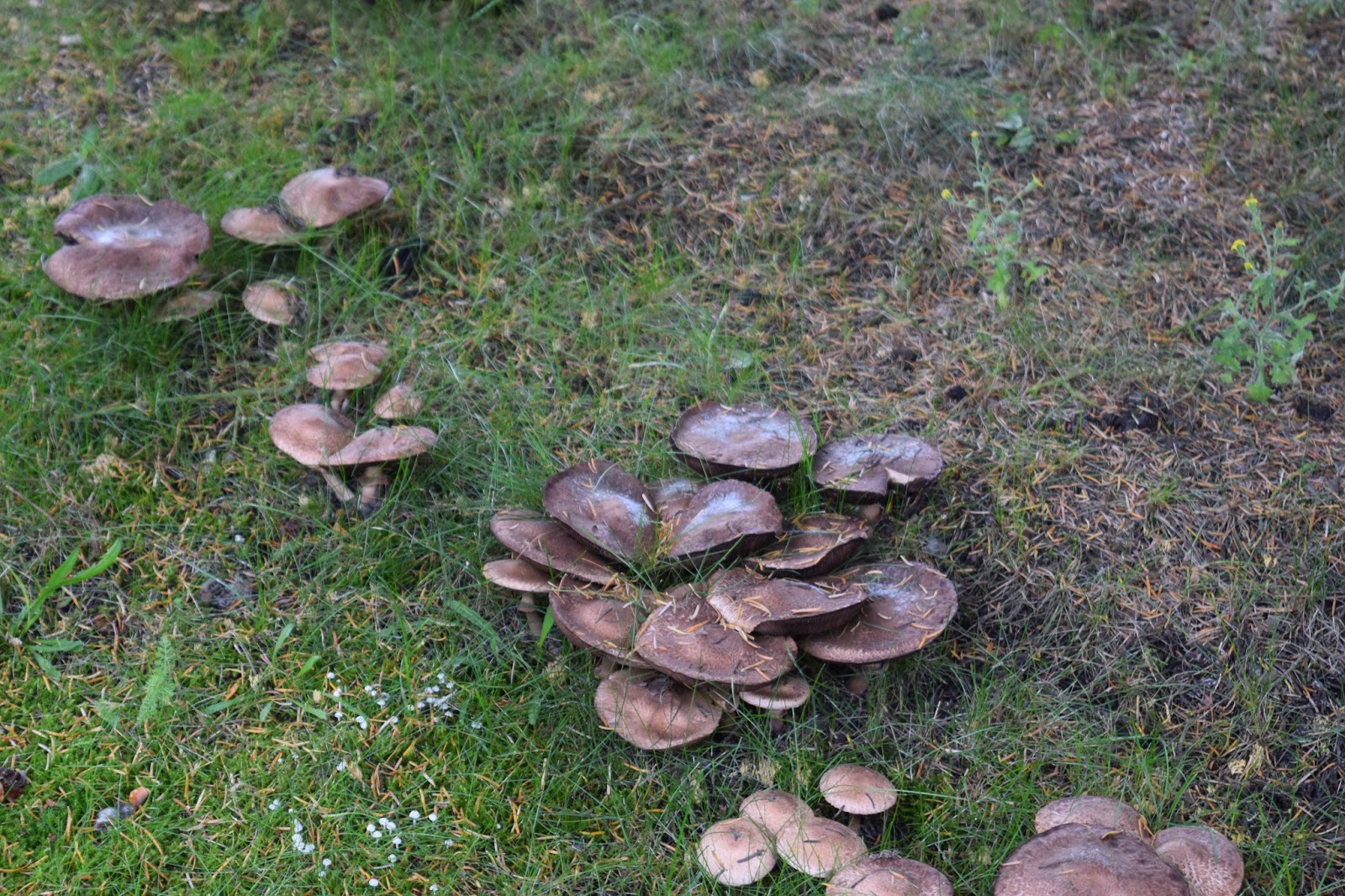
I didn't. I took a wrong turn and kept walking. There was a park. I remembered a park from the map, so I kept walking. There were mushrooms. Big mushrooms.

You can't tell from the photo, but this guy was close to two feet tall.

Each lobe was the size of my hand.

And these were like mini-pizzas

Eventually, I came upon a sewage treatment plant, which was way wrong. Had a nice view, though.


But none of this was supposed to be there. I turned around, and for the first time I remembered that my phone was in my pocket, so I dialled up Google Maps. I had a 37-minute walk ahead of me. The day was overcast, wet from the previous day's rains. I was still jet-lagged. I walked and walked and after about 20 minutes of slogging through industrial wasteland and alongside a freeway, I arrived just down the hill from the Russian church at a place where I should have turned right instead of left. The phone said I still had 18 minutes to go. I don't know if it was a combination of jet-lag and diabetes or what, but I was exhausted and starving. I lurched onto a traffic island and felt myself losing my balance as oncoming traffic sped inches away from me. I threw out an arm and embraced a traffic sign. When the light changed, I trudged in the right direction and sure enough: there was a park. I had to sit down, but soon enough felt good enough to soldier on. An arm of the park I'd sat in divided a street on the right, and I walked where the phone told me to. And there was the Lenin Museum, confusingly enough in the administrative building of the state theater. And, a quick look at the map told me, the market hall was just a few minutes away, so, knowing that I needed to eat, I headed in that direction, and found it. Right inside there was a lunch counter, and the woman behind it spoke simple English. I ordered what she said was chicken in a cheese sauce with mashed potatoes. It wasn't like any chicken in cheese sauce I'd imagined, but it was very good, and not just because I was hungry. The rest of the food hall, I discovered, was mostly lunch counters, but then, I doubt there were many crops in early October.

Okay, time for Lenin. The building was fairly opulent, and I eventually learned that it had been the union hall for all the industrial unions in Tampere, where Finland's heavy industries created factory equipment and locomotives. I'd even passed an ancient locomotive in the industrial section I'd wandered through. In the early 20th century, Tampere's workers were unionized and were very interested in the communism/socialism brewing elsewhere in Russia, so when a couple of Bolshevik thugs knocked over a bank in Estonia (another Russian province), they realized they were too hot for Petersburg, where most of the rest of the Bolsheviks were and fled to the small provincial city of Tampere, where the union guy welcomed them at the opulent union hall, all polished wood and marble. One of the thugs was a Georgian named Josep Dzhugashvili, who seemed hot to get the revolution going, so the Finns sent word to Germany, where Lenin was hanging out, and he got on the famous sealed train to Tampere. The unionists introduced him to the bank robbers and he soon decided it was time to go back to Petersburg and get this Party started. When he arrived, he was greeted in an office at the union hall, which is now the Lenin Museum. There's actually not much in it, the major artifact being Lenin's cane (although it's not even his cane, but an exact replica traded to Tampere's mayor, who brought the original to Moscow on a friendship tour some years ago), and there's this corny bit:

Red marks the spot!
I'm pretty sure you can't read what's on the red spot on the floor, but it says that this is the exact spot where Lenin and Stalin first met. The corny bit of Lenin in the sidecar ("Have your picture taken on the motorcycle!") and the life-size Stalin figure (my friend JJ Gordon, during his acting career, performed a one-man play called I Am Joseph Stalin, about one of the doubles Stalin used, and I have to say that I never met Stalin -- thank heavens -- but this thing's the spitting image of JJ) give you something of the flavor of the place. Cool gift-shop, though, if you don't have enough Commie crap.

The reason this is Finland's 100th birthday is because once the Bolsheviks took over the Russian government, they thanked Finland by giving it its independence. Of course, they also changed their mind, which resulted in yet another 1917 revolution, and that's given as the reason Finnish, inscrutable as it is, is the national language. (Actually, Swedish is the second official language, which means German-speakers can sort of make out some signs).

The next day, I returned to Helsinki, and spent the night, flying off to Berlin for a short visit, my first to the place I'd lived for 15 years for eight years. I understood it had changed. Uh, yeah.

* * *

Dude, where's my apartment?
It's really hard to take a picture of what's not there, but since Berlin has always been a city of vanished places, I got kind of good at it there. This one takes some explanation, though, because it's not a very good picture of something that's not there. Okay, my old apartment was impossible to find unless you knew the secret. The yellowish building in the center of the picture was Borsigstr. 2. Next door on the right was 1, and next door on the left was 4. I was in 3, which, for reasons known only to the city of Berlin, referred to the building behind 2. Somehow, my landlord sold off the driveway you'd walk down to get to it, the tiny vacant lot on the side of the driveway, and part of the parking lot behind the building to developers, who put up the grey building, which is now allegedly a four-star hotel. I need not remind anyone who visited me at this place that my apartment was barely even a one-star one. The note on the grey door, which was never open during the 11 years I lived here, says that access to 3 was through the hotel garage. 

That was only the first shock. Although I could probably have found cheaper and better accommodation, for nostalgia's sake I chose the hotel on the corner (to the left and all the way up the block), Honigmond. Honigmond started as a bar during Communist days, the Borsigeck. It was the favored watering hole for the students at the theological seminary in the church two doors up from my place, and back then, the church and divinity students were secret centers of dissidence, as was the theater. Borsigeck was also a favorite of another bunch of malcontents, actors. The code word for meetings was "playing chess at Borsigeck." After the regime change, a bunch of Borsigeck folks bought the bar and renovated it in turn-of-the-century elegance, and made the kitchen into one that produced excellent German food, with a weekly menu that also had Italian touches. I first ate there with my editor at the English-language magazine whose offices were not too far away, Checkpoint. It had just reopened, and we thought that, as far off the track as it was, it was doomed. Hardly. It was a neighborhood joint, our secret. Once they acquired the whole building and turned it into a hotel, I wondered what the breakfast was like, but I never found out. Eventually, they bought two more buildings to add to the hotel. It made me happy; I ate and drank there a lot, and when I started my communication company, Berlin Information Group, we'd commandeer the back room on Tuesday nights, which were very slow, and have our meetings there until someone talked a developer into giving us free office space a couple of blocks away.  So you see why I picked the hotel. 

But Honigmond the restaurant died earlier this year. The space has far fewer tables, and it is now Neumond. And on Neumond's dinner menu, amidst all the gussied up dishes, is that signifier of Euro-hipsterdom gone bad: a fancy cheeseburger. I had breakfast there my first day (very generic) and went elsewhere from then on. (Yes, I'll get to food in a minute here). 

But beyond all this there was an onslaught of change to absorb. My friend Nikki picked me up at the airport and after I checked in, we went for a walk just to check it out. Torstr., on whose corner I almost lived (it's a major street, so it was good to have a couple of buildings muffling the noise), had been a collection of this and that, a couple of bakeries, kebab stands, a television repair place...that sort of miscellanea. There were a couple of restaurants, especially late in the game, with an excellent if terminally trendy Chinese place, the super-snotty Bandol (I was denied entrance once because I was wearing jeans, which was so out of place in that neighborhood that I just laughed at them), and an excellent Italian place. Now, it's wall-to-wall restaurants, of which the only one I recognized was Bandol. Some of them, I was told, were quite good. Many appeared to be hipster-yupster in appeal: a great number of people with money from elsewhere in Germany have arrived, and it's unlikely I could even manage to aford an apartment on a side-street. By the time we made the grand circle, I was dizzy. Nikki drove off and I went uptairs to think. 

The next day I kept walking, this time below Torstr. in the so-called Scheunenviertel, which had been filled with emigrants between the wars and featured the Neue Synagogue, a prominent Reform congregation that was accidentally bombed by the British in World War II. When I lived there, it was where the edgy galleries were, a couple of odd bars, and our magazine offices, and, later, the studios of JazzRadio, where I did three shows a week for about 8 years. I took a lot of shitty photographs. But not all of them were bad. 

The Empty Apartment
For some reason, I'd never gotten a good shot of this memorial to the deportation of the neighborhood Jews. Or maybe this is better than the ones I took because the greenery's had eight more years to grow in. I could have framed it better, though. 

I think the reason the photos were so bad, though, was because I wasn't looking at what was there, which is, well, kind of important. I was looking at what I remembered, and that made accurate documentation imposible. Okay, and the early-morning light was off; I never got up this early when I lived there. But it's also that there were ghosts. Things I expected to see that weren't there. The hotel was quite close to the apartment of my short-lived ex-girlfriend, Lady Drunkula. She may still be there if she isn't dead, which she might well be; it'd only be a question of whether someone murdered her, she had an accident while drunk, or she drank herself to death. I'd walk past places and memories came back to me despite myself. I found I didn't much enjoy this. 

To be honest, though, I returned without much of a plan, many of the people I wanted to see were out of town or busy, and I realized that the next visit would have to be planned a bit differently. And there should be one, but maybe not too soon. 

One thing that went off brilliantly was that the same day I went below Torstr. I also went to the Bode Museum to look at their room of Tilman Riemenschneider sculptures. The Nordrhenisch school of wood-carvers appeal to me greatly, and I've seen plenty of their work over the years, but Riemenschneider is a cut above. The Bode doesn't even have a lot of them, I discovered. I'd remembered a lot more when I was rushing through the Bode for the first (and until now only) time I'd gone there, writing it up for one of the many guidebooks I'd worked for, and since everything in Berlin is always under construction, there was a room with at least one of his pieces that was blocked off. But the room that had ones was fascinating. I'm not even a sculpture guy, but these knocked me out. 

Venetian dude

Another Venetian dude

No idea dude
And then there was Riemenschneider. The masterpiece was the four Evangelists. 

All together


And, of course, the band of angels.


Most of the rest of the museum is later stuff that doesn't appeal to me, much of which isn't first-rate (that'd be off by Potsdamer Platz in the Gemäldegalerie), and I went and overdosed myself by buying a ticket good for all the museums so I could see what they'd done to the Neues Museum, which had a hole you could (and some did) drive a truck through due to wartime bombing. It's now been patched up, rebuilt, and houses Greek and Egyptian things, including that bust of Tutankhamen's wife (and sister) Nefertiti. Bet you thought that was in the Metropolitan, eh? In the basement was a nice show about the beginnings of civilization in China and Egypt, their similarities and differences as demonstrated by objects. As is the custom in Germany, though, the museum was grossly overheated, I was getting tired, and so I went back to the hotel after an increasingly more cursory glance at this exhibit. 

My proposed last-night mass meetup wound up being Nikki, two of her boys, Uwe, her ex, who is also the father of one of the kids, and my friends John and Aimee, at a bar Uwe was running (and has since left) called Kegelbahn. It was pretty low-key, especially since John and Aimee had to leave early, but at one point we were all at the table nursing our beers and I said "You know, this place has ruined me. I just can't get used to the States." And...well, I can't. It's not just our grotesque, evil President, or the utter alienation of the new, bloated Austin. It's a way of living that overlays the entire country I've seen since I've been back. I just don't like it. If it were mere culture-shock, it would have worn off. And it hasn't. I'm not sure what I'll do, exactly, but I can't budge for another couple of years, while I write this next book and promote it when it comes out. I didn't really have any choice in returning: there were things here I needed to use for the book. But once I don't have that choice...

* * *

A FEW CULINARY NOTES:

Finland is probably not high on your list of countries for destination dining, but should you have to do there, you shouldn't regret it. One thing I noticed immediately was that the bread there is extraordinary. This is because it's mostly rye; wheat doesn't grow too well, so it's not as much used in the national cuisine. At breakfast in the hotel, I got that immediately, including a crispbread covered with seeds that I brought back with me. The cheeses were good, too. 

I had dinner at some fine places. My friend Karen in Berlin suggested Seahorse, in Helsinki, whose business card advertises "Finnish food and culture since 1934," which would be better for someone who, unlike me, does not have a deep, visceral distaste for beets, root vegetables being another of the mainstays of local agriculture. I had some herring, some of which had a camphor flavor (not bad, but weird), and then a "Scandinavian hash" of ham and potatoes that wasn't too memorable. Cheap and friendly joint, though. Another place I enjoyed quite a bit was Kuu, which means "month" in Finnish (it's the suffix of the names of all the months, the waitress explained). The salmon cured in aqavit with a crayfish sauce was super, and the reindeer stew (had to have it once!) was very well done, letting the distinctive flavor of the meat play off the berry-studded wine reduction brilliantly. A mixture of locals and Japanese tourists, superb service, highly recommended. My third dinner was at Bryggeri, which, as you can tell from its (Swedish) name is a brewpub, but one with extraordinary food, matched with the in-house beers. I had a bit of a cold so I remember I started with their cheese and charcuterie plate, but my taste buds faded before the main course so I don't remember what I had. And the receipt is in Finnish. Recommended, though. Bryggeri is also near the harbor, which is where you'll find the market hall, which has far more food than restaurants (including a pancake place with the motto, in English, "A pancake a day keeps the sadness away," which tells you everything you need to know about Seasonal Affect Disorder in Finland), where I got a nice snack of a slice of superb smoked salmon which I munched as I walked around. 

In Tampere, I ate twice at the hotel restaurant (not particularly recommended, although there was nothing wrong with it) and once at Tiiliholvi, a place which also seems to have a branch in Helsinki. This was very nice, although I was the only person in the place when I went. A soup of root vegetables was a fine Finnish start, and the "duck two ways" turned out to be breast meat and liver, each with its own sauce. They brag that they have the best wine cellar in town, and if the glass of Les Douves Latour Carnet (I was intimidated by the "Latour" part, but it was affordable) was anything to go by, they're right. It was not only a perfect accompaniment, but a profound wine -- and, as I discovered on my return, a $20 bottle if you can find it. 

In Berlin, after the Honigmond disappointment, I went down the street to a place that had opened when I was living there. I hadn't liked it, thinking it pretentious but not cooking to meet its pretentions, so I never went back. But this time, it appeared that the spirit of the old Honigmond had just picked up and walked a block. True, Alpenstück has white tablecloths, but the Radeberger beer is just as good, and the bread, well, that's different. The reason is that they've expanded across the street, clearing out a hairdresser and a bar (Smily :-) der Friseur and Cheer's -- a copy-editor's nightmare in 3-D) to put in a bakery-cafe, whose first-rate breads and pastries would have been a real boon to the 'hood back when I was living there. 

Quite the adventure, and now I'm back in the USA, where hamburgers (and cheeseburgers) sizzle on an open grill night and day. But I know I'll be back to Berlin. And who knows, maybe Finland. 

Saturday, December 24, 2016

Notes From An Attic: The Never-Ending Vacation, Maimondes' Autograph, Promoting The Book, And More

Two months since I've touched this blog? Apparently so. And a very odd two months it's been. To recap: in early October, while on vacation in Spain, I received photos of water seeping outside the door to my house, which water proved to be the result of a toilet valve failing and 48 hours' worth of uncontrolled release of water. The landlord quickly shut it off, but sheetrock, ceiling, and wooden floors all needed replacing. He predicted three weeks or more.

More. If the most optimistic forecasts are correct, I'll have been out of the house for three months by the time I get to move back in. Christmas and New Years will be elsewhere. Fortunately "elsewhere" isn't as onerous as it might be: after a week and a half in a horrible, expensive, poorly-run "extended stay" hotel, a Facebook friend offered me one of his airbnb properties, this not being the high season, and I moved into an attic on his property. It has its down side.

First rule: don't be tall. Photo credit: Special K
Also, I packed for a three-to-four-week stay here, which meant I grabbed a few clothes and some kitchen stuff that was either in excess of what I needed or not enough. There's a stove (oven doesn't work) and a microwave, but cooking has been a problem. When the weather got cold, I had to buy some new shoes (fine: the winter shoes I bought in January sucked, and REI will take them back) and a down jacket thing (already have one, but can't get to it). Fortunately, the place is centrally located, which means I can walk a lot of places, and driving isn't quite the pain it is down south, where you have to drive places to get places. You kind of have to get out of where you are before you can start going where you're going, if you see what I mean. Here, it's a lot more like living in a city.

So I'm still living out of a suitcase, eating out much too much for my comfort (both dietary and financial), but things could be worse: the main focus of the past couple of months has been assuring a smooth launch for The History of Rock & Roll, Vol. 1, which has certainly been interesting. Fortunately, so far most of the reviews have been very positive, and I've mostly done interviews with really intelligent people, like Gil Roth, whom I'd never heard of before, and Michaelangelo Matos, whom I had. There have been some radio interviews, most notably on KQED's Forum, which had the most chaotic, ill-prepared, ignorant host I'd ever dealt with. He'd never so much as opened the book, knew nothing of its subject, and couldn't keep the conversation on track. Unfortunately, I had a severe attack of cedar fever just as the mike went live, so I wasn't at my best initially, either. Fortunately, I recovered. The host...maybe not so much. And there was the Bellowing Celt who called in, completely bonkers. I'm still shaken, but I suspect that's the worst of it.

That cedar fever, too, has slowed me down some: there was a cold snap in Austin and the trees went wild. Me, I went to New York and Montreal, where it was cold enough, caught some kind of flu in all the subways and airplanes and trains and whatnot, so I had to deal with that and the cedar disease when I got back. I haven't been very active, to put it mildly. Oh, and in November there was the Texas Book Fair, where all the music book writers were up against one another, so who do you think got the crowds: Thomas Dolby, me, or the woman who wrote a biography of Guy Clark, beloved late Texas songwriter, who, instead of having a panel in the Capitol building, had the Paramount Theater at her disposal, and had several local high-profile songwriters on board to do some of Guy's songs? I got to the signing tent, there was a huge line...but not for me, of course: her publisher had sensibly augmented Barnes & Nobel's supply. B&N only had 30 books for me to sign, and five were for the store. There were a lot more at Book People, though, for the official release event, and I even had to go down again to sign another raft of them there. (They have 'em on mail-order, too, if you want one).

Still there, newly renovated for your Manhattan office address. Brill himself was in the menswear biz. 


This is all pretty un-chronological, I see, but at the end of November, I went to New York for a week on a project totally unrelated to the book (but got a bit of promo, if you can call five minutes' worth of interview on an AM New York Jesus station "promo": who knew New York had a Jesus station called THE ANSWER? Who knew New York had a Jesus station at all? What can the listenership of an AM station like that be?). Before I left, though, I decided to go to a couple of museums as long as I was in town, and it really felt good.

MOMA had the first US retrospective of Surrealist painter Francis Picabia, whom I'd mostly known as a major pain in the ass to the entire Paris art scene throughout Cubism, Surrealism, and beyond. It wasn't until after I saw the show that I learned that at the age of 15, Francis, son of a wealthy man, learned to paint so that he could copy his father's collection of old Spanish paintings, replace them with his copies, and sell the originals to dealers so he could buy expensive stamps for his stamp collection. That, however, is consistent with the rest of his life, as is the excerpt from one of his writings that gives the show its title: Our Heads Are Round So Our Thoughts Can Change Direction. His thoughts certainly did: austere drawings of machines that actually do nothing, colorful abstracts, odd cartoon-like stuff, bland but disturbing hyper-realist oils, some of them sourced from soft-porn magazines, during the German occupation of France, and, if your feet are tired, you can sit and watch a film he and René Clair made called entr'acte, which was shown during the intermission (entr'acte) of an Erik Satie ballet. It's exhausting and goofy, and the show made my day. Heads off to Picabia!

The show I knew I wanted to see, however, was up at the Met, and I devoted a day to it: Jerusalem, 1000-1400, Every People Under Heaven.  It was a bit odd: having not quite returned from a trip to Spain to try to get a handle on the three-culture Christian-Jewish-Muslim culture there, from which Crusaders went off to try to "reclaim" the Holy Land, here I was in New York watching the story from the other end of the telescope. It's not a particularly arty show, because two of the religions involved weren't much on representational art, and also because a lot of the prize exhibits are books. Delicate and tending towards fading, they're displayed in darkish rooms, and you really have to want to look at them -- and you need to to get the show's message.  Here's a beautiful illuminated manuscript, obviously French 14th century, groaning with gold leaf, showing a biblical scene. The lettering's in Hebrew, though, and it was used by the Jewish community of Tours. Here is a deluxe fold-out map of Jerusalem, prepared for tourists -- or, rather, for a tourist, since it's hand-lettered and hand-illustrated. Of course, the guy who did it had never been there, but it's still amazingly accurate. Over here, a letter asking that some hostages be freed -- the caption says such letters are quite common from this period -- signed by Maimondes! That gave me an electric shock and once again reminded me that this story I've been chasing -- whatever it is -- spreads over a huge area. I have to say, the show is huge, painstakingly fair to all sides, and not only fills in a lot of blanks on the three-culture story for me, but also shows that the idea of the tourist trap is millenia old: lots of the stuff on display was made for pilgrims to take back to Europe with them. Only open until January 8, so get down there if you can.

Most of the rest of my time has been spent waiting for the house down south to be finished. At some time after the first of the year, I'm confident that my publisher will make an offer for Vol. 2 of the book, and I can get back to doing what I do best: writing. I may attempt a couple of signing tours -- I'm trying to work one up with Amtrak so that I can take the train up the West Coast -- which I'll have to finance myself. But that's in the future: right now I want to move back into my house, sit on my couch, sleep in my bed, and cook in my kitchen again. Three months is too damn long. When you're walking up Madison Avenue (to the Grand Central Oyster Bar: some things never change) and you realize that you're taking a vacation from your vacation and soon will be on a train to Montreal to visit friends as a vacation from the vacation to the vacation, you realize how much you miss having a home.

Of course, I've been feeling that way for about two years now, and the recent election only firmed up my decision to leave again once this next book is finished. I could, and no doubt will, go into that in some detail. But not today. Today is Christmas Eve in the attic. I have to stockpile some food for the weekend. Ho ho ho, y'all.

Thursday, April 14, 2016

Europe, Spring 2016, Part One: The Backstory


Nel mezzo del cammin di nostra vita...

Well, not quite, but it was going through my head a lot, so a bit of explanation may be in order. Early last fall, when I finished my rock and roll history book's actual writing, I knew there would be a lot of post-writing work to do. I also had the second half of my advance, and it was, in a sense, more than the first half because the immediate debts I'd had to repay with the first half weren't there, giving me some room. And I knew what I wanted to do: return to Spain and France as a tourist, seeing stuff I'd never seen before, like the western end of Languedoc-Roussillon in France and some more of the area around Barcelona. So I went to Google Flights and started playing around. By then it was too late to ensure a pleasant experience: fall was coming in, and although that meant good things for food, it also meant that the driving I was anticipating doing could be hard, particularly in some of the places I was planning to go.

Eventually, a plan emerged. UT Informal Classes had me down for the two I was going to teach (Austin music history, and a new one about being a tourist and being a resident in Europe) and the first one would start on the evening of April 13. SXSW took up two weeks in March, and I knew from returning to Europe after a number of SXSWs that what I wanted wouldn't be ready immediately thereafter. The alternative, waiting until after the classes, would probably give me the best weather, but the book stuff would be getting hotter around then, probably. I narrowed it down to Easter Monday (March 28) to April 11.

And then I did some boneheaded stuff. Prices were all over the map, and the best one seemed to be to fly from the US into Rome, then back to Barcelona. Weird, but in terms of time in the air, not very different than something that seemed more direct. I decided to think about it: I was committing a bunch of dough to this and I didn't want to screw up.

I did anyway, though. As time moved forward, I decided I had to act, only to find that the flight I wanted had sold out. Aha! I thought. British Airways has a non-stop from Austin to London, and I could connect there! But the BA website wasn't cooperating. I'd get to where I'd pay and it wouldn't load. I started the process over. Same deal. I quit in frustration, knowing I'd mess up if I were too angry. And I went back the next day, booking through American Airlines, which runs the route with BA. Austin-London, London-Barcelona and, in reverse, back. I was so happy to see the website work that I didn't notice that I'd booked a nine-hour layover at Heathrow to start and an overnight layover there on the way back. I had an idiot for a travel agent, all right. Me. But I'd bought it, so that was that.

As I went through this two-day process, what surprised me was the vehemence with which I was doing this. The project had gone from "I want to go" to "I have to go." What was up here?

That question began to be answered only weeks later. Shortly before SXSW was due to begin, John Morthland, an early colleague at Rolling Stone, my very best friend on the staff, and, afterwards, a guy who'd shared my house for a while before moving into San Francisco with other friends, had been found dead at his home of natural causes. My age, approximately. And the day of President Obama's speech opening SXSW, news spread in the crowd that Louis Jay Meyers, one of the event's founders, had died of a heart attack in the night. Again, my age, approximately. Naturally, I didn't know these things would happen when I was booking, but the idea of getting out of town suddenly, for some reason, seemed more urgent.

And there was more, not life-and-death, but a gathering storm of personal and professional issues that were closing in. The publishers of both of my impending books were working faster than I'd thought (thanks, digital age -- and I'm not being sarcastic) and there was stuff that needed doing. I started doing it, but I'd warned both publishers that I'd booked this trip and couldn't change it. Mostly, they were gracious about it.

And in the back of my mind, there was more, which the two deaths had nudged loose. Which I have to digress to explain.

Some years ago (not many, I see now, looking it up; not as many as I'd thought) my friend Mark Rubin alerted me via Facebook that some friends of his were coming to Montpellier. They were busking their way through Europe and had just been in Denmark and were headed to Italy. A duo, male and female, they wandered the world like this. The male half had been producing a singer/songwriter from New Mexico in Denmark, the female half told me as I picked her up at the Montpellier train station, and the two of them would arrive soon. And so it developed, and it's a long story, but they found a house with some hippies to stay at and the singer/songwriter and I started  hanging out and having long conversations. She was a doctoral student in botany, about to take her exam for the degree, but was also pursuing a music career. She was also smart as a whip, sharp as a tack, and all of that. And gorgeous. And too young for me. I managed to get the three of them a gig at a friend's bookstore, and there I heard some of her songs, and it seemed something was not quite right. Besides, of course, the fact that she hadn't copyrighted any of them and was selling self-burned CDs at gigs, which led to more conversation.

But that was nothing next to what happened once she returned to the States. A question about proofreading, posted on Facebook, led to a correspondence, which led to an uprooting of a lot of my cherished beliefs. If our late-night yammerings in France had been intense, our transatlantic correspondence was positively incandescent. We batted ideas back and forth via e-mail and occasionally in video calls with Skype. She was obsessed with architecture, the way we capture space and live in it and arrange it to make that act of habitation as pleasurable as possible. As she hurtled on to her PhD, she challenged my entire intellectual superstructure on a daily basis. It was like a carnival ride.

It ended badly, of course. I invited her to SXSW and she came, which was, from her end, not such a hot idea, cutting in to her study and preparation time as it did. I selfishly wanted to spend time with her, which I couldn't do in France, where I still lived. What happened in Austin was that the thing essentially imploded. She got her degree, although she had to put it off for some months after Austin, and she moved to the desert. The songwriting career seems to have quieted down. We lost touch, which is probably best for both of us.

I can't speak for her, but some of those discussions we had profoundly affected my life and thinking, and for that I'll always be beholden to her. After months of thinking about it, I can distill one of the main changes like this: Everyone needs reasons to stay alive, by which I mean far more than food and shelter. I decided that the only two things worth living for, on that level of existence above food-and-shelter, were love and beauty. The former you have to be open to, but if you search too assiduously, it will elude you. The latter is all around you, and you can also increase your input of it by going to places -- art museums, concerts, natural spaces -- where an elevated level of it may be available. This became my mantra, and I've been much happier ever since it has.

And that was foremost in my mind when I booked this trip. The love thing continued to be problematical. The beauty thing was waiting for me in specific places I knew -- and in places I had no idea existed. The deaths just underscored this in a big way, as did the changes these books would likely make in my life starting this fall. It was time to escape for a while and let things dangle. And, of course, to let other things in.

The trip started well, too: I asked at the Austin airport if I could somehow rectify my stupid mistake and not have to spend an entire jetlagged day in Heathrow, and the guy clicked some keys stared at a screen, went to talk to someone else, and bingo: a 90-minute layover rather than a 9-hour one. I'd just bought myself another day in Barcelona, getting in at 2 rather than 10:30pm. I'd planned the trip rigorously, as I always try to do, knowing there would be things that didn't go as planned, and being open to them.

Two weeks. This was going to be fun.

Next: Ola Catalunya/Bon Jour Catalogne

Tuesday, November 10, 2015

The Oldest City

And so it came to pass -- anyone's guess how -- that I was invited to a literary festival in Florida. No, really, a guy who hasn't had a book out since 1986 rubbing shoulders with professors and authors. Not only that, I was sort of the headlining act, last one of the conference.

The Other Words conference has been going on for several years, and although I'd never heard of it, I did note, once I'd been invited, that it would allow me a weekend in St. Augustine, Florida, a place I'd never been, and that all I had to do was show up on Saturday night so that this guy Wyn Cooper and I could talk. Cooper, as you'll see from the link, is a poet who's also had one of his poems turned into a hit record by Sheryl Crow, and a brief conversation with him before I left convinced me this would be fun.

I don't have much to say about the conference itself -- if you're curious, you can click the link above -- but I was very interested in being in America's oldest city, seeing as how just a little while back I'd been to America's other oldest city, Santa Fe. St. Augustine has them beat by about 50 years, though, and I figured there'd be something to see.

And there was: when I woke up on Friday morning, there was this big grey edifice across the street and a bit to the left of my hotel, the Castillo de San Marcos, the Spanish fort built to defend the city from the various forces who wanted it for themselves. The town itself was founded in 1565, and some wooden forts erected against the threat of the French, largely Huguenots (aha! A Montpellier connection!), who'd settled a bit to the north near what is now Jacksonville. This didn't prevent the French fleet from trying their luck against the Spaniards, but their luck was bad: the fleet was destroyed by a storm, and the Spaniards marched north and destroyed their fort. Then the shipwrecked sailors appeared and the Spaniards killed them all. Florida was off to a great start.

Then came the British, who burned St. Augustine to the ground in 1586, but wound up settling further north in Jamestown, Virginia and Charleston, South Carolina. The reason St. Augustine was so important to Spain was that it was on the Gulf Stream, which could whoosh boats coming up from South America, often laden with gold and silver, straight to Spain. Seeing that their location was so vital and their new settlement could be used as a stop for Spanish ships for repairs and supplies, they decided to build a stone fort, and work was started in 1672 and finished in 1695. The main building material was coquina, a fossil-bearing rock that's much sturdier than limestone, and it's held up.

Which is better than the town itself has done: British forces from South Carolina showed up in 1702 and burned it again, but spent 50 days beseiging the Castillo and never took it. Giving the British the finger, the Spanish governor announced that runaway slaves would be given their freedom if they came to town, and made good on it. Of course, they were still employed in manual labor, but they got paid for it.

Good defenses make good neighbors
In 1763, the British acquired Florida as part of a deal involving a peace treaty, and took over the administration of St. Augustine and the Castillo. There's really not much to see per se inside the fort: the most interesting stuff is graffiti scratched by soldiers stationed there, which include pictures of boats that naval experts can actually identify and assign to a nation, but the Parks Service has good posters detailing the various periods of the Castillo's history, and some of them highlight individuals who were important in the city's history. My favorite was a Swiss mercenary who rose high enough in the British army to be appointed governor, and apparently complained bitterly about how awful Florida was. He wound up getting transferred to Quebec, where he really enjoyed the weather.

Owing to the turbulent history, "old" as far as structures go in St. Augustine means early 18th century, and there are older structures in New England, the Hudson valley, and Philadelphia, among other places, and because the Spanish gave the place up for the last time in 1821, when they gave Florida to the United States (and the Americans renamed the Castillo de San Marcos Fort Marion after the "Swamp Fox"), there's no real Spanish vibe to the town except a self-conscious one. Part of that came about when Henry Flagler, who had helped John D. Rockefeller establish Standard Oil (and was acknowledged as the mastermind behind it) decided that Florida held an unprecedented opportunity for healthful tourism, and, in 1882, moved to St. Augustine to start developing it. The first thing he did was to build a hotel.

Not the Best Western where I stayed
He also built another one across the street, a little less grand. It's now St. Augustine's City Hall. This one is now Flagler College, where the conference was based. Flagler built a railroad to connect various of his enterprises in Florida tourism, and eventually it went all the way to Key West, but he really lavished a lot of attention on St. Augustine. Thanks to the conference, I had an ID that let me into the no-go areas in this building, including the dining hall.


Thanks to the miracle of my patented Blur-O-Vision photography, you can't really make out the lavish murals in the top photo or discern the little stage where musicians would play for hotel diners. Nor, in the lower photo, can you see that the windows are stained glass by Tiffany, the largest holding of Tiffany glass in the U.S. 


Here's a view of the main entrance, showing some of the books conference attendees had for sale, most of them poetry, which is definitely not my field. But the whole building is this over the top, take my word. 

Unfortunately, there's not much of interest in this tourist enclave I was staying in unless you need scented candles, bath supplies, or candy. Dang, there was a lot of candy for sale. I found a place called the Fudge Bucket, which I humbly submit is the worst business name I've seen this year. It's on St. George St., where a lot of old houses have been turned into bars, restaurants, and tchotchke emporia. 

I did a lot of walking, mostly because I like to walk, and you never know what you'll find. There was one area where there were some impressive old houses that I liked. 


And there were other, more fanciful, ones.
Photo somewhat worse for shooting directly into Florida sunshine
I spent a lot of Friday tramping around these streets and pretty much exhausted the possibilities. I was also wary: this was the weekend of a marathon, and Pirate Days, where the city is invaded by people who like pirate cosplay. There was a van parked at my motel which had skeletons all over it, and I saw a lot of people walking the streets in full (and meticulously detailed) pirate drag. Saturday there was a parade, but fortunately I missed it. 

Since I was free until Saturday night, I did a lot of wandering, and managed to meet some St. Augustinians who, I hope, aren't typical, although I fear they might be. First was a sort of hippie chick who accosted me when I was headed to Flagler College. "Pentax or Nikon?" she asked, pointing at my camera. It was a Nikon, and she told me that's what she'd had. She asked me what I was doing in town, and I told her, and she introduced herself as Georgia and said that she didn't know much about poetry but she did know about rock and roll and had adopted Jim Morrison as her mentor "as a poet and as a clown," which I thought was fair. She said she'd have a camera "when I get everything back," and wished me a good stay. The second one was a young guy I met crossing a bridge a bit further up the street that runs by Flagler. I'd gone to a huge liquor store outside the city limits to buy a six-pack for nightcaps while reading at night, and this kid perched on the bridge's railing said "Do you believe in God?" Not wanting to walk into a minefield, I said "Sure," and he replied by knocking on the railing's stone and saying "He's concrete, just like this. He's not an abstraction, no way." Okay. The third one was a chunky young guy who struck up a conversation as I was eating breakfast. He said he listens to NPR all the time and asked about the conference and went back to what he was doing. As he got up to go, he handed me a napkin. "Check this out sometime. Have a nice day." The napkin had a URL for something called The Political Cesspool, and he had written "Check the archives," and then two Latin words, one of which was "deo" and the other a form of the verb "vencere," which, having never really learned all the tenses despite my Latin teacher's best efforts, made me think it could be translated as "God will win." 

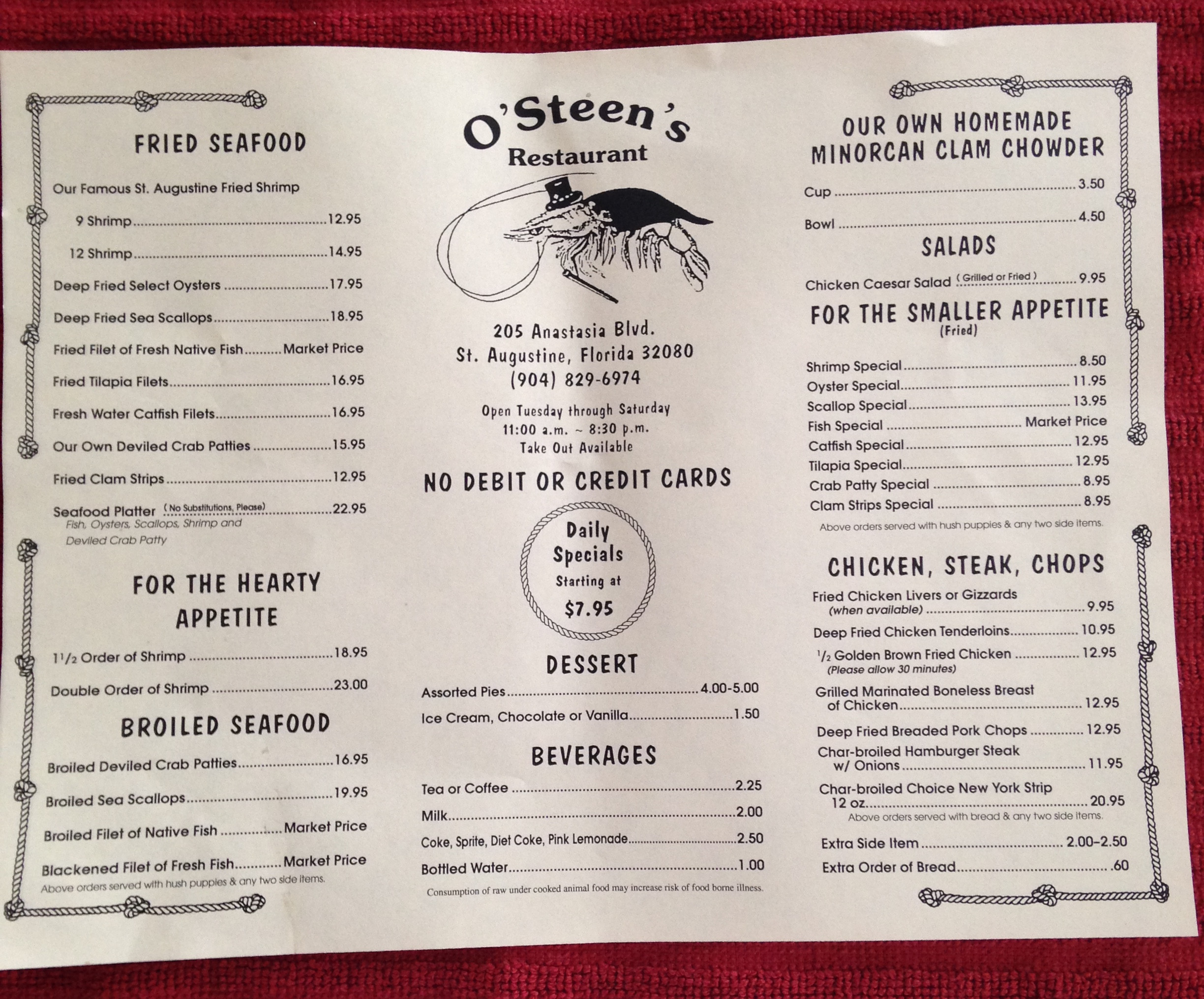
Food? Yes, they have it. St. Augustinian cuisine is seafood, of course, and yet it's not all that varied: you have mahi-mahi, you have blue crab, and you have shrimp. And that seemed to be it. There's also a local specialty of Menorcan clam chowder. Menorca is a Spanish island in the Balearic group, much touristed by Germans and Brits these days, but with a version of Catalan culture and language. Although Menorcans were disproportionately represented among St. Augustine's Spanish population, and set up the town's bakery (now a tourist trap serving fake Spanish pastry) and provided ancestry for Steven St. Vincent Benet, the clam chowder is all that remains. Thus, I had to have some, and so I hit Catch 27, which looked pretty good, for dinner on Friday. If their version was anything to go by, the broth is tomato enhanced by the local datil pepper, an odd-looking, mildly hot, chile, which adds a good deal of complexity to the flavor by not trying to overwhelm anything. The flavor of the clams comes through, and the only problem I had with Catch 27's version was the two immense croutons in it, which soaked up the broth and sogged out. But it gave me ideas, which I intend to try out in a self-invented recipe soon, so I bought a bottle of datil sauce at a hot-sauce emporium tourist trap and brought it home. Catch 27 also made some decent crab-cakes. 

My other bit of culinary knowledge was provided on Saturday, when I went to find a pharmacy. I walked across the Lions Bridge, a drawbridge across the bay, and into another part of town that was less touristy. Still, there was no pharmacy for as long as I walked, although I did happen on the Alligator Farm, one of St. Augustine's earliest tourist attractions, which is actually in the National Register of Historic Places. Cost $22.95 to get in, so I passed but I took the opportunity to ask my phone where the nearest pharmacy was. The answer was discouraging -- why are there no consumer-friendly businesses in the St. Augustine tourist area where I was staying? Santa Fe seems to have no problem having convenience stores and so on in their tourist area -- so I walked back. On the way out, I'd passed O'Steen's Restaurant, highly recommended by locals, so, hot and sweaty from the long walk, I decided to stop in. A cup of Menorcan chowder was out of the question, sad to say (I figured it'd be the definitive one), but their famous fried shrimp wasn't. It was, um, fried shrimp, but the shrimp themselves were fine: the local shrimp seem to have an iodine-y tang I associate with the Atlantic, not overwhelming, but another note in the basic shrimp taste. They were inexpensive and gave me the energy to hike back to my motel and collapse. 

The other place of note to eat was, amazingly, the coffee shop attached to my motel, Mary's Harbor View Cafe, which is the place to catch breakfast (or lunch, apparently). Mary, a large no-nonsense woman with a cheery demeanor, runs a tight ship, and has earned the neon sign on the back wall declaring the place The Mary Show. I had omelettes all three days, and can report that the hash-browns on offer here are the real deal, not some grease-soaked previously-frozen slab of starch. And the shrimp omelette I had Sunday morning was top-notch, as were the others, but that one was special. Mary's joins the pantheon of great motel coffee-shops that also includes the legendary Duke's At The Tropicana of sainted memory. 

My interview went well, and Sunday I headed to the Jacksonville airport in a cab driven by a chatty but sane woman who'd survived what sounds like a fairly impoverished upbringing in a trailer. And I survived the flight home, which was smooth, although the route went through a swath of weather that scared me to death every time I called up the map on my phone. Interesting short trip, although I have no particular interest at the moment in exploring Florida further. Just remember: if you visit, no bookstore, no pharmacy closer than six miles, and no convenience store, but a Fudge Bucket. What an odd place. 
 
Site Meter