Monday, October 17, 2016

Spain 101, Part One: Entry

Here's the way I figured it: In September, I'd be promoting my Michael Bloomfield book (you do have your copy, right?). Come late October, and going into November, I'd be hard at work promoting my first new book in 33 years, The History of Rock & Roll Part 1. There would be a gap, and in that gap airfares would fall. I was getting mighty sick of America, between the horrific election, the lack of civility in everyday society, and all the rest of the stuff I don't have to tell you about. Google Flights informed me that I could afford a round-trip ticket to Barcelona, which seemed, as always, to be a great place to shake off the jetlag. But I've spent a lot of time there, and I have, since my visit to Girona this spring, developed an inexplicable fascination for that part of Spanish history where Spaniards (whoever they may have been in any given area of the Iberian Peninsula), Jews, and "Arabs" (more properly Maghrebis, since they, like most of the Jews, were from Northern Africa) lived together, not always peaceably, but... Of course, it ended in 1492, when Spain kicked out all of its scientists, physicians, mathematicians, philosophers and businessmen (ie, Arabs and Jews) and descended into 350 years of being a peasant society under the heel of the Inquisition.

Thus, I decided to read up on this history and go visit some of it. Lest the trip be too medieval, I also planned to stop in Madrid, a city that went up mostly in the late 19th and 20th centuries, to see the Prado and visit someone I knew there. After that, it would be a short train ride to Toledo, which has a fascinating history of the three-culture society, then back through Madrid to Valencia, up the coast to Tarragona, and back to Barcelona for a good rest before getting back on the plane. I had about two weeks to squeeze this in, and let me tell you in front, that wasn't enough in some of these places. Also, I've missed a couple of important sites, most notably Grenada, where the Arabs held on right up to the Expulsion. I mapped it all out carefully, chose some good looking hotels, and bought a Renfe Spain Pass, which entitled me to five trips on the Ave, the Spanish national railroad's high-speed network.

Pro tip: Do not buy a Spain Pass. Allegedly, Renfe lets you print out your tickets. In practice, negotiating their website is about as difficult as it can be, as we'll see. Renfe has now displaced '90s-era Deutsche Telekom as the worst-managed public utility in Europe in my mind.

Another pro tip: Wherever you may be travelling, if you use the Rough Guide series, there'll be a Kindle edition of it on Amazon. I bought the Spanish edition, and loaded it onto my iPad, and it was an unexpected joy: hot links everywhere to museum websites, local tourist info offices, and the like, as well as excellent maps which you tap twice and they blow up bigger than they are in the paper book itself. Highest recommendations.

Okay, I'm packed. Let's get outta here.

* * *

There's not much of Tourist Barcelona I haven't seen, but I do have a strong affection for the city, and love to start off my trips there. There were two museums I'd neglected, and they gave me an excuse to leave the hotel to do something besides eat. One was the MACBA, the Barcelona contemprorary art museum. Greil Marcus had just been there and seen a show dedicated to punk, which would be interesting because punk hit Spain very shortly after Franco was deposed, and my guess was that they'd have a very different take on it. I walked down there to discover that the show had closed on Sunday, and today was Thursday. Dang. But it was a lovely building, and what else was I going to do? Turns out the answer was not stay for very long: the ground floor was filled with an insufferable one-woman show by an artist whose work is criticism of the art world. I knew this kind of stuff existed, because a woman I know in Germany does it, but wall after wall of documents and videos of this woman complaining about minutiae can only be of deep interest to people deeply involved in it, which isn't me. Upstairs, the permanent collection also seemed to focus on conceptual and text-heavy work, never my thing. The one room I found fascinating, though, was a large one concerned with the Downtown New York scene of the 1970s, with a video by Vito Acconci, another by Gordon Matta-Clark, and, on a full wall, a documentation (perversely attributed to the woman who'd filmed it) of a Trisha Brown dance performance. I'd read a great deal about her, but of course never seen her in her prime. The word that fits is "furious." Not angry, just a phenomenal amount of energy channelled directly into the movement. It made the entire visit to the museum worthwhile. 

I spent some time getting sort of lost in the surrounding neighborhood, relishing the street art and other weirdness before heading back to the tapas bar next to my hotel for a late lunch. 

Yes, this is an actual restaurant in Barcelona. 
No idea who this artist is, but they're all over town
Actual Barcelona bar. My kind of clinic, although who knows if it's my kind of bar
And so, armed with a ticket I'd printed out at home, I bravely walked, with my luggage, to Barcelona Sants station and boarded an Ave to Madrid. 

* * *

Jetlag is a nasty companion, so I dozed and missed some of the scenery between Barcelona and Madrid. I use the word advisedly: most of it isn't "scenery" at all, but, rather, sere brownness occasionally interrupted by what could only be called mesas, like in the American West, weird rounded hills with flat tops, made from sedimentary rock. Really bleak, really odd. But the train was on time, a cabbie whisked me to my hotel (an actual palace at one time, but Spain's so full of minor royalty a "palace" isn't quite as grand as it sounds), I checked in, and then went into the neighboring square for a late lunch. After that, I wandered around the vicinity for a while and tried to get a vibe. Back at the hotel, I contacted Miguel, my acquaintance there, and we made a dinner date. He's been living in Madrid for some time, so he knows the city, and later that evening (it's true: Madrileños eat late) we walked through some crowded plazas and down some streets and came to a seafood joint he likes. I never found out the name and have no idea where it was, but most of what we had was prepared the same way: broiled, doused with olive oil, sprinkled with paprika. This allowed the baby scallops, razor clams, and sardines to show off how fresh and perfectly cooked they were. Fine with me!

Sunday was devoted to the Prado. Now, what could I possibly say about the Prado, right? Well, here's one thing: in 2013, José Luis Várez Fisa and his family were kind enough to drop a nice collection of Spanish art from the 13th to the second decade of the 16th centuries on the museum, who stuck it in a fine set of galleries in the basement, which, if you enter the museum the way I did, can be the first thing you see. Since this is my favorite period of art history until you get to the 20th century, it made the visit totally worthwhile before I'd even gone anywhere. There was a bit more upstairs, but man, the ceiling they'd lifted from a church in León, painted with heraldic designs, Bible stories, myths, and a veritable 14th century kitchen sink of images made my day. 

Upstairs, the museum most people go to see begins, and I dutifully walked it, dodging tour groups, as one does, and hoping to see something that would catch my interest beyond what I already knew would do so. Thanks to Robert Hughes' magnificent book on Goya, I had a newfound appreciation for Velásquez, and thanks to the way the Prado is organized, I noted that Velásquez, Zurbarán, and a guy named Cano with whom I hadn't been familiar, all flourished at the same time. I'm very much into Zurbarán, and although I lucked into a clutch of his work many years ago in Castellón, the Prado has, predictably, loads of great ones. In fact, I got so numb wandering through gallery after gallery that I missed his still life with a cardoon, which was a kind of fuck you to the dominant still-life style of the day with its white streak of cardoon stalk sweeping across the picture as if to say "Oh, yeah? Watch this!" But basically, as time goes on and the 17th century goes into the 18th and 19th, my eyes glaze over. 

What saved the rest of the day was, of course, Bosch (whom the Spanish call "El Bosco," summoning up memories for those of a certain age of after-school chocolate milk), with the definitive collection of his work, and Goya. The Bosch room isn't big because it turns out his work isn't that big. It did have one work I'd totally forgotten about, a round tabletop depicting the seven deadly sins (and you can bet he did a great job of that), as well as the under-known masterpiece "The Haywain." And, of course, the tryptich of "The Garden of Earthly Delights," that enigmatic explosion of weirdness. There was an awful piece of bloviation about it in the New York Review of Books this year that added nothing to the world's knowledge of the painting except to note that in the very right-hand corner of the central panel, there's a little guy apparently giving a blowjob to another little guy, the only explicit sex act I could find in the painting, although there's some ambiguous male-female action and other weirder maybe-sexual stuff going on. I saw a great show in Rotterdam years ago, where just about everything but the Prado stuff was included, and it made a great case for some of the imagery in the "Garden" coming from pilgrim's badges, the tin souvenirs pilgrims to Santiago and other places bought to show where they'd been and pinned to their cloaks. But the great news is that the Prado has this thing close enough to stand and gaze at, and I did, for a long while. 

Goya, with Hughes' writing still in my mind (it was the last book I read before leaving), was great. It was interesting to note how small the two Maja paintings were (and Hughes is right: her head's on wrong! Not that I was noticing when I first saw a reproduction as a kid), and thrilling to stand in front of his revolutionary paintings, and the "black" paintings that he did on the walls of his house in his last years, which Hughes doesn't reproduce all of, for obvious reasons. (I also, like many people, really loved the painting Hughes calls "Head of a Dog" and wonder why the Prado decided to call it "Drowning Dog." It may be Goya, but not everything in his life at this point was dark and gloomy.)

A day in the Prado can -- and did -- exhaust one, so I limped home knowing both that I'd be back (hell, big museums don't faze me: I used to work in the Metropolitan!) and that I'd had a very full day. Miguel suggested a secret restaurant in another corner of town called Asturianos, where Madrid's top chefs enjoy authentic cuisine from Asturias prepared by an old woman and her two sons and is, as far as I can tell, nearly perfect. I didn't much like the ultra-dry sherry we were served initially -- it seemed to have a chemical taste I couldn't shake -- but the sardines, beef cheeks and sausage-and-bean stew that came later hit the spot decisively. 

One more day, two more museums, which, if I hadn't gotten lost, wouldn't have been enough to fill a day. Okay, to be honest, the Reina Sofia has a great collection of early 20th century stuff, and if you want Cubism, well, the Spanish sort of co-invented that. My disappointment was 100% not being in the mood, so I'll have to go back when I know what I'm getting into. Down at the other end of the big street connecting the Reina Sofia and the Prado is the Thyssen-Bornemizsa Museum.  I was lucky: Monday Master Card underwrites free admission for all, with the caveat that the museum closes at 4. The collection here is the result of a Hungarian billionaire with a taste for art marrying a former Miss Spain who likewise had a passion for collecting. What's wrong with the museum, I figured out when I snapped that the color coding of the captions indicated whose collection was whose, is that it was a case of unlimited funds and limited appreciation of what they were buying. There are hundreds of paintings in this museum, a couple dozen of which, at the most, are worth your while. With that much cash to sling around, you kind of have to get lucky occasionally. 

Hey, Baroness T-B: I think the kid's in on the joke
The acquisition was handled like a grocery-shopping trip: "Hey, we need Canalettos! Get some Canalettos!" And they did. There's a good reason why you've likely never heard of most of the painters here, as you'll see. Only just as they were about to close did I find a piece of the Baroness's collection when she began dipping her toe into contemporary art, with some decent pieces including two huge Richard Estes photo-realistic canvases -- hopelessly un-hip in the current market, but I thought they were pretty arresting. But, not wanting to get arrested any further, I allowed myself to be shooed out. 

Dinner that night was an amazing "tapas" restaurant. I put the quotes in there because the portions were so huge. The oxtail stew alone was worth the trip. I'm not naming the place, though, because a guy who looked like Gary Busey walked up to us (Miguel had invited his chef friend Pepe along, and I was describing Cajun food) and noted as how he never heard American accents. Turned out he was from Dallas and owned the building and there were four floors and a rooftop terrace devoted to a private club above the restarant. The view from the roof was amazing (and would have been more amazing had I known more about what I was looking at) but I found the denizens, including our host, just a bit creepy. We finally got loose of him and said good night. Tomorrow, I'd leave for Toledo, and looking at a map, I noticed that the taxi driver who'd take me to the hotel had "gone through the park," as we say in New York. But the short walk to the station on a morning that promised a fine day was a great adios to Madrid. 

Retail in the 'Hood I
Retail in the 'Hood II
Permanent residents of the Madrid train station gathering to say good-bye

Sunday, September 25, 2016

It's Almost Time...


In a couple of days, I'm going to disappear to rest up between the promotion of my Michael Bloomfield book, which I've been doing for the past month, and the -- much bigger -- promotion for this, my first physical book under my own name in 33 years.

A lot of people have asked me where they can pre-order it, so here's the skinny on that. First, though, some explanation. At this moment (ie, as I write this, on September 25), the pre-orders won't get you a discount. I seem to remember Amazon telling me that a book I'd pre-ordered from them might drop in price, and since I wasn't going to be charged until the book shipped, the amount I paid would reflect the price on the day it was shipped. You may or may not get a deal like this. You will if you wait, most likely.

What I vastly prefer for you to do is to patronize your local independent bookstore, because giants like Amazon threaten their existence. Indies tend to know their local communities and select the books they sell accordingly. An alarming number of them are literal mom-and-pop stores, family businesses. They mean a lot to your community, and any writers who may live in your community.

If you want an inscribed copy of the book, you're going to have to see me in person. I really, really, don't want to drive to the post office to mail one off to you, and no, I don't get hundreds of free copies  when the book comes out. You can get inscribed -- or merely signed -- copies ("inscribed" means my writing "To Joe: I promise I'll pay you that $10 one of these days" or something; "signed" means just my signature) at my November 6th appearance at the Texas Book Festival here in Austin or at the release party at Book People on November 19th. Book People will also have signed books for sale after that, and they'll be available via mail order.

I also hope that there will be a modest book tour, although publishers no longer do them as a matter of course. I'd like to do a West Coast tour via Amtrak -- San Diego, Los Angeles, San Francisco/Berkeley, Portland, Seattle -- and an East Coast one of Washington DC, Philadelphia, New York, and Boston/Cambridge. The only way this'll happen is if people in those cities ask for an appearance at a bookstore, and the bookstore contacts the publisher. So if you get to work, that might work out.

Meanwhile, for those of you who need to do this on-line, here are links to the pre-order sites:

Amazon
Barnes & Noble
Books-A-Million
IndieBound
and Book People in Austin.

I've written the pitch for Vol. 2 (1964-2000), and my agent will be arm-wrestling the publisher while I'm away. I'm hot to get started on that one, which will be pretty controversial and just as much fun to read as this one is.

And if you're just tempted to get only one, remember that Christmas is just around the corner!

Tuesday, August 23, 2016

Midsummer East Coast Tour, Canada And Back

Why the train is relaxing.
There are better times to visit Montreal than the ones I've visited in the past. When I lived in Europe, I'd go as I left the country after SXSW, stopping in New York, then heading north. The trouble was, late March up there is like early February in other places, and I've had to make my way through loads of snow and slush just to get from one place to another. Not to mention the time the train back to New York froze and the rescue vehicle coming to fix it fell over on its way up from Albany. But summer, summer's very different.

In fact, this year, Montreal was suffering higher temperatures than New York, which was odd indeed, and I was beginning to regret having packed the jeans jacket I figured I'd be needing. Not to worry; it rained the day I spent on the train, and by the time I got there, it was considerably milder.

This was to be a quick trip, to come down from the New York experience before heading back to Texas to start doing publicity for one of the two books I have coming out this year, so I wasn't in any particular rush to do anything when I got off the train except check into my hotel and get dinner. Fortunately my friends Terry and Patricia had done research on the latter and were at the station to hustle me into a cab. Dinner turned out to be up a side street around the corner from the hotel in a restaurant called Bonaparte. It was first-class: absolutely traditional French cooking -- I had a goose-leg confit with a mushroom ragout, and Terry and Patricia had skate wings and veal -- done perfectly. The big surprise was the wine: it was an extensive list, so I stuck to what I knew, and picked a Pic-St.-Loup I'd never heard of from a winery that seems to be brand-new. A glance at their website doesn't show the wine we had, which had a Japanese name, but I know the area they're located in, and the rest of their stuff looks very interesting.

On the way to the restaurant we noted a video projected on the side of one of the buildings: a black woman was running towards us, fleeing a wall of flames. Terry said there was a 19th century woman who was accused of arson who'd become a symbol of racism and sexism. On the way out, though, she'd been replaced by a young Jackie Robinson, who'd gotten his start in the minor leagues in Montreal. Apparently there are a number of these things around the city, called Montréal en Histoires, with an app that can help people discover where and what they are.

Terry was anxious that I see the Pompeii exhibition at the Museum of Fine Arts, so Sunday we hustled down there to discover a line out the door and down the block. So much for that, but there was also the Redpath Natural History Museum at McGill University, right nearby. Terry described it as an instructive look at an institution of a previous century struggling to catch up with changing attitudes, particularly in its cultures-of-the-world section. I knew what he meant: the natural history museum in New York features quotes from Theodore Roosevelt about Manliness and Duty set in metal letters right in the marble walls, and as I waited for my ride to Nyack, I gazed at the huge bronze statue of him outside, on his horse, leading the inferior races -- an Indian in a big warbonnet and a mostly-naked Negro -- into a glorious future. They may have to deal with that some day. But for some reason the Redpath was closed on Sunday.

Trying to salvage the day, we headed to the Fur Building, a nearly block-sized structure downtown that had held the warehouses for furs, back when that was one of Montreal's biggest businesses. Today, the fur companies have left, and artists and galleries, happy to have such huge rooms with long windows at their disposal, have moved in, along with a couple of dance studios, martial-arts instructors, and yoga studios. We'd been there before, and the galleries never seem to be open at once, so you pick your way down the hall to see what's open. Of course, it was August, hardly high season in the art world, so there wasn't much to see. A couple of galleries were open, but I doubt they were showing their A-list clients. There was an amusing video shot under some elevated subway tracks, the images heavily treated, and one mysterious and effective installation where objects were placed in square columns of frosted glass. Some of them were moving, some not, and the amount of visibility on each side varied. It was clever, which was more than you could say about most of the rest of the stuff.

Having arted, we made it back to my hotel, rested our feet, and finally set out for an experience we knew would be deeply satisfying: dinner at Cuisine Szechuan, which I consider one of the best Chinese restaurants in North America. Since the last time I was in Montreal, Terry and Patricia have befriended the owner, who happened not to be in this time. Still, the place was superb again, and since they turned the ordering over to me (except for starting with both Szechuan-style -- in a tart sauce with Szechuan pepper and toasted sesame seeds -- and Hunan-style -- in a peanut-based sauce -- dumplings, traditional favorites going back years in this place) we wound up with a bunch of stuff nobody had had before: a meatball soup with glass noodles, crispy chicken with a lot of stir-fried vegetables and a sauce I'd never heard of before, and a casserole of eggplant and fried tofu in a garlicky sauce. (I think there was one other dish, but it's not coming back to me: it was one of the ones whose leftovers they packed up for the next day's breakfast). Two great meals in two nights.

Terry and I got into the Pompeii show on Monday, and it was very much worth it. A lot of what one goes to see at Pompeii isn't exactly moveable, nor were all the first-class artifacts taken on the road for this, but the show (which I can't seem to find moving elsewhere, although it showed in Toronto last year) brilliantly exposes daily life in Pompeii (and the other two towns that got hit by the eruption of Mt. Vesuvius, Herculanaeum and Stabiae, the latter a tiny resort town that never gets mentioned) through intelligent labels and well-lit displays. Sports, sex, business, daily life, all get their rooms, and then one walks into a room with a dramatically-lit cast of a dog that died in agony and the four walls projecting the progress of the disaster, the chronology of which we know because the Plinys, father and son, were living nearby and went to rescue friends of theirs from the eruption. Pliny the Elder's lungs got filled with volcanic dust and he died during the rescue, while his son, when it was over, wrote a detailed letter to the historian Tacitus about what had happened. It's a dramatic use of space: after we've seen all the artifacts, the decorations, the silverware, the shrines to the household gods, the statues of unknown people, we're in the destruction. The next room has casts. Everything was covered by ash so quickly that people were suffocated, and when the ash hardened, their bodies disappeared. When these hollow areas are discovered, casting material is poured into them and the cast is excavated. There are men, women, a child, all at the moment of death. In the next room, a film shot by U.S. Army personnel stationed in the area documents a 1944 eruption, the latest major one.

After this bravura display, the rest of the museum could have been a letdown, but it wasn't. A fine Toulouse-Lautrec show had many of his familiar images, but put them into the social context of his circle and Bohemian Paris in general, and was just large enough. The permanent collection, like those in many regional art museums, is largely filled with the best work of second-tier artists, enjoyable in its way. At least that was true for the older stuff: downstairs there is some first-rate stuff by "name" modern and contemporary artists and some surprises by folks I'd never heard of, not all of whom were Canadian. There was a separate gallery for Canadian stuff, a design gallery, and lots more, but I began to get art burn after a while, so we left and headed to the Redpath, which was quite a let-down after what we'd both seen and, yes, trying its best to put things into the current cultural context.

I was pooped, so we headed back to the hotel to meet Patricia, who'd been studying at Terry's office at Concordia University. She was going to take a French proficiency test, passing which will mean she can work in Quebec. Make no mistake: French is the first language in Montreal, even if it isn't for a lot of its population. It's a shred of cultural identity for Quebec to hold on to, and they do so like pit bulls. We took a bus to Point St. Charles, the tough Irish working-class neighborhood that's very slowly gentrifying, so I could see the current progress on their house. (Others who are interested should check out Terry's blog on the subject). We had no idea where to go for dinner, so we decided not to go far. Across the street, as a matter of fact. Chez Dallaire is a hipster bar in a non-hipster zone, but it seems to attract enough people to keep going and has added a small but interesting menu. Across the street is a place I have yet to try, Boom-J's, run by an affable and savvy Jamaican. So while it's a bit premature to suggest the Point as a destination for dining, I bet in five years it'll have some great stuff to offer. As for now, we had pork rillettes in a little glass jar for appetizers and "grilled cheese" sandwiches for the main course: toasted high-quality bread enveloped a wad of smoked meat -- Montreal pastrami -- and had a tangy cheddar-like cheese melted over it. Along with the craft beers they pour, a satisfying meal. These guys look like they'll make it.

Happy diners, Chez Dallaire


Having had a "sandwich vietnamien" that was made from canned tuna in the museum, I was anxious for the real deal, and Montreal's Chinatown was just down the street from my hotel. With Terry and Patricia sidelined by work for much of the day, I'd have time to find the place Terry had told me about when I was expressing my disappointment with the museum sandwich: real Vietnamese banh mi. I had Terry's instructions with me, but no such place was in evidence. I walked the streets of Chinatown, untempted by the Chinese places (I'd just been in the best of them), and finally settling for a place with a specialty of "soupe tonkinoise," which, because Quebecers don't like foreign languages, means pho. This place had a line in front of it when I first passed, but by the time I'd scoured the rest of the neighborhood, it had calmed down, and despite its weird name (Pho Bang New York, possibly connected to a New York restaurant also called Pho Bang) I went in and had a pho that had the best tasting broth I've had in a long time. It's at 1001 Boulevard St-Laurent if you're in the neighborhood. And another cool thing was stepping into a tiny shop to see if they had gong fu shoes, which make wonderful house slippers, and not only finding them, but finding big enough ones to fit my feet, a sign that Chinese people are indeed getting biger. Ten bucks Canadian, too. Can't beat that.

The latter half of the afternoon was meeting up with Terry and taking a whirlwind tour of the magnificent Atwater Market to pick up groceries he needed and admire the just-in Quebec strawberry crop, which I wished I could teleport back to my place in Texas. The tomatoes also looked great. After depositing this at the house, we decided to visit another gentrifying neighborhood, this one with a lot of history. For a long time, much longer than was healthy, Terry was married to a woman he'd met in college (we both went to Antioch). I performed the ceremony, in fact, with my Universal Life Church credentials. Eventually, the marriage fell apart, divorce papers were filed, and much ugliness ensued, with the bright spot being Terry's deepening affair with one of his students, Patricia, whom he followed to Japan, where she was teaching. During Terry's previous marriage, they'd lived in a suburb called Verdun, where I visited many, many times. It was gritty, working-class, and not that easy to get to on the Metro, either. But it did have potential, and now some of it is being realized. Terry remembered that Wellington, a main street a quick bus ride away, had a number of good restaurants on it, so we headed down there. Alas, it may have had, but like many pioneers, they'd gone out of business or been forced to change menus. True, there were two Indian places, which I certainly would have appreciated way back when, but we stumbled on a fish joint that doubled as a market: Queue de Poisson. They do excellent fish and chips, the grilled monkfish I had was perfect, and there's a good selection of Canadian craft beers. (A note on these: Quebec microbrewers seem to be chasing French beer as an ideal. Folks, French beer just sucks. Try to embrace a teeny part of your English -- or even American -- heritage for at least a couple of your beers. Thanks.) Once again we ate outside, once again the young folks who ran the restaurant did a great job. First Point St. Charles, then Verdun. There's hope for Montreal yet.

Sunset, Hudson, NY railroad station


I said good-bye to Terry and Patricia when they got off the bus and then rode it the rest of the way to my hotel. The next morning, Amtrak took its sweet time getting me to New York, but I managed dinner and a good night's sleep, then spent the next day shopping for salt-cured anchovies (at Eataly, of all places, and a good sight cheaper than in Oakland) and got to JFK with lots of time to spare.

I was headed home, and happy about that. Less happy, though, that that home was in Texas. Not that I'd gotten any inspiration where to go next (which won't be for a while). Jersey City has pockets that are real nice, and much larger areas that just exude despair. I hadn't seen enough of Nyack, Hoboken was out of the question, and forget Canada. Still looking. I've got time.

Saturday, August 20, 2016

Midsummer East Coast Tour, The U.S.

File under "offer you can't refuse": my agent, David, asked me what I was doing around the beginning of August. His wife is from Hawaii, and every year they head down that way with their kid and visit the in-laws. Would I be interested in house-sitting for him in Jersey City? Oh: and cat-sitting a ten-year-old cat. How hard could that be? Jersey City is a couple of stops on the PATH rapid-transit system from Manhattan, and although it was August, there'd be stuff to do there. My publisher for The History of Rock & Roll, Vol. 1 was having a typical publishing August -- ie, not doing much -- and wanted to sit down and chat about the book. Playing around with Google Maps with a vague idea of renting a car and going somewhere for a day came up with all kinds of interesting suggestions. And best of all, it'd be free, at least up until the last day, when I'd hop on Amtrak and head to Montreal for a few days.

So I said yes.

David's house is about a mile from the PATH station, Little India, and many other attractions. I was determined not to over-plan anything, except to nail down a lunch with the publisher and explore JC. I'm still planning to leave Austin as soon as it makes sense -- ie, not for a while yet -- and wanted to see what the place was about.

After a conversation with last-minute details (which I should have taken notes on) I went back to the Ramada (the only hotel except for that weird Indian one I stayed in a couple of years ago in that part of town) and crashed. The next morning, I checked out, carefully picked my way down JFK Boulevard, and arrived at the place I'd be occupying for the next ten days. No sooner had I arrived than Maud, the cat who I'd been assured would mostly sleep while I was there, emerged and started yowling, hissing, and spitting at me. No matter that, over the rest of my stay, I would feed and water her and clean her litter box, she didn't ever warm to me. Far from it.

Maud, none too happy
I actually had no clear plan for touristing, except I did want to go to the Cloisters, the Metropolitan Museum's collage of medieval buildings in Ft. Tryon Park at Manhattan's northernmost point. I hadn't been there since I was a teenager, and by now I've seen lots of stuff of the sort it contains, as well as having visited the church in St. Guilhem le Désert where they got one of their cloisters. Plus, I heard they had a piece by the Master of Cabestany.

My first day, though, was spent finding a grocery store and familiarizing myself with the surrounding neighborhood. There would be a farmer's market the next day at the PATH terminal in Journal Square. Didn't expect much from that, but it'd be worth looking at. I took a quick look around Lincoln Park as the sun set and walked back to the house.

Monument to the early settlers of JC who fled the Irish potato famine, Lincoln Park
There was no doubt where I wanted to eat that night: Deccan Spice in Little India is one of the best Indian restaurants I've ever enjoyed. Thing is, I forgot something important about them: as you approach Newark Avenue from JFK, you see their sign, so naturally you suppose the restaurant on which it hangs is Deccan Spice. It's not. Deccan Spice is two doors down, and if you're walking up Newark Avenue, there's a sign facing your way on the right building. I chose the wrong restaurant, and paid for it: it's called Home Kitchen, although it also has another name, too. The menu is confusing, but not as confusing as something I thought I spotted on the way in: a Bible, a picture of Jesus, and a rosary with a crucifix on it. The chicken dish I had was very ordinary, except for the effect it had on my intestines an hour later. That was impressive.

That farmer's market was also a surprise the next day: only one farmer was represented, along with a Puerto Rican food truck and a bakery, but the vegetables looked top-notch. With the idea of making a salade niçoise, I bought lettuce, a red potato, some green beans, and some black cherry tomatoes. Now all I needed was some good tuna and I was ready to rock. And I knew where to get that: David's printed guide to JC mentioned Carmine's Italian Deli, where he said cops and firefighters went to get sandwiches. It wasn't far.

Not, that is, if you read the address right. Instead, my brain told me it was on a nearby street, albeit a fair walk down that street. So, after walking the mile back to the house and resting up a bit, I started walking down that street. And walking. And walking. Finally, a sign I was looking for came into view, but not Carmine's. Cool Vines was the wine shop David had mentioned, so I went in and looked around. They seem to import everything in the shop themselves, so there was nothing I recognized, which was good and bad. The proprietor was a bit sniffy, but I bought a couple of interesting-sounding bottles and walked all the way back to the house. I sat around until I got hungry and realized there was no vegetable steamer in the house with which to make the salad. I consulted the list again, and started walking down that same street to downtown JC in search of Razza, an upscale pizza joint. For some reason, pizza was just what I wanted, and there was apparently no old-school pizza joint in JC any more. Razza more than fulfilled my expectations. Let's just say that I rarely eat all of the crust. I ate all of the crust. The heirloom tomatoes with a chive vinaitrette was also a perfect opener. And let's face it: after all that walking, I was ravenous. I took a cab back and collapsed into sleep.

JC Astrology #1
I was annoyed enough the next morning that I'd made so many mistakes that I decided to do something I knew how to do: go to the Cloisters. And I did. It was a beautiful day for it, too: the Hudson's palisades were as lovely as I remembered them, and Ft. Tryon, or at least its site (Washington thought he could invade New York City from there and boy was he wrong), a cool and quiet place to spend time.

Note to Founding Father: you can get there from here, but it's not a good idea.
The Cloisters' collection had been added to considerably since I was there last, and I was gratified to see that I could pick out pieces from places I'd spent time, most notably Catalonia, Germany (a bunch of Tilman Riemenschneider wood carvings) and of course the Eastern Languedoc.

And there it is: the cloister from St. Guilhem le Désert!
There was a lot of stuff to see, and yet the place was small enough that I believe I saw it all. One note I made was that the familiar yellow Valencian pottery that had unexpectedly entranced me all those years ago in Castellón was using identical colors to Moorish pottery made in the same vicinity. I found this exciting because I will be in Valencia in a little over a month and am hoping fate steers me into more information about this. I realized after visiting the Cloisters that I seem to have picked up a hobby after all these years: figuring out the three-part society of pre-expulsion Spain, as the Moors, their fellow North Africans the Jews, and the Spanish worked out a way to live together, albeit with some tension. I attribute this to the pieces that clicked into place this spring in Girona.

And here's the Master of Cabestany's piece, considerably larger than I thought.  If he existed, this is by him. 
I left the Cloisters feeling great: between the weather, the views, and all the stuff I'd just seen, I was in a good mood. I pulled out my phone to send the Cabestany picture to a friend in Austin and a grandmotherly black woman with a teen in tow asked me if I were playing Pokémon Go. I told her no, I was trying to send a photo, but had just discovered I couldn't, and also told her that seeing me with my phone was a rare sighting indeed. She clearly approved. I walked a bit further and came upon a setup where a photographer was erecting lighting and tripods and such and a tall, thin black man had a drone in his hand. A couple in full wedding gear were sitting waiting and suddenly I put the pieces together. "If you don't mind," I told the drone pilot, "I'm enough of a geek that I'd like to watch this." "Sure, just stay out of the shot." Easily done from the bench once the couple stood up and too their places. The drone hovered in front of them and then shot out over the Hudson River. Then it hovered a bit and he brought it in, more slowly, as they waved. Man, they don't do wedding videos like they used to.

Bride, groom, drone

Tuesday, July 19, 2016

Critter Report, Summer 2016

Any day that starts with a lizard in my pants is okay with me. This morning, I walked out of the bathroom, put on a t-shirt, reached for my pants, and saw a swift motion out of the corner of my eye. Fortunately, I didn't reach out to smash whatever it was, mostly because I thought it was a roach, and those guys are filled with goo that you have to clean up. Nope, I could see it clearly, looking up at me: a tiny lizard. And I knew just which one it was.

• • •

Don't make it sound too good. Tell 'em we got bugs that'll hurt you bad. Plants that'll poison you. There's rattlesnakes and other critters that don't mean you no good. People should think about that before they decide to move here.

Hondo Crouch, in an interview with me, Luckenbach, Sept. 26, 1976

* * *

I grew up in a lizardless region, the New York suburbs. There were salamanders, and I always liked our vacations in Vermont because there were toads and frogs around the lake the cabin we rented was on, but there were few critters around the place I spent most of my time. 

But, as Hondo Crouch (who died the day after I interviewed him) made clear, that simply isn't the case in Texas. You've got to be careful in Texas. The plants can get you: I've never seen such opulent poison oak as used to thrive in the woods by my old house on West 9 ½ Street. Pecan trees were everywhere, and you could pick up a snack any time from the windfalls. If, that is, you were willing to crack them and then very, very carefully pick out the membrane from the meat. It contains so much tannic acid that your mouth will pucker so badly you'll be hard pressed to get anything in it. And of course, there's cactus, but nothing as lethal as the cholla that's all over the place in Arizona. 

Some of the animal life seems incredibly exotic, too. One morning my dog got very excited, the hair standing up on his back as he ran around on tiptoe, growling. I was still asleep and yeah, I heard something walking outside the window, but it was moving quickly and after a while the dog calmed down. After breakfast, the dog and I went on our customary walk in the woods and found two cops with Stetsons and rifles on horseback, and a very excited little Latina girl, about six. "Did you see the pantera?" she asked. "Yeah," one of the cops said. "We got a report on a panther on the loose around here." It happens, I guess. The lady next door to me complained about armadillos digging up her garden, and I'd see them occasionally when I went to pick up my girlfriend in way-far-north Austin (hardly way-far-north these days, of course) and once, on Thanksgiving, I was invited to dinner out in the country, and took a British friend who was about to return home. "I've really enjoyed my stay here," he said, "but I'm sorry I've never seen an armadillo." As if by magic, two appeared at the side of the road. They were, um, making more armadillos. 

So far, there's been a decided lack of such critters here in suburban far south Austin. There are birds, of course. My office looks out on my back yard and I can hear birds with the windows open, which alerts me to their presence. For a while, I had a woodpecker who pecked a wound in one of the trees he visited daily. The wound bled sap, which was sweet, ants were attracted to it, and the bird would show up to eat them. I'd always assumed there were bugs in the wood that they were after. There's also a cardinal couple, who seem to hunt as a pair. He is the most brilliant red imaginable outside of the tropics, a magnificent bird. She, conforming to the ways of birds, isn't. She's a kind of drab brown with a tiny bit of red on her head. That seems to be how bird love works: "Darling, I've seen some drab females in my life, but you're really drab." "Ooh, listen to mister sweet-talk." 

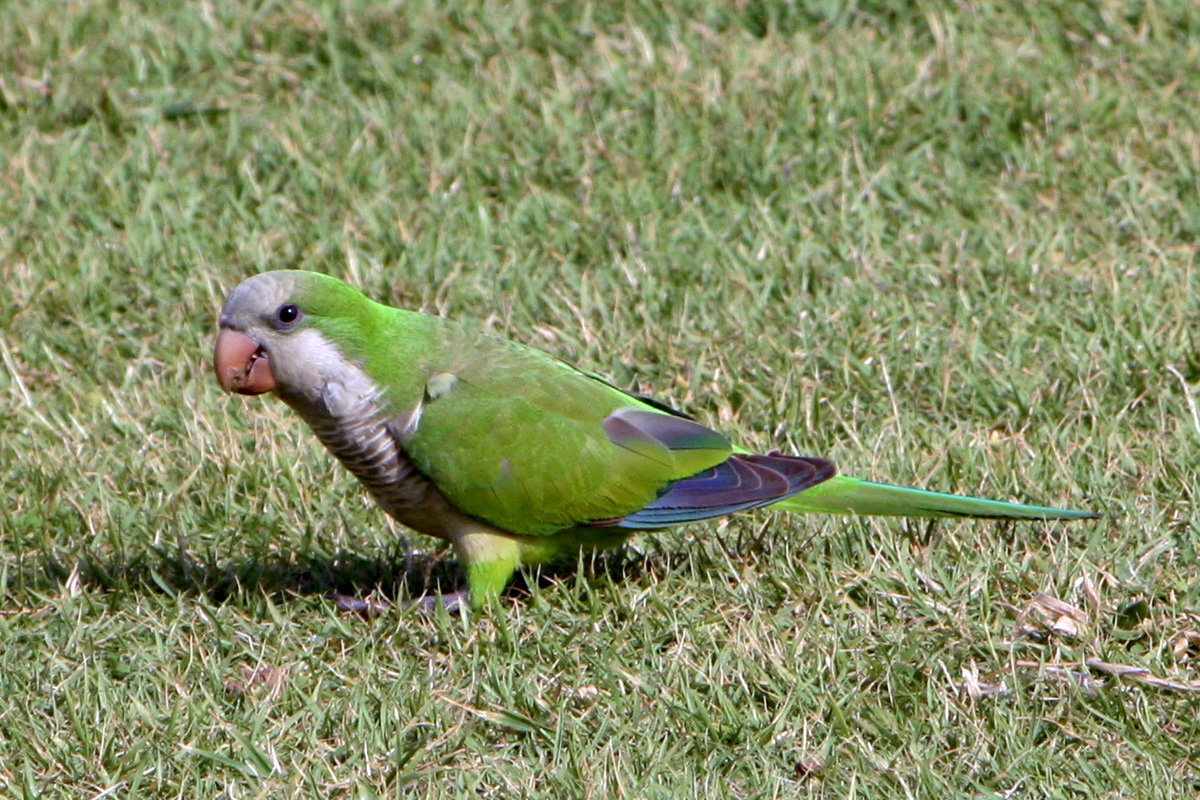
The one bird I've been wanting to see, but hadn't until recently, was the monk parakeet. Friends tell me of them visiting their yard, but they don't come here. Finally, one day when I was walking to the nearby middle school to vote -- it might have been the primary -- I heard a familiar sound, and sure enough two green birds, bickering loudly, swooped over my head and onto a branch. I have no idea why they don't come to this side of South First, but I've never seen one here, although I'm about ⅛ of a mile from that sighting. I also enjoy them in Barcelona, where they seem to outnumber pigeons. 

Bigger than a budgie, and surprisingly omnipresent. Wikipedia photo


But this year I made the decision not to mow the back yard. This was in large part because of the regal toad that used to come every night and sit beneath the light on the back of the house, which also attracted bugs, or, as he thought of them, dinner. I hoped there were more critters out there. Benign ones, of course. And there were: as springtime came on and the rains let up a bit, at sunset giant clouds of lightning bugs would lift off of the plants back there, a luminous flying carpet. That was nice. And I knew I was getting somewhere when I found a small brown Cuban anole hanging out on the deck sunning himself. 

The toad hasn't been back, but the back yard wasn't my only concern. The tree in my front yard was host some days to a magnificent Texas spiny lizard, which I'd never seen before, and whose commanding presence (at about 11") just plain looked good, even though he was expert at dodging the camera. 

Not a great shot, but not mine, either. Wikipedia.
He hasn't been back yet, either, but I gather they have a pretty good range they wander, eating bugs as they go. Welcome back any time, dude. 

And I was aware that there was other critter action in the front, dating from two years ago, when I found a J-shaped toad turd in the driveway, and running up to early May of this year, when I returned from shopping to find a small snake waiting by the front door. I ran inside and grabbed a camera (or maybe it was my phone) and found he'd stuck his head under a pile of leaf litter, so I took a stick and pulled him back to photograph. His head arched up and he took a good snap at the stick, hard enough that I felt it. Then he sat back and let his picture get took:

Healthy snake, wounded stick
A Texas garter snake, a useful website told me. 

I haven't seen him since, but I suspect he showed up because a bit up the hill Google Fiber was putting in cable. This has resulted in a bunch of eco-upheaval, because there's a tiny stream up there, right where they're working, and its critters are abandoning it. The most remarkable one I've seen was hanging out in the parking space in front of my house, fortunately when I was carrying my phone. 

Somewhat traumatized by the speed at which he was moved, a red-eared slider,  who later moved on to another small creek. 
You can tell by the pattern on the shell that he was just hanging out in a diminishing stream when the decision was made for him to move. Nine inches long, and plenty heavy. 

Then there was the night when I went out to light the grill and this guy hitched a ride on my shoe and hopped off when we returned to the house.


Not a great photo, but he was jumping around like crazy, and I wanted him outside where he could do some good: a tiny, tiny toadlet who could have perched on a quarter. Progeny of Back Door Toad? Maybe, maybe. At any rate, a quick ride on a piece of paper, and back to foraging for bugs. 

Because there are bugs. Anybody who lives here knows that. The most common one is the ant, of which Texas seems to have 23,847 kinds. My computer hasn't gotten clogged with Raspberry Crazy Ants, fortunately, but there are small ants who manage to squeeze through the windows, and, recently, great big ants I call Iron Ants because you step on them and they kind of go "ow" and keep on walking. They hold regular love-ins in my shower, where I literally pour cold water on their assembly, and they either go down the drain or retreat behind the shower lining into the wall. Last night, though, I saw something odd that I've never seen before: an Iron Ant walking with another one in its mandibles, a kind of a T walking across the living room floor. I have no idea what that was about. 

And, sadly, there are roaches. Mostly, there are the big ones, the ones you can't step on unless you want to get down on the floor with a paper towel or something to clean up the ooze that results. My research, though, says that these so-called palmetto bugs or waterbugs don't want to be in the house, since it's not their natural habitat. The way I deal with them now is to stun them with a broom and then go all Canadian on their asses and play curling with them, opening the door and launching them outside. Sometimes I say "cheeseburger" to alert the neighbohood reptiles and birds that a sumptuous meal awaits. (Or any Thais who might be around: I found a small Thai grocery here that sells them canned, and in Montpellier there was a Thai restaurant with an insect menu that I never went near). They're not real smart, but they are real fast. And, according to Wikipedia, they're properly called American cockroaches. The ones you don't want because they do want to live in your house (and which you can whack with impunity) are brown, or German cockroaches. I never saw one in my 15 years in Germany, so maybe this is a xenophobic leftover from one of the World Wars, like "liberty cabbage" for sauerkraut or the more recent Freedom Fries. 

Another new visitor this year was one I found irrationally scary. I routinely approach the bathroom by my bedroom with watchful eyes, because there appear to be a couple of entryways from outdoors, and the big roaches get in. Well, the other night there wasn't a roach, but under the sink was a three-inch scorpion, reddish brown. There are over 1000 species of scorpions, none of the ones in Texas are lethal (for that you have to go to the Sonora desert in Arizona), but I, a Scorpio, freaked out, whisked it out with the broom, and stomped the hell out of it. Then I swept it out the door and waited for the adrenaline to subside. 

Right there, on the wall, under the brace, that's where it was. 
But wait, the lizard in your pants, aren't you going to tell us about that? Well, yes, because the above photo is about that, in a way. 

A few weeks back, I was passing in and out, grilling something for dinner, and a two-inch brown Mediterranean gecko (not unlike the Moroccan geckos who occasionally visited in France) ran in. I tried to dissuade him, but no soap: he ran to where I couldn't get him and it was at a crucial part of dinner so I gave up. Anyway, I don't mind a gecko in the house. They have prodigious appetites, and the summer I moved away from Austin to go to Berlin, my house suddenly had two of them in the kitchen. There had been a problem with German roaches, as there usually is in a house with no central air conditioning and open windows and doors. There was, within 24 hours of these two moving in, no longer a problem with German roaches at all. And, with his propinquity to the shower and the ant love-ins, I suspect this one had found a good place to hang and was hanging and dining well. I tried to photograph him, but it was before I'd had my coffee, so it didn't happen: the camera refused to click when I had him in focus and when I returned with the phone (and its clip-on fancy lenses) he'd vanished. But I was curious why the camera wasn't working so I aimed it at the under-sink area, and hence the above photo. 

I'm blessedly without mammals, although a large, fat white cat with black blotches saunters through my yard each day. He is manifestly not welcome: I caught him staring at an area where the toad hung out during the day last year, and wished I had a pan of water to throw at him. Cats are stupid hunters and predators, and with the cardinals and the various reptilia, I just don't want them in the yard. And yes, there are squirrels. I don't pay them much mind, but this spring, there was a very cool sighting. Remember Pizza Rat? He was a thing on the internet a few months ago, a tiny rat straining to take a mammoth slice of pizza down the stairs to the New York subway. Well, one day this spring, I noticed a squirrel behaving oddly, and saw that it had a slice of pizza in its mouth. No camera nearby, no phone, and he was moving quickly: he was, after all, bigger than Pizza Rat, and the slice was smaller. And I kind of felt sorry for him.  Pizza Rat was rewarded by a luscious New York slice. Poor Pizza Squirrel probably had Domino's. But no matter where it was from, it didn't matter: none of us critters in Austin have access to good pizza. 

Sunday, July 10, 2016

On Returning, Part...Uh...

Lord, it's been a while since I touched this thing. I have to keep reminding myself it's not just a travel diary, but, then, what else has been of interest recently? I've been contemplating using my new camera to keep a log of the critters that have been in and out of the house, but I'm waiting for a moment when there's a critical mass of critter-to-photo data. Anyway, the summer's only just settled in. I'm sure there'll be more.

As for the rest, I'm mainly just hanging around waiting for the books to come out. Not a lot to write about there. I'm reading, doing very little writing, taking the opportunity to grab DVDs from Netflix while they're still trafficking in physical media, and, well, that's about it.

But it was that last bit that inspired me to write something today. A friend recommended a film, suspecting that I might have a reaction to it. Since none of the things I actually want to see on my Netflix queue are coming very quickly, this one got delivered last week and I watched it last night.


Having been elsewhere during his ascent as a filmmaker (although I think I got screwed by Mother Jones under his leadership), I'd never seen this one, but the premise intrigued me: Moore visits ("invades") a bunch of mostly-European countries, "stealing" good ideas to take back home as the spoils of his invasion. Thus, we learn about why Finland's educational system rates as the highest in the world, how workers in Italy get so much time off but still manage to be productive and competitive with other economies, why the French take school lunches and sex education so seriously, and so on. So I watched it, and fired off this e-mail to the guy who suggested I watch it. I've edited it somewhat, but this is mostly first-draft, top-of-the-head stuff.

* * *

On your recommendation, I checked out that Michael Moore film last night. Knew most of it, of course. Some random comments. 
 
As you might expect, I looked for counter-arguments and/or hidden nuances behind the rosy pictures he presented. Here are a few of them. 

FRANCE: Despite the nutritional benefits of those school cafeterias, he tiptoed around the big issue, which is that they also have to accommodate Jewish and Muslim students by observing dietary laws. The good news is, Kashruth and Hallal are almost identical. The bad news is, nativist right-wingers are using this as a wedge: several schools in more right-wing parts of the country have refused to stop serving pork. This became a major issue in Denmark, actually, where the Right is blooming like the Occupation never happened. 

ITALY: Yeah, that lifestyle looks good, but a lot of Italians don't pay the taxes that support it and it's a good question how much longer they'll be able to keep going unless some serious enforcement among the titans of industry takes place. On the other hand, Berlusconi is obviously dying, and I would imagine his type of "legit" "businessman" (ie, non-mafia) is also becoming a thing of the past, since there's no postwar economy to build up and make obscene profits from these days. 

GERMANY: Yes, they're hyper-vigilant about any possibility that fascism will return. So much so that neighbors like Austria and Denmark worry about the effect on free speech and the foreigner-in-the-street wonders why the few undeniably positive things that can be said about German culture and history are so rarely mentioned. In fact, that's one of the things that made life there finally unbearable for me. Well, that and the food and the weather. But the fact that they've hidden the remains of the Old Synagogue in Berlin always spoke volumes to me: starting in the 18th century, it spawned a revolution in Jewish thinking, leading to a renaissance in German intellectual life, German business, and, not coincidentally, the birth of Reform Judaism. But not a peep about that on site, and Libeskind's much-vaunted Jewish Museum, like much contemporary German thinking, continues to present Jews as victims. 

(I'm having zero luck finding the photos that went along with this blog post and hope they're still recoverable, and the post makes far less sense without them, but whaddya gonna do?)

NORWAY, FINLAND & SLOVENIA: One thing missing here is the lives the ordinary people live, and the spaces in which they live them. Mile after mile of postwar identi-housing, very small living quarters, dreary public spaces. Of course, some of this is inherent in the physical properties of the countries themselves. My guess is that prison in Norway isn't quite as cheerful in February as it was when Moore and his crew visited, and yes, the old town of Ljubljana sure is pretty but I'd guess that a ten-minute walk in any direction from the central square puts you smack in the middle of a bunch of Tito-era kleenex-box buildings. And it's nice that the Finns enforce equality the way they do, but it's a very small population they're dealing with, so micro-solutions work. 

TUNISIA: Moore's surprise ending may well present an over-optimistic view of the situation here, the one country in the film that I don't have as much first- or second-hand knowledge as I'd need to comment with any authority. The reactionary Islamist forces aren't as benign as the old man with bad teeth who comments here, especially the ones operating out of the country's neighbors like Algeria and Morocco. My optimism is a bit more guarded than what's on display here. 

The film seems to naively suggest that these solutions -- made, as several Europeans note, out of American ideas (Thomas Dewey, among others, I imagine) -- could work if applied here. The problem with that is that they *are* in fact American ideas, and they've been tried and discarded here. Not always for good or even desirable reasons, or with enough of a trial period to make a reasonable assessment of their viability or worth, but there is definitely a large, well-funded, powerful opposition to them. Barring a catastrophe, our grandchildren will die of old age before even modest progress will be made along those lines. In other words, I continue to believe that this country is doomed. Self-doomed, at that. 

As I am not the first to mention, Moore is a very clever polemicist and propagandist. It's just that it feels nice to be in the choir being preached to. For a change. 

Moore does not look well. He's gargantuan, and it's all fat. Expect we'll be losing him soon.

* * *

If you think the above touches on my ongoing deep ambivalence about my repatriation to the US, well, you don't win a prize. For a long time after my last blog post, way back there in April after returning from France and Spain, I struggled to make clear an idea that had formed during the trip, and finally it came to me. I had returned from a civil society to a highly uncivil one. This goes way beyond the events of this past week here, the various cop shootings and shootings of cops, or the candidacy of the most manifestly unsuited candidate for President in American history. For me the annoyances are far more granular: the way people drive, the astounding amount of self-absorption, the refusal to give an inch in compromise, even when all that's gained is getting to the red light faster. I try not to let it get to me, and I fail a lot. I got too used to something different, and it's not that I'm having trouble adjusting, it's that I resolutely don't want to adjust. 

I'm pretty sure by the time we figure that all out it'll be way too late. As for me, I have two books coming up that I have to promote, as well as another one to plan and, I hope, write. So for now, I have to stay where I am, get out when I can, and put one foot in front of the other. Live like the alcoholics, as I always tell people, one day at a time. And plan my escapes wisely: I may well be house sitting in Jersey City and then go to Montreal next month, and I'm planning a trip to Spain at the end of September and the beginning of October. Then back to taking it as it comes. Which is okay, given that I'm living somewhere I don't particularly like. But hell, I've done that before, and at least I'm pretty capable of expressing myself in its native language. 

Tuesday, April 19, 2016

Europe, Spring 2016, Part Five: Spain Again and Out


I'll admit to a certain relief as I steered the Peugeot out of Montpellier and on to the motorway (which was, along most of its length, the old Roman Via Domitia) towards Perpignan to return it. Maybe if I'd had someone with me to whom I could have shown bits of my past, perhaps driven up to Pic St. Loup and up the tiny road that leads to the ruined castle hanging off its companion escarpment l'Hortus that I thought I'd hallucinated until I actually was able to stop and photograph it. Or maybe I needed the down-time as a day of drawing a deep breath before heading into the last couple of days of this trip.

Spring in this part of the world announces itself with wind. Cold winds sweep out of the mountains and lower the temperature until they're countered by warmer winds from the south, the Mediterranean, and Africa itself. I used to sweep up a fine yellow dust that blew into my apartment, and someone who knew told me that this was sand from the Sahara in Algeria, picked up and transported to coastal France. The winds were in full effect on the highway, and I had to pay attention to stay in my lane, and make sure that the gigantic semi-trucks stayed in theirs. Fortunately there weren't many campers on the road: signs in French, English, Spanish, and German appeared every dozen or so miles warning against violent cross-winds.

But at least I didn't have any problem finding the Center of the World again, even if I did make a misstep finding the parking garage and, then, the rental return. It was okay: I had plenty of time before my train to Girona at 3:17. I was concerned about the scratches -- very concerned -- but just as concerned that Europcar had closed for lunch and there were various customers milling around. My body was sending me signals, so I went to the main waiting room, found some packaged sandwiches, and found a French BLT, speck, lettuce, marinated tomatoes on a seeded baguette. I knew I'd burn off enough glucose toting the case of wine that this wouldn't be an issue. Then I headed back to the Europcar area to wait. Apparently someone had tipped off the cops that someone arriving on the train from Marseille, a teenage boy, might be trouble, and a number of suspects had their luggage searched. Another pair, who looked to be in the demographic, were apparently undercover cops, checking in with the uniforms from time to time.

Eventually the agent reappeared, several families pushed ahead of me and got their cars, and I returned mine. She didn't seem unduly concerned about the scratches and I still haven't heard anything. My American Express card showed only the $100 I'd charged on it, so who knows. And the train to Girona, when I finally got on it, was impossibly crowded and noisy, but it was only 45 minutes, so I arrived in Girona, got a cab despite the fact that my hotel was only a few blocks away (luggage again) and checked in to a once-elegant hotel (cigarette burns on the desk? really?) crowded with British and Scottish golfers. I went out as soon as I'd stashed my luggage to look at the town, but the weather had other ideas and I returned, somewhat damper for the experience, about a half-hour later.

For dinner, I hit the city's oldest restaurant, Casa Marieta, and had some odd pâtés to start, then a dish of squid with green peas, which was interesting. But I'd read a description of the place as "tired," and that's just how it seemed. Surely there was someone doing something more interesting with Catalan food here. Fortunately, there was.

The next morning I set off to see the obvious sights and to figure out what the story was with Girona. I'd read that it had the best-preserved Jewish quarter in Spain and deduced from that, mistakenly, that the Jews hadn't been expelled from Girona with the rest of the Spanish Jews in 1492. A visit to the Jewish Museum set me straight, as well as inadvertantly providing me with a perfect first stop in figuring the place out. The Jewish quarter, El Call, had apparently existed in one form or another since before 1000 CE, and besides becoming a center of trade, it was a center of Jewish intellectual life, epitomized by Mossé ben Nahman (1194-1270), who must have been a busy guy, since he penned famous commentaries on the Talmud, systematized the Kabballah, wrote poetry, practiced medicine, and found a little time to preach at the synagogue, which at the time was located atop Girona's hill next door to the cathedral. He left town in his old age and died in Acre, which the museum puts in Israel, but I seem to remember as a Jordanian city. By the time of Mossé's death, though, Gironans had become suspicious of the Jews, and demanded a wall be built around the Call. Riots and laws persecuting the Jews began in 1381, and a lot of them converted, at least outwardly, but they continued to socialize with the unconverted and also made mistakes when practicing their new religion's rituals. The Inquisition finally came to town to see what was up, mostly because Barcelona, where they'd been working, kept having bouts of plague, and Jews started emptying out the Call. The usual punishment for being a Jew was burning in a bonfire, but so many had left by the time the Inquisition's bureaucracy had found them guilty that straw dolls were used in almost every case. And by 1492, of course, the Jews had all left. The Inquisition proved so popular with the people of Girona that in 1820, during the Riego Uprising (unexplained in the wall caption), the House of the Inquisition was burned to the ground, destroying all its records. With the Jews gone, they'd gone after herbalists, homosexuals, witches, Lutherans, and anyone else they didn't like.

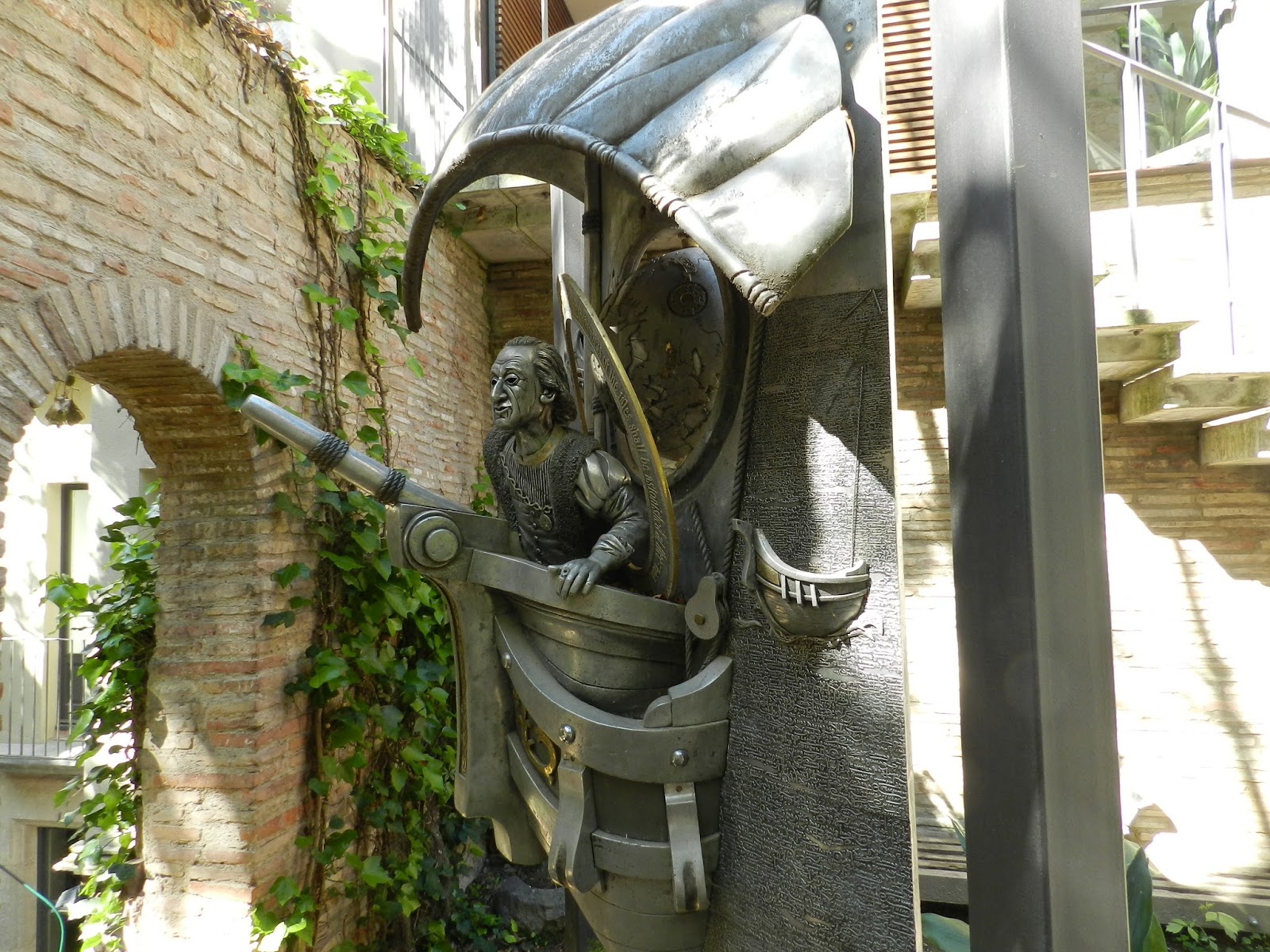
If you wanted to sum up the history of the Jews of Girona, a rather ugly sculpture in the museum's courtyard does a great job:

On one side, the Zodiac, an astrolabe, various navigational instruments, and Mossé with a book...


...and on the other side, Columbus sailing from a Jew-free Spain using those instruments.


It was time to climb the hill, where the rest of the story would unfold, and explore the cathedral and its surroundings. The Museu d'Art is located in one of the buildings where the cathedral's bureaucracy was once housed, including its prison, and it has an impressive amount of mostly older stuff (ie, right up my alley), including a minor work by the Master of Cabestany, a long painted beam of unknown provenance, showing a procession of monks,


Rather badly captured here, but click to enlarge

the ubiquitous lion-eating-a guy carving, 

There's one in Montpellier, too. No idea.
and lots more. Impressive. Eventually, you leave into the plaza in front of the cathedral, where, letting my eyes adjust to the bright sunlight, I saw an act of rather shocking violence: I was noting the seagulls that were up there among the pigeons, because they were about two feet from one end to the other. As I was trying to decode whether or not the cathedral was actually open (it still serves as a cathedral, after all, with several Masses a day) I noticed that one of the seagulls had taken a small black pigeon in its beak and had broken its neck, and was bashing it against the pavement to hasten its death as it flapped its wings, ever more feebly. I'd always known that seagulls were eaters of every sort of junk available, but had no idea they'd hunt live prey. 

Although, in its odd way, it set me up for the cathedral, which is big, filled with Baroque chapels as over-the-top as any Spanish Baroque art can be (and that's plenty, althoug I do like that period's organ music), lots of depictions of martyrdom (Spanish Catholicism is gory) and its treasury has, as its central display, a very old tapestry depicting the Creation. I liked that a lot: it was a cheapo way of teaching the bible to the illiterate masses and it's crowded with bible stories and other goodies, like the pair of Jews at the bottom who serve as an informal logo for the Jewish Museum. 

Outside again, I descended the hill and headed for the grandly-named Archaeological Museum of Catalonia, housed in the former church of San Pere de Gallegants, which has a nice cloister and good paintings in the museum part showing how ancient people lived here (burning the dead, putting them in ceramic vessels, and burying them surrounded by mini-Stonehenges of rocks) and were influenced by the Greeks and, later, the Romans. Christianity seems to have arrived early, around the 4th century, possibly with Roman colonial settlers, and there are apparently small basilicas out in the countryside dating from then, centered around the cult of St. Felix the Martyr, who remains the city's patron saint. 

Next I went to the "Arab baths," so-called not because they were made by resident Arabs (a people who seem missing from the city history, interestingly enough) but because they were in the style the Arabs employed: first a cold dip, then outdoors, then a hot  room for the steam. The building dates from 1194, but there really isn't enough of it to warrant a visit, and it was made less pleasant by a couple of those cult-kids making new-agey music on what looks like an overturned wok with dimples in it. Those suckers are loud!

It was time for lunch, and as I made my way down the street, I passed the City Museum, which would be the perfect knitting-together of the various threads I'd gathered so far, but I wasn't going to miss another meal and get goofy, so I went to a place in the Call and had the one signature Catalan dish I'd missed in my visits to Barcelona: botifarra amb mongetes, which looks like this: 

Right: sausage and beans
It wasn't all that distinguished, but it was just enough to fill the gap, and I was off for my last museum of the day. 

The City Museum starts out with one of the weirder rooms I've ever been in. It was once a Capuchin monastery, and when the monks died, they were arranged in a seated position and placed in the dessicarium. 

Dry up, bro!
When the corpses were mummified by the air circulating around them, they were dressed in their old robes and displayed in another part of the monastery. Memento mori, dudes!

The city museum is big on history and light on artifacts, which was okay by me, and the period between the Romans and the Inquisition is wisely left to other institutions in the city, but come the 19th century and the city's realization that its economic growth was stunted by its still being encircled by the age-old city wall, the citizens decided to tear most of it down so the city could grow. It became a printing center and had a few other industries, but it also suffered badly when it was bombed (by the Spanish government) during the Civil War in 1938. There is an amazing small display of children's drawings of the bombardment, all done in typical primitive kid style with bright crayons, and it reminded me that, starting with that, Spain became ruled by a fascist dictatorship under Generalissimo Francisco Franco, with full support from the Church, and that it remained so until 1975. With the current stirrings of reactionary right-wing politics fuelled by extreme conservative religion in the United States, remembering Spain's history during these times is a disturbing and, I'd say, necessary thing to do. 

After that, I was museumed out, and started strolling back towards the hotel. Along the way, I passed a restaurant that looked interesting enough, wrote down its name (incorrectly, but thank heavens for Google Maps, where I just zoomed in further and further until its name appeared) and, when I eventually got back, I checked out their website. There, I thought, would be a meal worthy of Girona's spirit. 

Because there is a spirit there, as there is in Barcelona, but it's more concentrated because the town is smaller. The place thrums with activity: Lance Armstrong, Gerry told me, took a house here because the hills were great training places for him and his team, and although I'm used to being a minority group as a pedestrian in Austin, not until Girona was I outnumbered by bikers. Had it not been for a book festival in the evening that drew crowds to its entertainment part, between the golfers and the bikers, I might not have seen any civilians at all. I liked this place, and once I arrived at my interesting-looking restaurant (where I'd reserved: you have to, I'd say), Llevataps, the deal was sealed. I started with a warm salad that contained calçots, a uniquely Catalan cousin of the green onion and leek that's usually roasted, touched with a bit of romesco sauce, went on to an absolutely amazing dish of grilled artichokes and razor clams, which concentrated the artichoke flavors while charring the leaves -- a tour-de-force -- and finished up with tender octopus whose method of preparation I didn't note, because by then I was too full and had to regretfully leave half of it behind. With this, I had a bottle of Io Masia Serra, a brilliant combo of Cabernet Sauvignon, black Grenache, and Merlot, one of those creative red blends I've favored recently, and which paired with the artichokes and clams spectacularly. Without question, the best meal of the trip, and not nearly the most expensive. The staff was friendly and the whole experience underscored my belief that Catalonia is well ahead of France in experimenting and creating within the tradition, extending it instead of merely preserving it. I gotta get back to this place. 

Obligatory cliched pic of houses along the Onyar River

Non-obligatory picture of feline residents of the river's edge

* * *

I had no train to meet to get me to Barcelona the next day, but I wanted to get going, even though I knew the hotel wouldn't have my room ready. But I seemed to have trouble getting out of hotels on this trip: construction workers hit a power line in Narbonne, trapping everyone inside (the front door had an electric eye to open it) for an hour or so, and Sunday morning in Girona, there was the city's annual 10,000k run. The brilliant folks who organized it managed to cut off the three big streets surrounding the hotel so no cabs could pick anyone up. This lasted for 90 minutes, with one of the desk ladies getting testier and testier with the cab company, who didn't seem to have any idea if there were a solution or how long the race would last. I hung out in the lobby, watching runners dash in to use the john and then dash out again, and finally the thing ended and a cab took me to the railroad station, where I was offered a fast train and a slow train. The fast train got me into Barcelona ten minutes earlier, so I chose the slow one, which took a different route and went through some lovely countryside. Had I but known, I could have gotten off at the Paseig de Gracia station in Barcelona, two blocks from my hotel. I also realized that, if one left at about 9, one could do a day-trip to Girona from Barcelona. Llevataps is open for lunch, too. 

Monday I checked out, but I also met a friend from Austin who arrived that day to start a trip with his girlfriend that would also take in Florence, where they would do some work on a film they're making. She wouldn't be in until later, so I took him to try to get a cheap phone, then to the hotel/housing agency that handled the apartment they'd rented to get the key, then to the apartment, and then back up to the housing agency's next door neighbor, a stellar northern Spanish tapas joint called Pulperia Bar Celta. A perfect last meal in Barcelona!

* * *

I'd also booked this end of the flight badly, and had to overnight at an overpriced, dingy hotel at Heathrow, a fate I wouldn't wish on anyone. After that, though, I had a long time to think about the trip (and, much as I'd disliked the Austin-Heathrow nonstop on the way out, this flight wasn't nearly as crowded, so I had some room). And I did. Beauty had clearly been encountered and enjoyed -- luxuriated in, even -- both natural and man-made. Love was, of course, unchanged, except for a nagging realization that a lot of women I'd been encountering in the States thought it unseemly that I could still be interested at my advanced age. Of course, my friend who was just starting his Barcelona trip was with a woman ten years younger than me -- and he's nearly ten years older than I am. I landed in Austin to discover a text from him: "What a big lovely city, Paris with a better attitude." Can't say that about the city I'd just landed in, and I'm going to have to cope with that somehow. I'm about to embark on a period where if all goes well I should see some changes in my material and professional life, and I intend to take as much advantage of that as possible. I would dearly love to get out of Austin: it's a bad fit, and had I known, I needn't have come here when I realized I couldn't stay in France any more. This isn't the place to bitch about that now. Just do your work, keep the love and beauty thing in your mind, and keep on. 

* * *

Two days after I got back, I ran out of coffee and headed up to Anderson's to re-fill. The next morning I poured some beans out of the bag into the grinder and took the egg man's rubber band to close it up. It snapped. 
 
Site Meter